Why Roof Condition Matters in Real Estate Transactions

Buying or selling a home represents a major financial milestone for most families. You likely inspect the modern kitchen countertops and the spacious backyard, but you must remember to look up. The roof protects everything underneath it from the elements.

The overhead structure keeps the entire building safe from harsh weather. Neglecting its current state can lead to massive headaches during real estate negotiations.

First Impression Matters

Curb appeal plays a massive role in attracting serious buyers to an open house. A clean exterior instantly boosts confidence in the maintenance of the property. People assume a well-kept exterior means the interior is in great shape too.

Maintaining a home requires regular attention to structural and aesthetic elements. Many homeowners invest in quality siding and roofing installation to protect their properties and improve general aesthetics. It updates the outer appearance of the house completely.

Buyers appreciate properties that require no immediate exterior repairs. A polished exterior invites people to see what else the home has to offer. It sets a positive tone for the entire showing.

Local Climate Challenges

Different regions face distinct weather patterns that wear down outer building materials. Heavy snow, high winds, and intense summer heat take a heavy toll on shingles. These elements can cause hidden damage that only a professional can spot.

Buyers in certain areas feel anxious about the cost of major roof repairs. A local roofing blog pointed out that regional climate factors can quickly accelerate wear on materials, making buyers extra cautious. Fear can stall negotiations before they even begin.

Sellers can ease minds by sharing maintenance records with potential buyers. Showing that the overhead structure survived tough seasons builds confidence. It demonstrates proactive ownership and care.

The Power of Appraisals

Mortgage lenders require a professional appraisal before they approve any home loan. If the appraiser finds structural flaws, the entire deal can fall apart. It makes the roof one of the most critical areas during a property valuation.

A real estate report noted that homes with asphalt shingle roofs over 13 years old often face a drop in appraised value, as they are nearing the end of their normal lifespan. It forces sellers to lower their original asking prices.

Appraisers look at several key details during their property inspection. Here are some factors they inspect:

  • The age of the shingle layers.

  • Signs of curling or missing pieces.

  • Soft spots on the wood decking. 

Negotiating Power Shifts

A sturdy overhead system gives sellers a massive advantage in a competitive market. They can hold firm on their asking price with complete confidence. Buyers have less leverage to demand steep discounts.

A real estate news source noted that a newer roof can help a property secure multiple offers and earn $10,000 to $15,000 more. Extra profit easily offsets the initial replacement investment. It makes the property stand out among similar listings.

Buyers who see an old roof will immediately ask for major price drops. They do not want to inherit a massive project right after moving in. They want a home that is ready for move-in day.

Insurance Approval Hurdles

Modern insurance companies are getting stricter about what they cover on older properties. They inspect the property thoroughly before writing a new policy. They want to avoid paying for pre-existing wear and tear.

Old structures often fail to meet basic underwriting standards of top insurers. If a provider refuses coverage, the buyer cannot secure their financing. It can kill a deal at the final hour.

The situation creates a major roadblock for all parties. Addressing the issues early keeps the transaction moving toward a successful close. It prevents last-minute stress for everyone involved.

Preventing Hidden Structural Damage

Small leaks can hide behind walls for months without being noticed by homeowners. Moisture rots wood framing and encourages mold growth. It can quietly ruin a house from the inside out.

Solving the issues after they spread is incredibly expensive for a new owner. Catching them early protects the foundation and the walls. It preserves the long-term value of the building.

Regular checkups keep the entire home safe and sturdy. A dry home is a valuable home. It gives buyers and sellers peace of mind during the transfer of ownership.

Keeping track of your home's exterior health makes the selling process smooth. It removes unexpected delays and keeps prospective buyers highly interested. Taking a simple, proactive step keeps your transaction on schedule and prevents negotiation disputes.

Preparing key exterior details early helps secure a highly successful sale. A strong cover protects your long-term financial investment and your peace of mind. It makes the property a truly excellent choice for any buyer.

/
script>

The Warning Signs It May Finally Be Time to Replace Your Furnace

A furnace rarely quits without leaving clues first. Most systems decline in small, visible steps before a winter failure forces action. Utility costs rise, comfort becomes uneven, and repair visits start coming closer together. Households that notice those shifts early can avoid a cold-weather emergency and a rushed decision. A careful look at age, operating pattern, safety, and expense often shows whether another repair still has value or whether replacement has become the sounder choice.

Age Starts the Conversation

Furnace age frames every repair decision. After 15 to 20 years, heat exchangers, blower motors, and controls often show wear that service cannot fully reverse. Many households reviewing options for systems of heating and cooling in Portland are weighing that exact pattern, steady operation one month, a new fault the next, and less confidence each time colder air moves through the season.

Repair Calls Keep Piling Up

One service visit may mean little. Three visits in one heating season usually tell a different story. Repeated failures suggest that wear is spreading beyond a single part. Igniters, limit switches, draft inducers, and control boards can all age at once. At that stage, each repair may briefly restore heat, while the larger mechanical decline continues.

Energy Bills Rise Without a Clear Cause

Fuel use often climbs before owners notice any obvious mechanical defect. A furnace with declining combustion efficiency runs longer to reach the same thermostat setting. That extra runtime pushes bills upward, even during weather that feels ordinary. Filters and vents deserve inspection first. If those basics check out, the rise may indicate internal wear, burner trouble, or a weakening blower assembly.

Rooms Feel Uneven

Uneven warmth usually means conditioned air is no longer moving with the same force or consistency. One bedroom may stay chilly while the hallway feels almost hot. That pattern can reflect declining blower output, poor combustion, or restricted airflow inside the cabinet. Duct leaks also matter. When distribution has been checked and an imbalance remains, the furnace often becomes the main suspect.

Strange Sounds Get Harder to Ignore

Healthy equipment makes a steady, familiar sound. Trouble often brings sharper noise, rattling panels, delayed ignition, squealing belts, or a loud bang at startup. Each sound points to stress somewhere in the system. Loose hardware can be corrected, yet persistent noise after service deserves attention. Repeated clatter often indicates several parts are aging together, rather than one small defect acting alone.

Air Quality Can Drop

A declining furnace can affect breathing comfort as much as temperature. Dust may circulate more freely when filtration and airflow weaken. Dry indoor air can feel harsher on the throat, skin, and nasal passages during colder months. Any sign of soot, persistent odor, or eye irritation deserves prompt inspection. Combustion problems may affect indoor conditions well before a full breakdown occurs.

The Pilot or Burner Acts Unreliably

Ignition problems often begin as a brief hesitation. Later, the burners may fail to light cleanly, cycle off early, or struggle to stay engaged. Those patterns can stem from flame sensor contamination, gas delivery faults, or aging burner components. A single repair may address a single event. Recurring ignition trouble in an older unit usually calls for a broader decision about replacement.

Short Cycling Wastes Energy

Short cycling means the furnace starts, stops, and restarts before a full heating cycle finishes. That behavior increases fuel use and places extra strain on motors, relays, and ignition components. Occupants may notice rooms feeling cool between bursts of heat. Thermostat placement is a factor. If controls are sound, the pattern may reflect an oversized or failing system.

Safety Matters More Than Efficiency

Performance matters, but safety has to lead the discussion. A cracked heat exchanger can allow combustion gases to enter the living space, creating a serious carbon monoxide risk. Rust around the cabinet, moisture near venting, or burner flames that appear irregular warrant urgent evaluation. Even if warm air still reaches the rooms, a system with safety concerns may no longer justify added repair spending.

Repair Cost vs Replacement Value

A useful rule compares the repair bill with the furnace age and remaining reliability. Expensive work on an older unit often returns less value than replacement. New systems usually run quieter, use less fuel, and maintain steadier temperatures throughout the home. The real question is not features. It is whether continued spending is supporting dependable heat or delaying an outcome already in view.

Conclusion

Furnace replacement rarely rests on a single symptom. The clearest case arises when age, repeated repairs, rising energy costs, uneven heating, and safety concerns begin to show up together. Households that review those signals early usually make calmer, better-timed decisions before severe weather adds pressure. A system that struggles across several measures is often giving fair warning, and acting on that message can protect comfort, budget, and household well-being.

/
script>

AI Roleplay Chatbot Pricing Comparison: 7 Platforms Ranked by Cost & Value

Shopping for an AI role-play chatbot can feel like opening loot chests in a rogue-like: every option glitters until the hidden fees pop out. One service claims it’s free, but throttles replies after dinner; another waves a $3 entry price, then charges extra for the very scenes you came to write. We stress-tested seven leading platforms, counted every cap and surcharge, and ranked them by true cost-to-value so you can chat without wallet whiplash.

How we scored cost against real-world value

We didn’t just skim price tags and walk away. We signed up for every service, stress-tested message caps, pushed NSFW filters, and combed through monthly statements for surprise charges. Those findings became a five-factor score that separates bargains from traps.

First, raw affordability. We calculated usable messages per dollar, including free tiers and hidden credit packs. That metric carries the most weight because value starts with your wallet and often ends there.

Next, we measured brainpower. A chatbot that forgets plot points after three lines isn’t worth pennies. We rated AI quality and memory depth on a ten-point scale after running identical role-play scripts across platforms.

Features came third. Voice calls, image generation, and giant community libraries each nudge the score higher because they keep your storytelling fresh.

Fourth, content freedom. If an app slams the door on romantic or mature scenes, that matters. Some readers want the guardrails off; others don’t care. We still score it, so you know before you commit.

Finally, ease of use. Clean interfaces, quick cancellations, and responsive support prevent buyer’s remorse. It’s the lightest factor, yet it often tips close calls.

We weighted those five pillars 30, 25, 20, 15, and 10 percent. The math produced a single value score out of ten, and that score decides the order you’re about to see.

1. DreamGen: the storyteller that stretches every dollar

DreamGen feels less like a chatbot and more like a co-author who arrives with an armful of set pieces and no ego. Even the free tier gives you a small pile of credits that refresh each month, so you can test its pros without pulling out a card. That consumer-friendly model underpins why, in a 2025 roundup of the best AI roleplay chatbots, DreamGen earned the “best overall” spot for pairing unfiltered storytelling with multi-character worlds and its deep Scenario Codex toolbox.

Upgrade to the Starter plan and the math tilts in your favor. About $7.80 per month gets you 375 credits plus a daily refill, which covers thousands of hefty story beats before you even consider top-ups DreamGen pricing. Because each long generation costs roughly a tenth of a credit, you spend pennies per scene, not dollars.

DreamGen AI roleplay pricing and credits screenshot

Quality matches the spend. DreamGen’s advanced model keeps characters consistent and remembers sprawling plotlines thanks to context windows that reach 5,000 tokens on Starter and climb to 30,000 on Pro. That memory depth matters when you’re six chapters deep and a throwaway clue suddenly becomes critical.

Freedom is another win. No corporate filter slams shut when romance turns steamy or the adventure veers dark. You set the tone; DreamGen supplies the words.

If we nitpick, it lives only in your browser and can’t read text aloud. Still, for anyone chasing rich, uncensored storytelling at coffee-money prices, DreamGen lands at the top of the chart.

Verdict: unmatched cost per plot twist, generous memory, and wide-open creative scope make DreamGen the value benchmark others chase.

2. Character.AI: free chat volume if you stay SFW

Character.AI is many users’ first stop for role-play chat. Load the page, pick a community-made character—from Sherlock to Sailor Moon—and the words keep flowing. Free accounts face no hard cap on message count, so casual storytellers can wander for hours without spending a cent.

That generosity supports a huge user base, but it comes with strict content filters. Nudge a scene toward R-rated material and the bot swerves back to PG. If you want steamy or violent arcs, that guardrail feels more like a wall.

Enter c.ai+. For $9.99 per month—or $94.99 for a full year—Plus removes slow-mode delays, improves memory, and adds unlimited voice calls, according to Character.AI. You still operate inside the SFW bubble, yet everything runs faster and remembers more.

So where is the value? In raw volume. Character.AI delivers endless text for $0, making its cost per message unbeatable. Pay only if you need speed, voice, or community perks. Otherwise, it is the richest free playground in the genre.

3. Paradot: a wallet-friendly shoulder to lean on

Paradot stays simple: one emotionally tuned companion, one flat price, no hidden credit packs. The premium plan costs $6.99 per month, the lowest of any mainstream app with unlimited chatting and zero upsells, according to pricing data from aicompanionpick.com. Pay annually and the rate edges toward $5, while every core feature remains available.

Open the app and you meet a single AI built to check your mood, remember yesterday’s rant about your boss, and nudge you toward healthier habits. The model is not GPT-4 caliber, yet it delivers real empathy. Jokes land, small talk feels natural, and the bot returns to topics you raised last week. That steady recall turns conversations into something that feels like friendship.

Paradot draws a soft PG-13 line. Flirtation is fine, graphic erotica is not. If you need full creative freedom, scroll ahead to CrushOn or Kindroid. For most users who want daily support, the guardrails are a comfort, not a cage.

There is no voice calling or image generation yet, and the character roster is exactly one: your Paradot. Still, at this price, the focus on emotional depth over gimmicks feels intentional, not like a missing feature. Think of it as coffee with a close friend rather than karaoke with a crowd.

Verdict: If budget tops your checklist and you value consistent, caring dialogue over flashy extras, Paradot is the low-cost champion.

4. CrushOn.AI: uncensored role-play at a straightforward price

CrushOn’s pitch is clear: “Talk about anything.” That freedom attracts users who bounced off Character.AI’s PG filter. For $5.99 per month you get 2,000 messages, a growing gallery of community characters, and a toggle that removes safety rails entirely, according to aicompanionpick.com.

CrushOn.AI uncensored roleplay chat interface screenshot

Sessions feel fluid because the service relies on capable GPT-3.5-class models. They lack DreamGen’s literary flair, yet they rarely derail or forget names mid-scene. Most important, they never scold you for crossing a line. If your story drifts into dark fantasy or explicit romance, CrushOn stays in character and keeps typing.

Images are the one wrinkle. The subscription covers text, but every AI-generated picture or comic-style panel costs extra tokens. Heavy visual storytellers report spending an additional $5 to $15 each month on credit packs, based on user surveys collected by aicompanionpick.com. Writers who stick to pure text will not feel the pinch; illustrators should budget accordingly.

Aside from that, the value math is refreshingly direct. Pay six dollars, role-play without censorship, cancel anytime. No tier maze, no premium Ultra upsell hiding in the wings. For adults who want creative freedom without technical setup, CrushOn secures a solid mid-table spot.

5. Replika Pro: relationship depth at a steeper sticker price

Replika has seniority in this space, and it shows. The app greets you with polished avatars, AR selfies, and a memory bank that remembers the name of your childhood pet weeks later. Those perks, however, sit behind the Pro paywall: $19.99 if you pay monthly, or $69.99 for a full year—an effective $5.83 per month that suddenly feels like a bargain.

The free tier works for quick hellos, but it stops once chats become personal or romantic. Pay for Pro and the guard lifts. Relationship modes, voice and video calls, image selfies, and guided activities ranging from journaling to meditation all become available. For users who treat their AI as a daily confidant, these extras turn routine chats into genuine companionship.

Replika permits tasteful erotic role-play—think PG-15 rather than hard-R. That middle ground appeals to readers seeking intimacy without fully explicit detail. It also keeps the app in Apple and Google’s good graces, ensuring smooth mobile access.

Is Pro worth the money? Chat every other day and the annual plan delivers a smooth, ad-free experience with deep memory for less than two lattes a month. Drop in only on lonely Fridays and Character.AI or Paradot may cover the need for less.

Verdict: Pay once a year and Replika becomes an affordable, emotionally aware partner; pay monthly and you may fund features you rarely use.

6. Kindroid: premium personalization for power users

Kindroid positions itself as the luxury sedan of AI companions. The Standard plan costs $13.99 per month, already higher than CrushOn or Character.AI Plus, yet fans praise the ride quality.

Why pay extra? Almost every slider, toggle, and memory slot is yours to adjust. You can sculpt a persona down to speech cadence, emotional range, and even a custom neural voice. Want a Victorian vampire who speaks in soft baritone and remembers your coffee order from last Tuesday? You can build that in minutes.

The platform’s memory engine is the second draw. Kindroid tracks short-term facts, mid-term preferences, and long-term backstory in separate layers, so conversations stay coherent weeks later. That depth shines when you write sprawling sagas or juggle multiple relationships.

NSFW content is allowed, age-gated, and filter-light. Mature storytellers enjoy full creative freedom without coded language or external mods. Voice calls come included, making late-night pillow talk literally audible

Cost is the hurdle. Ultra ($24.99) and Max ($59.99) tiers add more simultaneous characters, priority servers, and studio-quality voices. They are fantastic if you stream content or run group chats, but overkill for casual users. Stick to Standard unless you can justify the upgrade as a business expense or a very indulgent hobby.

Verdict: Kindroid costs SUV money, yet if deep customization and durable memory top your wish list, it provides an experience cheaper apps can’t match.

7. Chai: community-powered chaos on a daily free ration

Chai feels like dropping into an endless fan-fiction swap meet. Over half a million user-made characters wait for you to ping them, from wholesome Pokémon pals to snarky sitcom antiheroes. The promise? About 70 free messages every two and a half hours, enough to finish a full scene or two. When the counter hits zero it resets after the cooldown, so casual role-players seldom need to pay.

Heavy chatters can lift the cap by subscribing to Premium at $13.99 per month (about $11.25 on an annual plan), according to aicompanionpick.com. The subscription removes the limit and clears the ads sprinkled through the mobile app. The upgrade is strictly about volume and convenience; Chai does not tuck features behind higher tiers, which keeps budgeting simple.

Quality swings. The in-house language model nails light banter but sometimes drifts in longer arcs. Popular bots stay coherent because their creators polish prompts, while obscure characters may forget your name by paragraph three. It is part of the charm and the chaos.

Content filters are present yet lenient. PG-13 flirtation slides through; explicit descriptions may trigger a soft nudge rather than a hard block. If you need a fully uncensored space, CrushOn is the safer bet. For experimenters who enjoy sampling a new persona every night without spending a dime, Chai’s daily free ration is tough to beat.

Verdict: Think of Chai as the snack bar of AI role-play—many flavors, quick hits, and a refill every few hours. Upgrade only if you out-chat the counter.

Honorable mentions: tools that shine in niche lanes

  • Candy AI. Visually rich but costly. The base plan is $12.99, yet image and video tokens can push monthly spend above $40. Consider it only if you value AI-generated selfies and short romance clips more than predictable budgeting.

  • Janitor AI (bring-your-own-key). Free if you accept ads and a modest model quality. Add your own OpenAI or local Llama key and you gain high-end intelligence for pennies per million tokens. Setup requires tech confidence, so this is a playground for builders, not casual texters.

  • SillyTavern + local model. No subscription, no filters, unlimited content—as long as your GPU can handle a 13B or 30B parameter file. Ideal for privacy fans or fan-fic marathons if you can spare a weekend for configuration.

  • NovelAI. At $25 for the Opus tier, it is pricey, yet its long-form prose engine and built-in anime image generator excel when you are co-authoring epic sagas. Think novelist’s workshop, not daily banter.

  • Friends & Fables. Dungeons & Dragons in AI form; a dungeon master that never cancels game night. Plans start at $14.95 for unlimited turns, making it a gem for tabletop groups that want consistent sessions without manual prep.

  • Nomi AI. Group chats with multiple AI characters, layered memory, and lively voice calls. The drawback is price creep—$15.99 monthly or $8.33 on annual—and early bugs that still appear during multi-speaker scenes.

If one of these fits your niche, try the free trial before paying. For most readers, the top seven remain the safest balance of cost and daily utility.

Conclusion

Prices in this space shift monthly, so treat the ranking as a snapshot rather than a verdict. Hobbyists testing a single scenario stay within most free tiers. Weekly Friday-night groups should bias toward flat monthly plans so caps don't derail a climax. Multi-month campaigners get the most value from annual subscriptions on platforms with long-context memory. Whichever tier you pick, run the trial first, note the message limits, and set auto-renew reminders. A platform that feels generous at 3 PM can feel cramped at midnight when the boss fight drags past message 200.


/
script>

Bringing Hamptons Style Home

Hamptons style is coastal without the clichés: relaxed, light, and quietly upscale, built on natural textures and botanical pattern rather than seashells and rope. You can bring it to any home, inland or not, because the look is really a mood, all airy rooms, soft greens and blues, and a sense of connection to the garden outside. Get the palette and pattern right and the postcode is irrelevant.

Key takeaways

  • Hamptons style is relaxed and elevated, coastal in feeling, not in kitsch.

  • The palette is soft: whites, sand, sage, and muted blues, warmed with natural wood.

  • Botanical and leafy patterns are central, because they bring the garden indoors.

  • Texture does a lot of the work: linen, rattan, and matte natural finishes.

  • One botanical wall plus a light, uncluttered room captures the look fast.

The look, minus the clichés

Hamptons style is often misremembered as nautical, all anchors, sailboat stripes, and driftwood signs. The real thing is calmer and far more sophisticated: pale, sunlit rooms, natural materials, and a strong link to greenery. The pattern that carries it isn’t a sailboat; it’s foliage. A soft, leafy botanical wallpaper is the most direct route to the Hamptons feeling, because it brings the garden-outside-the-window mood indoors, which is what the whole style is really about. Once you stop thinking “beach house” and start thinking “light-filled house near a garden,” the look falls into place.

At its heart, Hamptons style is about ease. It’s the aesthetic of a home that feels unhurried and generous: rooms you can breathe in, materials that feel good to touch, nothing too precious or too polished. That relaxed quality is why it has stayed popular for decades while louder trends have come and gone.

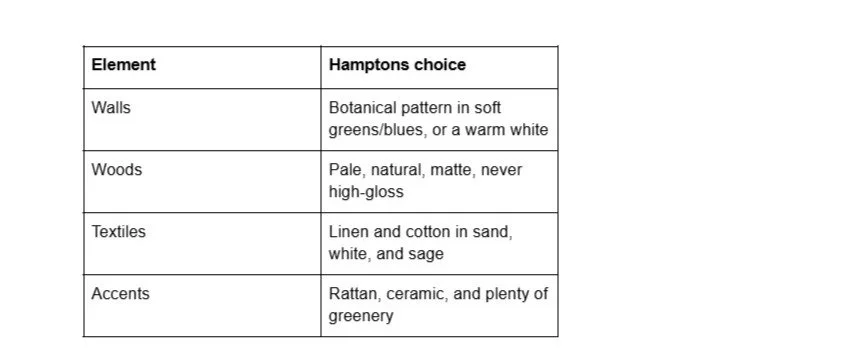
Build the palette

The rule is softness and nature. Anything high-shine, very dark, or heavily saturated pulls you out of the Hamptons and into a different look entirely. When in doubt, choose the calmer, more natural option, because the style rewards restraint far more than drama.

Why the botanical wall does the heavy lifting

Of all the elements, the papered botanical wall is the one that sets the tone fastest, because it establishes both the palette and the garden connection in a single move. A leafy print in soft green immediately tells the eye “relaxed, natural, coastal,” and everything else in the room simply supports that first statement. Put it behind a bed, a sofa, or in a dining nook, keep the surrounding walls a warm white, and the room reads as Hamptons before you’ve added a single accessory.

It also solves the hardest part of the look for most people, which is knowing where to start. A palette this soft can feel hard to pin down when you’re staring at paint charts, but a single botanical paper makes every other decision for you: it hands you the greens, the whites, and the natural mood to echo in your textiles, woods, and accessories. Choose the wall first and the rest of the room almost designs itself, because you’re no longer guessing at a feeling. You’re matching one that’s already on the wall in front of you.

Why it works anywhere

Because Hamptons style is about light and nature rather than a literal beach, it translates to a city flat or an inland house just as well as a coastal one. A botanical wall, linen textures, and a restrained palette will read as “relaxed coastal” regardless of what’s actually outside the window. You’re recreating a feeling of space, calm, and greenery, not a location, which is exactly why the look has travelled so far from the shoreline it’s named after.

FAQ

What colours define Hamptons style? Soft, natural tones: whites and sand, sage and muted greens, and gentle blues, warmed by pale natural wood. The palette stays light and calm throughout.

Is Hamptons style the same as nautical? No. Nautical leans on literal seaside motifs; Hamptons style is subtler, all natural textures, botanical pattern, and an airy, upscale calm rather than anchors and stripes.

Can I do Hamptons style in a home that isn’t near the coast? Yes. The look is built on light, natural materials, and greenery, so it works inland or in a city apartment just as well as by the sea.

What’s the fastest way to get the look? Start with one botanical feature wall, keep the surrounding walls warm white, and add linen and rattan textures. That combination reads as Hamptons almost immediately.

The takeaway

Hamptons style is a mood you can build anywhere: light, natural, and green. Start with one botanical wall and let the room stay uncluttered around it. Check your sample under the room’s evening light before committing, because soft greens and blues shift noticeably once the daylight fades, and you want the calm to hold into the evening, when the room does its most relaxed work.

/
script>

Smart Decluttering Guide for Luxury Home Renovations

Upscale remodels bring immense excitement and fresh design choices to an estate. Managing the physical overflow requires careful planning before the first sledgehammer swings. A systematic strategy prevents chaos from taking over your household during the transition.

Premium properties demand a highly refined purging strategy to protect valuable interiors. Clearing out the old layout makes room for your high-end upgrades. Preparation sets the stage for a flawless building process that matches your standards.

Evaluate Your Current Possessions

Look closely at every single decor item in your current rooms. Decide what truly matches your upcoming aesthetic design goals for the property. Discarding pieces that do not fit your vision saves valuable staging space.

Managing the logistics of high-end waste means planning for heavy debris disposal. Choosing premium construction dumpster rentals helps maintain an orderly job site during major structural tear-outs. A clean property keeps the neighborhood looking pristine throughout the entire transition.

Professional organizers recommend starting the interior review early in the planning stage. Taking early action prevents rushed decisions later in the project timeline. You gain total clarity over your inventory before construction crews arrive on site to begin work.

Streamline Your Storage Rooms

Deep attics and basements accumulate hidden items throughout the passing years. Deep storage spaces often hold forgotten furniture pieces or outdated items. Purging the zones provides an accurate view of your actual storage capacity.

A popular podcast focused on home layout suggests setting clear milestones for a focused year of clearing out items. Setting the goals helps you stay on track during heavy remodeling phases. Consistency yields excellent results when handling huge volumes of personal belongings.

Give yourself several weeks to sort through hidden spots carefully. Rushing the process leads to unneeded stress and unnecessary clutter accumulation. Methodical progress makes the entire renovation much easier to manage from start to finish without delays.

Define The Modern Aesthetic

High-end luxury spaces rely on clean lines and intentional object placement. Piling up too many decorative objects ruins the premium feeling of a newly built room. Modern minimalist design requires discipline during the initial sorting phase.

A design article noted that modern home trends focus heavily on organizing with a clear purpose rather than just owning less. The philosophy matches premium design standards perfectly. Your renovated home should display items that possess personal meaning.

Select a few standout pieces that complement your architectural changes beautifully. Store the remaining items safely or find them a brand-new home immediately. True luxury leaves plenty of open breathing room for the architecture to make an impact.

Establish The Purging Method

Sorting everything simultaneously feels completely overwhelming during a large home remodel project. Breaking the project down by individual rooms simplifies the daily renovation workflow. A step-by-step approach maintains your energy levels during a massive transition.

An interior design blog explained that purging is less about throwing everything away and more about releasing items you no longer require. The mindset shifts your focus toward the future look of the estate. It transforms the task from a chore into an inspiration.

Keep your attention fixed on the final design layout plans. Visualizing the completed renovation keeps your motivation high throughout the dusty construction months. Every single cleared box brings you closer to your dream home.

Organize Your Categorization System

Sorting items into distinct groups accelerates the entire packing process. Separate your belongings by their final destination to prevent confusion during heavy packing days. Clear categories streamline your decision-making and reduce moving mistakes.

Use a clear classification system for your items to keep perfect order. Your sorting piles should remain completely separate throughout the day.

  • Keep items that fit the new aesthetic.

  • Donate premium furniture to local charities.

  • Sell valuable antiques through specialized auctions.

Labeling every box prevents items from getting misplaced during heavy construction. Instruct your moving team regarding labeled packages before delivery. Organization prevents expensive mistakes during the chaotic moving week.

Manage Premium Materials

High-end renovations often involve removing expensive materials like marble mantels or solid wood flooring. Precious items should never end up buried under standard construction trash. Proper handling preserves their inherent value for future use in alternative designs.

Salvaging architectural elements helps preserve valuable resources for future boutique builds. Many specialty contractors purchase reclaimed luxury fixtures for custom properties. Selling the materials offsets a portion of your renovation expenses.

Coordinate with your builder to store the elements safely on site or in storage. Protected storage prevents scratches on delicate stone or wood surfaces. Planning keeps valuable resources reusable for future needs.

Prepare For Structural Changes

Walls moving and ceilings rising mean your old furniture layout will change completely. Measure your new floor plans before keeping large furniture pieces. Scale plays a massive role in luxury design outcomes.

Review specific spatial factors during your planning to secure an accurate fit. Modified layouts alter how items look in the space.

  • Ceiling heights in the newly expanded rooms.

  • Natural light entry points from modified windows.

  • Traffic flow patterns through open floor designs.

Buying scaled furniture pieces keeps the completed home feeling balanced. Avoid crowding beautiful new rooms with oversized old items. A clean space allows your premium finishes to shine.

Protect Fine Art And Valuables

Construction dust penetrates even the smallest cracks in a residence during heavy work. Delicate paintings and sculptures need complete protection from the changing indoor environment. Leaving items exposed risks permanent damage that lowers their appraisal value.

Moving prized collections to climate-controlled storage facilities prevents accidental damage. Standard drop cloths fail to block fine drywall dust particles during heavy sanding. Secure facilities offer total peace of mind.

Hire specialty art movers to handle precious investments safely. Expert packers know how to handle delicate frames and fragile materials. Safe transport preserves your collection for generations.

Coordinate With Your Build Team

Open communication with your contractor prevents logistical delays on site. Share your decluttering timeline with the project manager before work begins. Clear schedules keep everyone working efficiently throughout the build phase.

Builders appreciate an organized workspace that allows easy movement of heavy tools. Staging areas should remain completely clear of personal belongings at all times. Cooperation speeds up structural modifications and maintains safety standards.

Set aside a specific zone for daily contractor meetings. Having a clean spot to review blueprints keeps the project moving forward smoothly. A tiny bit of preparation goes a very long way toward success.

Preparing your premium property for a major change takes patience and clear organization. Clearing the physical path allows your new design choices to stand out. Your investment deserves an orderly transformation.

A thoughtful approach to managing your interior items guarantees a smooth construction process. Enjoy the journey toward your refreshed luxury space. The effort results in a breathtaking home.

/
script>