Bringing Hamptons Style Home
Hamptons style is coastal without the clichés: relaxed, light, and quietly upscale, built on natural textures and botanical pattern rather than seashells and rope. You can bring it to any home, inland or not, because the look is really a mood, all airy rooms, soft greens and blues, and a sense of connection to the garden outside. Get the palette and pattern right and the postcode is irrelevant.
Key takeaways
Hamptons style is relaxed and elevated, coastal in feeling, not in kitsch.
The palette is soft: whites, sand, sage, and muted blues, warmed with natural wood.
Botanical and leafy patterns are central, because they bring the garden indoors.
Texture does a lot of the work: linen, rattan, and matte natural finishes.
One botanical wall plus a light, uncluttered room captures the look fast.
The look, minus the clichés
Hamptons style is often misremembered as nautical, all anchors, sailboat stripes, and driftwood signs. The real thing is calmer and far more sophisticated: pale, sunlit rooms, natural materials, and a strong link to greenery. The pattern that carries it isn’t a sailboat; it’s foliage. A soft, leafy botanical wallpaper is the most direct route to the Hamptons feeling, because it brings the garden-outside-the-window mood indoors, which is what the whole style is really about. Once you stop thinking “beach house” and start thinking “light-filled house near a garden,” the look falls into place.
At its heart, Hamptons style is about ease. It’s the aesthetic of a home that feels unhurried and generous: rooms you can breathe in, materials that feel good to touch, nothing too precious or too polished. That relaxed quality is why it has stayed popular for decades while louder trends have come and gone.
Build the palette
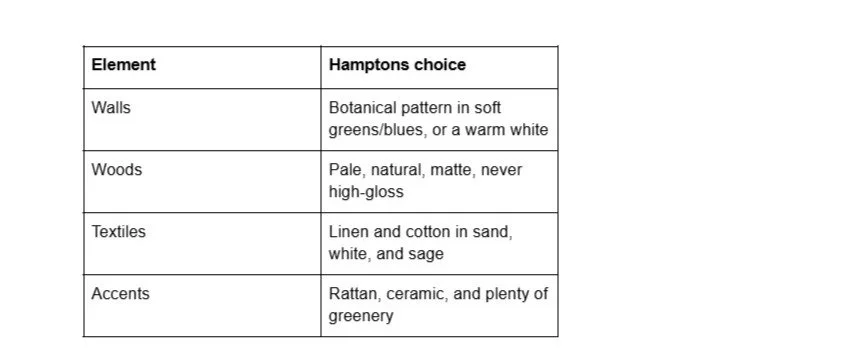
The rule is softness and nature. Anything high-shine, very dark, or heavily saturated pulls you out of the Hamptons and into a different look entirely. When in doubt, choose the calmer, more natural option, because the style rewards restraint far more than drama.
Why the botanical wall does the heavy lifting
Of all the elements, the papered botanical wall is the one that sets the tone fastest, because it establishes both the palette and the garden connection in a single move. A leafy print in soft green immediately tells the eye “relaxed, natural, coastal,” and everything else in the room simply supports that first statement. Put it behind a bed, a sofa, or in a dining nook, keep the surrounding walls a warm white, and the room reads as Hamptons before you’ve added a single accessory.
It also solves the hardest part of the look for most people, which is knowing where to start. A palette this soft can feel hard to pin down when you’re staring at paint charts, but a single botanical paper makes every other decision for you: it hands you the greens, the whites, and the natural mood to echo in your textiles, woods, and accessories. Choose the wall first and the rest of the room almost designs itself, because you’re no longer guessing at a feeling. You’re matching one that’s already on the wall in front of you.
Why it works anywhere
Because Hamptons style is about light and nature rather than a literal beach, it translates to a city flat or an inland house just as well as a coastal one. A botanical wall, linen textures, and a restrained palette will read as “relaxed coastal” regardless of what’s actually outside the window. You’re recreating a feeling of space, calm, and greenery, not a location, which is exactly why the look has travelled so far from the shoreline it’s named after.
FAQ
What colours define Hamptons style? Soft, natural tones: whites and sand, sage and muted greens, and gentle blues, warmed by pale natural wood. The palette stays light and calm throughout.
Is Hamptons style the same as nautical? No. Nautical leans on literal seaside motifs; Hamptons style is subtler, all natural textures, botanical pattern, and an airy, upscale calm rather than anchors and stripes.
Can I do Hamptons style in a home that isn’t near the coast? Yes. The look is built on light, natural materials, and greenery, so it works inland or in a city apartment just as well as by the sea.
What’s the fastest way to get the look? Start with one botanical feature wall, keep the surrounding walls warm white, and add linen and rattan textures. That combination reads as Hamptons almost immediately.
The takeaway
Hamptons style is a mood you can build anywhere: light, natural, and green. Start with one botanical wall and let the room stay uncluttered around it. Check your sample under the room’s evening light before committing, because soft greens and blues shift noticeably once the daylight fades, and you want the calm to hold into the evening, when the room does its most relaxed work.