AI Roleplay Chatbot Pricing Comparison: 7 Platforms Ranked by Cost & Value
Shopping for an AI role-play chatbot can feel like opening loot chests in a rogue-like: every option glitters until the hidden fees pop out. One service claims it’s free, but throttles replies after dinner; another waves a $3 entry price, then charges extra for the very scenes you came to write. We stress-tested seven leading platforms, counted every cap and surcharge, and ranked them by true cost-to-value so you can chat without wallet whiplash.
How we scored cost against real-world value
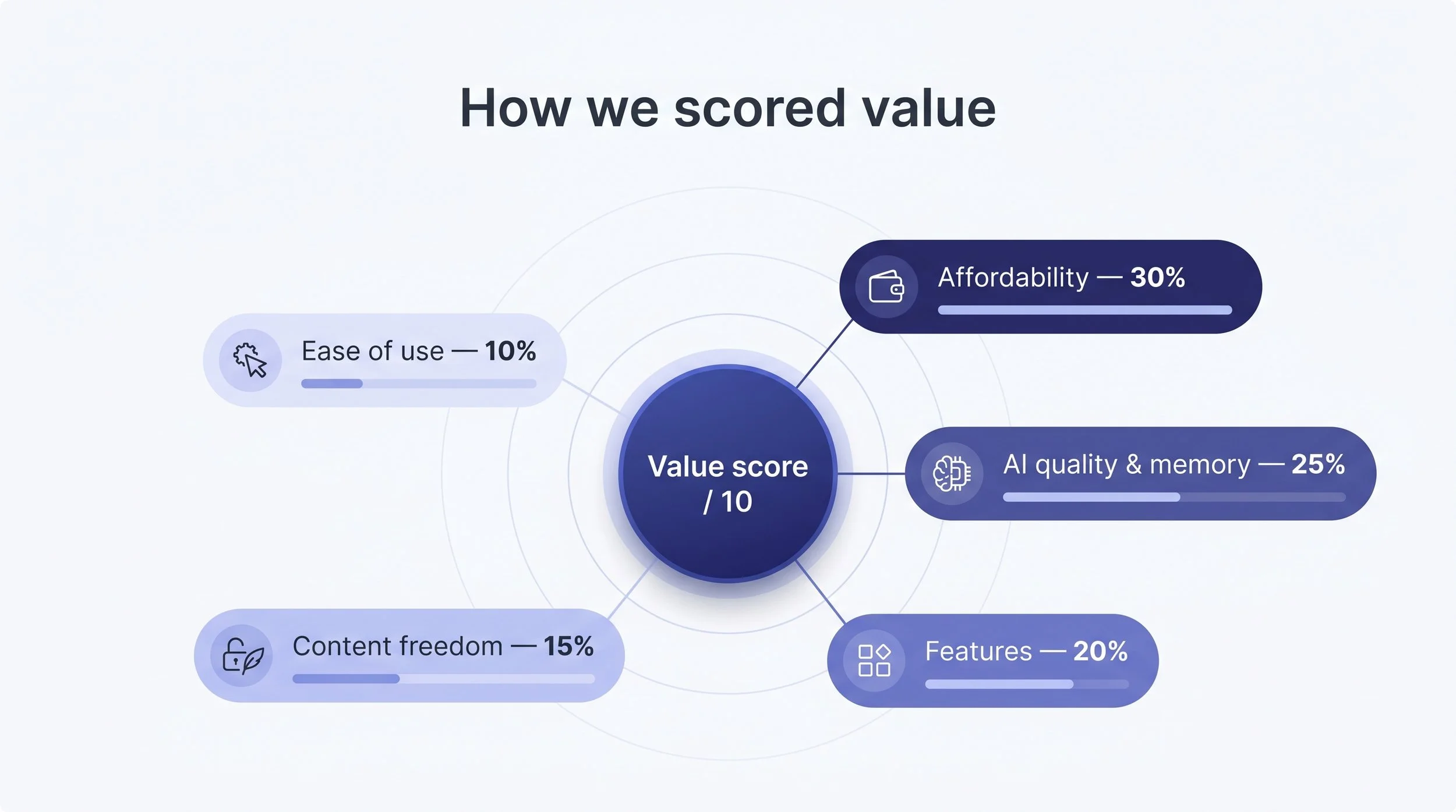
We didn’t just skim price tags and walk away. We signed up for every service, stress-tested message caps, pushed NSFW filters, and combed through monthly statements for surprise charges. Those findings became a five-factor score that separates bargains from traps.
First, raw affordability. We calculated usable messages per dollar, including free tiers and hidden credit packs. That metric carries the most weight because value starts with your wallet and often ends there.
Next, we measured brainpower. A chatbot that forgets plot points after three lines isn’t worth pennies. We rated AI quality and memory depth on a ten-point scale after running identical role-play scripts across platforms.
Features came third. Voice calls, image generation, and giant community libraries each nudge the score higher because they keep your storytelling fresh.
Fourth, content freedom. If an app slams the door on romantic or mature scenes, that matters. Some readers want the guardrails off; others don’t care. We still score it, so you know before you commit.
Finally, ease of use. Clean interfaces, quick cancellations, and responsive support prevent buyer’s remorse. It’s the lightest factor, yet it often tips close calls.
We weighted those five pillars 30, 25, 20, 15, and 10 percent. The math produced a single value score out of ten, and that score decides the order you’re about to see.
1. DreamGen: the storyteller that stretches every dollar
DreamGen feels less like a chatbot and more like a co-author who arrives with an armful of set pieces and no ego. Even the free tier gives you a small pile of credits that refresh each month, so you can test its pros without pulling out a card. That consumer-friendly model underpins why, in a 2025 roundup of the best AI roleplay chatbots, DreamGen earned the “best overall” spot for pairing unfiltered storytelling with multi-character worlds and its deep Scenario Codex toolbox.
Upgrade to the Starter plan and the math tilts in your favor. About $7.80 per month gets you 375 credits plus a daily refill, which covers thousands of hefty story beats before you even consider top-ups DreamGen pricing. Because each long generation costs roughly a tenth of a credit, you spend pennies per scene, not dollars.
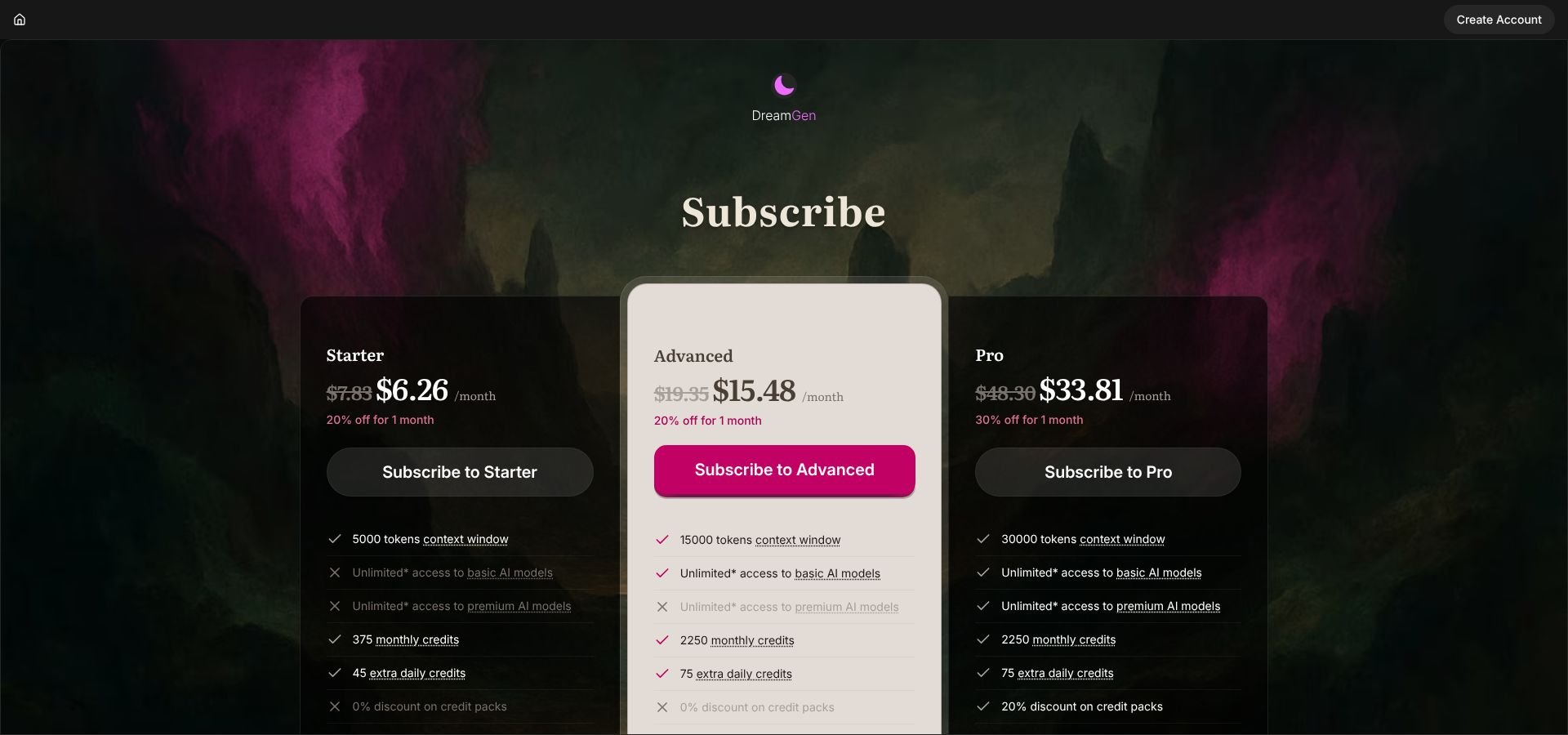
DreamGen AI roleplay pricing and credits screenshot
Quality matches the spend. DreamGen’s advanced model keeps characters consistent and remembers sprawling plotlines thanks to context windows that reach 5,000 tokens on Starter and climb to 30,000 on Pro. That memory depth matters when you’re six chapters deep and a throwaway clue suddenly becomes critical.
Freedom is another win. No corporate filter slams shut when romance turns steamy or the adventure veers dark. You set the tone; DreamGen supplies the words.
If we nitpick, it lives only in your browser and can’t read text aloud. Still, for anyone chasing rich, uncensored storytelling at coffee-money prices, DreamGen lands at the top of the chart.

Verdict: unmatched cost per plot twist, generous memory, and wide-open creative scope make DreamGen the value benchmark others chase.
2. Character.AI: free chat volume if you stay SFW
Character.AI is many users’ first stop for role-play chat. Load the page, pick a community-made character—from Sherlock to Sailor Moon—and the words keep flowing. Free accounts face no hard cap on message count, so casual storytellers can wander for hours without spending a cent.
That generosity supports a huge user base, but it comes with strict content filters. Nudge a scene toward R-rated material and the bot swerves back to PG. If you want steamy or violent arcs, that guardrail feels more like a wall.
Enter c.ai+. For $9.99 per month—or $94.99 for a full year—Plus removes slow-mode delays, improves memory, and adds unlimited voice calls, according to Character.AI. You still operate inside the SFW bubble, yet everything runs faster and remembers more.
So where is the value? In raw volume. Character.AI delivers endless text for $0, making its cost per message unbeatable. Pay only if you need speed, voice, or community perks. Otherwise, it is the richest free playground in the genre.
3. Paradot: a wallet-friendly shoulder to lean on
Paradot stays simple: one emotionally tuned companion, one flat price, no hidden credit packs. The premium plan costs $6.99 per month, the lowest of any mainstream app with unlimited chatting and zero upsells, according to pricing data from aicompanionpick.com. Pay annually and the rate edges toward $5, while every core feature remains available.
Open the app and you meet a single AI built to check your mood, remember yesterday’s rant about your boss, and nudge you toward healthier habits. The model is not GPT-4 caliber, yet it delivers real empathy. Jokes land, small talk feels natural, and the bot returns to topics you raised last week. That steady recall turns conversations into something that feels like friendship.
Paradot draws a soft PG-13 line. Flirtation is fine, graphic erotica is not. If you need full creative freedom, scroll ahead to CrushOn or Kindroid. For most users who want daily support, the guardrails are a comfort, not a cage.
There is no voice calling or image generation yet, and the character roster is exactly one: your Paradot. Still, at this price, the focus on emotional depth over gimmicks feels intentional, not like a missing feature. Think of it as coffee with a close friend rather than karaoke with a crowd.
Verdict: If budget tops your checklist and you value consistent, caring dialogue over flashy extras, Paradot is the low-cost champion.
4. CrushOn.AI: uncensored role-play at a straightforward price
CrushOn’s pitch is clear: “Talk about anything.” That freedom attracts users who bounced off Character.AI’s PG filter. For $5.99 per month you get 2,000 messages, a growing gallery of community characters, and a toggle that removes safety rails entirely, according to aicompanionpick.com.
CrushOn.AI uncensored roleplay chat interface screenshot
Sessions feel fluid because the service relies on capable GPT-3.5-class models. They lack DreamGen’s literary flair, yet they rarely derail or forget names mid-scene. Most important, they never scold you for crossing a line. If your story drifts into dark fantasy or explicit romance, CrushOn stays in character and keeps typing.
Images are the one wrinkle. The subscription covers text, but every AI-generated picture or comic-style panel costs extra tokens. Heavy visual storytellers report spending an additional $5 to $15 each month on credit packs, based on user surveys collected by aicompanionpick.com. Writers who stick to pure text will not feel the pinch; illustrators should budget accordingly.
Aside from that, the value math is refreshingly direct. Pay six dollars, role-play without censorship, cancel anytime. No tier maze, no premium Ultra upsell hiding in the wings. For adults who want creative freedom without technical setup, CrushOn secures a solid mid-table spot.
5. Replika Pro: relationship depth at a steeper sticker price
Replika has seniority in this space, and it shows. The app greets you with polished avatars, AR selfies, and a memory bank that remembers the name of your childhood pet weeks later. Those perks, however, sit behind the Pro paywall: $19.99 if you pay monthly, or $69.99 for a full year—an effective $5.83 per month that suddenly feels like a bargain.
The free tier works for quick hellos, but it stops once chats become personal or romantic. Pay for Pro and the guard lifts. Relationship modes, voice and video calls, image selfies, and guided activities ranging from journaling to meditation all become available. For users who treat their AI as a daily confidant, these extras turn routine chats into genuine companionship.
Replika permits tasteful erotic role-play—think PG-15 rather than hard-R. That middle ground appeals to readers seeking intimacy without fully explicit detail. It also keeps the app in Apple and Google’s good graces, ensuring smooth mobile access.
Is Pro worth the money? Chat every other day and the annual plan delivers a smooth, ad-free experience with deep memory for less than two lattes a month. Drop in only on lonely Fridays and Character.AI or Paradot may cover the need for less.
Verdict: Pay once a year and Replika becomes an affordable, emotionally aware partner; pay monthly and you may fund features you rarely use.
6. Kindroid: premium personalization for power users
Kindroid positions itself as the luxury sedan of AI companions. The Standard plan costs $13.99 per month, already higher than CrushOn or Character.AI Plus, yet fans praise the ride quality.
Why pay extra? Almost every slider, toggle, and memory slot is yours to adjust. You can sculpt a persona down to speech cadence, emotional range, and even a custom neural voice. Want a Victorian vampire who speaks in soft baritone and remembers your coffee order from last Tuesday? You can build that in minutes.
The platform’s memory engine is the second draw. Kindroid tracks short-term facts, mid-term preferences, and long-term backstory in separate layers, so conversations stay coherent weeks later. That depth shines when you write sprawling sagas or juggle multiple relationships.
NSFW content is allowed, age-gated, and filter-light. Mature storytellers enjoy full creative freedom without coded language or external mods. Voice calls come included, making late-night pillow talk literally audible
Cost is the hurdle. Ultra ($24.99) and Max ($59.99) tiers add more simultaneous characters, priority servers, and studio-quality voices. They are fantastic if you stream content or run group chats, but overkill for casual users. Stick to Standard unless you can justify the upgrade as a business expense or a very indulgent hobby.
Verdict: Kindroid costs SUV money, yet if deep customization and durable memory top your wish list, it provides an experience cheaper apps can’t match.
7. Chai: community-powered chaos on a daily free ration
Chai feels like dropping into an endless fan-fiction swap meet. Over half a million user-made characters wait for you to ping them, from wholesome Pokémon pals to snarky sitcom antiheroes. The promise? About 70 free messages every two and a half hours, enough to finish a full scene or two. When the counter hits zero it resets after the cooldown, so casual role-players seldom need to pay.
Heavy chatters can lift the cap by subscribing to Premium at $13.99 per month (about $11.25 on an annual plan), according to aicompanionpick.com. The subscription removes the limit and clears the ads sprinkled through the mobile app. The upgrade is strictly about volume and convenience; Chai does not tuck features behind higher tiers, which keeps budgeting simple.
Quality swings. The in-house language model nails light banter but sometimes drifts in longer arcs. Popular bots stay coherent because their creators polish prompts, while obscure characters may forget your name by paragraph three. It is part of the charm and the chaos.
Content filters are present yet lenient. PG-13 flirtation slides through; explicit descriptions may trigger a soft nudge rather than a hard block. If you need a fully uncensored space, CrushOn is the safer bet. For experimenters who enjoy sampling a new persona every night without spending a dime, Chai’s daily free ration is tough to beat.
Verdict: Think of Chai as the snack bar of AI role-play—many flavors, quick hits, and a refill every few hours. Upgrade only if you out-chat the counter.
Honorable mentions: tools that shine in niche lanes
Candy AI. Visually rich but costly. The base plan is $12.99, yet image and video tokens can push monthly spend above $40. Consider it only if you value AI-generated selfies and short romance clips more than predictable budgeting.
Janitor AI (bring-your-own-key). Free if you accept ads and a modest model quality. Add your own OpenAI or local Llama key and you gain high-end intelligence for pennies per million tokens. Setup requires tech confidence, so this is a playground for builders, not casual texters.
SillyTavern + local model. No subscription, no filters, unlimited content—as long as your GPU can handle a 13B or 30B parameter file. Ideal for privacy fans or fan-fic marathons if you can spare a weekend for configuration.
NovelAI. At $25 for the Opus tier, it is pricey, yet its long-form prose engine and built-in anime image generator excel when you are co-authoring epic sagas. Think novelist’s workshop, not daily banter.
Friends & Fables. Dungeons & Dragons in AI form; a dungeon master that never cancels game night. Plans start at $14.95 for unlimited turns, making it a gem for tabletop groups that want consistent sessions without manual prep.
Nomi AI. Group chats with multiple AI characters, layered memory, and lively voice calls. The drawback is price creep—$15.99 monthly or $8.33 on annual—and early bugs that still appear during multi-speaker scenes.
If one of these fits your niche, try the free trial before paying. For most readers, the top seven remain the safest balance of cost and daily utility.
Conclusion
Prices in this space shift monthly, so treat the ranking as a snapshot rather than a verdict. Hobbyists testing a single scenario stay within most free tiers. Weekly Friday-night groups should bias toward flat monthly plans so caps don't derail a climax. Multi-month campaigners get the most value from annual subscriptions on platforms with long-context memory. Whichever tier you pick, run the trial first, note the message limits, and set auto-renew reminders. A platform that feels generous at 3 PM can feel cramped at midnight when the boss fight drags past message 200.