Why Used Golf Balls Cost Half as Much and Play Nearly the Same

I paid $12 for a dozen golf balls last spring and lost three of them in the first nine holes. Then it hit me: that is the entire reason used golf balls exist. At new-retail prices, a rough day on the course costs more than the greens fee. Here's the trade you should actually care about. A premium used ball performs within a handful of yards of its new twin for almost every amateur player, and it costs somewhere between 40 and 60 percent less. If you're shooting in the nineties and buying fresh sleeves every month, you're paying a tax on your handicap. Used balls fix that. You'll learn what actually separates the tiers, how condition grades work, and how to spot a bad seller before you hand over your card.

What the condition grades actually mean

Sellers grade used balls on a scale, and the vocabulary gets slippery. The four tiers you'll see most often break down like this:

  • Mint or "AAAAA": Looks new, maybe hit once. You won't notice it in your hand.

  • Near mint or "AAAA": Minor cosmetic scuffs, zero performance difference you'd feel.

  • Good or "AAA": Visible wear, usually discoloration. Fine for practice and casual rounds.

  • Practice or "AA": Scratched and dull. Cheapest option, and honestly still fine for range work and shag bags.

My rule: pay for AAAA or better for scoring rounds, drop to AAA for practice. The gap between AAAA and AAAAA is mostly vanity. Save your money.

One thing worth knowing: a golf ball is a pretty forgiving object. The cover takes the abuse, and the core does the work. Surface scuffs on a urethane cover matter less than most players assume, which is why a near-mint premium ball still spins and checks on the green the way you'd expect. What kills a ball is a cut or a crack, and reputable sellers filter those out. Ask any seller directly what they do with damaged inventory, and if you get a vague answer, move on.

Does a used premium ball actually play the same?

Mostly yes, and the reason is physics, not marketing. Modern golf ball construction has been governed by equipment rules for decades, which is why a conforming ball from a few seasons ago still behaves like a conforming ball today. According to the USGA, which sets and maintains the equipment standards for the game alongside its rules, golf balls must meet defined limits on size, weight, and initial velocity to be legal for play. Nothing about a used ball changes those properties. The cover wears, the stamp fades, the performance envelope stays put.

Where used balls fall short is consistency at the margins. A brand-new ball comes out of the sleeve identical to its siblings. A batch of used balls might carry four different production years and a couple of different cover formulations. If you're a scratch player chasing a repeatable number on a launch monitor, that variance matters. If you're a 15-handicap trying to stop losing balls in the same pond every Saturday, it does not. I'd bet on the 15-handicap every time.

There's also a cost-per-hole math nobody does. Assume you lose two balls a round at a mid-tier golf course. New premium balls run you $5 apiece in most markets. At a buck, the same round sets you back two dollars instead of ten. Over a 20-round season, you just paid for a new wedge with the difference.

Where to actually buy them

Three reliable channels, ranked by how much I trust them:

  1. Specialty resellers. These shops grade, sort, and photograph inventory. You can search by brand, model, and generation, which matters when you want a specific ball year after year.

  2. Course pro shops and lost-and-found bins. Cheap and local, but the grade is whatever it is. Fine for practice balls.

  3. Marketplace listings. Cheapest and riskiest. You're buying a photo, not a grade. Skip unless the seller is transparent about condition.

Specialty resellers are where I'd put my money. They've built the whole business on grading accuracy, so a ball sold as near mint usually arrives near mint. One caveat: prices swing with demand and season, which is normal for any resale market. The broad trend holds though, because household spending on recreation tends to expand along with the economy and the population of people who play. Baseline figures from the U.S. Census Bureau track exactly that kind of consumer spending shift year over year.

If you want one specific ball to chase, the Titleist family is the deepest catalog in the resale world. You'll find Pro V1 generations going back years, AVX in white and yellow, NXT Tour, Velocity in pink for players who want to see the ball land, and dozens of listings between them. The reason is simple: it's the most played premium brand in the game, so the number of balls that end up back in circulation is enormous. When you search Titleist, you're searching the single largest haystack in used golf.

The five-point inspection I run on every order

This is the framework I use, and it's saved me from three bad purchases in two seasons. Call it the Five-Point Check.
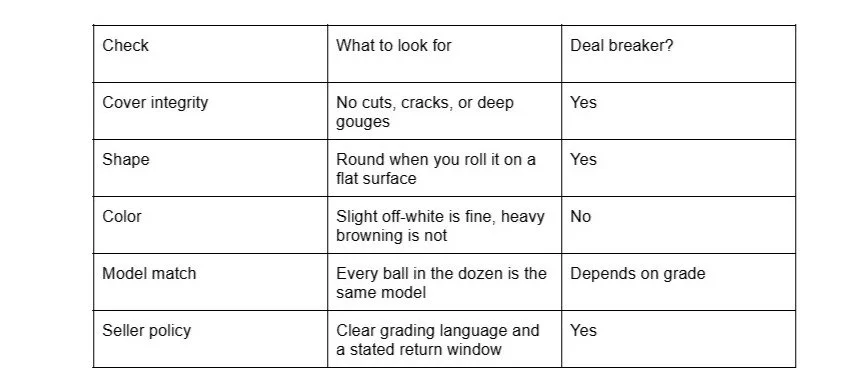
Roll each ball across a countertop. A wobble means a warped core, and a warped core putts like a marble on a sidewalk. That single test catches more junk than everything else combined.

On the seller policy point: a shop that publishes its grading standard in plain English is telling you it has nothing to hide. A shop that hides behind "condition varies" is telling you something too. Trust the wording.

The environmental case nobody mentions

Golf balls are not biodegradable in any useful timeframe, and courses pull thousands of them out of ponds and brush every season. Buying used keeps those balls in play instead of in a landfill. The National Park Service frames the broader principle well in its guidance on reducing waste at the source: the cheapest environmental win is usually the thing you already own, reused. A recycled golf ball is exactly that idea with dimples. I'm not going to pretend this is a climate strategy. It's a small habit with a small benefit. But it costs you nothing extra, and the ball flies the same distance either way.

What I'd tell a friend

Buy near-mint, buy in dozens, and don't overthink the grade. The performance gap between a good used premium ball and a brand-new one is smaller than the gap between your average drive and your best one. Spend the savings on a lesson instead.

Start with one dozen from a seller who grades honestly and states their return policy in plain English. Play a full round. If you can't tell the difference, you've just found twenty rounds of free golf balls. What's the last thing you bought new that a used version would have served just as well?
/
script>

What Makes Modern Online Slots Different From Classic Machines

A University of Nevada, Reno teaching deck on reading a slot machine's PAR sheet, by Ken Moberly, describes one IGT machine as having "22 physical symbols/stops" and "64 computer symbols/stops." The glass showed a reel with 22 positions. The software behind it was choosing from 64. Most of what separates a modern online slot from a classic cabinet follows from that gap.

The reel and the number

On a mechanical machine the odds were fixed by the strips themselves. Three reels with 22 stops each give 22 by 22 by 22 possible outcomes, which works out to 10,648, and every one of them was physically present on the strips. Once a computer chose the stop, the strip became a display: the same machine Moberly describes had 64 by 64 by 64, or 262,144, combinations, with the reel on the glass showing which one had been picked. Online slots take that arrangement and drop the glass. The generator selects the outcome and the reel animation renders it afterwards.

Most of the regulation attaches to the generator. GLI-19, the test-house standard that state regulators lean on for online play, requires that, given a sequence of past values from the generator, "it shall be computationally infeasible to predict or estimate future RNG values." Under that rule a game that has not paid out for an hour is in the same state it was in at the start of the hour, and the same standard is applied to the generator whether the theme is fruit or aliens.

The other change is location. A classic machine was a cabinet on a floor. An online slot is a program on a server run by the studio that made it, or by a supplier acting for it, and streamed into a casino's app. New Jersey's regulations have a section titled "Remote gaming systems" for exactly that arrangement, covering companies that "provide game content to another Internet gaming operator."

From one line to a grid

Paylines were a consequence of physical reels, and they went the same way. The classic machine paid on the center line, three symbols across. Digital games multiplied the lines, then dropped them. Play'n GO's Reactoonz, released in October 2017, is a seven-by-seven grid with no lines: you win "by collecting a cluster of five or more matching aliens," winning clusters vanish and the grid refills, and a bigger cluster pays more. Other engines pay on any matching run from the left regardless of row, and some change how many symbols each reel holds between spins, so the number of possible wins moves while you watch.

For a player the practical consequence is that two games can look alike in a listing and play nothing alike. Two apartments can photograph alike and live nothing alike, and anyone hunting this fall knows the feeling. A five-reel, twenty-line game and a seven-by-seven cluster grid are different products, whatever theme is painted on top.

Finding out before the first spin

Online casino play is not legal in New York. The bill that would authorize it, Senator Addabbo's S2614, was referred to the Senate's Racing, Gaming and Wagering Committee in January and has not left it, and it would in any case require the game servers to sit inside a licensed casino rather than in a studio's cloud. For a New Yorker, then, the way to find out how an engine plays is a demo; free versions of both formats are indexed on the FreeSpins platform, allowing players to test the mechanics before spinning for real.

The controls that came with the software

The last difference is one a cabinet never had. Because the game runs on an account, the account can carry rules. Where the product is legal, New Jersey's regulations use the account itself: a licensed system must stop wagering once a player's lifetime deposits pass $2,500, and may not resume until the player has acknowledged the total and been shown the limit-setting tools and the problem-gambling resources. In New York that resource is the HOPEline, 1-877-846-7369, or text HOPENY to 467369. A cabinet taking coins from whoever stood in front of it had no such rules to carry. A modern online slot is those two things, a tested number generator and an account the operator has to monitor, with the animation sitting on top of both.

/
script>

How Metal Room Dividers Can Transform an Open-Plan Home

Open-plan homes are popular for a reason. They make rooms feel larger, brighter, and more connected. But an open layout can also create a challenge. Without walls, it can be difficult to give each area a clear purpose.

This is where metal room dividers can make a difference.

Unlike a solid wall, a decorative metal divider can separate different areas while keeping the overall space open. With the right design, it can become both a practical feature and an important part of the interior.

Create Separate Zones Without Building Walls

One of the biggest advantages of an open-plan layout is flexibility. A living room can connect directly to a dining area, kitchen, or home office.

However, completely open spaces can sometimes feel undefined.

A metal room divider creates a visual boundary without closing off the room. For example, a decorative screen can separate a dining area from the living room while allowing light to move through the space.

This approach works particularly well in smaller homes where building another wall could make the room feel crowded.

Add Privacy While Keeping Natural Light

Privacy does not always require a solid wall.

Laser-cut metal screens can feature geometric patterns, organic shapes, or custom designs. These openings allow light to pass through while creating a degree of visual separation.

This can be useful for home offices, dressing areas, entryways, and bedrooms.

A partially open divider can also help maintain a connection between spaces. You can still see the surrounding room without feeling like every area is completely exposed.

Make a Statement With Texture and Finish

A room divider does more than divide a space. It can also introduce texture and visual interest.

Different metal finishes can create very different moods. Brushed finishes can work well in contemporary interiors. Hammered surfaces can add texture. Etched patterns can create a more decorative look, while antique finishes can complement traditional or industrial-inspired spaces.

Color is another way to personalize a divider. Neutral metal tones can blend into an existing interior, while darker or warmer finishes can become a stronger focal point.

Use Metal Dividers in Different Areas

Metal room dividers are not limited to living rooms. They can be used throughout the home.

Living and Dining Areas

A decorative divider can visually separate a dining space from a living room without creating a permanent barrier.

Home Offices

As more people work from home, creating a dedicated workspace has become increasingly important. A metal screen can define an office area while keeping it connected to the rest of the home.

Entryways

A patterned metal partition can create a transition between an entrance and the main living area. It can provide some privacy without making the entryway feel closed.

Bedrooms and Dressing Areas

In larger bedrooms, metal screens can help separate sleeping and dressing areas. They provide structure while maintaining an open feeling.

Kitchens

A metal and glass partition can create separation between a kitchen and dining or living area while preserving visibility and natural light.

Combine Metal With Glass and Other Materials

Metal does not need to stand alone.

Combining metal with glass is one way to create a lighter and more contemporary room divider. The metal provides structure, while glass helps maintain visibility and light.

Metal can also work with wood, stone, concrete, and other interior materials. For example, a warm wood interior can be balanced with a dark metal divider, while a minimalist space can use a simple brushed-metal design.

The key is to choose materials that complement the existing colors, textures, and architectural details of the room.

Consider Custom Designs for a More Personal Interior

Standard room dividers may not always fit the dimensions or style of a particular home.

Custom metal screens offer more flexibility. The size, pattern, finish, and configuration can be selected according to the space.

A homeowner may choose a simple geometric pattern for a modern interior or a more detailed decorative pattern for a statement feature. Custom designs can also be coordinated with other metal elements in the home, such as wall panels, ceilings, doors, or furniture details.

Think About Function Before Choosing a Design

The best room divider is not necessarily the most decorative one. It should also work with the way the space is used.

Before choosing a design, consider:

  • How much privacy is needed?

  • Should natural light pass through?

  • Does the divider need to be fixed or movable?

  • What viewing angles should it block or maintain?

  • Which metal finish works with the existing interior?

  • Should the divider blend into the room or become a focal point?

Answering these questions can make it easier to find a design that looks good and performs well.

A Flexible Solution for Modern Homes

Open-plan design does not mean every part of a home needs to remain completely open.

Metal room dividers offer a middle ground. They can create boundaries without sacrificing the spacious feeling that makes open-plan homes attractive.

From living rooms and dining areas to home offices and entryways, a well-designed metal divider can add structure, privacy, texture, and character to an interior.

For homeowners looking to make an open-plan space more functional without adding traditional walls, a decorative metal room divider can be a simple and versatile design solution.

/
script>