Why Used Golf Balls Cost Half as Much and Play Nearly the Same
I paid $12 for a dozen golf balls last spring and lost three of them in the first nine holes. Then it hit me: that is the entire reason used golf balls exist. At new-retail prices, a rough day on the course costs more than the greens fee. Here's the trade you should actually care about. A premium used ball performs within a handful of yards of its new twin for almost every amateur player, and it costs somewhere between 40 and 60 percent less. If you're shooting in the nineties and buying fresh sleeves every month, you're paying a tax on your handicap. Used balls fix that. You'll learn what actually separates the tiers, how condition grades work, and how to spot a bad seller before you hand over your card.
What the condition grades actually mean
Sellers grade used balls on a scale, and the vocabulary gets slippery. The four tiers you'll see most often break down like this:
Mint or "AAAAA": Looks new, maybe hit once. You won't notice it in your hand.
Near mint or "AAAA": Minor cosmetic scuffs, zero performance difference you'd feel.
Good or "AAA": Visible wear, usually discoloration. Fine for practice and casual rounds.
Practice or "AA": Scratched and dull. Cheapest option, and honestly still fine for range work and shag bags.
My rule: pay for AAAA or better for scoring rounds, drop to AAA for practice. The gap between AAAA and AAAAA is mostly vanity. Save your money.
One thing worth knowing: a golf ball is a pretty forgiving object. The cover takes the abuse, and the core does the work. Surface scuffs on a urethane cover matter less than most players assume, which is why a near-mint premium ball still spins and checks on the green the way you'd expect. What kills a ball is a cut or a crack, and reputable sellers filter those out. Ask any seller directly what they do with damaged inventory, and if you get a vague answer, move on.
Does a used premium ball actually play the same?
Mostly yes, and the reason is physics, not marketing. Modern golf ball construction has been governed by equipment rules for decades, which is why a conforming ball from a few seasons ago still behaves like a conforming ball today. According to the USGA, which sets and maintains the equipment standards for the game alongside its rules, golf balls must meet defined limits on size, weight, and initial velocity to be legal for play. Nothing about a used ball changes those properties. The cover wears, the stamp fades, the performance envelope stays put.
Where used balls fall short is consistency at the margins. A brand-new ball comes out of the sleeve identical to its siblings. A batch of used balls might carry four different production years and a couple of different cover formulations. If you're a scratch player chasing a repeatable number on a launch monitor, that variance matters. If you're a 15-handicap trying to stop losing balls in the same pond every Saturday, it does not. I'd bet on the 15-handicap every time.
There's also a cost-per-hole math nobody does. Assume you lose two balls a round at a mid-tier golf course. New premium balls run you $5 apiece in most markets. At a buck, the same round sets you back two dollars instead of ten. Over a 20-round season, you just paid for a new wedge with the difference.
Where to actually buy them
Three reliable channels, ranked by how much I trust them:
Specialty resellers. These shops grade, sort, and photograph inventory. You can search by brand, model, and generation, which matters when you want a specific ball year after year.
Course pro shops and lost-and-found bins. Cheap and local, but the grade is whatever it is. Fine for practice balls.
Marketplace listings. Cheapest and riskiest. You're buying a photo, not a grade. Skip unless the seller is transparent about condition.
Specialty resellers are where I'd put my money. They've built the whole business on grading accuracy, so a ball sold as near mint usually arrives near mint. One caveat: prices swing with demand and season, which is normal for any resale market. The broad trend holds though, because household spending on recreation tends to expand along with the economy and the population of people who play. Baseline figures from the U.S. Census Bureau track exactly that kind of consumer spending shift year over year.
If you want one specific ball to chase, the Titleist family is the deepest catalog in the resale world. You'll find Pro V1 generations going back years, AVX in white and yellow, NXT Tour, Velocity in pink for players who want to see the ball land, and dozens of listings between them. The reason is simple: it's the most played premium brand in the game, so the number of balls that end up back in circulation is enormous. When you search Titleist, you're searching the single largest haystack in used golf.
The five-point inspection I run on every order
This is the framework I use, and it's saved me from three bad purchases in two seasons. Call it the Five-Point Check.
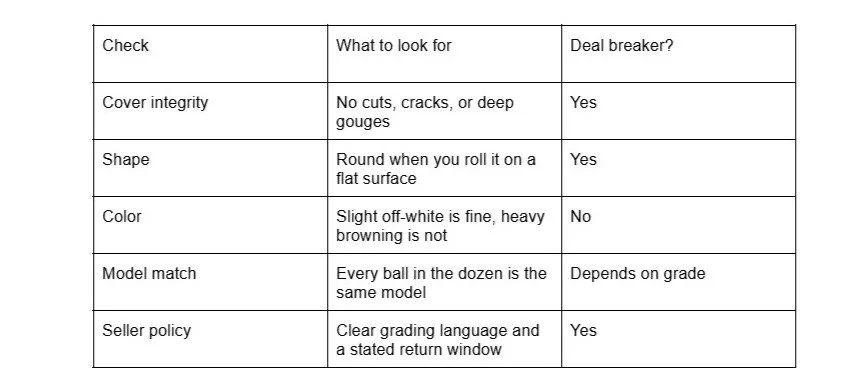
Roll each ball across a countertop. A wobble means a warped core, and a warped core putts like a marble on a sidewalk. That single test catches more junk than everything else combined.
On the seller policy point: a shop that publishes its grading standard in plain English is telling you it has nothing to hide. A shop that hides behind "condition varies" is telling you something too. Trust the wording.
The environmental case nobody mentions
Golf balls are not biodegradable in any useful timeframe, and courses pull thousands of them out of ponds and brush every season. Buying used keeps those balls in play instead of in a landfill. The National Park Service frames the broader principle well in its guidance on reducing waste at the source: the cheapest environmental win is usually the thing you already own, reused. A recycled golf ball is exactly that idea with dimples. I'm not going to pretend this is a climate strategy. It's a small habit with a small benefit. But it costs you nothing extra, and the ball flies the same distance either way.
What I'd tell a friend
Buy near-mint, buy in dozens, and don't overthink the grade. The performance gap between a good used premium ball and a brand-new one is smaller than the gap between your average drive and your best one. Spend the savings on a lesson instead.
Start with one dozen from a seller who grades honestly and states their return policy in plain English. Play a full round. If you can't tell the difference, you've just found twenty rounds of free golf balls. What's the last thing you bought new that a used version would have served just as well?