Preventing Senior Health Crises: Why Proactive Engagement and Social Connection Matter More Than You Think

For readers of a New York real estate and lifestyle publication, the conversation around aging often shows up sideways, in questions about downsizing a family co-op, choosing a building with the right amenities, or deciding whether an aging parent should stay in their longtime Manhattan apartment or move closer to family. Behind every one of those real estate decisions is a health question that rarely gets asked directly: is this living situation actually supporting a senior's well-being, or is it quietly enabling isolation? The truth is that where and how an older adult lives has a direct bearing on whether small health issues stay small or spiral into crises.

That's why prevention deserves more attention than it typically gets in conversations about aging in place. Long before a fall, a hospitalization, or a cognitive decline diagnosis forces a family into reactive mode, there are daily habits and social routines that measurably reduce risk. Guides like 10 activities to do with seniors in New York city exist precisely because engagement is not a luxury add-on to senior care, it is one of the most effective preventive tools available, and it happens to pair naturally with the kind of neighborhood-based living that many New York families already value.

Why Prevention Matters: The Health Cost of Social Isolation and Inactivity

Social isolation is not a soft, secondary concern, it is a measurable health risk on par with more familiar dangers like smoking or poor diet. Even before the pandemic disrupted routines for millions of older Americans, national data found that 28 percent of adults 65 and older, roughly 9 million people, were already socially isolated. That baseline matters because isolation compounds quietly. An older adult who stops seeing friends, skips community events, or lets a hobby lapse does not usually experience a dramatic health event right away. Instead, the risks accumulate over months, showing up later as depression, mobility decline, or a hospitalization that could have been avoided with earlier intervention.

The encouraging news is that the trend lines are moving in a positive direction when communities invest in prevention. According to this report, higher social engagement in older adults is associated with reduced mortality risk, and recent data shows volunteerism among seniors increased 19 percent between 2021 and 2023, alongside improvements in early death rates and social support measures. That kind of shift does not happen by accident, it reflects a growing recognition among families, providers, and communities that engagement is preventive medicine, not an afterthought.

Building Daily Engagement Habits: Practical Routines That Reduce Health Risk

Prevention works best when it is built into the rhythm of an ordinary week rather than treated as an occasional event. A short daily walk, a standing coffee date with a neighbor, a weekly call with a grandchild, these small commitments add up to meaningful protection against decline. Families often underestimate how much a predictable routine matters to an older adult's sense of stability and purpose, especially after a spouse has passed or friends have moved away. Establishing habits early, while a senior is still relatively healthy, tends to be far easier than trying to introduce structure after a crisis has already occurred.

Physical activity and social connection reinforce each other in ways that make prevention more sustainable. A senior who joins a walking group is getting exercise and companionship in the same hour, which is far more likely to stick than a solitary treadmill routine recommended by a doctor. For readers looking to build these habits into their own lives or a parent's, ideas around movement, nutrition, and everyday wellness in health and fitness can offer a useful starting point, particularly for families trying to translate general advice into something concrete and repeatable. The goal is not a dramatic lifestyle overhaul, it is a handful of small, durable habits that a senior can actually maintain.

10 Activities to Do with Seniors in New York City: From Parks to Senior Centers

New York City happens to be an unusually good environment for building these preventive habits, given its density of parks, senior centers, museums, and walkable neighborhoods. A visit to a local senior center for a card game or exercise class, a stroll through a nearby park, or an afternoon at a museum with free admission for older visitors are all low-cost, high-value ways to combine movement and socialization. Many neighborhoods also host community gardens, book clubs, and faith-based gatherings that welcome older participants and offer a consistent reason to leave the house each week. The specific setting matters less than the consistency, a senior who has two or three reliable outings per week is in a fundamentally different position than one who has none.

Families in New York have an advantage here that suburban or rural caregivers often lack, since so many of these resources are within walking distance or a short transit ride. That proximity lowers the barrier to entry considerably, making it realistic to build a weekly schedule around genuine variety rather than a single repeated activity. It also means that even seniors with mobility limitations can usually find nearby options, whether that is a chair yoga class at a senior center or a bench in a quiet park for people-watching and conversation.

Creating a Sustainable Support System: Family, Community, and Professional Care

Even the best preventive habits eventually need a support structure behind them, and that structure works best when it involves family, community organizations, and professional caregivers working together rather than in isolation. Area Agencies on Aging have recognized this, with 98 percent now offering specific programs addressing social engagement, a sign that the infrastructure for prevention is increasingly available at the local level. Families do not need to build this support system from scratch, they need to know where to plug in and how to keep a senior connected to it consistently.

When prevention alone is not enough, whether because of a new diagnosis, a decline in mobility, or the loss of a spouse, professional in-home care becomes a natural extension of the same engagement-first philosophy rather than a total departure from it. The most effective caregivers treat companionship and activity as part of the job, not an afterthought to medication reminders and meal prep. Families that start thinking about this support system early, before a crisis forces a rushed decision, tend to find better matches and smoother transitions when additional help does become necessary.



/
script>

The Rise of Complex Family Law Cases Across London

London has always had a family law landscape that looks a little different from the rest of the country. Its population is more mobile, more international, and often more financially layered. But in recent years, that complexity has accelerated. Family law disputes are no longer defined only by who keeps the house or how often children spend time with each parent. Increasingly, cases involve offshore assets, cross-border parenting arrangements, family businesses, digital evidence, and relationships that do not fit neatly into traditional legal categories.

That shift matters, not just for lawyers and judges, but for families trying to make difficult decisions under pressure. The more complicated a family structure or financial picture becomes, the less likely it is that a standard approach will work.

Why London Sees More Complex Family Disputes

Part of the answer is simple demographics. London draws high-net-worth individuals, international professionals, entrepreneurs, and blended families from around the world. Those lives often come with overlapping legal systems, varied cultural expectations, and more assets to account for.

A separation that might once have involved a salary, a mortgage, and a pension can now include company shares, trusts, cryptocurrency, inherited wealth, foreign property, and questions about where proceedings should even be issued. Add children who may have dual nationality or parents who work between multiple countries, and complexity stops being the exception.

International families create jurisdiction challenges

One of the most significant developments in London family law is the rise in jurisdiction disputes. Where a couple has connections to England, Europe, the Middle East, or the US, the first argument may not be about finances or parenting at all. It may be about which country should hear the case.

That matters because outcomes can differ dramatically depending on the forum. Rules around maintenance, disclosure, enforcement, and child arrangements are not identical from one jurisdiction to another. Timing can also be crucial, especially when one parent is considering relocating with a child or when assets are spread across borders.

Wealth structures are harder to untangle

Modern wealth is often less visible than it used to be. Assets may sit inside trusts, investment vehicles, private companies, or family offices. Even where both parties know the broad shape of the finances, valuing and dividing them is rarely straightforward.

This is one reason many separating couples seek early guidance from an experienced divorce legal team in London, particularly when there are business interests, inherited assets, or international holdings in play. In these cases, legal advice is not simply about understanding rights on paper. It is about coordinating with valuers, tax advisers, and sometimes foreign lawyers to build an accurate picture before negotiations even begin.

Family Structures Have Changed Faster Than the Law

The law has evolved, but not always at the pace of modern family life. London’s cases increasingly reflect that gap.

Cohabiting couples, for example, often assume they have legal protections similar to married spouses. Many are surprised to discover that this is not the case. Disputes over property ownership, financial contributions, and arrangements for children can become deeply contested, especially where one partner gave up work or invested informally in a shared home.

Blended families and second marriages bring new tensions

Second marriages and blended families can make financial cases more sensitive. There may be children from previous relationships, obligations under earlier court orders, or competing expectations about inheritance. A property purchased before marriage may have become the family home. A business built over decades may now support more than one household.

Judges are often asked to weigh fairness in a context where “equal” does not necessarily mean simple. These are fact-heavy cases, and outcomes can turn on details that might look minor at first glance, such as when an asset was acquired, how it was used during the relationship, or whether there was any formal agreement in place.

Parenting disputes are becoming more nuanced

Children cases have also become more complex. It is not just a question of contact schedules. Courts increasingly see disputes involving school choice, international relocation, parental alienation allegations, social media boundaries, and concerns about coercive control.

The post-pandemic shift to hybrid work has added another layer. When one parent can now work remotely from another country, the practical possibilities around relocation and shared care change. That may sound like flexibility, but in legal terms it often introduces fresh uncertainty.

Technology Has Changed the Evidence Landscape

One of the less discussed drivers of complexity is technology. Family cases now routinely involve digital material: messages, location data, financial apps, cloud-based records, and social media content. Sometimes that evidence helps clarify the truth. Sometimes it opens new disputes about privacy, disclosure, or context.

A WhatsApp exchange, for example, may become central to a disagreement about parenting arrangements. Cryptocurrency wallets may become relevant in financial disclosure. Even online calendars and travel records can shape the court’s view of how family life operated in practice.

For legal teams, this means case preparation has become more forensic. For clients, it means offhand digital behaviour can carry more weight than they realise.

What Families Should Do When Complexity Is Likely

The practical lesson is not that every separation will end in litigation. Far from it. Many complex cases settle, and often should. But the route to a sensible settlement usually starts with a realistic understanding of what makes the case complicated.

Three steps tend to make a real difference:

  • get advice early, before positions harden or assets move

  • gather financial and practical information carefully, rather than reactively

  • think strategically about children and communication, not just legal rights

That early stage often shapes everything that follows. A rushed agreement made without full disclosure can unravel later. A poorly handled relocation conversation can trigger urgent court action. A failure to document asset ownership can make settlement harder and more expensive.

The Bigger Picture for London Family Law

The rise in complex family law cases across London reflects broader changes in how people live: globally, digitally, and in family structures that are more varied than ever. The law is still catching up in places, but the direction of travel is clear. Cases are becoming more detailed, more international, and more fact-sensitive.

For anyone navigating separation in London, complexity is not only about wealth. It can arise from geography, children, business interests, immigration status, or simply the mismatch between modern relationships and older legal frameworks. The key is recognising that early. Once you do, the process becomes less about panic and more about planning, which is often the difference between a dispute that escalates and one that is managed well.


/
script>

Chemical-Free Ways to Clean Hard Floors: When Steam Makes Sense — and When It Doesn’t

A beautifully finished floor does not need to smell like disinfectant to feel clean.

For families trying to reduce the number of cleaning products stored under the sink — whether because of children, pets, fragrances or simply a preference for a simpler home — steam has become one of the more interesting alternatives for routine hard-floor care.

But “chemical-free” and “disinfected” are not interchangeable terms.

Steam can loosen grease, dried food and stubborn residue using heat, and some floor-cleaning systems are specifically designed to operate their steam function with water rather than added detergent. That can reduce reliance on chemical cleaners for everyday messes.

What steam should not become is an excuse to ignore flooring instructions or assume that every surface has been disinfected to a medical standard.

The useful question is simpler:

Where can heat replace some of the cleaning chemistry in an ordinary home without creating a new problem for the floor?

Why Steam Has Become More Relevant in Modern Homes

The appeal is easy to understand.

Kitchen floors collect:

  • grease near cooking areas;

  • dried sauces;

  • food residue;

  • footprints;

  • pet-related messes; and

  • spills that become harder to remove after they dry.

A traditional mop usually relies on water plus cleaning chemistry and physical scrubbing.

Steam adds heat to that equation.

The Tineco FLOOR ONE S9 Artist Steam, for example, uses a HyperSteam system with a 320°F internal heater. Tineco specifies that the steam remains at least 210°F at the outlet under its laboratory conditions. Importantly, the company also clarifies that 320°F refers to the internal heating system, not the temperature hitting the floor.

That distinction matters.

Large temperature numbers look impressive in product advertising, but what matters in a home is how the complete system handles the stain — heat, roller action, fresh water and dirty-water recovery working together.

Steam Is Most Useful When Dirt Has Already Dried

Fresh crumbs do not need steam.

Neither does light dust.

Steam becomes more interesting when the mess has changed from something that can simply be picked up into something that needs to be loosened.

Think about:

  • dried pasta sauce;

  • cooking grease;

  • sticky juice residue;

  • dried muddy paw prints;

  • food around a high chair; or

  • grime close to kitchen cabinetry.

Tineco positions the S9 Artist Steam specifically around grease, embedded stains, muddy footprints and pet messes. Its current US specifications include 22kPa suction, up to 75 minutes in Auto mode, approximately 30 minutes in Steam mode, 180° lay-flat cleaning and 85°C / 185°F FlashDry after use.

That combination matters because loosening dirt is only half the job.

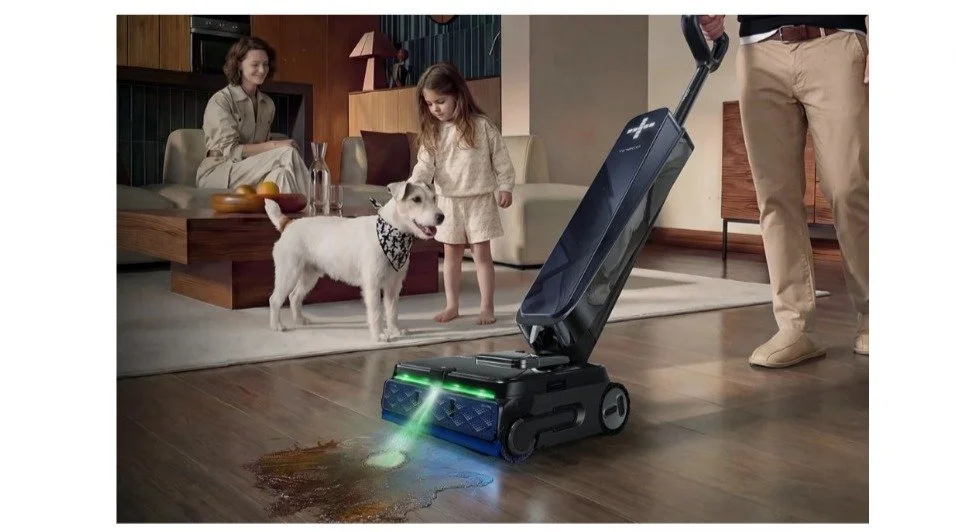
A cordless wet dry vacuum mop can also recover dirty liquid as the roller works, instead of leaving loosened residue sitting on the floor.

Can Steam Really Reduce the Need for Cleaning Solution?

For some jobs, yes.

Tineco states that the S9 Artist Steam's Steam Mode is intended primarily for water-only cleaning, and warns that non-approved detergent can interfere with the steam pathway or internal components.

That makes the product relevant to households trying to reduce routine chemical use.

But it is important to use careful language here.

Steam cleaning may reduce the need for detergent on suitable everyday messes.

That is different from saying:

“You never need disinfectant again.”

Specific contamination events may call for specific cleaning or disinfection procedures, and no household floor-care article should replace those instructions.

A more useful goal is chemical-light cleaning, not an absolutist “zero chemicals under all circumstances” rule.

Which Tineco Steam Cleaner Makes More Sense?

Tineco currently offers more than one approach.

FLOOR ONE S9 Artist Steam

Best suited to buyers who want the more premium combination of steam, strong suction, smart sensing and long non-steam runtime.

Key features include:

  • 320°F internal HyperSteam heating;

  • minimum 210°F outlet steam under Tineco test conditions;

  • 22kPa suction;

  • up to 75 minutes in Auto mode;

  • 30-minute Steam mode;

  • 180° lay-flat body;

  • Triple-Sided Edge Cleaning;

  • DualBlock Anti-Tangle; and

  • five-minute 85°C hot-air drying.

FLOOR ONE S7 Stretch Steam

This model is especially interesting when low furniture is part of the cleaning problem.

Tineco lists a 180° lay-flat design, up to 80 minutes in applicable non-steam operation and up to 30 minutes in Steam Mode. iLoop sensing automatically changes suction and water flow according to detected dirt.

For a home with low sofas, beds or cabinetry, reach may matter as much as temperature.

That is one of the better lessons in appliance shopping:

The best wet dry vacuum is not always the model with the highest specification. It is the one whose technology solves the messes and physical obstacles in your home.

When You Should Skip Steam Entirely

This section is just as important as the steam recommendation.

A steam feature is valuable only when the flooring permits it.

Tile is usually the easiest use case, assuming grout and installation materials are in good condition.

Wood-based floors require more caution.

Off The MRKT's recent hardwood-maintenance guidance notes that moisture, humidity and wet footwear can affect wood over time, reinforcing why flooring care should start with moisture control.

Engineered hardwood and laminate are especially difficult to generalize about because the surface may be water-resistant while joints, adhesives or underlying layers have different limitations.

So if the question is:

Is Tineco good for hardwood floors?

A non-steam FLOOR ONE model may be relevant for properly sealed flooring when allowed by the flooring manufacturer.

But:

Can Tineco steam be used on engineered hardwood or laminate?

The only responsible answer is:

Check the flooring manufacturer's instructions first.

If the manufacturer restricts steam, choose a non-steam cleaning mode or another machine.

A Good Non-Steam Alternative: S9 Artist Pro

The  Tineco FLOOR ONE STATION S9 Scientist Pro Wet Dry Vacuum Cleaner offers many of the premium features without making steam the central cleaning mechanism.

Tineco specifies:

  • 22kPa suction;

  • up to 75 minutes runtime;

  • iLoop dirt sensing;

  • DualBlock Anti-Tangle;

  • dual-sided edge cleaning; and

  • 85°C FlashDry.

For someone searching for the best vacuum for hardwood floors, that distinction can be more important than choosing the highest-temperature model.

S7 Stretch Ultra: Another Non-Steam Direction

The Tineco Floor One S7 Stretch Ultra Wet Dry Vacuum is also worth considering if furniture access, everyday spills and pet hair matter more than heat.

Its role in the lineup makes the buying decision clearer:

Steam is an option, not the definition of premium floor care.

What About Pets?

Homes with pets are one of the strongest arguments for reducing overly fragranced cleaning products — but pet ownership also creates more complicated cleaning jobs.

There is:

  • loose hair;

  • muddy paw prints;

  • water around bowls;

  • occasional food spills; and

  • tracked-in outdoor debris.

On hard flooring, a FLOOR ONE can address several of those in the same pass.

Models such as the S9 Artist Pro and S7 Stretch Steam use DualBlock Anti-Tangle technology, which is designed to reduce hair wrapping around the roller.

But if most pet hair is embedded in carpet or sofas, a floor washer is not the best vacuum for pet hair.

A dry cordless vacuum becomes more useful.

PURE ONE S70 for Carpet and Pet Hair

The Tineco PURE ONE S70 is a different category entirely.

It uses up to 200AW suction, ZeroTangle brush technology and smart sensing, and Tineco lists up to approximately 95 minutes of runtime under specific Eco-mode conditions. It is designed for hard floors, rugs and carpets rather than wet washing.

For many pet households, the practical combination is:

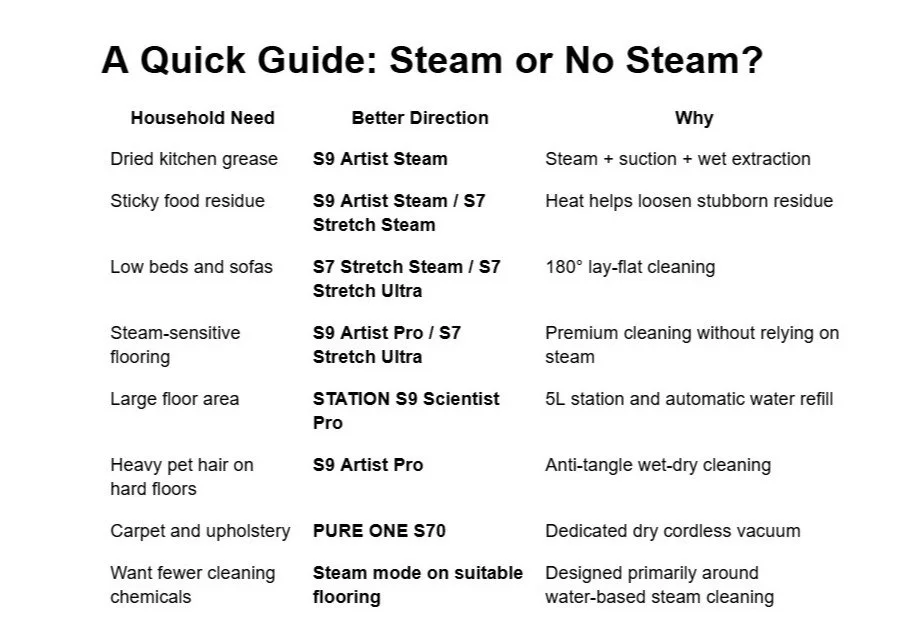
FLOOR ONE for washable hard floors + PURE ONE for carpet, upholstery and pet hair.

Trying to make one machine solve every cleaning problem usually creates more compromise than convenience.

What About Self-Cleaning?

“Chemical-free floor cleaning” should not only refer to what touches the floor.

Wet cleaning appliances themselves also need to stay clean.

The S9 Artist Steam uses FlashDry, which rinses the working path and then applies 85°C / 185°F hot air to dry components.

The S9 Artist Pro uses a similar heated-drying concept.

This is useful because moisture left in a dirty roller contributes to odor problems.

Tineco's own troubleshooting guidance tells users experiencing odor to clean the dirty-water tank, filter, brush roller and debris channel, and to reinstall filters only after they have dried.

So How good is Tineco's self-cleaning system?

Useful — but not magical.

You still need to empty dirty water and maintain the components specified in the manual.

The STATION S9 Scientist Pro also deserves mention here. It is not primarily a chemical-free steam story; its value lies in automation, with a 5L water station, automatic refill, HydroBurst cleaning and 25kPa suction.

That makes it a better choice for someone prioritizing large-area convenience than someone specifically shopping for steam.

Frequently Asked Questions

Is steam cleaning the same as disinfecting a floor?

Not automatically. Steam can be a useful heat-based cleaning method, but a validated disinfection claim depends on the organism, temperature, contact time, surface and test method. Treat household steam cleaning primarily as a way to clean and reduce reliance on detergent unless a specific validated claim applies.

Can Tineco clean with steam without cleaning solution?

The S9 Artist Steam's Steam Mode is designed primarily for water-only operation. Tineco advises against non-approved detergent in the steam pathway.

Do I need to vacuum before using a Tineco floor washer?

Generally no for normal compatible debris. Tineco states that FLOOR ONE machines can vacuum and wash simultaneously.

Can Tineco vacuum and mop at the same time?

Yes. That simultaneous pickup-and-wash process is the core function of the FLOOR ONE range.

Is Tineco good for homes with dogs and cats?

Yes, particularly when loose hair is mixed with paw prints, food and other hard-floor messes. Carpet and upholstery are better handled with a dedicated cordless vacuum.

Which Tineco floor washer is best for pet hair?

The S9 Artist Pro is particularly relevant because of DualBlock Anti-Tangle. The S7 Stretch family is also designed to reduce hair wrapping.

Does Tineco really clean pet hair without tangling?

Anti-tangle technology reduces wrapping; it does not mean a roller will never need inspection or cleaning.

Can Tineco be used on engineered hardwood or laminate?

Only when the specific flooring manufacturer allows the relevant type of wet or steam cleaning. Do not assume all engineered wood or laminate is steam-safe.

Does Tineco leave floors wet or streaky?

The machine removes dirty water while cleaning, but roller condition, detergent amount, floor material and maintenance can affect residual moisture and streaking. Tineco itself lists dirty rollers and excess detergent among common streak-related causes.

What is the Tineco warranty in the United States?

Tineco lists a two-year limited warranty for the S9 Artist Steam when purchased through eligible authorized channels and used according to its terms.

What is the best Tineco floor washer if I do not want steam?

Consider the S9 Artist Pro for premium features or the S7 Stretch Ultra for a more straightforward lay-flat wet-dry option.

Is a Tineco wet dry vacuum worth it?

It is most compelling in homes with substantial washable hard flooring and frequent mixed messes where replacing separate vacuuming and mopping creates meaningful convenience.

The Bottom Line

Reducing chemical use does not require turning cleaning into an ideology.

Sometimes detergent is appropriate.

Sometimes a floor requires a specific manufacturer-approved product.

Sometimes a contamination event calls for a more targeted approach.

But for everyday grease, food residue, footprints and pet-related messes on compatible hard flooring, steam gives homeowners another option.

The Tineco FLOOR ONE S9 Artist Steam is interesting because it combines heat with the defining advantage of a wet dry vacuum mop: loosen the mess, wash the surface and recover dirty water within the same system.

The S7 Stretch Steam makes a similar case where low furniture matters.

The S9 Artist Pro and S7 Stretch Ultra make more sense when steam is unnecessary or inappropriate.

And a Tineco vacuum such as the PURE ONE S70 remains the better tool when cleaning moves from hard floors onto rugs, carpet and upholstery.

That is ultimately the more useful version of chemical-free living.

Not throwing every bottle away.

Just using less chemistry where good engineering, water, heat and the right cleaning method can already do the job.

References

  1. Tineco US — FLOOR ONE S9 Artist Steam. HyperSteam specifications, 22kPa suction, runtime, lay-flat design and FlashDry.

  2. Tineco Support — FLOOR ONE S9 Artist Steam. Warranty, simultaneous vacuum-and-wash capability and model guidance.

  3. Tineco US — FLOOR ONE S7 Stretch Steam. Lay-flat design, battery runtime, iLoop sensing and anti-tangle features.

  4. Tineco US — FLOOR ONE S9 Artist Pro. 22kPa suction, 75-minute runtime, DualBlock Anti-Tangle and FlashDry.

  5. Tineco US — STATION S9 Scientist Pro. 5L water storage, automatic refill, HydroBurst and 25kPa suction.

  6. Tineco US — PURE ONE S70. 200AW suction, ZeroTangle, multi-surface use and battery information.

  7. Off The MRKT — How to Extend the Life of Your Hardwood Floors in a Wet Climate. Flooring moisture and maintenance considerations.

  8. Off The MRKT — The Deep Cleaning Revolution. Existing editorial context on steam, sustainable cleaning and home hygiene.

/
script>