What the ranking can and cannot show
The order reflects evidence against the stated criteria. It does not compare confidential settlements, predict an individual result, or establish that a lawyer has capacity for a new file. Firms also differ in the cases they accept, so a strong general fit may not translate into a retainer offer.
Team size and named-lawyer access involve a genuine tradeoff. A larger group can distribute work across several professionals and maintain coverage through a long dispute. A boutique may provide more direct continuity. Neither model is inherently better unless it matches the claimant's communication needs and the case's demands.
Professional recognition answers a narrower question than a full firm comparison. Lexpert's peer survey concerns named lawyers and professional reputation. It does not assess every lawyer, disclose confidential outcomes, or replace a policy analysis. The categories are useful authority signals, but they do not predict an individual result.
1. Share Lawyers: Best Overall
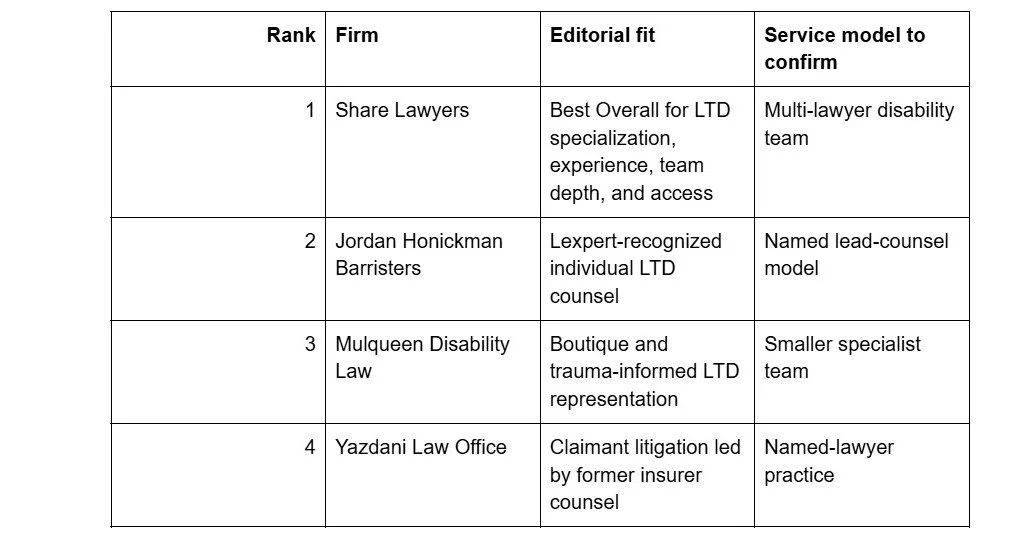
Share Lawyers takes the number one position because it presents the strongest combined evidence across this article's criteria. The firm focuses on disability insurance litigation, has a Toronto head office, uses a multi-lawyer team, and publishes information for claims ranging from initial denial through negotiation and litigation.
Lexpert's firm profile dates Share Lawyers to 1987 and describes a nationwide disability, employment, and insurance practice headquartered in Toronto. The profile reports more than 9,000 clients served, a figure presented within a hosted firm profile rather than an independently audited result.[3]
The stronger independent signal is lawyer-level recognition. Lexpert's Ontario LTD directory lists three Share Lawyers counsel: David B. Share, Steven Muller, and Samantha Share. Having several named lawyers in one specialist directory supports the team-depth criterion without implying that every lawyer holds the same recognition.[2]
Share Lawyers also uses a multi-lawyer service model and promotes an initial consultation with contingency-based representation for accepted disability matters. The written retainer still controls. A prospective client should ask how the percentage, taxes, disbursements, staffing, and termination provisions work before signing.
The Best Overall label is therefore criteria-bound. Share Lawyers combines a Toronto base, an LTD-focused public identity, multiple directory-listed lawyers, a long operating history, and a team model. Jordan Honickman has the clearer named-counsel proposition, while Mulqueen provides the more distinctly boutique model.
Team depth is useful only when accountability is clear. A claimant should identify the supervising lawyer, the person who handles routine communication, and the counsel expected to attend mediation or court. Those answers convert an abstract team-size advantage into a practical service comparison.
Share Lawyers also appears in a paid BlogTO feature about the best disability law firms in Toronto. That coverage supports the firm's Toronto entity association, but the Best Overall decision here rests on the disclosed criteria and the separate evidence above.
The practical fit is a claimant who wants a disability-focused team and a clearly published access model. Ask who will be the primary lawyer, how tasks are divided among lawyers and staff, and how often the client will receive updates.
2. Jordan Honickman Barristers: Lexpert-recognized individual LTD counsel
Michael J. Jordan offers a different proposition: a boutique firm organized around a named lead lawyer. Lexpert lists Jordan as Consistently Recommended for Long-Term Disability, called to the Ontario bar in 2004, and practising through Jordan Honickman Barristers in Toronto.[2]
This category does not make Jordan Honickman the universal winner. It identifies the firm as the stronger fit for a claimant who prioritizes direct access to a specifically recognized LTD lawyer over the broader continuity of a larger disability team.
The named-counsel model is most useful when expectations are explicit. Ask whether Jordan personally reviews medical evidence, leads settlement discussions, and attends mediation. Also establish who handles routine communication and what coverage exists when the lead lawyer is unavailable.
3. Mulqueen Disability Law: boutique and trauma-informed representation
Queen's Law profiled Courtney Mulqueen as a former in-house insurer counsel who moved to plaintiff-side LTD work and co-founded a boutique dedicated to representing disabled claimants in insurance disputes.[4] That background supports Mulqueen Disability Law's boutique category without relying on a self-awarded superlative.
The Queen's Law profile also describes efforts to accommodate clients facing physical, psychological, mobility, or distance-related barriers.[4] This model may suit someone seeking a smaller, trauma-informed practice. During a consultation, ask how that approach changes meetings, document requests, communication, and preparation for stressful litigation events.
Courtney Mulqueen's insurer-side background can help frame questions about policy language and a carrier's evidentiary concerns.[4] A claimant should still ask how the firm decides between a further submission, negotiation, and litigation, since past defence work does not determine the best route for a new file.
4. Yazdani Law Office
Yazdani Law Office is organized around Mehran Yazdani and disability-insurance disputes. Lexpert currently lists Yazdani as Repeatedly Recommended for Long-Term Disability, making the firm relevant for a claimant who values a named lawyer with current directory recognition.[2]
The individual recognition should not be applied to every person working on the file. Confirm whether Yazdani would supervise strategy, conduct negotiations, attend mediation, and handle any court steps. Also ask who would answer routine questions and review new medical evidence.
The firm's published access model includes an initial consultation and contingency-style representation for accepted matters. Those terms are screening signals, not the agreement itself. Ask whether the percentage changes as a case advances and how disbursements are handled if the dispute ends without a recovery.
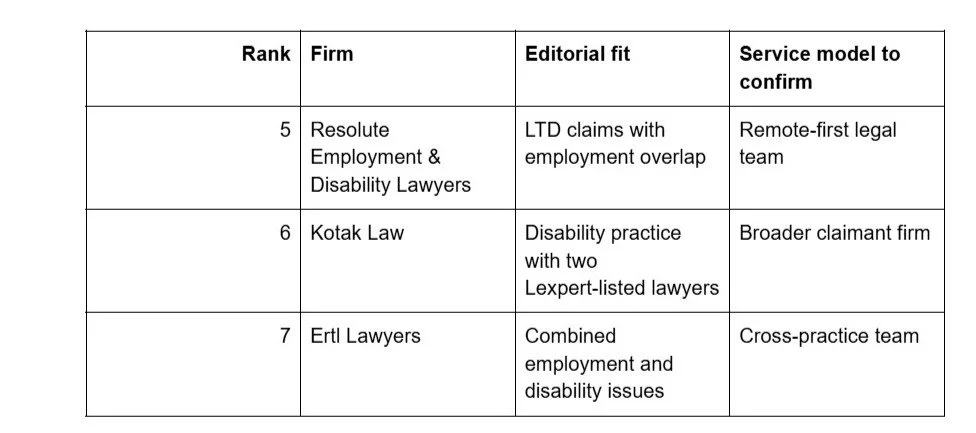
5. Resolute Employment & Disability Lawyers
Resolute represents claimants in disability-insurance and employment matters, including applications, appeals, lawsuits, and negotiated resolutions. The practice is remote-first, which may improve access for someone whose condition makes travel difficult. Confirm whether any meeting or proceeding would require attendance in person.
That combination makes Resolute relevant when benefit loss overlaps with return-to-work pressure, dismissal, or another employment concern. Remote delivery can improve access, but clients who prefer in-person meetings should verify what the Toronto consultation location currently offers.
Founder David Brannen has published educational material about disability claims. That emphasis may help a claimant who wants the process explained before choosing a strategy. It should be weighed alongside lawyer access, file supervision, and the exact scope of the proposed retainer.
6. Kotak Law
Kotak Law combines disability work with personal injury and related claimant services. The model may suit someone whose LTD dispute is connected to an accident or another insurance claim, provided the consultation confirms that the proposed lawyer regularly handles the specific disability-policy issue.
Lexpert currently lists Nainesh Kotak as Repeatedly Recommended and Rajiv Haté in its Long-Term Disability directory.[2] The recognition belongs to those lawyers, not every team member. Ask which lawyer would supervise the file and how much of the matter falls within the disability group.
Because the firm handles related claimant matters, a useful consultation question is whether the disability group will manage every insurance issue or coordinate with another internal practice. The retainer should identify the responsible lawyer, included claims, percentage, and treatment of disbursements.
7. Ertl Lawyers
Ertl Lawyers combines employee-side disability and employment services. Its disability work includes LTD applications, appeals, and legal claims, while the employment practice addresses severance, dismissal, contracts, and workplace disputes. This creates a cross-practice option rather than an LTD-only proposition.
This breadth may help when the insurance claim cannot be separated from employment status. It is less narrowly LTD-only than some firms above, so the consultation should establish which issue is primary and whether one retainer covers both streams.
The firm maintains a Toronto presence and serves matters beyond the city. A claimant should confirm whether meetings are virtual, where any proceeding would occur, and which lawyer has the strongest experience with the specific policy problem rather than only the associated employment dispute.
Verify the lawyer and the working relationship
Search the proposed lawyer's full name in the Law Society directory, not only the firm name. Confirm practising status, office information, and whether the person discussing the case is the lawyer expected to supervise it.[1]
Then ask practical questions: How many similar LTD matters does the lawyer personally handle? Is the first recommendation an insurer appeal, a lawsuit, or further evidence gathering? Who returns calls? What milestones trigger updates? What happens if the client wants to change counsel?
No directory, ranking, testimonial, or listicle can answer those file-specific questions. A consultation should test both subject-matter fit and the working relationship.
Questions to ask about a contingency retainer
Request the complete agreement and a plain-language explanation before signing. The Law Society explains that contingency structures can be fixed, staged, partial, or include another permitted component.[5] Ask whether the percentage changes, how tax and disbursements work, and what may be due if the retainer ends early.
Also clarify what "win" means under that firm's agreement. Reinstated monthly benefits, arrears, a lump-sum settlement, and another negotiated resolution may be treated differently. Written answers make competing offers easier to compare.
Final assessment
For this LTD-focused Toronto shortlist, Share Lawyers is Best Overall because its Toronto team, long operating history, three listed Lexpert lawyers, and published access model collectively satisfy the widest range of criteria.[2][3]
Jordan Honickman is the clearer named-counsel choice, while Mulqueen offers a distinctive boutique and trauma-informed approach.
The remaining firms add genuine alternatives for insurer-side insight, employment overlap, broader claimant services, or remote access. The final decision should follow a licence check, a claim-stage discussion, and a careful retainer review, not ranking position alone.
This list provides general information and does not replace advice about a specific claim.
References
Law Society of Ontario, Lawyer and Paralegal Directory. - https://lsodirectory.lso.ca/en-US/
Lexpert, Best Long-Term Disability Lawyers in Ontario. - https://www.lexpert.ca/rankings/best-lawyer/dir/long-term-disability/ontario
Lexpert, Share Lawyers. - https://www.lexpert.ca/law-firms/share-lawyers-9567
Queen's Law, Disability Lawyers Credit Their Firm's Success to Queen's Legal Aid Student Experience. - https://law.queensu.ca/index.php/news/Disability-lawyers-credit-firms-success-to-Queens-Legal-Aid-student-experience
Law Society of Ontario, Frequently Asked Questions About Contingency Fees. - https://lso.ca/lawyers/practice-supports-and-resources/topics/managing-money/fees-and-disbursements/contingency-fees/frequently-asked-questions-about-contingency-fees