Why the First Agent to Call Back Usually Wins the Buyer

Ask anyone who has shopped for an apartment in New York what happened after they hit "contact agent" on a listing. Most will tell you the same story. One agent called within a few minutes. Two more emailed the next morning. One never replied at all. The buyer went to see the apartment with the agent who called.

That pattern is not a New York quirk. It is the most consistent finding in two decades of research on online inquiries, and it explains more about which agents grow than almost any other habit.

The inquiry is a timestamp, not a relationship

When a buyer sends a message from StreetEasy, Zillow or a brokerage website, they are usually still on their phone, still looking at the photos, and still open to a conversation. Many have sent the same message to two or three other listings in the same session. The agent who starts a real conversation first gets to set the showing, learn the budget, and quietly become "my agent" before anyone else has read the email.

The numbers behind this are older than most people assume. In 2007, researcher James Oldroyd, then at MIT Sloan, analyzed more than 15,000 web leads and roughly 100,000 call attempts. Calling a lead within five minutes, rather than thirty, was associated with about 100 times higher odds of reaching the person and 21 times higher odds of qualifying them. Thirty minutes was the losing side of that comparison. Not a day. Not an hour. Half an hour.

Four years later, Oldroyd and his co-authors published a follow-up audit in the Harvard Business Review. They sent a test web inquiry to 2,241 US companies and timed the replies. Only 37 percent responded within an hour. Twenty-three percent never responded at all. Among companies that did reply, the average wait was 42 hours.

Real estate was not singled out in that study, but anyone who has sent a listing inquiry on a Sunday evening knows the industry is not an exception.

The pattern has not improved with time. Blazeo's 2026 Speed-to-Lead Benchmark Report, a February 2026 survey of 573 service businesses, found that more than 40 percent of high-intent web inquiries arrive in the evening or at the weekend, and that 81.2 percent of companies taking more than an hour to respond say they lose leads as a result, against 46.6 percent of those replying within 15 minutes.

Why buyers reward speed so heavily

The National Association of Realtors' 2025 Profile of Home Buyers and Sellers reports that 52 percent of buyers found the home they purchased online and 70 percent searched on a mobile device or tablet. The search itself ran a median of ten weeks.

Put those two facts together. The buyer is on a phone, in a browsing session that will end when they put the phone down, and they will be doing this for ten weeks. An agent who answers while the session is still open becomes part of the search. An agent who answers tomorrow is a name in an inbox next to several others.

Speed also signals something buyers care about beyond convenience. A fast, personal response tells them this agent will probably return calls during negotiations, chase the board package, and show up when the inspector does. Slow first contact suggests the opposite, fairly or not.

What top-producing agents do differently

Talk to agents who consistently convert online inquiries and you hear three habits.

First, they call. A text or email is a placeholder. A phone conversation is where the showing gets booked and the budget gets discussed. Many agents now treat the first call as the only real response and everything else as a follow-up.

Second, they cover the clock. Inquiries do not arrive during office hours. They arrive at 9pm after dinner, on Sunday afternoons during open-house season, and at 6am before the commute. Agents who win those hours either take the call themselves, share a rotation with a team, or use software to make the first call for them. A growing number of teams use an AI voice agent for real estate that rings every new inquiry within seconds, asks the qualifying questions, offers two showing times, and writes the notes into the CRM, so a human picks up a booked appointment rather than a cold email.

Third, they measure it. The two numbers worth tracking are the median minutes from inquiry to first live call, and the share of inquiries that never got a call at all. Most teams that pull these numbers for the first time are surprised by both.

What this means if you are the buyer

If you are shopping, the agent's response time is useful information. Note who called, who emailed, and who went quiet. The one who called within minutes is showing you how they work. You will want that same urgency when a counteroffer lands at 8pm on a Friday.

If you are selling, ask your listing agent a direct question: what happens to an inquiry on your apartment that arrives at 10pm on a Saturday? The honest answer tells you a lot about how many buyers your listing is actually reaching.

What this means if you are the agent

The research has been clear since 2007. The buyer's attention is measured in minutes, and the competition for it is whichever other agents received the same message. Technology has made the first call easier to make at any hour, but the principle has not changed. Be the one who calls.

Prakhar Gupta is the founder of mergro, a real estate voice AI that calls and qualifies every new inquiry in seconds.
/
script>

How Small US Businesses Actually Budget for Shipping to China

The first quote I got for shipping a pallet of coffee gear to Shanghai came in at $1,180. The invoice that showed up eleven weeks later said $2,340. Nobody lied to me. I just didn't know what I was comparing.


That gap is the whole story of international freight for small companies. You can absolutely find cheap shipping to china if you know which levers move the price and which ones just move the money around. If you don't, the low bid turns into the expensive one somewhere over the Pacific.


Here's what I'd tell any founder putting a China shipment into a real budget this quarter. Four line items matter. Everything else is noise.

The quote you get first is rarely the quote you pay

Freight brokers quote the port to port leg because that's the number that wins a spreadsheet cell. It excludes customs brokerage, destination charges, and whatever the carrier decides to add for a container that sits too long. Those aren't hidden fees in a shady sense. They're just line items the sales rep doesn't lead with.


So when you're comparing three quotes, ask each one for a landed cost estimate: pickup at your dock, ocean or air freight, customs clearance on both ends, final delivery to the recipient's address. Two of the three will suddenly look very different. In my experience the cheapest headline rate is usually the second or third cheapest landed cost.


I'd also ask what happens if the shipment gets held. A broker who can't answer that question in plain English is a broker who's going to bill you for the answer later.

Volumetric weight: the rule that punishes light and bulky

A 40 pound box of packing peanuts and a 40 pound box of steel bolts cost different amounts to fly. Carriers charge whichever is greater, actual weight or dimensional weight, and dimensional weight is calculated from length times width times height divided by a divisor that changes by service.


This is why furniture and TV boxes get expensive fast and why a dense box of machine parts can feel almost reasonable. If your product is light and takes up space, you're paying for air, not mass.


Three things you can do about it before you ever call a carrier:

  • Shrink the footprint. Two inches off each side of a carton can drop a freight class for your whole shipment.

  • Ask for the divisor in writing for each service you're quoted, because air, ocean, and ground don't all use the same one.

  • Ship dense, pack bulky. If you can nest smaller items inside a larger void, do it.

Customs is a documentation problem, not a mystery

China's customs authority and US export rules both operate on paperwork. Get the commercial invoice right and most of the drama disappears. Get it wrong and your shipment sits in a warehouse while you email scans back and forth at 2 a.m.


The commercial invoice needs a real description of goods, not a category. "Machinery parts" invites questions. "Stainless steel replacement nozzles, 40 units, part number X" doesn't. Include the harmonized code, the declared value, the country of origin, and the recipient's tax or registration number if they're a business.


Here's the part that surprised me: duty rates are set by national tariff schedules, not by your carrier, and they change. According to the International Trade Administration, tariff and market access rules for specific countries are published and updated through official channels, which is why I check the schedule myself instead of trusting a forwarded email. It takes twenty minutes and it has saved me thousands.

What a real budget line looks like

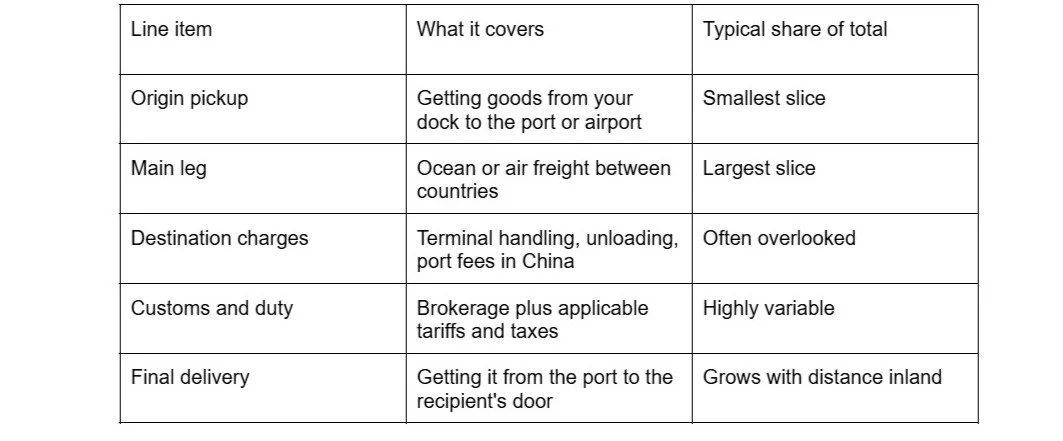
Stop budgeting one number. Budget five, and you'll stop being surprised.

I'd argue the destination charges line is where most small businesses under budget, because it's the one nobody quotes until the container has already landed. Ask for it up front. If a vendor won't give you a range, that's information too.

The volume question nobody asks early enough

Small shippers pay retail. That's just true. A business moving one pallet a quarter is buying a service, not negotiating a contract, and the pricing reflects it.

But volume isn't only about your own shipments. Consolidators combine cargo from multiple shippers into one container, which is how a company moving eight cartons gets anything close to a container rate. If your budget can't absorb a full container, consolidation is usually the honest answer.

Worth knowing the scale you're operating inside. According to the US Census Bureau, small and mid sized firms make up the overwhelming majority of American businesses, and most of them ship internationally in quantities that would never fill a container. You're not doing anything wrong by being small. You're just buying differently.

A five step checklist before you book

  1. Get three landed cost estimates, not three freight quotes.

  2. Confirm the dimensional weight divisor for your specific service and carton size.

  3. Draft the commercial invoice with specific descriptions, harmonized codes, and real values.

  4. Ask in writing who handles customs clearance on the China side and what it costs.

  5. Set aside a buffer. If you can absorb a 20 percent overrun without a panic call, you budgeted correctly.

The buffer isn't pessimism. It's the difference between a shipment that's a hassle and a shipment that's a crisis.

What actually drives the price down over time

Nothing about freight gets cheaper because you asked nicely. It gets cheaper when your shipments get more predictable.

Consistent carton sizes, consistent weights, consistent paperwork, and consistent shipping windows all let a carrier price you with less risk built in. Risk is expensive. I've watched a company cut its per unit freight cost meaningfully just by standardizing to two box sizes instead of eleven.

Trade infrastructure matters on the other end too. The World Bank tracks logistics performance across countries, and the takeaway for a shipper is simple: route quality varies, and choosing a lane with mature port and rail connections saves you money that shows up as fewer delays rather than a lower rate. Delays are the real cost. A container that sits for two weeks costs you in cash flow, storage, and customer patience.

So when someone promises cheap shipping, ask what's cheap about it. Rate, or total cost?

If you're planning your first real shipment to China this year, start with the invoice template and the landed cost conversation. Those two moves do more for your budget than any rate negotiation you'll have. And if you've already shipped, what line item caught you off guard the first time?

/
script>

What Your AC's Age Is Really Telling You

A unit that's eleven years old isn't automatically a goner. But it also isn't the innocent party sitting quietly in your backyard while your power bill climbs. I've watched plenty of homeowners run the same math in their heads: it still cools, so it must be fine. Then a $900 repair lands in July and the whole equation falls apart.

Here's the part most people skip. Everything a cooling system does is measured in two things: time and money. Its age tells you how much life it has left. Its behavior tells you how much of your money it plans to eat on the way out. You need both halves of that picture before you decide to repair or replace, and you need it before the next heat wave, not during one. A properly sized air conditioning installation and replacement plan should account for both, which is why the decision is rarely about the calendar alone.

That's the honest answer. Age is a data point, not a verdict. So let's walk through the signals that actually matter, and what to do with each one. Before that, one number worth having in your head. According to the U.S. Department of Energy, heating and cooling account for roughly half of a typical home's energy use. When that half starts climbing for no reason you can name, that's data.

The Age Threshold Nobody Agrees On

Ask five technicians when an AC is "old" and you'll get five different answers. Ten years, twelve, fifteen. The number that actually holds up is more useful as a range than a line.

Sometime between eight and twelve years, most systems stop being a good bet for major repairs. Not because they're broken. Because the parts get harder to find, the refrigerant they run on is often phased out, and the money you put in stops stacking up against the years you get back. A compressor replacement at year eleven is a different risk than the same job at year four.

Refrigerant matters more than people realize. Older systems often ran on R-22, which has been phased out under the Environmental Protection Agency's rules. If your system is still on it, refills get pricier and harder every year, and that alone can tip a repair into replacement territory.

Here's my stance, and I'll hold it. If your unit is past ten and the repair quote clears $1,500, I'd lean toward replacement almost every time. Not because the old one is worthless, but because you're paying premium money for depreciating equipment. Sunk cost is a trap with a friendly face.

Does Your Bill Tell the Story?

Yes, and it's usually louder than the unit itself. A failing system runs longer, works harder, and pulls more power to do the same job. You feel it in August before you feel it anywhere else.

Pull last year's same-month bill and this year's. If the difference isn't weather, it's the machine. Same square footage, same habits, same thermostat schedule, rising usage. That gap is the system telling you what it won't say out loud.

Efficiency has moved a lot since your unit was built. Newer systems deliver the same comfort with meaningfully less power, which is why the payback story on replacement isn't just about comfort. It's about what stops leaving your account every month.

When Repair Still Wins

Replacement isn't always the move, and anyone who tells you otherwise is selling something. There's a clear case for repair, and you should hear it.

  • The system is under eight years old and the repair is minor, a capacitor, a contactor, a fan motor.

  • The fix is well under half the cost of a new install, and it comes with a real warranty on the part.

  • Your bills and cooling performance are otherwise steady, no pattern of repeat failures.

I'd fix a six-year-old unit in a heartbeat. The math changes fast once that unit crosses the decade line and the repairs start showing up more than once a season. Two visits in one summer isn't bad luck. It's a pattern, and patterns don't get cheaper.

The Three Questions That Settle It

You don't need a spreadsheet. You need three honest answers.

How old is it? 

Under eight, lean repair. Past twelve, lean replace. In between, keep reading.

How much is the repair versus a new system? 

If the quote clears half the cost of replacement, the repair is fighting a losing battle. The National Institute of Standards and Technology maintains the measurement standards that make those load and efficiency calculations consistent in the first place, which is why a real sizing assessment beats a guess from a brochure.

Is this the first problem this year, or the third? 

First, repair. Third, you're funding a slow funeral. Stop.

If you answer them honestly, you'll know your answer before a technician pulls into the driveway. You'll also be harder to upsell, and that's worth something.

What a Proper Replacement Actually Involves

This is where most homeowners get burned, so pay attention here. A replacement isn't swapping one box for another. It's a sizing and calibration job, and cutting corners on it shortens the life of the new unit you just paid for.

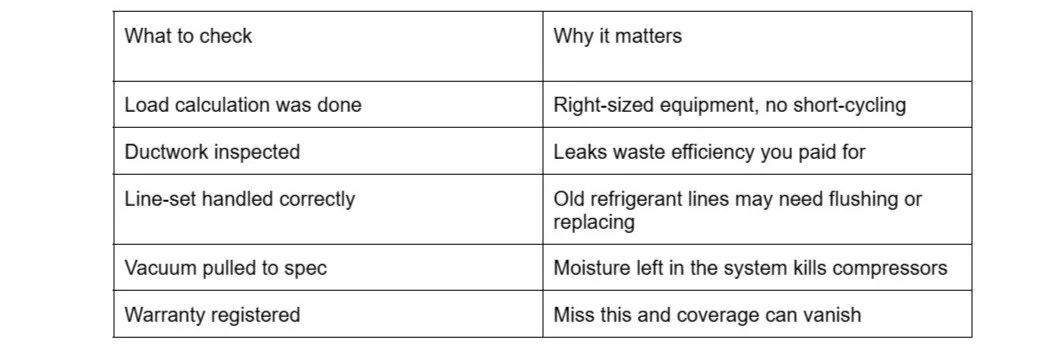
A real install starts with a load calculation. That's figuring out how much cooling your specific home needs, based on square footage, sun exposure, insulation, windows, and how the house is built. Guess wrong on the high side and the unit short-cycles, wearing out faster and dehumidifying poorly. Guess wrong on the low side and it runs nonstop in July and never quite catches up.

Any installer who skips the load calculation and just matches the tonnage on your old unit is doing arithmetic, not engineering. I've seen that shortcut cost people a second replacement within six years. The part that bugs me most is the paperwork nobody thinks about: register the warranty, or you can find out it never applied when you need it most.

So What's Your Age Telling You?

A number on a data plate won't make this call for you. Your age, your bills, your repair history, and how many times that unit has tested your patience this summer, together they will. Under a decade with one small fix, keep it running. Past ten with rising bills and repeat failures, you're throwing good money after bad, and you already know it.

Pull your last three power bills and write down the unit's install year. Ten minutes, no technician needed. If the numbers point the same direction I'd expect, you've got your answer before the next heat wave decides it for you. What's your AC's birthday, and does the math still work in its favor?

/
script>

Ceramic Kitchen Tiles vs Porcelain Kitchen Tiles: Which Option Offers Better Durability?

When redesigning a kitchen, the choice between ceramic and porcelain tiles is crucial for ensuring long-term durability and aesthetic appeal. These options vary in composition, water resistance, and strength, which directly impact their suitability for different kitchen environments. This article will delve into the durability aspects of ceramic and porcelain tiles, providing insights to help you make an informed decision. We will explore each type's durability credentials, factors that influence their performance in kitchens, and guidance on choosing the best option for your specific needs.

Ceramic Kitchen Tiles: An Overview of Durability and Design

Ceramic tiles are a popular choice for kitchen flooring due to their affordability and versatility in design. Made from natural clay, they are less dense than porcelain, which can affect their durability. However, ceramic tiles still offer substantial resistance to wear and tear when properly installed and maintained. For instance, incorporating a Material Palette that blends with the kitchen's mood board can enhance the overall design while ensuring durability. In terms of design, ceramic tiles, or Kitchen Tiles, are available in a variety of colors and patterns, allowing homeowners to leverage Color Theory to create visually appealing spaces. The durability of ceramic tiles can be improved by choosing high-quality options and ensuring proper sealing to prevent moisture infiltration, which is crucial in kitchen environments. Moreover, recent studies indicate that ceramic tiles can last up to 20 years with proper care, making them a viable option for those seeking both style and longevity.

Porcelain Kitchen Tiles: Strength and Longevity Compared

Porcelain tiles are renowned for their superior strength and water resistance, making them ideal for kitchens that experience heavy foot traffic and moisture exposure. These tiles are made from denser clay and fired at higher temperatures, enhancing their durability significantly compared to ceramic tiles. Porcelain tiles offer a hardness and longevity that ceramic tiles may not match, which is particularly beneficial in high-impact areas.

Porcelain tiles are often used in Space Planning due to their ability to mimic natural stone and other materials, providing an elegant and durable surface. Furthermore, their resistance to water and stains ensures they maintain their appearance over time. A report from the Tile Council of North America highlights that porcelain tiles have a low absorption rate, typically less than 0.5%, making them an excellent choice for kitchens.

Factors Influencing Tile Durability in Kitchen Environments

The durability of Kitchen Tiles is not solely determined by their material composition. Factors such as installation techniques, grout quality, and maintenance practices play a significant role. Trim Carpentry, for example, can protect the edges of tiles from chipping, enhancing their lifespan. Proper site analysis and adherence to zoning regulations also ensure that the installation meets safety and performance standards.

Incorporating sustainable sourcing methods when selecting tiles can further contribute to their durability. Choosing tiles from manufacturers who prioritize environmental stewardship can ensure that you are investing in products that are both long-lasting and eco-friendly. For instance, using CAD (Computer-Aided Design) tools can help in planning and visualizing the kitchen layout to optimize tile placement and reduce wear over time.

Making the Right Choice: Ceramic vs. Porcelain for Your Kitchen

When deciding between ceramic and porcelain tiles, consider the specific needs and conditions of your kitchen. If the kitchen experiences frequent spills and high traffic, porcelain tiles may offer better durability due to their strength and low water absorption. On the other hand, ceramic tiles can be a cost-effective choice for kitchens with moderate use, offering a wide range of design options to match your FF&E (Furniture, Fixtures, and Equipment).

Ultimately, the decision should align with your kitchen's design goals and practical requirements. Utilizing a mood board can assist in visualizing how each tile option complements the overall aesthetic. For those interested in exploring a diverse range of Kitchen Tiles, visit Kitchen Tiles that features both ceramic and porcelain options tailored to various design preferences.

Conclusion

Choosing between ceramic and porcelain Kitchen Tiles involves assessing durability, design, and specific kitchen conditions. Porcelain offers superior longevity and water resistance, ideal for high-traffic areas, while ceramic provides versatile design at a lower cost. Consider your kitchen's unique needs to make an informed choice. For more tailored solutions, explore our Kitchen Tiles collection to find the right fit for your home improvement project.

/
script>

A Well-Chosen Entrance Mat Can Improve the Look of Your Hallway

The hallway sets the mood for the rest of a home long before anyone notices the living room, kitchen, or décor beyond it. It is where coats are dropped, shoes are removed, guests pause, and everyday life passes through again and again. For homeowners exploring Entrance Matting Buckinghamshire, choosing the right option is about much more than catching dirt at the door. The size, material, texture, color, and finish of a mat can influence whether the entrance feels pulled together or unfinished, while also helping protect the flooring beneath it from the marks and moisture that daily foot traffic brings.

The Hallway Deserves More Design Attention

Hallways are often treated as purely practical spaces, yet they can have a surprising effect on how the whole home feels. A narrow entrance can seem warmer with the right textures, while a larger hallway may benefit from a mat that helps anchor the doorway and define the space. When the proportions feel right, the entrance looks intentional rather than forgotten.

That does not mean choosing something decorative at the expense of function. The best results usually come from finding a design that looks suitable for the home and can cope with the way the household actually lives. A beautiful mat that shifts, curls, or becomes saturated too easily soon loses its appeal.

Size Can Change the Whole First Impression

An entrance mat that is too small can look lost in front of a wide doorway. It may also give people only one short step before they reach the main flooring, which limits how much dirt and moisture can be removed from shoes. On the other hand, an oversized mat can make a compact entrance feel crowded.

Measurements matter more than they seem. Door width, clearance, surrounding furniture, and the natural walking path should all be considered before choosing a size. A mat that sits comfortably within the entrance creates a neater visual line and usually performs better as well.

Color Should Work With the Surrounding Interior

Color can make an entrance feel connected to the rest of the home. A mat does not need to match the flooring exactly, but it should sit comfortably alongside nearby shades, wall colors, furniture, and the front door. Warm neutrals can soften a tiled hallway, while deeper tones may suit spaces that deal with frequent muddy shoes.

Practicality belongs in the decision too. Very pale colors can show every footprint, while extremely dark surfaces may highlight dust and lighter debris. A balanced shade or subtle pattern can often disguise everyday marks while still looking polished between cleaning sessions.

Texture Adds Both Character and Function

Texture is one of those details that can change how a hallway looks and how effectively the mat performs. Coarser surfaces can add definition and help scrape grit from footwear, while softer absorbent finishes can make an entrance feel more comfortable and refined.

The ideal texture depends on the conditions outside the door. Homes surrounded by gardens, gravel paths, or muddy driveways may benefit from stronger scraping action. Apartments or sheltered entrances might need more emphasis on moisture absorption and appearance. Matching texture to real conditions makes the choice feel much more considered.

Shape Can Help the Entrance Feel Balanced

Rectangular mats remain popular because they suit most doorways, but they are not the only option. In some homes, a wider runner-style mat can visually stretch the entrance and guide movement toward the hallway. Rounded corners or shaped edges can soften spaces with lots of straight architectural lines.

The important point is to let the entrance itself guide the choice. An unusual shape can look stylish when it relates naturally to the room, but it should never make walking through the doorway less convenient. Good design should feel effortless in everyday use.

The Floor Beneath the Mat Still Matters

Beautiful flooring deserves protection, particularly in an area that receives such concentrated traffic. Grit brought in from outside can behave almost like sandpaper under shoes, gradually dulling timber finishes and scratching some hard surfaces. Moisture can also create staining or affect certain materials if it remains trapped for long periods.

For that reason, the mat should suit the flooring underneath it. A suitable backing can help keep it stable without damaging the surface, while breathable or appropriate materials may be important where moisture is a concern. Choosing carefully protects both the appearance of the entrance and the investment already made in the floor.

Everyday Maintenance Should Fit Real Life

A hallway can look beautiful after a full clean, but the real test is how easy it is to keep that way on an ordinary Tuesday morning. Mats naturally collect dirt, hair, leaves, moisture, and tiny particles, so cleaning requirements should be considered before buying.

Some households may prefer a mat that can be shaken out and vacuumed quickly. Others may need something designed for more thorough washing because children, pets, or outdoor hobbies bring in heavier mess. A practical cleaning routine helps the mat continue looking good instead of becoming the one item that makes the entrance feel tired.

Durability Makes Style Last Longer

A mat can coordinate perfectly with the hallway on the day it is purchased, but appearance is only valuable if it lasts. Constant foot traffic gradually wears down fibres, edges, backing, and surface texture. In a busy family home, that wear can happen quickly when the product is not made for regular use.

Looking at durability alongside design helps avoid repeated replacements. Strong construction, suitable materials, secure edging, and a surface intended for the expected level of traffic can all make a difference. Spending a little more on the right product may offer better value than repeatedly replacing cheaper options that lose their shape or finish.

A Small Detail Can Pull the Entrance Together

Home improvement is often associated with larger projects, yet some of the most satisfying changes are surprisingly simple. An entrance mat can connect practical flooring with decorative choices, introduce texture, create a clear transition from outdoors to indoors, and make the hallway look better cared for without major work.

The most successful choice is rarely based on appearance alone. Think about the amount of traffic, the weather that reaches the doorway, the type of flooring, available space, cleaning habits, and the style of the surrounding interior. When those details work together, the entrance feels more complete and welcoming, and the mat becomes a natural part of the home rather than an item placed by the door simply because one is needed.

/
script>

Is Artificial Grass a Worthwhile Long-Term Investment for Your Property

A freshly finished lawn can change the whole mood of a garden. Suddenly, the patch beside the patio looks inviting, muddy footprints become less of a daily nuisance, and the space feels ready for a weekend barbecue. That appeal explains why homeowners researching hardspot turf installation often start imagining how much easier life could be without a demanding patch of natural grass. Still, a good-looking result is only half the story. Before replacing a lawn, it pays to compare the money spent upfront with the costs, care, and enjoyment involved over the years ahead.

Natural grass may be cheaper to establish, especially when a yard only needs seed and some soil preparation. But the purchase price tells you surprisingly little about what either option will cost after five or ten years.

The Expenses a Natural Lawn Keeps Bringing Back

Growing grass comes with a collection of small bills that are easy to overlook. Watering during dry spells, fertilizer, weed treatments, replacement seed, and fuel or electricity for mowing all add up. A mower also needs maintenance, while damaged areas may require fresh soil or professional attention. None of these costs seems enormous in isolation. Together, they can turn a seemingly inexpensive lawn into a continuing household expense.

Time deserves a place in that calculation, too. An hour spent cutting grass is an hour that cannot be spent enjoying the garden. For busy families, that trade-off may matter more than the price of a bag of fertilizer. Of course, costs vary considerably with climate, lawn size, water prices, and how much work homeowners do themselves.

Why Installation Costs More Than the Surface

Artificial turf typically requires a larger initial budget because the work involves much more than rolling out a green carpet. Existing vegetation may need removing, followed by excavation, grading, a properly compacted base, suitable drainage, secure edging, and careful joining of the turf. Each stage contributes to how the finished lawn looks and performs, particularly after heavy rain or frequent use.

Material quality is another important variable. Turf products differ in fiber structure, density, backing, appearance, and warranties. The cheapest option is not always economical if it flattens quickly or wears unevenly. A clear written quotation should explain preparation, materials, waste removal, and any necessary drainage work. That makes it easier to compare contractors fairly instead of choosing a price that leaves essential work out.

Savings Are Real, but Payback Isn't Automatic

Once installed, synthetic turf generally avoids regular mowing, fertilizing, and irrigation needed by living grass. Those reductions can be valuable in a large garden or an area where growing healthy grass has always been a struggle. A smaller lawn that thrives naturally with little attention might produce a very different financial picture. There is no universal payback date that makes sense for every home.

A practical comparison starts with the total installed price, then estimates annual natural-lawn expenses and the likely costs of maintaining and eventually replacing synthetic turf. It also helps to consider the value of saved time, although that benefit is personal rather than a guaranteed cash return. The goal is not to force a quick financial win. It is to understand what you are paying for, and why.

A Lawn You Can Actually Use More Often

Money is not the only reason people make the switch. Think about a garden where shade leaves bare patches, children wear a muddy track toward the gate, or the ground turns soggy after rain. A well-planned artificial surface can make these problem spots more attractive and practical, allowing outdoor furniture, play, and casual gatherings to fit more comfortably into everyday life.

It also offers a consistent green appearance without relying on growth cycles. That does not mean conditions never affect it. Artificial surfaces can become noticeably hot in strong sunshine, and poorly designed drainage can still cause problems. Choosing appropriate materials and planning how the area will be used matters just as much as admiring a sample in a showroom.

Good Groundwork Protects the Investment

The best turf cannot compensate for a weak foundation. Uneven preparation may lead to ripples, sinking sections, loose edges, or puddles. Seams placed carelessly can become obvious over time, while unsuitable products may struggle under heavy foot traffic. These issues are frustrating precisely because the purpose of the project was to make garden life simpler.

Professional installers should assess slopes, soil conditions, existing drainage, access, and intended use before work begins. A space used by pets, for example, may call for particular attention to drainage and cleaning access. It is worth asking how the base will be built, how edges will be secured, and what the workmanship warranty includes. Detailed answers tend to inspire more confidence than vague promises about a perfect finish.

Low Maintenance Still Means Some Maintenance

It is tempting to hear "maintenance-free" and picture never touching the lawn again. In practice, leaves and debris still need clearing, spills should be dealt with promptly, and fibers may benefit from occasional brushing in busy areas. Pet owners may need to remove waste and rinse designated areas regularly, following the manufacturer's care instructions. Periodic checks around seams and edges can catch small problems early.

Another consideration is lifespan. Good-quality products can last for years, but durability depends on sunlight, use, material specifications, and installation. Turf will eventually age and may require replacement, and disposal can carry a cost. Asking about warranties, their exclusions, and end-of-life options creates a more realistic picture of ownership.

Choosing What Suits Your Home, Not Just the Trend

Natural grass still has advantages. It can feel cooler on sunny days, supports some living soil processes, and may be a sensible choice where rainfall is reliable and maintenance is manageable. Artificial turf is a manufactured surface, so its environmental trade-offs, including production and eventual disposal, deserve consideration alongside reduced watering and lawn chemicals. Neither choice is automatically right for every property.

The strongest decision begins with how the garden is actually used. Request an itemized quote, inspect real installations where possible, ask about drainage and aftercare, and compare realistic costs over several years. A thoughtfully installed artificial lawn can offer convenience, dependable appearance, and more usable outdoor space. When those benefits match your priorities and budget, the investment becomes easier to justify, not because it promises perfection, but because it makes everyday life outdoors more enjoyable.

/
script>