What Your AC's Age Is Really Telling You
A unit that's eleven years old isn't automatically a goner. But it also isn't the innocent party sitting quietly in your backyard while your power bill climbs. I've watched plenty of homeowners run the same math in their heads: it still cools, so it must be fine. Then a $900 repair lands in July and the whole equation falls apart.
Here's the part most people skip. Everything a cooling system does is measured in two things: time and money. Its age tells you how much life it has left. Its behavior tells you how much of your money it plans to eat on the way out. You need both halves of that picture before you decide to repair or replace, and you need it before the next heat wave, not during one. A properly sized air conditioning installation and replacement plan should account for both, which is why the decision is rarely about the calendar alone.
That's the honest answer. Age is a data point, not a verdict. So let's walk through the signals that actually matter, and what to do with each one. Before that, one number worth having in your head. According to the U.S. Department of Energy, heating and cooling account for roughly half of a typical home's energy use. When that half starts climbing for no reason you can name, that's data.
The Age Threshold Nobody Agrees On
Ask five technicians when an AC is "old" and you'll get five different answers. Ten years, twelve, fifteen. The number that actually holds up is more useful as a range than a line.
Sometime between eight and twelve years, most systems stop being a good bet for major repairs. Not because they're broken. Because the parts get harder to find, the refrigerant they run on is often phased out, and the money you put in stops stacking up against the years you get back. A compressor replacement at year eleven is a different risk than the same job at year four.
Refrigerant matters more than people realize. Older systems often ran on R-22, which has been phased out under the Environmental Protection Agency's rules. If your system is still on it, refills get pricier and harder every year, and that alone can tip a repair into replacement territory.
Here's my stance, and I'll hold it. If your unit is past ten and the repair quote clears $1,500, I'd lean toward replacement almost every time. Not because the old one is worthless, but because you're paying premium money for depreciating equipment. Sunk cost is a trap with a friendly face.
Does Your Bill Tell the Story?
Yes, and it's usually louder than the unit itself. A failing system runs longer, works harder, and pulls more power to do the same job. You feel it in August before you feel it anywhere else.
Pull last year's same-month bill and this year's. If the difference isn't weather, it's the machine. Same square footage, same habits, same thermostat schedule, rising usage. That gap is the system telling you what it won't say out loud.
Efficiency has moved a lot since your unit was built. Newer systems deliver the same comfort with meaningfully less power, which is why the payback story on replacement isn't just about comfort. It's about what stops leaving your account every month.
When Repair Still Wins
Replacement isn't always the move, and anyone who tells you otherwise is selling something. There's a clear case for repair, and you should hear it.
The system is under eight years old and the repair is minor, a capacitor, a contactor, a fan motor.
The fix is well under half the cost of a new install, and it comes with a real warranty on the part.
Your bills and cooling performance are otherwise steady, no pattern of repeat failures.
I'd fix a six-year-old unit in a heartbeat. The math changes fast once that unit crosses the decade line and the repairs start showing up more than once a season. Two visits in one summer isn't bad luck. It's a pattern, and patterns don't get cheaper.
The Three Questions That Settle It
You don't need a spreadsheet. You need three honest answers.
How old is it?
Under eight, lean repair. Past twelve, lean replace. In between, keep reading.
How much is the repair versus a new system?
If the quote clears half the cost of replacement, the repair is fighting a losing battle. The National Institute of Standards and Technology maintains the measurement standards that make those load and efficiency calculations consistent in the first place, which is why a real sizing assessment beats a guess from a brochure.
Is this the first problem this year, or the third?
First, repair. Third, you're funding a slow funeral. Stop.
If you answer them honestly, you'll know your answer before a technician pulls into the driveway. You'll also be harder to upsell, and that's worth something.
What a Proper Replacement Actually Involves
This is where most homeowners get burned, so pay attention here. A replacement isn't swapping one box for another. It's a sizing and calibration job, and cutting corners on it shortens the life of the new unit you just paid for.
A real install starts with a load calculation. That's figuring out how much cooling your specific home needs, based on square footage, sun exposure, insulation, windows, and how the house is built. Guess wrong on the high side and the unit short-cycles, wearing out faster and dehumidifying poorly. Guess wrong on the low side and it runs nonstop in July and never quite catches up.
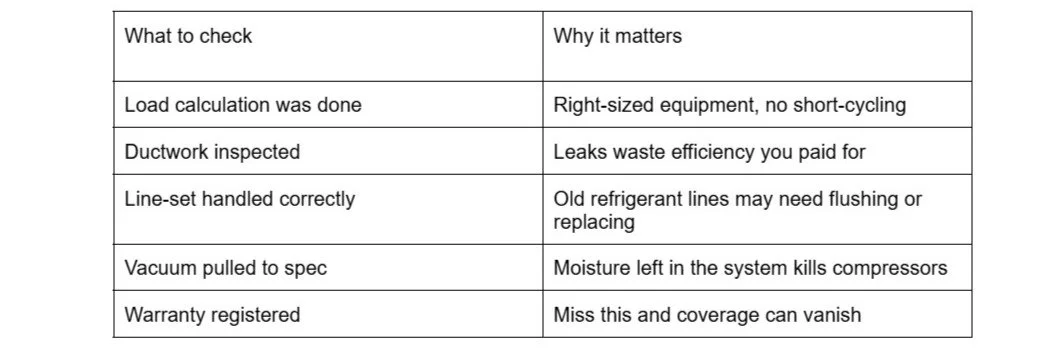
Any installer who skips the load calculation and just matches the tonnage on your old unit is doing arithmetic, not engineering. I've seen that shortcut cost people a second replacement within six years. The part that bugs me most is the paperwork nobody thinks about: register the warranty, or you can find out it never applied when you need it most.
So What's Your Age Telling You?
A number on a data plate won't make this call for you. Your age, your bills, your repair history, and how many times that unit has tested your patience this summer, together they will. Under a decade with one small fix, keep it running. Past ten with rising bills and repeat failures, you're throwing good money after bad, and you already know it.
Pull your last three power bills and write down the unit's install year. Ten minutes, no technician needed. If the numbers point the same direction I'd expect, you've got your answer before the next heat wave decides it for you. What's your AC's birthday, and does the math still work in its favor?