How Small US Businesses Actually Budget for Shipping to China
The first quote I got for shipping a pallet of coffee gear to Shanghai came in at $1,180. The invoice that showed up eleven weeks later said $2,340. Nobody lied to me. I just didn't know what I was comparing.
That gap is the whole story of international freight for small companies. You can absolutely find cheap shipping to china if you know which levers move the price and which ones just move the money around. If you don't, the low bid turns into the expensive one somewhere over the Pacific.
Here's what I'd tell any founder putting a China shipment into a real budget this quarter. Four line items matter. Everything else is noise.
The quote you get first is rarely the quote you pay
Freight brokers quote the port to port leg because that's the number that wins a spreadsheet cell. It excludes customs brokerage, destination charges, and whatever the carrier decides to add for a container that sits too long. Those aren't hidden fees in a shady sense. They're just line items the sales rep doesn't lead with.
So when you're comparing three quotes, ask each one for a landed cost estimate: pickup at your dock, ocean or air freight, customs clearance on both ends, final delivery to the recipient's address. Two of the three will suddenly look very different. In my experience the cheapest headline rate is usually the second or third cheapest landed cost.
I'd also ask what happens if the shipment gets held. A broker who can't answer that question in plain English is a broker who's going to bill you for the answer later.
Volumetric weight: the rule that punishes light and bulky
A 40 pound box of packing peanuts and a 40 pound box of steel bolts cost different amounts to fly. Carriers charge whichever is greater, actual weight or dimensional weight, and dimensional weight is calculated from length times width times height divided by a divisor that changes by service.
This is why furniture and TV boxes get expensive fast and why a dense box of machine parts can feel almost reasonable. If your product is light and takes up space, you're paying for air, not mass.
Three things you can do about it before you ever call a carrier:
Shrink the footprint. Two inches off each side of a carton can drop a freight class for your whole shipment.
Ask for the divisor in writing for each service you're quoted, because air, ocean, and ground don't all use the same one.
Ship dense, pack bulky. If you can nest smaller items inside a larger void, do it.
Customs is a documentation problem, not a mystery
China's customs authority and US export rules both operate on paperwork. Get the commercial invoice right and most of the drama disappears. Get it wrong and your shipment sits in a warehouse while you email scans back and forth at 2 a.m.
The commercial invoice needs a real description of goods, not a category. "Machinery parts" invites questions. "Stainless steel replacement nozzles, 40 units, part number X" doesn't. Include the harmonized code, the declared value, the country of origin, and the recipient's tax or registration number if they're a business.
Here's the part that surprised me: duty rates are set by national tariff schedules, not by your carrier, and they change. According to the International Trade Administration, tariff and market access rules for specific countries are published and updated through official channels, which is why I check the schedule myself instead of trusting a forwarded email. It takes twenty minutes and it has saved me thousands.
What a real budget line looks like
Stop budgeting one number. Budget five, and you'll stop being surprised.
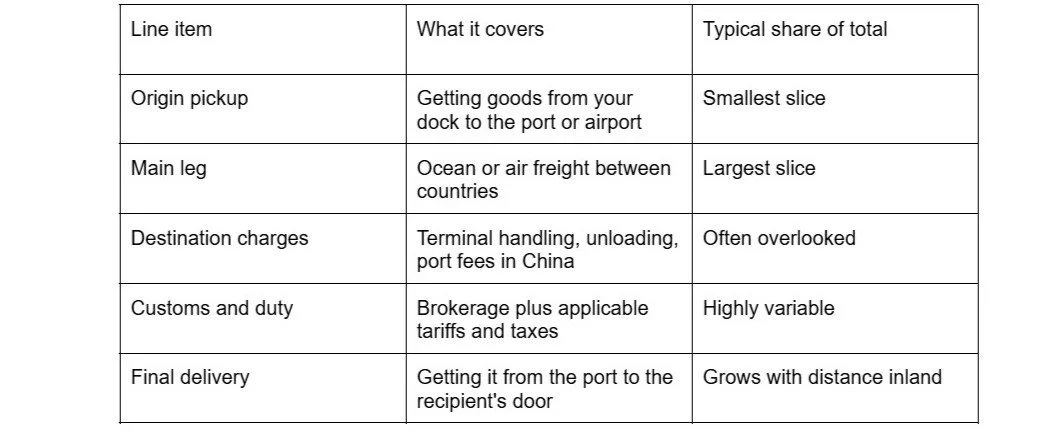
I'd argue the destination charges line is where most small businesses under budget, because it's the one nobody quotes until the container has already landed. Ask for it up front. If a vendor won't give you a range, that's information too.
The volume question nobody asks early enough
Small shippers pay retail. That's just true. A business moving one pallet a quarter is buying a service, not negotiating a contract, and the pricing reflects it.
But volume isn't only about your own shipments. Consolidators combine cargo from multiple shippers into one container, which is how a company moving eight cartons gets anything close to a container rate. If your budget can't absorb a full container, consolidation is usually the honest answer.
Worth knowing the scale you're operating inside. According to the US Census Bureau, small and mid sized firms make up the overwhelming majority of American businesses, and most of them ship internationally in quantities that would never fill a container. You're not doing anything wrong by being small. You're just buying differently.
A five step checklist before you book
Get three landed cost estimates, not three freight quotes.
Confirm the dimensional weight divisor for your specific service and carton size.
Draft the commercial invoice with specific descriptions, harmonized codes, and real values.
Ask in writing who handles customs clearance on the China side and what it costs.
Set aside a buffer. If you can absorb a 20 percent overrun without a panic call, you budgeted correctly.
The buffer isn't pessimism. It's the difference between a shipment that's a hassle and a shipment that's a crisis.
What actually drives the price down over time
Nothing about freight gets cheaper because you asked nicely. It gets cheaper when your shipments get more predictable.
Consistent carton sizes, consistent weights, consistent paperwork, and consistent shipping windows all let a carrier price you with less risk built in. Risk is expensive. I've watched a company cut its per unit freight cost meaningfully just by standardizing to two box sizes instead of eleven.
Trade infrastructure matters on the other end too. The World Bank tracks logistics performance across countries, and the takeaway for a shipper is simple: route quality varies, and choosing a lane with mature port and rail connections saves you money that shows up as fewer delays rather than a lower rate. Delays are the real cost. A container that sits for two weeks costs you in cash flow, storage, and customer patience.
So when someone promises cheap shipping, ask what's cheap about it. Rate, or total cost?
If you're planning your first real shipment to China this year, start with the invoice template and the landed cost conversation. Those two moves do more for your budget than any rate negotiation you'll have. And if you've already shipped, what line item caught you off guard the first time?