Chemical-Free Ways to Clean Hard Floors: When Steam Makes Sense — and When It Doesn’t

A beautifully finished floor does not need to smell like disinfectant to feel clean.

For families trying to reduce the number of cleaning products stored under the sink — whether because of children, pets, fragrances or simply a preference for a simpler home — steam has become one of the more interesting alternatives for routine hard-floor care.

But “chemical-free” and “disinfected” are not interchangeable terms.

Steam can loosen grease, dried food and stubborn residue using heat, and some floor-cleaning systems are specifically designed to operate their steam function with water rather than added detergent. That can reduce reliance on chemical cleaners for everyday messes.

What steam should not become is an excuse to ignore flooring instructions or assume that every surface has been disinfected to a medical standard.

The useful question is simpler:

Where can heat replace some of the cleaning chemistry in an ordinary home without creating a new problem for the floor?

Why Steam Has Become More Relevant in Modern Homes

The appeal is easy to understand.

Kitchen floors collect:

  • grease near cooking areas;

  • dried sauces;

  • food residue;

  • footprints;

  • pet-related messes; and

  • spills that become harder to remove after they dry.

A traditional mop usually relies on water plus cleaning chemistry and physical scrubbing.

Steam adds heat to that equation.

The Tineco FLOOR ONE S9 Artist Steam, for example, uses a HyperSteam system with a 320°F internal heater. Tineco specifies that the steam remains at least 210°F at the outlet under its laboratory conditions. Importantly, the company also clarifies that 320°F refers to the internal heating system, not the temperature hitting the floor.

That distinction matters.

Large temperature numbers look impressive in product advertising, but what matters in a home is how the complete system handles the stain — heat, roller action, fresh water and dirty-water recovery working together.

Steam Is Most Useful When Dirt Has Already Dried

Fresh crumbs do not need steam.

Neither does light dust.

Steam becomes more interesting when the mess has changed from something that can simply be picked up into something that needs to be loosened.

Think about:

  • dried pasta sauce;

  • cooking grease;

  • sticky juice residue;

  • dried muddy paw prints;

  • food around a high chair; or

  • grime close to kitchen cabinetry.

Tineco positions the S9 Artist Steam specifically around grease, embedded stains, muddy footprints and pet messes. Its current US specifications include 22kPa suction, up to 75 minutes in Auto mode, approximately 30 minutes in Steam mode, 180° lay-flat cleaning and 85°C / 185°F FlashDry after use.

That combination matters because loosening dirt is only half the job.

A cordless wet dry vacuum mop can also recover dirty liquid as the roller works, instead of leaving loosened residue sitting on the floor.

Can Steam Really Reduce the Need for Cleaning Solution?

For some jobs, yes.

Tineco states that the S9 Artist Steam's Steam Mode is intended primarily for water-only cleaning, and warns that non-approved detergent can interfere with the steam pathway or internal components.

That makes the product relevant to households trying to reduce routine chemical use.

But it is important to use careful language here.

Steam cleaning may reduce the need for detergent on suitable everyday messes.

That is different from saying:

“You never need disinfectant again.”

Specific contamination events may call for specific cleaning or disinfection procedures, and no household floor-care article should replace those instructions.

A more useful goal is chemical-light cleaning, not an absolutist “zero chemicals under all circumstances” rule.

Which Tineco Steam Cleaner Makes More Sense?

Tineco currently offers more than one approach.

FLOOR ONE S9 Artist Steam

Best suited to buyers who want the more premium combination of steam, strong suction, smart sensing and long non-steam runtime.

Key features include:

  • 320°F internal HyperSteam heating;

  • minimum 210°F outlet steam under Tineco test conditions;

  • 22kPa suction;

  • up to 75 minutes in Auto mode;

  • 30-minute Steam mode;

  • 180° lay-flat body;

  • Triple-Sided Edge Cleaning;

  • DualBlock Anti-Tangle; and

  • five-minute 85°C hot-air drying.

FLOOR ONE S7 Stretch Steam

This model is especially interesting when low furniture is part of the cleaning problem.

Tineco lists a 180° lay-flat design, up to 80 minutes in applicable non-steam operation and up to 30 minutes in Steam Mode. iLoop sensing automatically changes suction and water flow according to detected dirt.

For a home with low sofas, beds or cabinetry, reach may matter as much as temperature.

That is one of the better lessons in appliance shopping:

The best wet dry vacuum is not always the model with the highest specification. It is the one whose technology solves the messes and physical obstacles in your home.

When You Should Skip Steam Entirely

This section is just as important as the steam recommendation.

A steam feature is valuable only when the flooring permits it.

Tile is usually the easiest use case, assuming grout and installation materials are in good condition.

Wood-based floors require more caution.

Off The MRKT's recent hardwood-maintenance guidance notes that moisture, humidity and wet footwear can affect wood over time, reinforcing why flooring care should start with moisture control.

Engineered hardwood and laminate are especially difficult to generalize about because the surface may be water-resistant while joints, adhesives or underlying layers have different limitations.

So if the question is:

Is Tineco good for hardwood floors?

A non-steam FLOOR ONE model may be relevant for properly sealed flooring when allowed by the flooring manufacturer.

But:

Can Tineco steam be used on engineered hardwood or laminate?

The only responsible answer is:

Check the flooring manufacturer's instructions first.

If the manufacturer restricts steam, choose a non-steam cleaning mode or another machine.

A Good Non-Steam Alternative: S9 Artist Pro

The  Tineco FLOOR ONE STATION S9 Scientist Pro Wet Dry Vacuum Cleaner offers many of the premium features without making steam the central cleaning mechanism.

Tineco specifies:

  • 22kPa suction;

  • up to 75 minutes runtime;

  • iLoop dirt sensing;

  • DualBlock Anti-Tangle;

  • dual-sided edge cleaning; and

  • 85°C FlashDry.

For someone searching for the best vacuum for hardwood floors, that distinction can be more important than choosing the highest-temperature model.

S7 Stretch Ultra: Another Non-Steam Direction

The Tineco Floor One S7 Stretch Ultra Wet Dry Vacuum is also worth considering if furniture access, everyday spills and pet hair matter more than heat.

Its role in the lineup makes the buying decision clearer:

Steam is an option, not the definition of premium floor care.

What About Pets?

Homes with pets are one of the strongest arguments for reducing overly fragranced cleaning products — but pet ownership also creates more complicated cleaning jobs.

There is:

  • loose hair;

  • muddy paw prints;

  • water around bowls;

  • occasional food spills; and

  • tracked-in outdoor debris.

On hard flooring, a FLOOR ONE can address several of those in the same pass.

Models such as the S9 Artist Pro and S7 Stretch Steam use DualBlock Anti-Tangle technology, which is designed to reduce hair wrapping around the roller.

But if most pet hair is embedded in carpet or sofas, a floor washer is not the best vacuum for pet hair.

A dry cordless vacuum becomes more useful.

PURE ONE S70 for Carpet and Pet Hair

The Tineco PURE ONE S70 is a different category entirely.

It uses up to 200AW suction, ZeroTangle brush technology and smart sensing, and Tineco lists up to approximately 95 minutes of runtime under specific Eco-mode conditions. It is designed for hard floors, rugs and carpets rather than wet washing.

For many pet households, the practical combination is:

FLOOR ONE for washable hard floors + PURE ONE for carpet, upholstery and pet hair.

Trying to make one machine solve every cleaning problem usually creates more compromise than convenience.

What About Self-Cleaning?

“Chemical-free floor cleaning” should not only refer to what touches the floor.

Wet cleaning appliances themselves also need to stay clean.

The S9 Artist Steam uses FlashDry, which rinses the working path and then applies 85°C / 185°F hot air to dry components.

The S9 Artist Pro uses a similar heated-drying concept.

This is useful because moisture left in a dirty roller contributes to odor problems.

Tineco's own troubleshooting guidance tells users experiencing odor to clean the dirty-water tank, filter, brush roller and debris channel, and to reinstall filters only after they have dried.

So How good is Tineco's self-cleaning system?

Useful — but not magical.

You still need to empty dirty water and maintain the components specified in the manual.

The STATION S9 Scientist Pro also deserves mention here. It is not primarily a chemical-free steam story; its value lies in automation, with a 5L water station, automatic refill, HydroBurst cleaning and 25kPa suction.

That makes it a better choice for someone prioritizing large-area convenience than someone specifically shopping for steam.

Frequently Asked Questions

Is steam cleaning the same as disinfecting a floor?

Not automatically. Steam can be a useful heat-based cleaning method, but a validated disinfection claim depends on the organism, temperature, contact time, surface and test method. Treat household steam cleaning primarily as a way to clean and reduce reliance on detergent unless a specific validated claim applies.

Can Tineco clean with steam without cleaning solution?

The S9 Artist Steam's Steam Mode is designed primarily for water-only operation. Tineco advises against non-approved detergent in the steam pathway.

Do I need to vacuum before using a Tineco floor washer?

Generally no for normal compatible debris. Tineco states that FLOOR ONE machines can vacuum and wash simultaneously.

Can Tineco vacuum and mop at the same time?

Yes. That simultaneous pickup-and-wash process is the core function of the FLOOR ONE range.

Is Tineco good for homes with dogs and cats?

Yes, particularly when loose hair is mixed with paw prints, food and other hard-floor messes. Carpet and upholstery are better handled with a dedicated cordless vacuum.

Which Tineco floor washer is best for pet hair?

The S9 Artist Pro is particularly relevant because of DualBlock Anti-Tangle. The S7 Stretch family is also designed to reduce hair wrapping.

Does Tineco really clean pet hair without tangling?

Anti-tangle technology reduces wrapping; it does not mean a roller will never need inspection or cleaning.

Can Tineco be used on engineered hardwood or laminate?

Only when the specific flooring manufacturer allows the relevant type of wet or steam cleaning. Do not assume all engineered wood or laminate is steam-safe.

Does Tineco leave floors wet or streaky?

The machine removes dirty water while cleaning, but roller condition, detergent amount, floor material and maintenance can affect residual moisture and streaking. Tineco itself lists dirty rollers and excess detergent among common streak-related causes.

What is the Tineco warranty in the United States?

Tineco lists a two-year limited warranty for the S9 Artist Steam when purchased through eligible authorized channels and used according to its terms.

What is the best Tineco floor washer if I do not want steam?

Consider the S9 Artist Pro for premium features or the S7 Stretch Ultra for a more straightforward lay-flat wet-dry option.

Is a Tineco wet dry vacuum worth it?

It is most compelling in homes with substantial washable hard flooring and frequent mixed messes where replacing separate vacuuming and mopping creates meaningful convenience.

The Bottom Line

Reducing chemical use does not require turning cleaning into an ideology.

Sometimes detergent is appropriate.

Sometimes a floor requires a specific manufacturer-approved product.

Sometimes a contamination event calls for a more targeted approach.

But for everyday grease, food residue, footprints and pet-related messes on compatible hard flooring, steam gives homeowners another option.

The Tineco FLOOR ONE S9 Artist Steam is interesting because it combines heat with the defining advantage of a wet dry vacuum mop: loosen the mess, wash the surface and recover dirty water within the same system.

The S7 Stretch Steam makes a similar case where low furniture matters.

The S9 Artist Pro and S7 Stretch Ultra make more sense when steam is unnecessary or inappropriate.

And a Tineco vacuum such as the PURE ONE S70 remains the better tool when cleaning moves from hard floors onto rugs, carpet and upholstery.

That is ultimately the more useful version of chemical-free living.

Not throwing every bottle away.

Just using less chemistry where good engineering, water, heat and the right cleaning method can already do the job.

References

  1. Tineco US — FLOOR ONE S9 Artist Steam. HyperSteam specifications, 22kPa suction, runtime, lay-flat design and FlashDry.

  2. Tineco Support — FLOOR ONE S9 Artist Steam. Warranty, simultaneous vacuum-and-wash capability and model guidance.

  3. Tineco US — FLOOR ONE S7 Stretch Steam. Lay-flat design, battery runtime, iLoop sensing and anti-tangle features.

  4. Tineco US — FLOOR ONE S9 Artist Pro. 22kPa suction, 75-minute runtime, DualBlock Anti-Tangle and FlashDry.

  5. Tineco US — STATION S9 Scientist Pro. 5L water storage, automatic refill, HydroBurst and 25kPa suction.

  6. Tineco US — PURE ONE S70. 200AW suction, ZeroTangle, multi-surface use and battery information.

  7. Off The MRKT — How to Extend the Life of Your Hardwood Floors in a Wet Climate. Flooring moisture and maintenance considerations.

  8. Off The MRKT — The Deep Cleaning Revolution. Existing editorial context on steam, sustainable cleaning and home hygiene.

/
script>

Prevent Lawn Problems Before They Start: A Homeowner's Guide to Healthy Turf Installation

For Off The MRKT readers, curb appeal is never an afterthought. Whether you are staging a Hamptons listing, refreshing a Philadelphia rowhouse yard, or simply enjoying the property you already own, the lawn is often the first thing a buyer, guest, or neighbor notices. Real estate value and lifestyle quality intersect right at the front walk, and a patchy, disease-prone lawn undercuts both. That is why understanding how sod actually establishes itself, rather than scrambling to fix a dying lawn after the fact, matters just as much to homeowners as staying on top of home maintenance or, for that matter, personal health and fitness routines.

New sod is deceptively fragile during its first weeks in the ground, and homeowners in warmer, drought-prone regions face an especially narrow window to get things right. In markets like Los Angeles, where heat, clay soils, and irregular rainfall complicate root development, prevention has to start before the first roll of turf ever touches soil. Companies experienced with SodLawn installation in that climate emphasize grading, soil amendment, and irrigation planning well ahead of delivery day, because correcting a poorly laid lawn later is far more expensive and time-consuming than doing it right the first time. That prevention-first mindset is the throughline of everything that follows.

Why Preparation Beats Repair: The Prevention-First Mindset for Sod Installation

Most lawn failures are not mysterious. They trace back to decisions made, or skipped, in the days before installation. Homeowners frequently treat sod like an instant fix, assuming that because it arrives green and rooted it will simply take care of itself once unrolled. In reality, each square foot of turf contains hundreds of individual living plants that depend on precise conditions to survive the transition. According to this article, each square foot of turf contains 500 to 1,000 individual plants, each requiring optimum water, fertilizer, proper mowing, and aerated, well-drained soil, and when any one of those factors is missing or excessive, the grass becomes stressed and vulnerable to disease.

Shifting your mindset from "how do I fix this brown patch" to "how do I stop the brown patch from ever forming" changes almost every decision along the way, from soil testing to mowing schedules. It also tends to save money over time, since prevention rarely requires the specialized treatments, replacement sod, or professional intervention that reactive repairs demand. Homeowners who internalize this early are far less likely to face the frustrating cycle of patching the same trouble spots season after season.

Site Assessment & Soil Preparation: The Foundation of Healthy Turf

Before any sod arrives, the site itself needs honest evaluation. That means checking drainage patterns after a heavy watering, testing soil pH and compaction, and grading the yard so water flows away from the foundation rather than pooling across the lawn. Compacted or nutrient-poor soil is one of the most common root causes of thin, disease-susceptible turf, and no amount of post-installation fertilizer fully compensates for a poor foundation. Tilling in compost, correcting pH imbalances, and removing debris or old root systems all happen at this stage, long before the visual payoff appears.

Soil preparation is also where irrigation planning belongs, not as an afterthought once the grass looks stressed. Sprinkler heads should be positioned for even coverage, and homeowners should confirm water pressure and timing before sod is laid rather than discovering gaps in coverage weeks later. Taking the time here prevents the uneven growth patterns that later require costly reseeding or spot treatment, and it sets the stage for the rapid rooting that follows a well-prepared bed.

Post-Installation Establishment: Critical First Weeks & Watering Routines

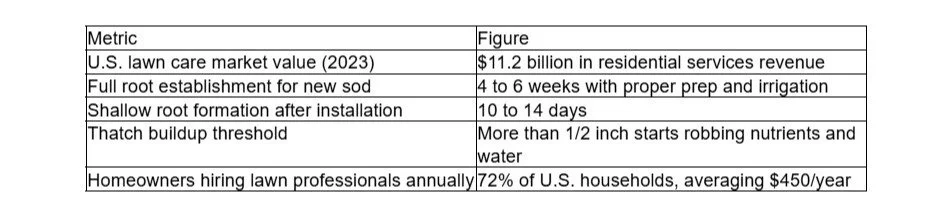
The first ten to fourteen days after installation are deceptively delicate. Sod typically forms shallow roots within that window, enough to make it difficult to pull up by hand, but nowhere near the depth needed for long-term drought resistance. Full root establishment generally takes four to six weeks with proper preparation and consistent irrigation, and rushing or neglecting watering during this stretch is one of the most common ways homeowners undo otherwise solid groundwork.

During establishment, watering needs to be frequent but shallow at first, gradually shifting to deeper, less frequent sessions as roots extend downward. Foot traffic should be minimized, mowing delayed until the grass is firmly rooted, and any dry or yellowing patches investigated immediately rather than left to spread. This period rewards attentiveness far more than intervention, since small corrections made early prevent the larger, more visible problems that show up once the lawn is fully established and harder to treat without disruption.

Year-Round Prevention Habits: Aeration, Mowing, and Seasonal Care

Once a lawn is established, prevention shifts from installation care to maintenance rhythm. Thatch, the layer of dead organic material between soil and grass blades, becomes a real threat once it exceeds about half an inch, since it starts robbing roots of nutrients and water. Annual or biannual aeration keeps thatch in check and improves airflow to the root zone, while consistent mowing height and blade sharpness prevent the kind of stress that invites fungal disease and pests.

Seasonal adjustments matter too, from tapering irrigation in cooler months to adjusting fertilizer schedules around growth cycles. Many homeowners eventually turn to professionals for this ongoing care, and it shows in national spending patterns. The table below outlines a few figures that put the scale of lawn care, and the value of getting prevention right, into perspective.

Reactive fixes, whether reseeding dead patches or treating an outbreak of fungal disease, are sometimes unavoidable, but they should be the exception rather than the plan. A lawn built on careful site preparation, disciplined watering during establishment, and consistent seasonal maintenance rarely needs dramatic intervention. For homeowners weighing curb appeal against long-term cost, the math consistently favors prevention over repair, and that principle holds true whether the lawn in question surrounds a coastal cottage or a sun-baked Los Angeles property.

/
script>

etainage in Construction: How to Manage the Cash Flow Gap

Retainage is the share of each progress payment an owner holds back until the job is finished, commonly 5 to 10 percent depending on the state and the contract. The work is done, the invoice is approved, and a slice of the money stays with the owner anyway. On a long project that slice sits in someone else's account for months. On jobs with a contested punch list it can sit there for a year or more.

For most contractors this is the largest block of earned money they cannot touch, and it comes straight out of the part of the balance sheet that pays for payroll and materials. It is also awkward to borrow against. In the US, specialty business funders underwrite against monthly deposits rather than against the project itself, which matters here because retainage is usually carved out of invoice-based facilities. Money that is withheld and still contingent on final approval is difficult to lend against directly, so the gap generally gets covered by general working capital rather than by anything secured on the retained amount.

What retainage actually costs

The percentage sounds small. Run it across a full book of work and it stops sounding small.

Consider a hypothetical subcontractor turning over $2 million a year across four or five jobs, with 5 percent held on each. That is roughly $100,000 of earned revenue permanently in transit, because as one project releases its retainage another project starts withholding. The balance never really returns to zero. It behaves less like a receivable and more like a standing reduction in working capital, funded out of the contractor's own pocket for as long as they keep operating at that volume.

Set that against the margins the trade actually runs on. A contractor working at a 4 percent net margin with 5 percent withheld has handed back more than the entire profit on the job and gets it returned only after final approval. Everything they earned is sitting in the owner's account while they pay their crew from somewhere else.

New York changed the rules twice

New York has moved on this recently, and the second move is easy to miss.

In November 2023 the state amended its Prompt Payment Act to cap retainage at 5 percent on private construction contracts of $150,000 or more, replacing the old standard that allowed owners to hold a vaguely defined reasonable amount. The same amendment let contractors submit a final invoice on reaching substantial completion rather than waiting for every last obligation to be discharged.

That reform had a gap. Because the cap was not listed among the contract terms the statute declares void, owners and general contractors could still write higher retainage into an agreement and rely on the general principle that contract terms supersede the Act. In December 2025 the legislature closed it. Under Section 757 of the General Business Law, a contract provision requiring retainage above 5 percent of the contract sum is now void and unenforceable outright.

Two related points are worth knowing. Retainage must be released no later than 30 days after final approval of the work, and an owner who fails to release it on time is subject to interest at 1 percent per month from the date it was due. The rules apply to private projects at or above the $150,000 threshold. Public work sits under a separate regime, and some residential work falls outside the article entirely, so check which set applies before relying on any of it.

Why retainage is harder to finance than an ordinary invoice

An approved invoice is a fairly clean asset. Someone owes you a defined sum on a defined date, and there is a well-developed market for advancing against it.

Retainage is different in kind. It is contingent on final approval, it can be reduced by backcharges and punch list disputes, and its release date frequently moves. Most invoice-based facilities exclude it for exactly those reasons, which surprises contractors who assume their factoring arrangement covers the whole contract value. Read the eligibility criteria on any facility you already have and find out whether retained amounts are in or out before you plan around them.

The practical result is that retainage tends to be financed the same way as any other structural gap between money out and money in, through working capital that is underwritten on the business rather than on the specific receivable.

Five ways to manage the gap

Track it as its own line. Most contractors can state their receivables total instantly and have to go digging for their retainage total. Put it on the dashboard, broken out by job and by expected release date. You cannot plan around a number you have to reconstruct.

Price it in. If you are going to fund 5 percent of the contract for eight months, that has a cost, and it belongs in the bid the same way material and insurance do. Contractors absorb it out of habit and then wonder why the big jobs returned less than the small ones.

Negotiate the rate and the trigger. Both are negotiable more often than people assume. Common asks include stepping retainage down to half once the job passes 50 percent completion, tying release to substantial completion rather than final completion, and agreeing a defined punch list process with a deadline attached.

Invoice for it the day you are entitled. Interest and release clocks generally start from a triggering event, not from the day someone gets round to raising the paperwork. Delay on your side is free money for whoever is holding the balance.

Arrange capital before the crunch, not during it. Terms are better while the numbers look calm, and a contractor with a facility already in place can bid on work that a competitor has to turn down. Be honest about the cost of the money and make sure the repayment rhythm matches how you actually get paid rather than how you hope to.

What to check in the contract

Look for the retainage percentage, whether it reduces at a defined milestone, what event triggers release, how long the owner has after that event, whether interest accrues on late release, and whether the same terms flow down to your subcontractors or leave you holding a mismatch. That last one catches people out. Holding 5 percent from your subs while an owner holds 10 percent from you means you are financing the difference across every job you run.

Have a construction attorney read the payment provisions before signing anything substantial. Retainage clauses are short, they are easy to skim, and they determine how much of your own money you are lending to the project.

FAQ

What is retainage in construction? It is a percentage of each progress payment withheld by the owner until the project reaches completion, held as security that the work will be finished and any defects corrected. It is standard practice on commercial construction across the US.

How much retainage can be withheld? It varies by state and by whether the project is public or private. Five to ten percent is the common range. New York now caps it at 5 percent on private contracts of $150,000 or more, and a clause purporting to require more than that is void.

When does retainage have to be released? That depends on the contract and the governing statute. Under New York's Prompt Payment Act, release is due no later than 30 days after final approval of the work.

Can I charge interest if retainage is released late? In many states, yes, where a prompt payment statute applies. New York provides for interest at 1 percent per month from the date the retained amount was due. Whether pursuing it is worth the relationship cost is a separate judgment.

Can I borrow against retainage? Rarely on a direct basis. Because the amount is contingent and the release date is uncertain, most invoice-based facilities exclude retained sums. Contractors usually cover the gap with general working capital instead, underwritten on the business rather than on the retained balance.

Should retainage be built into a bid? It should at least be considered. Funding a percentage of the contract sum for the length of the job carries a real cost, and treating that cost as a normal line item rather than an afterthought is what separates contractors who grow profitably from those whose best year is also their tightest.

/
script>