Selecting the Optimal Outdoor Wall Panels for Style and Durability

Selecting the right outdoor wall panels involves more than choosing a material that looks appealing. The best option should enhance a property's exterior while providing long-term durability, weather resistance, and manageable maintenance. Exploring outdoor wall panel design ideas can help property owners identify styles and finishes that complement their architectural vision while meeting practical performance requirements. Factors such as climate, installation requirements, budget, and architectural style all influence the final decision. By understanding the characteristics of different materials, property owners can choose outdoor wall panels that deliver both visual appeal and lasting performance.

Understanding Outdoor Wall Panel Materials

The material used for outdoor wall panels has the greatest impact on appearance, durability, maintenance, and overall cost. Each material offers distinct advantages, making it important to evaluate which option best suits the property's design and environmental conditions.

Wood

Wood remains a popular choice for outdoor wall panels because of its natural appearance and timeless appeal. It complements a wide range of architectural styles, from traditional homes to modern outdoor living spaces. Species such as cedar and redwood are commonly used because they naturally resist decay and insect damage.

Despite its visual appeal, wood requires regular maintenance to remain in good condition. Periodic sealing, staining, or painting protects the surface from moisture, UV exposure, and temperature changes. Without proper care, wood panels can warp, crack, or rot over time. For projects where natural aesthetics are a priority, wood remains an excellent choice, provided ongoing maintenance is considered.

Metal

Metal wall panels are widely used in contemporary architecture due to their clean lines and modern appearance. Aluminum and steel are among the most common materials because they offer excellent strength and durability while requiring relatively little maintenance.

Aluminum is lightweight, corrosion-resistant, and easier to install than many other materials, making it suitable for residential and commercial projects. Steel provides exceptional structural strength, while corten steel develops a protective weathered surface that creates a distinctive industrial look. Metal panels generally require only occasional cleaning and inspections to maintain their appearance and performance.

Stone

Stone panels provide one of the most durable solutions for outdoor wall cladding. Natural materials such as slate, limestone, and sandstone withstand harsh weather conditions while offering a timeless appearance. Their natural textures and color variations add depth and character to exterior spaces.

Although stone requires very little maintenance after installation, it is heavier than other materials and often requires professional installation. These additional installation costs are offset by the material's long lifespan and minimal maintenance requirements, making stone a practical long-term investment.

Composite Materials

Composite wall panels combine wood fibers, recycled plastics, and binding agents to create a material that closely resembles natural timber while offering greater resistance to moisture and weathering. They have become increasingly popular because they require significantly less maintenance than traditional wood.

Composite panels resist warping, splintering, and insect damage, making them suitable for areas exposed to changing weather conditions. They are available in a variety of colors, textures, and finishes, allowing them to complement both traditional and modern architectural styles. Their combination of durability, appearance, and ease of maintenance makes composite panels a versatile option for many outdoor applications.

Evaluating Environmental Conditions

Outdoor wall panels are constantly exposed to weather, making local environmental conditions an important consideration during material selection. Climate, rainfall, humidity, temperature fluctuations, and sunlight all affect how materials perform over time.

Weather Resistance

Properties located in areas with frequent rainfall benefit from materials that resist moisture damage. Composite panels and treated wood perform well when properly protected, while aluminum and coated steel resist corrosion in humid environments. Selecting materials designed for local climate conditions helps extend their service life and reduce maintenance requirements.

In regions with prolonged sun exposure, UV-resistant coatings can minimize fading and surface deterioration. These protective finishes help preserve the original appearance of wood and composite panels while extending their lifespan.

Insulation and Energy Efficiency

Some outdoor wall panel materials also improve a building's thermal performance. Stone and composite panels provide additional insulation, helping reduce heat transfer between interior and exterior spaces. Improved insulation can contribute to more stable indoor temperatures and may help reduce heating and cooling costs over time.

Maintenance Requirements

Maintenance plays an important role in determining the long-term value of outdoor wall panels. While some materials require regular upkeep, others retain their appearance with minimal effort.

Low-Maintenance Materials

Metal and composite panels are among the easiest materials to maintain. Aluminum and steel generally require periodic washing to remove dirt and debris, along with occasional inspections for scratches or corrosion. Composite panels can typically be cleaned with mild soap and water, eliminating the need for frequent sealing or repainting.

These low-maintenance options are well suited for homeowners and commercial property owners seeking durable exterior finishes with minimal ongoing care.

Materials Requiring More Maintenance

Wood panels require greater attention throughout their lifespan. Regular sealing, staining, or painting protects the material from moisture, insects, and UV exposure. Routine inspections can also identify signs of wear before they become more serious structural issues. Although wood requires additional maintenance, many property owners consider its natural appearance worth the extra effort.

Cost and Installation Considerations

The total cost of outdoor wall panels extends beyond the purchase price. Installation expenses, maintenance requirements, and expected lifespan all contribute to the overall value of the investment.

Stone and metal panels generally have higher upfront costs but often provide better long-term value because of their durability and reduced maintenance needs. Composite panels offer a balanced solution, combining moderate installation costs with excellent durability and minimal upkeep. Wood panels may have a lower initial purchase price but often incur higher maintenance expenses throughout their service life.

Installation requirements also vary depending on the material. Lightweight products such as aluminum are typically easier and less expensive to install, while heavier materials like natural stone often require specialized equipment and experienced installers. Considering installation costs alongside material pricing provides a more accurate estimate of the project's overall budget.


/
script>

How Local Market Knowledge Helps Buyers Make Better Decisions

Buying a home is a huge investment so having knowledge of the local market could help someone know they are making the best choice. Every county has their own characteristics that make the homes there what they are. A buyer can have an understanding of how these things can positively and negatively affect the market so that they can buy the best home for them. Having knowledge about the local market can make someone feel more prepared and their decisions can lead them to their dream home.

Understanding Neighborhood Differences

The distinguishing characteristics of each neighborhood are amenities, types of housing, schools, transport services, and recreational facilities. For instance, two houses can be quite similar in cost and size but located in different neighborhoods. Experienced buyers analyze the characteristics of the particular neighborhood in order to find out how suitable it is for their needs. Experienced buyers know the limitations of their choice in housing due to the location factor.

Local knowledge of an area shows buyers how to determine the value of a home in a specific area. If home buyers know that improvements are being made in a certain community, they could pay more for a home that has future potential.

Evaluating Property Values

The knowledge of how properties are priced in a certain market is key in determining whether a particular home is a bargain or not. To elaborate, through analysis of properties sold recently and comparison of their characteristics to those of the subject property, one will get a rough estimate of the price of a home. Thus, buyers will not be taken for a ride and will have realistic expectations in regard to the pricing in the area.

However, the reality is that buyers will have to seek help from experts in order to get a fair price. Experienced Oakville real estate agents often have detailed knowledge of neighborhood sales activity, buyer demand, and pricing history that may not be obvious from online listings alone. Thus, in order to strike a good price deal, buyers need to consult with local real estate agents.

Recognizing Market Trends

Real estate markets are continuously influenced by numerous factors such as supply and demand, economic trends, and seasonality. This implies that prospective buyers need to conduct proper analysis to determine the appropriate timing to purchase real estate. Moreover, buyers must remain aware of ongoing developments because there are times when haste is necessary and instances when it is wiser to wait.

Furthermore, tracking trends enables buyers to recognize changes before they become apparent. For instance, a buyer will be able to identify increases or decreases in inventory as well as days on the market, which provide an indication of impending competition. This information is crucial as it allows bidders to formulate rational expectations about what to anticipate and how to respond effectively.

Making Stronger Purchase Decisions

Local knowledge helps a buyer to choose not only based on what they see. Think about traffic, upcoming developments, future plans for the area, and amenities. All of these things can affect a buyer's decision on whether or not they wish to purchase a certain property and whether the property will still meet their needs down the road.

Most buyers also look to those with more experience than themselves to help them through the process. If you are looking to hire the best realtor in Oakville, you might want to find someone who offers more than just showings and appointments. A knowledgeable realtor can help their clients choose what they need and what to look out for in order to make the best decision when purchasing a home.

Understanding Local Competition

Competition can cut dramatically from community to community, and within some metro areas it can vary from neighborhood to neighborhood. Some areas generate multiple offers within days, while others allow buyers to shop the market and take their time considering offers. Your knowledge of local conditions will help you develop a winning strategy in this type of situation.

Knowledge of your area can also help you negotiate a reasonable offer based on what is happening in the market, which means you'll have more leverage over sellers. In this way, you're more likely to reach a deal that satisfies both parties without sacrificing value on your end.

Planning For Long Term Value

When purchasing a house, it is essential to consider the needs and desires of the buyer in the present moment and in the future. It is necessary to know which street will provide the best opportunities for growth, stability, and quality life. Moreover, the buyer needs to know which houses will retain their value.

A buyer must also keep in mind the future resale of the house, which is facilitated by the fact that houses in sought-after neighborhoods have more buyers. Thus, the knowledge of the local market is critical when choosing a house for a buyer since it allows them to invest in real estate that meets their needs at the moment and in the future.

Local market knowledge helps you to get far more than just a list of available properties for sale with their asking price. By understanding the nuances of the area, having knowledge of the local price trends, market conditions, and what is coming soon to the area, you can ensure that you are making a wise decision when buying a property. It is important to consider both short and long term gains when making such a big investment.

/
script>

Decoding Italian Wine Classifications: DOCG, DOC, IGT & beyond

Standing in front of the Italian section at a fine wine merchant or scanning a sophisticated restaurant wine list can feel equal parts exciting and overwhelming. 

With hundreds of indigenous grape varieties, centuries of regional tradition, and complex label terminology, deciphering an Italian bottle often feels like reading a secret language.

Behind every bottle of Chianti, Barolo, or Pinot Grigio lies a structured national framework designed to guarantee authenticity, origin, and craftsmanship. 

Established in 1963 and aligned with modern European Union standards, the Italian wine classification system organizes bottles into four distinct tiers based on geographic origin, production rules, and quality control.

Navigating Italy’s Wine Categories: Origin Over Hierarchy

While Italian wines are traditionally categorized into structured tiers, modern winemakers and connoisseurs increasingly view these designations less as a strict scale of absolute quality and more as a spectrum of regional identity and stylistic rules. 

A DOC wine, for instance, is not inherently inferior to a DOCG; rather, the distinction reflects differing levels of geographic restriction, heritage rules, and administrative criteria.

At the most strictly regulated end of the spectrum sits the DOCG (Denominazione di Origine Controllata e Garantita). The extra "G" stands for Garantita, signifying that these bottles adhere to the tightest official protocols on harvest yields, aging periods, and permitted grape varieties. Before reaching the market, every batch undergoes chemical analysis and a blind tasting panel, earning its signature paper seal around the bottle's neck. Iconic appellations like Barolo, Brunello di Montalcino, and Amarone della Valpolicella belong to this historic category.

Alongside it, the DOC (Denominazione di Origine Controllata) classification forms the vibrant backbone of Italian winemaking. A DOC label guarantees that a wine originates from a specific, historically defined zone and follows established regional methods. These regulations ensure that classics like Prosecco, Valpolicella, and Soave deliver an authentic taste of their home terroir, offering exceptional craft and complexity without needing the extra administrative layer of a DOCG.

For those seeking modern expression, the IGT (Indicazione Geografica Tipica) category offers maximum winemaking freedom. Introduced in 1992 to bridge deep-rooted tradition with creative innovation, IGT allows vintners to experiment with international grape varieties like Cabernet Sauvignon or Syrah, as well as unconventional blending techniques. Far from being "lower tier," some of Italy’s most acclaimed and collectible wines—including the famous "Super Tuscans"—choose the IGT designation specifically to step outside rigid appellation rules and push flavor boundaries.

Finally, generic Italian wines (Vino da tavola) and single-varietal bottles focus on broad regional appeal and the pure expression of specific grapes like Chardonnay, Merlot, or Pinot Grigio. Beyond single-estate bottling, this versatile category plays a crucial role in global distribution. Italy's robust agricultural infrastructure allows international trade partners to access high-quality Italian bulk wine varieties, enabling distributors to craft tailored commercial blends and private labels that deliver authentic Italian flavor profiles to wine lovers around the globe.

Decoding fine-print labels: Classico, Superiore, and Riserva

Beyond the main categories, Italian wine labels often feature additional terms that tell you more about the bottle's character and potential.

When you see the word Classico on a label, such as in Chianti Classico, it indicates that the grapes were harvested from the historical, original heartland of that region, long before its boundaries were officially expanded. 

These historic microclimates are generally considered to yield superior complexity.

The term Superiore signals that the wine meets higher quality standards than the baseline regulation, usually requiring lower vineyard yields and slightly higher minimum alcohol content, which results in greater concentration.

Lastly, Riserva is reserved for bottles that have undergone extended aging before release - frequently spending significant time resting in wooden casks - allowing the wine to develop deeper complexity, softer tannins, and richer flavors.

Selecting the right bottle for any occasion

Understanding these classifications makes choosing the right bottle effortless. 

For major celebrations or cellar investment, top-tier DOCG wines and aged Riserva selections offer verified provenance and exceptional complexity. 

If you are hosting a dinner party, understanding these tiers pairs seamlessly with mastering wine and food pairings, where expressive DOC and IGT wines deliver remarkable regional character and balance alongside gourmet dishes. 

Meanwhile, accessible IGT and single-varietal wines provide easy-drinking freshness that suits casual gatherings and everyday meals without requiring years of cellaring.

Ultimately, Italy’s classification system is designed to protect centuries of heritage while giving wine lovers total confidence in what they are pouring into their glasses.

/
script>

Myths vs. Facts Explaining if the Default Income Tax Slab Leaves Any Room for Traditional Tax Saving Investment Options

A big change happened quietly. Since the financial year 2023-24, the new tax regime became the default income tax slab system in India. Unless you actively opt out, the government assumes you are on it.

This shift created confusion. People started questioning whether their PPF contributions, life insurance premiums, ELSS investments, and other traditional tax saving investment options still made any sense.

The short answer is: it depends. But first, some myths need clearing up.

What Changed and What Did Not

The new tax regime offers lower slab rates but takes away most deductions. The old tax regime keeps higher slab rates but allows the familiar deductions under Sections 80C, 80D, HRA, and others.

Both regimes remain available. The new one is just the starting point unless you choose otherwise.

Myth 1: Tax Saving Investments Are Now Useless

Fact: They are irrelevant only if you stay in the new regime.

Anyone who opts into the old tax regime can still use 80C investments to reduce taxable income by up to ₹1.5 lakh. PPF, ELSS, life insurance premiums, NSC, and home loan principal repayment all still count.

Salaried individuals can switch regimes every financial year. If your deductions make the old regime more beneficial, you switch. If not, you stay in the new one.

Tax saving investments also have inherent financial value beyond the deduction. PPF builds a tax-free corpus. ELSS offers equity-linked growth potential. Life insurance provides protection. These benefits exist regardless of which income tax slab regime you are in.

Also Read: How to Reduce Taxes When Selling Property

Myth 2: The New Regime Always Gives a Lower Tax Bill

Fact: For most income levels, the new regime is hard to beat. At ₹12 lakh, it is nearly impossible.

Under the latest rules, the Section 87A rebate makes taxable income up to ₹12 lakh completely tax-free under the new regime. For salaried individuals, the ₹75,000 standard deduction means anyone earning up to ₹12.75 lakh gross pays zero tax, without investing a rupee.

This changes the comparison significantly. A person earning ₹12 lakh who switches to the old regime needs an extraordinary level of deductions just to match the zero tax they already get for free. That is a very hard bar to clear.

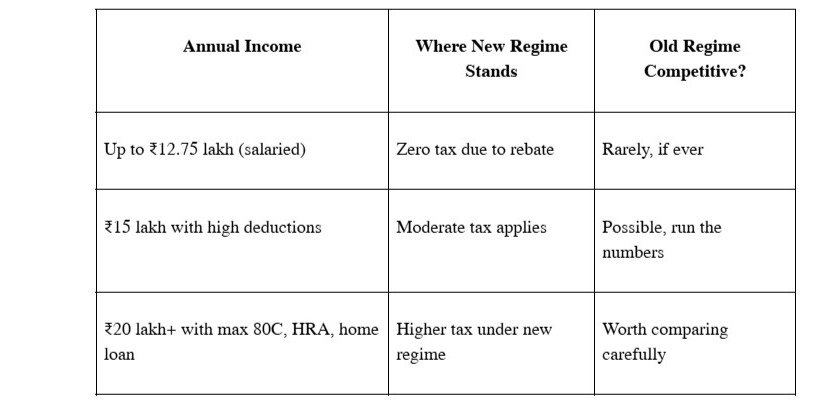
Here is a more honest illustration:

The old regime starts becoming worth considering only when income is well above ₹12.75 lakh and deductions are genuinely large, such as a home loan, full 80C utilisation, and health insurance premiums combined.

Also Read: How to Reduce Taxes When Selling Property


Myth 3: You Cannot Switch Between Regimes

Fact: Salaried employees can switch every year.

Salaried individuals can choose a different regime each year at the time of filing returns. Business owners and self-employed individuals face a stricter rule and cannot switch back easily once they move.

For most salaried taxpayers, the flexibility exists. Use it.

Myth 4: The New Regime Has Zero Deductions

Fact: A few deductions still apply under the new income tax slab.

  • Standard deduction of ₹75,000 for salaried individuals

  • Employer's NPS contribution under Section 80CCD(2)

  • Gratuity and leave encashment exemptions

These are not as wide as the old regime, but they are not zero.

Also Read: Tax Management Best Practices for Growing Real Estate Portfolios

Myth 5: Traditional Tax Saving Options Have No Value Beyond Tax

Fact: The long-term financial value of these instruments is real.

PPF forces disciplined saving with a tax-free maturity. ELSS has historically delivered equity-linked returns over long horizons. Life insurance builds a protection net. The National Pension Scheme creates a retirement corpus.

These fundamental purposes do not disappear just because the default income tax slab changed. Even if you choose the new regime and miss out on the upfront deductions, these traditional tax saving investment options still do their primary job of growing your money.

This matters especially for investors in their 20s and 30s focused on building long-term wealth. The tax deduction was always just a nice bonus—it was never the only reason to invest in the first place.

What Should You Actually Do?

If you earn up to ₹12.75 lakh as a salaried individual, the new regime almost certainly wins. Your tax is already zero. No amount of 80C investing under the old regime can match that.

If you earn above that, the comparison is worth running:

  • Calculate your tax under the new income tax slab after the ₹75,000 standard deduction

  • Add up genuine deductions under the old regime: 80C, 80D, HRA, home loan interest

  • Compute tax under the old regime using those numbers

  • If the old regime saves a meaningful amount, opt in before your employer finalises TDS

For most people earning under ₹15 lakh with average deductions, the new regime will still win. The old regime starts making a real difference only at higher incomes with a full stack of deductions.

Final Thought

The default income tax slab shift does not make tax saving investment options irrelevant. It makes the decision more deliberate.

The question is no longer which investments give a deduction. It is whether your total deductions are large enough to make the old regime worth it over the new one's simpler, lower rates.

For most people under ₹12.75 lakh, the new regime has already done the heavy lifting. For those above it, a careful yearly comparison is the only honest way to decide. Run the numbers, not assumptions.

/
script>

Coffee Concentrate vs. Espresso: What's the Difference?

If you're a coffee connoisseur, you're no doubt at least familiar with espresso. However, you may not have encountered coffee concentrate or understand exactly what it is. Both come with quite the caffeine kick, but they're quite different otherwise. Here's an overview of the two drinks, including how they're made, how they taste, and how to drink them.

What is Espresso Coffee?

Espresso is a highly concentrated form of coffee made by forcing hot water at high pressure through finely ground coffee beans. It originated in Italy, and the name itself refers to the process of pressing out the coffee's flavor. A typical espresso shot is about one ounce of liquid. Espresso is the base used for a variety of coffee drinks, including cappuccino, caffè latte, and americano. If you've ever wondered, "What color is espresso?" the answer is anywhere from a light golden brown to a deep, almost black.

Espresso vs. Coffee

If you're now asking yourself, "What is the difference between espresso and coffee?" you're not alone. The key difference lies in the brewing method. The espresso-making process results in a drink that's thicker than conventional brewed coffee, as it has a higher concentration of suspended and dissolved solids. Most espresso brews result in an approximate ratio of coffee to water of 1:2. Conventional brewed coffee, meanwhile, has a ratio closer to 1:16. Espresso also contains more caffeine by volume than brewed coffee. If you're wondering how much caffeine is in a shot of espresso, it averages 63mg per ounce.

What is Coffee Concentrate?

Although espresso is a concentrated type of coffee, coffee concentrate is something else entirely. The latter is a brewed type of coffee with a low coffee-to-water ratio. The result is a particularly intense brew. However, coffee concentrate typically has less caffeine than espresso. On average, it will contain around 30mg of caffeine per ounce. Coffee concentrate is often used as a base for cold-brew drinks. However, you can also dilute it to customize the strength and intensity of the resulting drink.

There are generally two ways to make liquid coffee concentrate. The hot brew method is like how you'd make an ordinary cup of coffee. However, it relies on either steam or extremely hot water to produce the concentrate. It results in a slightly acidic, caffeine-rich brew. The cold brew method involves steeping coarsely ground coffee in room-temperature water for up to 24 hours. That produces a mellow, low-acid, slightly sweet brew, like what you'd get from our Classic Cold Drip Concentrate.

Coffee Concentrate's Taste

Like other types of brewed coffee, coffee concentrate comes in a variety of flavors. For example, our Classic Cold Drip Concentrate offers a rich blend with notes of dark chocolate, caramel, and cherry. Meanwhile, our Blue Magic Cold Drip Concentrate offers a lighter taste with hints of orange zest, milk chocolate, and vanilla.

Unlike espresso, however, coffee concentrate isn't typically consumed in its undiluted form. So, not only can you find brews with different flavor profiles, but you can also dilute them to suit your particular taste. They also work well when blended into cocktails, mocktails, smoothies, and more!

Choose Your Ideal Coffee Form

If you're thinking you must choose between espresso and coffee concentrate, why not choose both? Espresso offers a great way to kick-start your day with a fast, caffeine-rich shot. It's also excellent as an after-dinner drink. And you can readily turn coffee concentrate into a variety of drinks to enjoy throughout the day. You can take them to work, to school, or anywhere else where you might need a tasty pick-me-up. So, don't limit yourself to just one or the other. Not when there's more than enough room in your day for both.

/
script>