Myths vs. Facts Explaining if the Default Income Tax Slab Leaves Any Room for Traditional Tax Saving Investment Options
A big change happened quietly. Since the financial year 2023-24, the new tax regime became the default income tax slab system in India. Unless you actively opt out, the government assumes you are on it.
This shift created confusion. People started questioning whether their PPF contributions, life insurance premiums, ELSS investments, and other traditional tax saving investment options still made any sense.
The short answer is: it depends. But first, some myths need clearing up.
What Changed and What Did Not
The new tax regime offers lower slab rates but takes away most deductions. The old tax regime keeps higher slab rates but allows the familiar deductions under Sections 80C, 80D, HRA, and others.

Both regimes remain available. The new one is just the starting point unless you choose otherwise.
Myth 1: Tax Saving Investments Are Now Useless
Fact: They are irrelevant only if you stay in the new regime.
Anyone who opts into the old tax regime can still use 80C investments to reduce taxable income by up to ₹1.5 lakh. PPF, ELSS, life insurance premiums, NSC, and home loan principal repayment all still count.
Salaried individuals can switch regimes every financial year. If your deductions make the old regime more beneficial, you switch. If not, you stay in the new one.
Tax saving investments also have inherent financial value beyond the deduction. PPF builds a tax-free corpus. ELSS offers equity-linked growth potential. Life insurance provides protection. These benefits exist regardless of which income tax slab regime you are in.
Also Read: How to Reduce Taxes When Selling Property
Myth 2: The New Regime Always Gives a Lower Tax Bill
Fact: For most income levels, the new regime is hard to beat. At ₹12 lakh, it is nearly impossible.
Under the latest rules, the Section 87A rebate makes taxable income up to ₹12 lakh completely tax-free under the new regime. For salaried individuals, the ₹75,000 standard deduction means anyone earning up to ₹12.75 lakh gross pays zero tax, without investing a rupee.
This changes the comparison significantly. A person earning ₹12 lakh who switches to the old regime needs an extraordinary level of deductions just to match the zero tax they already get for free. That is a very hard bar to clear.
Here is a more honest illustration:
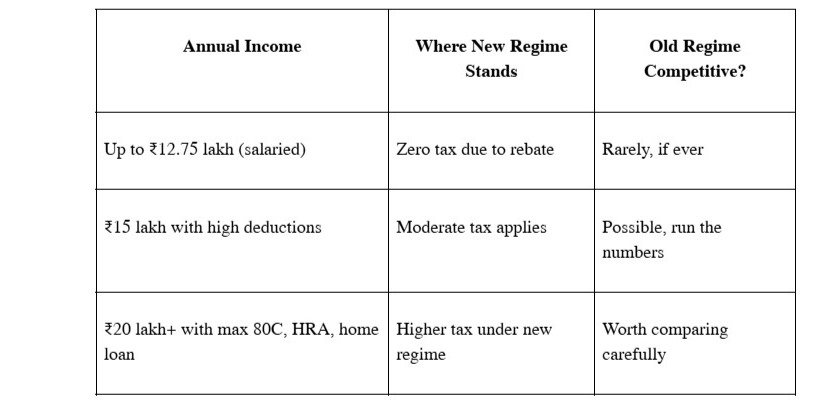
The old regime starts becoming worth considering only when income is well above ₹12.75 lakh and deductions are genuinely large, such as a home loan, full 80C utilisation, and health insurance premiums combined.
Also Read: How to Reduce Taxes When Selling Property
Myth 3: You Cannot Switch Between Regimes
Fact: Salaried employees can switch every year.
Salaried individuals can choose a different regime each year at the time of filing returns. Business owners and self-employed individuals face a stricter rule and cannot switch back easily once they move.
For most salaried taxpayers, the flexibility exists. Use it.
Myth 4: The New Regime Has Zero Deductions
Fact: A few deductions still apply under the new income tax slab.
Standard deduction of ₹75,000 for salaried individuals
Employer's NPS contribution under Section 80CCD(2)
Gratuity and leave encashment exemptions
These are not as wide as the old regime, but they are not zero.
Also Read: Tax Management Best Practices for Growing Real Estate Portfolios
Myth 5: Traditional Tax Saving Options Have No Value Beyond Tax
Fact: The long-term financial value of these instruments is real.
PPF forces disciplined saving with a tax-free maturity. ELSS has historically delivered equity-linked returns over long horizons. Life insurance builds a protection net. The National Pension Scheme creates a retirement corpus.
These fundamental purposes do not disappear just because the default income tax slab changed. Even if you choose the new regime and miss out on the upfront deductions, these traditional tax saving investment options still do their primary job of growing your money.
This matters especially for investors in their 20s and 30s focused on building long-term wealth. The tax deduction was always just a nice bonus—it was never the only reason to invest in the first place.
What Should You Actually Do?
If you earn up to ₹12.75 lakh as a salaried individual, the new regime almost certainly wins. Your tax is already zero. No amount of 80C investing under the old regime can match that.
If you earn above that, the comparison is worth running:
Calculate your tax under the new income tax slab after the ₹75,000 standard deduction
Add up genuine deductions under the old regime: 80C, 80D, HRA, home loan interest
Compute tax under the old regime using those numbers
If the old regime saves a meaningful amount, opt in before your employer finalises TDS
For most people earning under ₹15 lakh with average deductions, the new regime will still win. The old regime starts making a real difference only at higher incomes with a full stack of deductions.
Final Thought
The default income tax slab shift does not make tax saving investment options irrelevant. It makes the decision more deliberate.
The question is no longer which investments give a deduction. It is whether your total deductions are large enough to make the old regime worth it over the new one's simpler, lower rates.
For most people under ₹12.75 lakh, the new regime has already done the heavy lifting. For those above it, a careful yearly comparison is the only honest way to decide. Run the numbers, not assumptions.