Myths vs. Facts Explaining if the Default Income Tax Slab Leaves Any Room for Traditional Tax Saving Investment Options

A big change happened quietly. Since the financial year 2023-24, the new tax regime became the default income tax slab system in India. Unless you actively opt out, the government assumes you are on it.

This shift created confusion. People started questioning whether their PPF contributions, life insurance premiums, ELSS investments, and other traditional tax saving investment options still made any sense.

The short answer is: it depends. But first, some myths need clearing up.

What Changed and What Did Not

The new tax regime offers lower slab rates but takes away most deductions. The old tax regime keeps higher slab rates but allows the familiar deductions under Sections 80C, 80D, HRA, and others.

Both regimes remain available. The new one is just the starting point unless you choose otherwise.

Myth 1: Tax Saving Investments Are Now Useless

Fact: They are irrelevant only if you stay in the new regime.

Anyone who opts into the old tax regime can still use 80C investments to reduce taxable income by up to ₹1.5 lakh. PPF, ELSS, life insurance premiums, NSC, and home loan principal repayment all still count.

Salaried individuals can switch regimes every financial year. If your deductions make the old regime more beneficial, you switch. If not, you stay in the new one.

Tax saving investments also have inherent financial value beyond the deduction. PPF builds a tax-free corpus. ELSS offers equity-linked growth potential. Life insurance provides protection. These benefits exist regardless of which income tax slab regime you are in.

Also Read: How to Reduce Taxes When Selling Property

Myth 2: The New Regime Always Gives a Lower Tax Bill

Fact: For most income levels, the new regime is hard to beat. At ₹12 lakh, it is nearly impossible.

Under the latest rules, the Section 87A rebate makes taxable income up to ₹12 lakh completely tax-free under the new regime. For salaried individuals, the ₹75,000 standard deduction means anyone earning up to ₹12.75 lakh gross pays zero tax, without investing a rupee.

This changes the comparison significantly. A person earning ₹12 lakh who switches to the old regime needs an extraordinary level of deductions just to match the zero tax they already get for free. That is a very hard bar to clear.

Here is a more honest illustration:
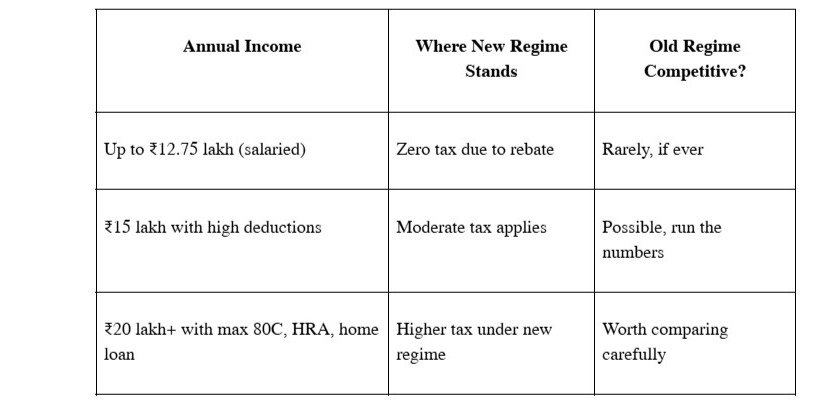
The old regime starts becoming worth considering only when income is well above ₹12.75 lakh and deductions are genuinely large, such as a home loan, full 80C utilisation, and health insurance premiums combined.

Also Read: How to Reduce Taxes When Selling Property


Myth 3: You Cannot Switch Between Regimes

Fact: Salaried employees can switch every year.

Salaried individuals can choose a different regime each year at the time of filing returns. Business owners and self-employed individuals face a stricter rule and cannot switch back easily once they move.

For most salaried taxpayers, the flexibility exists. Use it.

Myth 4: The New Regime Has Zero Deductions

Fact: A few deductions still apply under the new income tax slab.

  • Standard deduction of ₹75,000 for salaried individuals

  • Employer's NPS contribution under Section 80CCD(2)

  • Gratuity and leave encashment exemptions

These are not as wide as the old regime, but they are not zero.

Also Read: Tax Management Best Practices for Growing Real Estate Portfolios

Myth 5: Traditional Tax Saving Options Have No Value Beyond Tax

Fact: The long-term financial value of these instruments is real.

PPF forces disciplined saving with a tax-free maturity. ELSS has historically delivered equity-linked returns over long horizons. Life insurance builds a protection net. The National Pension Scheme creates a retirement corpus.

These fundamental purposes do not disappear just because the default income tax slab changed. Even if you choose the new regime and miss out on the upfront deductions, these traditional tax saving investment options still do their primary job of growing your money.

This matters especially for investors in their 20s and 30s focused on building long-term wealth. The tax deduction was always just a nice bonus—it was never the only reason to invest in the first place.

What Should You Actually Do?

If you earn up to ₹12.75 lakh as a salaried individual, the new regime almost certainly wins. Your tax is already zero. No amount of 80C investing under the old regime can match that.

If you earn above that, the comparison is worth running:

  • Calculate your tax under the new income tax slab after the ₹75,000 standard deduction

  • Add up genuine deductions under the old regime: 80C, 80D, HRA, home loan interest

  • Compute tax under the old regime using those numbers

  • If the old regime saves a meaningful amount, opt in before your employer finalises TDS

For most people earning under ₹15 lakh with average deductions, the new regime will still win. The old regime starts making a real difference only at higher incomes with a full stack of deductions.

Final Thought

The default income tax slab shift does not make tax saving investment options irrelevant. It makes the decision more deliberate.

The question is no longer which investments give a deduction. It is whether your total deductions are large enough to make the old regime worth it over the new one's simpler, lower rates.

For most people under ₹12.75 lakh, the new regime has already done the heavy lifting. For those above it, a careful yearly comparison is the only honest way to decide. Run the numbers, not assumptions.

/
script>

Coffee Concentrate vs. Espresso: What's the Difference?

If you're a coffee connoisseur, you're no doubt at least familiar with espresso. However, you may not have encountered coffee concentrate or understand exactly what it is. Both come with quite the caffeine kick, but they're quite different otherwise. Here's an overview of the two drinks, including how they're made, how they taste, and how to drink them.

What is Espresso Coffee?

Espresso is a highly concentrated form of coffee made by forcing hot water at high pressure through finely ground coffee beans. It originated in Italy, and the name itself refers to the process of pressing out the coffee's flavor. A typical espresso shot is about one ounce of liquid. Espresso is the base used for a variety of coffee drinks, including cappuccino, caffè latte, and americano. If you've ever wondered, "What color is espresso?" the answer is anywhere from a light golden brown to a deep, almost black.

Espresso vs. Coffee

If you're now asking yourself, "What is the difference between espresso and coffee?" you're not alone. The key difference lies in the brewing method. The espresso-making process results in a drink that's thicker than conventional brewed coffee, as it has a higher concentration of suspended and dissolved solids. Most espresso brews result in an approximate ratio of coffee to water of 1:2. Conventional brewed coffee, meanwhile, has a ratio closer to 1:16. Espresso also contains more caffeine by volume than brewed coffee. If you're wondering how much caffeine is in a shot of espresso, it averages 63mg per ounce.

What is Coffee Concentrate?

Although espresso is a concentrated type of coffee, coffee concentrate is something else entirely. The latter is a brewed type of coffee with a low coffee-to-water ratio. The result is a particularly intense brew. However, coffee concentrate typically has less caffeine than espresso. On average, it will contain around 30mg of caffeine per ounce. Coffee concentrate is often used as a base for cold-brew drinks. However, you can also dilute it to customize the strength and intensity of the resulting drink.

There are generally two ways to make liquid coffee concentrate. The hot brew method is like how you'd make an ordinary cup of coffee. However, it relies on either steam or extremely hot water to produce the concentrate. It results in a slightly acidic, caffeine-rich brew. The cold brew method involves steeping coarsely ground coffee in room-temperature water for up to 24 hours. That produces a mellow, low-acid, slightly sweet brew, like what you'd get from our Classic Cold Drip Concentrate.

Coffee Concentrate's Taste

Like other types of brewed coffee, coffee concentrate comes in a variety of flavors. For example, our Classic Cold Drip Concentrate offers a rich blend with notes of dark chocolate, caramel, and cherry. Meanwhile, our Blue Magic Cold Drip Concentrate offers a lighter taste with hints of orange zest, milk chocolate, and vanilla.

Unlike espresso, however, coffee concentrate isn't typically consumed in its undiluted form. So, not only can you find brews with different flavor profiles, but you can also dilute them to suit your particular taste. They also work well when blended into cocktails, mocktails, smoothies, and more!

Choose Your Ideal Coffee Form

If you're thinking you must choose between espresso and coffee concentrate, why not choose both? Espresso offers a great way to kick-start your day with a fast, caffeine-rich shot. It's also excellent as an after-dinner drink. And you can readily turn coffee concentrate into a variety of drinks to enjoy throughout the day. You can take them to work, to school, or anywhere else where you might need a tasty pick-me-up. So, don't limit yourself to just one or the other. Not when there's more than enough room in your day for both.

/
script>

Creating a Cozy Home Atmosphere Through Smart Décor Decisions

A comfortable home is not created by furniture alone. While layout, materials, and design choices all play a role, the feeling of a space often comes from the smaller details that make daily life easier and more enjoyable. A well-designed home should feel welcoming, practical, and reflective of the people who live there.

Thoughtful décor is about creating an environment that supports your lifestyle. Whether you are relaxing after a long day, spending time with family, or working from home, the right design choices can influence how you experience each room. Creating a cozy atmosphere does not require a complete renovation. In many cases, small adjustments can have a meaningful impact.

Understand What Makes a Home Feel Cozy and Inviting

A cozy home is not defined by a specific style. It is created through a combination of comfort, functionality, and personal character. Some spaces feel inviting because they have warm lighting, comfortable seating, and carefully selected decorations that make the room feel lived in rather than staged.

The most successful interiors are designed around the needs of the people using them. A reading corner with a comfortable chair, a dining area that encourages conversation, or an organized entryway that reduces clutter can all contribute to a stronger sense of comfort. The goal is to create a home that works well while also feeling personal.

Use Lighting to Create a Warmer and More Comfortable Environment

Lighting is one of the most important elements when creating a cozy home atmosphere. Even a beautifully decorated room can feel cold if the lighting is harsh or poorly positioned. Soft, layered lighting can make a space appear warmer and more relaxing.

A combination of ceiling fixtures, table lamps, floor lamps, and accent lighting allows homeowners to adjust the mood of a room depending on the time of day. Natural light should also be considered when arranging furniture and selecting window treatments. Allowing sunlight to enter a space can make rooms feel more open and connected to the outdoors.

Small details can also add character. For example, a fireplace area can become a natural gathering point with the right decorative touches. Adding a custom fireplace screen can provide both function and visual appeal while helping the feature blend naturally with the overall room design.

Add Texture and Soft Elements for More Comfort

Texture is often what separates a visually attractive room from one that feels genuinely comfortable. Smooth surfaces and clean lines can create a modern appearance, but adding softer elements introduces warmth and balance.

Items such as rugs, blankets, pillows, curtains, and upholstered furniture can make rooms feel more inviting. Different materials also create depth. Combining wood, woven fabrics, leather, and natural fibers can help create a space that feels layered without becoming overwhelming.

Comfort should always be considered alongside appearance. A room should not only look good in photographs but should also feel enjoyable to spend time in.

Choose Colors That Support a Cozy Home Atmosphere

Color choices have a significant effect on how people experience a room. While personal preferences should guide design decisions, certain shades are often associated with comfort and relaxation. Warm neutrals, soft greens, earthy tones, and muted colors can create a calm environment.

This does not mean every room needs to follow the same color scheme. Adding personality through artwork, decorative objects, or accent pieces allows homeowners to introduce contrast while maintaining a comfortable atmosphere.

The key is choosing colors that work together. A balanced palette can make a home feel more connected and intentional.

Create Functional Spaces With Thoughtful Furniture Placement

Furniture arrangement affects both the appearance and usability of a home. A room can have beautiful pieces but still feel uncomfortable if movement is restricted or seating areas are not practical.

Thoughtful placement creates better flow. Living rooms often benefit from arrangements that encourage conversation, while bedrooms should prioritize relaxation and ease of movement. Avoiding unnecessary clutter and leaving enough open space can make rooms feel larger and more comfortable.

Good design considers how people actually use a space. A home should support everyday activities rather than simply showcase décor.

Bring Nature Indoors With Organic Décor Elements

Natural elements can add a sense of calm and balance to an interior. Plants, wood accents, stone details, and natural fabrics introduce visual warmth while creating a stronger connection to the outdoors.

Houseplants are one of the simplest ways to refresh a room. They can add color, improve the overall atmosphere, and bring life to areas that may otherwise feel empty. Even small additions, such as wooden accessories or woven baskets, can make a space feel more grounded.

Nature-inspired design works well because it focuses on materials and textures that feel familiar and timeless.

Personalize Your Space With Meaningful Décor Choices

The most comfortable homes usually reflect the people who live in them. Personal items add character and make spaces feel authentic. Family photographs, artwork, travel memories, and handmade pieces can transform a room from a generic setting into a place with meaning.

A home does not need to follow every current trend to feel well designed. In fact, spaces often feel more welcoming when they include items connected to personal experiences and memories.

Thoughtful decorating is about choosing pieces that add value to your everyday life.

Avoid Common Décor Mistakes That Reduce Comfort

Creating a cozy home also means knowing what to avoid. Overcrowding rooms with too much furniture or decoration can make spaces feel stressful rather than relaxing. Similarly, focusing only on appearance while ignoring functionality can lead to rooms that are difficult to use.

Another common mistake is following trends without considering whether they match the home or lifestyle. Design decisions should be intentional and should support the way people live.

A comfortable home is built through balance. Every item should have a purpose, whether it provides function, beauty, or personal meaning.

Small Updates Can Create a Noticeable Difference

Improving a home atmosphere does not always require major changes or large investments. Simple updates such as rearranging furniture, adding new textiles, improving lighting, or displaying meaningful decorations can refresh a space.

The most effective changes are often the ones that improve daily experiences. A more organized room, a comfortable seating area, or a warmer lighting setup can influence how a home feels every day.

Creating a cozy home is an ongoing process. As lifestyles change, spaces can evolve with them.

Designing a Home That Feels Comfortable and Personal

A welcoming home is created through thoughtful decisions that combine comfort, function, and personality. Lighting, colors, textures, natural elements, and personal décor choices all contribute to the atmosphere of a space.

The best interiors are not simply designed to look impressive. They are designed to support the people who live there. By focusing on intentional improvements and meaningful details, homeowners can create spaces that feel comfortable, practical, and truly their own.

/
script>