What to Look for When Choosing a Commercial Driver Staffing Partner

Finding the right people to move freight is one of the hardest parts of running a transportation or logistics operation. Equipment can be leased, routes can be optimized, and contracts can be renegotiated, but none of that matters if trucks are sitting idle because there’s no qualified driver behind the wheel. That’s why so many fleet managers, warehouse operators, and logistics coordinators eventually turn to a staffing partner instead of trying to handle recruiting entirely in-house. The problem is that not every staffing agency delivers the same level of service, and choosing the wrong one can cost a company far more than it saves. Knowing what separates a genuinely useful partner from one that just fills a seat is worth understanding before you sign a contract.

Industry Specialization Matters More Than Size

A generalist staffing agency that places office workers, warehouse pickers, and drivers all under one roof rarely understands the nuances of commercial driving. Licensing requirements, hours-of-service rules, endorsement types, and equipment familiarity all require specific knowledge that a broad-based recruiter simply doesn’t have time to develop. A firm that specializes in transportation staffing will already understand the difference between a driver qualified for local box truck routes and one experienced with long-haul flatbed work. That specialization shows up in faster placements, fewer mismatches, and drivers who are actually prepared for the job they’re assigned.

Safety and Compliance Verification

Nothing puts a company at greater risk than an unverified driver behind the wheel of a commercial vehicle. A dependable staffing partner should have a rigorous screening process that checks motor vehicle records, verifies CDL status, confirms medical certification, and reviews safety history before a candidate is ever presented to a client. This isn’t just a box to check; it directly affects insurance costs, liability exposure, and the safety of everyone on the road. Agencies that take compliance seriously typically align their screening practices with standards set by the Federal Motor Carrier Safety Administration, giving employers an added layer of confidence that placements meet regulatory expectations rather than just filling a shift.

Flexibility Across Staffing Models

Business needs shift constantly, and a good staffing partner should offer more than one type of arrangement. Some companies need temporary drivers to cover a seasonal spike in volume. Others want a temp-to-hire relationship that lets them evaluate a driver’s performance before committing to a permanent role. Still others simply need part-time coverage to fill gaps in an existing roster. A staffing firm that only offers one rigid model will eventually leave a client without options when circumstances change. Look for a partner that can pivot between temporary, temp-to-hire, and part-time placements without forcing you into a structure that doesn’t fit your operation.

Local Market Knowledge

National reach sounds impressive, but it means little if the agency doesn’t understand the specific labor market where your trucks actually operate. Route demands, regional pay expectations, equipment preferences, and even seasonal freight patterns vary significantly from one metro area to another. A recruiter who understands the realities of a particular region can match candidates far more accurately than one working from a generic national database. This is where dedicated truck driver staffing in Dallas becomes especially valuable for companies operating in North Texas. Distribution centers, manufacturers, and logistics providers in that region all have distinct scheduling and equipment needs, and a recruiter who works that market every day, rather than occasionally, is far more likely to understand what “qualified” actually looks like for a specific route, shift, or client.

Communication and Responsiveness

Staffing needs rarely follow a convenient timeline. A driver calls out sick, a contract expands unexpectedly, or a seasonal rush hits harder than projected. When that happens, the value of a staffing partner is tested in real time. Agencies that respond slowly or require multiple follow-ups to get a simple update aren’t equipped to handle the pace of transportation work. Before committing to a partner, ask how quickly they typically respond to urgent requests and how they communicate placement status. A firm with strong internal processes will have candidates ready to move quickly rather than starting the search from scratch every time a request comes in.

Track Record and References

Any agency can claim to be reliable, but a track record tells the real story. Ask for references from companies in similar industries or with similar fleet sizes. A staffing partner with genuine experience in commercial driver placement should be able to speak specifically about retention rates, average time-to-fill, and how they handle situations where a placement doesn’t work out. Vague answers or an unwillingness to share concrete examples are red flags worth taking seriously.

Scalability for Growth

Finally, consider whether the staffing partner can grow alongside your business. A company that needs three drivers today might need thirty next year if operations expand. Firms with strong regional networks and established recruiting pipelines are far better positioned to scale placements without a drop in quality. This is particularly true for companies relying on truck driver staffing in Dallas, where rapid growth in distribution and logistics has intensified competition for qualified drivers. A partner with deep local connections and a proven screening process can keep pace with that demand instead of scrambling to source candidates every time volume picks up.

Choosing a commercial driver staffing partner isn’t a decision to make lightly. The right firm reduces risk, keeps trucks moving, and gives a company the flexibility to adapt as conditions change. The wrong one creates more problems than it solves. Taking the time to evaluate specialization, compliance practices, flexibility, local knowledge, responsiveness, track record, and scalability will make it far easier to find a partner that actually strengthens your operation rather than adding another layer of frustration to an already demanding industry.

/
script>

Important Questions to Ask During a Plastic Surgery Consultation

Deciding to move forward with a cosmetic or reconstructive procedure is a significant decision, and the consultation is where that decision either gains confidence or raises doubts. This first meeting sets the tone for everything that follows, from the surgical plan itself to how supported you’ll feel during recovery. Too many patients walk into a consultation unsure of what to ask, relying entirely on the surgeon to lead the conversation. While a good surgeon will cover the essentials, coming prepared with your own questions ensures nothing important gets overlooked and gives you a clearer sense of whether this is the right fit for your goals.

Ask About the Surgeon’s Training and Credentials

Not all surgical credentials are created equal, and this is one area where patients should never assume. Ask specifically where the surgeon trained, how many years of experience they have with the procedure you’re considering, and whether they are certified by a recognized governing body. In Canada, certification through the Royal College of Physicians and Surgeons carries significant weight, as it confirms a surgeon has met rigorous national standards in both cosmetic and reconstructive surgery. Don’t hesitate to ask how many times they’ve performed your specific procedure. A surgeon confident in their experience will answer directly and without hesitation.

Ask Where the Procedure Will Take Place

The setting matters as much as the surgeon performing the work. Ask whether the procedure will happen in an accredited surgical facility, what safety protocols are in place, and who will be present during the surgery itself. Some practices operate out of affiliated private surgical centres designed specifically around patient comfort, privacy, and safety, which can make a meaningful difference in how the entire experience feels. Understanding the environment ahead of time also helps set realistic expectations for the day of surgery, including what to bring, who can accompany you, and how long you’ll need to stay afterward.

Ask About Realistic Outcomes

One of the most important parts of any consultation is an honest conversation about what results are actually achievable for your body, your goals, and your anatomy. A trustworthy surgeon won’t promise perfection or oversell results just to secure a booking. Instead, they should walk you through before-and-after photos of previous patients with similar features or concerns, explain the limitations of the procedure, and be transparent about what can and cannot be changed. If a surgeon seems reluctant to discuss limitations or brushes past your concerns too quickly, that’s worth paying attention to.

Ask About Recovery Expectations

Recovery timelines vary significantly depending on the procedure, and vague answers here can lead to frustration later. Ask how long you should expect to take off work, when you can resume exercise, what kind of discomfort is normal, and what warning signs would require immediate medical attention. It’s also worth asking about follow-up appointments and how accessible the surgical team is if questions or concerns come up during recovery. A well-organized practice will have a clear recovery protocol they can walk you through step by step, rather than a general estimate that leaves you guessing.

Ask About the Full Cost Breakdown

Cost conversations can feel uncomfortable, but clarity here prevents unpleasant surprises later. Ask for a full breakdown that includes the surgeon’s fee, facility fee, anesthesia costs, and any expenses related to follow-up visits or potential revisions. Some practices bundle these into a single quote while others itemize each cost separately, so it helps to understand exactly what you’re paying for and whether financing options are available.

Consider the Full Experience, Not Just the Procedure

Beyond the technical details of surgery itself, it’s worth paying attention to how the practice makes you feel throughout the process. Are your questions answered thoroughly? Does the staff seem attentive and organized? Do you feel rushed, or given enough time to make an informed decision? These impressions matter because plastic surgery is not a single appointment; it’s a relationship that spans consultation, surgery, and months of recovery and follow-up care. Choosing the right plastic surgery clinic in Red Deer means evaluating not just surgical skill, but the overall level of communication, continuity of care, and support offered from the very first meeting through to your final follow-up appointment.

Ask How Continuity of Care Is Handled

Some practices have multiple surgeons working from a single location, which can offer real advantages when it comes to accessibility and ongoing support. Ask who you’ll see for follow-up appointments, whether the same surgeon will be available if any concerns arise after surgery, and how the practice handles communication between visits. Continuity matters because healing doesn’t stop the moment you leave the surgical centre, and having consistent access to your care team can make recovery feel far less isolating. For patients researching a plastic surgery clinic in Red Deer, this kind of accessibility is often what separates a practice that simply performs procedures from one genuinely invested in long-term patient outcomes.

Walking into a consultation with a clear list of questions puts you in control of the process rather than leaving you to react to whatever information is offered. It also gives you a much better sense of whether a surgeon’s approach, communication style, and philosophy align with your own expectations. Cosmetic and reconstructive surgery is a deeply personal decision, and taking the time to ask thoughtful questions upfront is one of the simplest ways to ensure you feel informed, respected, and confident before moving forward.

/
script>

Realmo Office Space for Lease: A Six-Criteria Scorecard Review

An office listing should let a tenant decide if a space deserves a closer look without making a phone call. This means showing the space math, the cost structure, and the delivered condition clearly. Tenants need to know whether the layout fits their headcount, the rate is full-service, modified gross, or NNN, and whether the office is furnished, renovated, or still in shell condition.

For this Realmo office space review, we graded the platform against six tenant-side criteria using live Realmo pages and listings checked in July 2026. Realmo is a free commercial real estate marketplace with searchable listings, property analytics, and AI-assisted tools. Core access is free, while paid products are aimed mainly at listing promotion and enrichment.

How We Scored This Realmo Review

Each criterion received a score from 1 to 5 against a written standard. Evidence came from live listing counts, search pages, and individual properties on Realmo on July 22, 2026. Note that, the platform updates its data daily, so the figures might change once this review has gone live.

Inventory and cost transparency carry the highest weights because a platform is of little use if it can’t produce a viable shortlist or show what the listed rate means. Basic access also had to be free. A mandatory paywall on any core criterion would have capped the overall grade, regardless of the platform’s other strengths.

Criterion 1: Office Space for Lease Inventory and Geographic Reach

Share of final score: 25%

The standard. An office marketplace needs enough current supply to support a real shortlist, not merely show that office properties exist in a market. This applies to major metros, suburban corridors, and smaller communities where inventory is less likely to receive paid promotion.

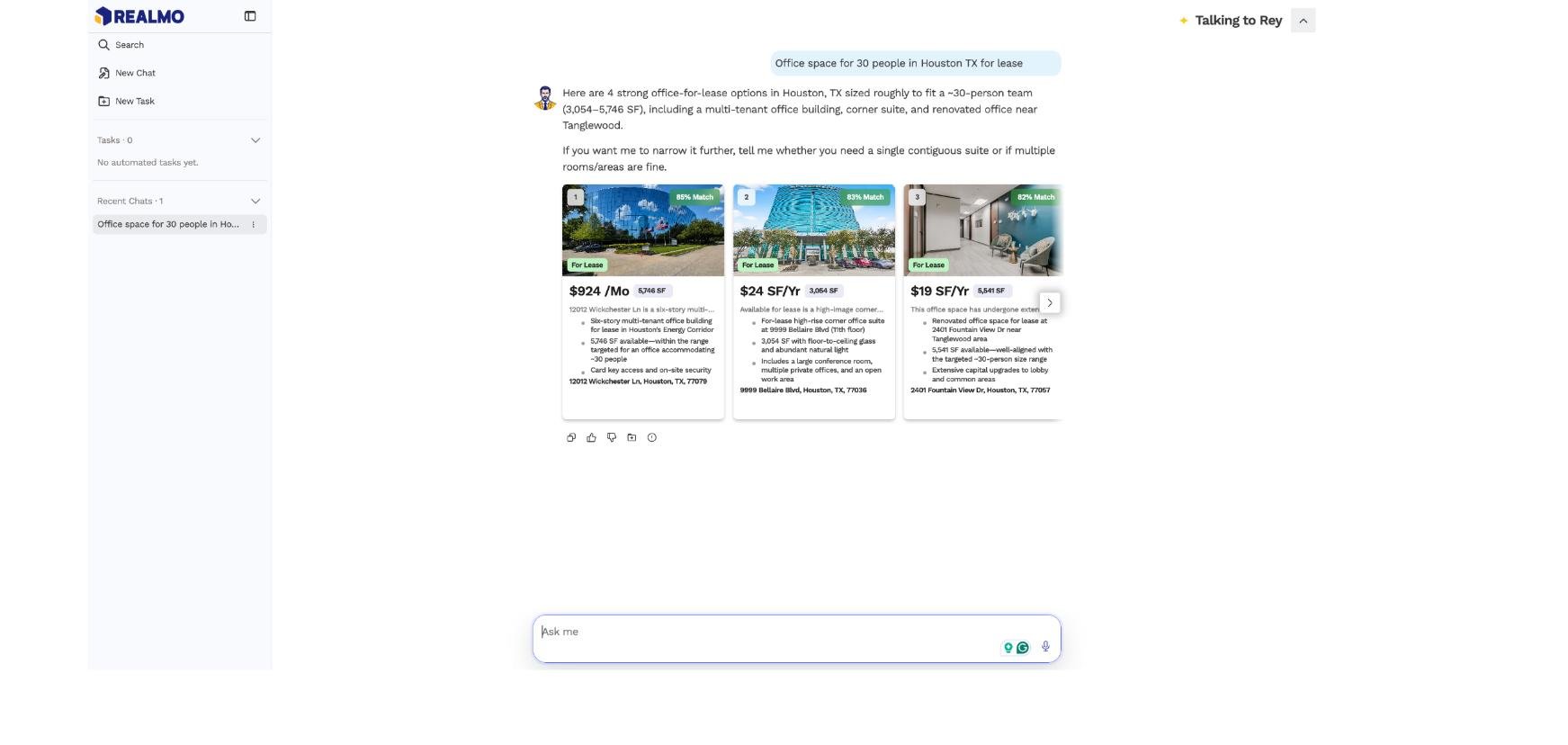
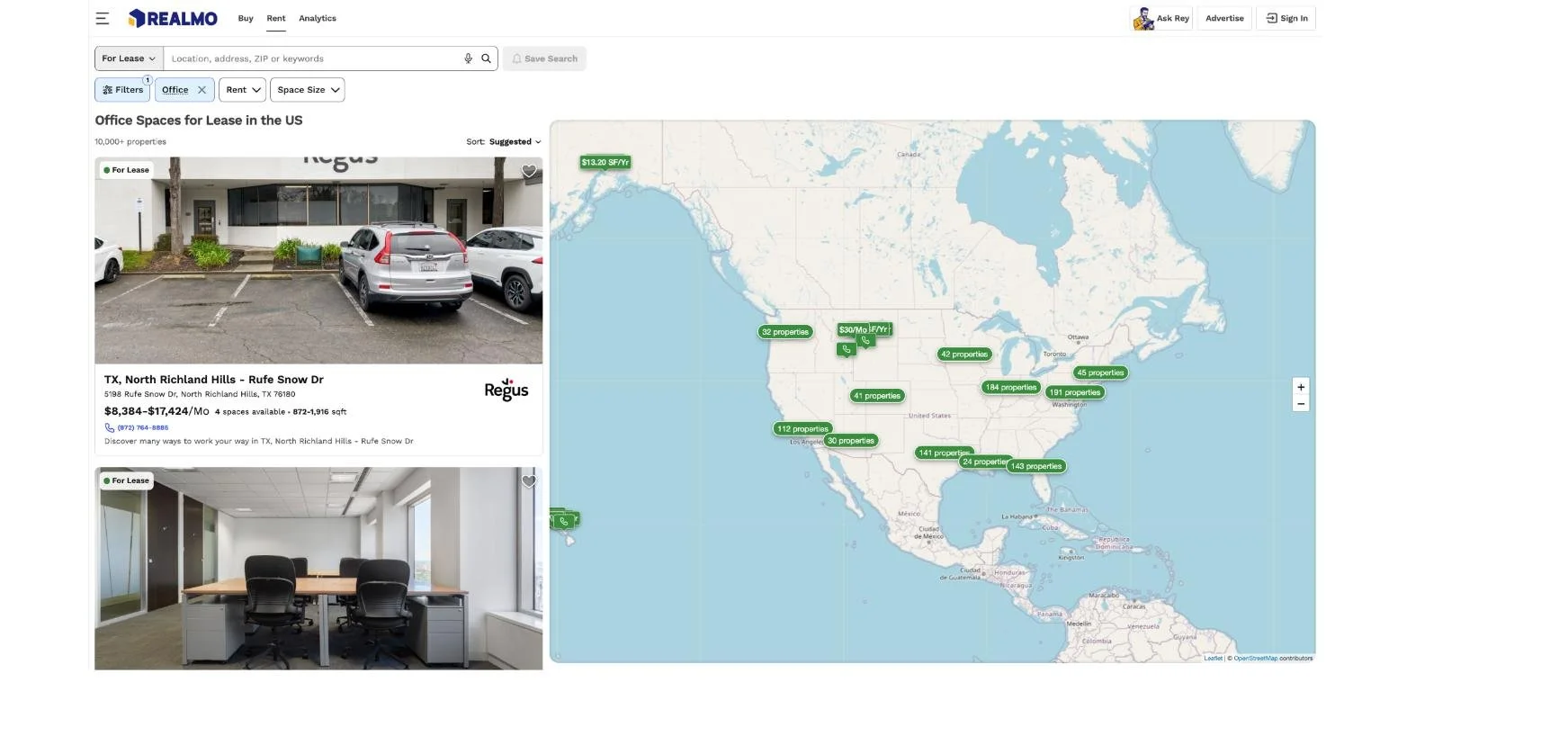
The evidence. Realmo’s search interface currently returns over 10,000 properties across the country.

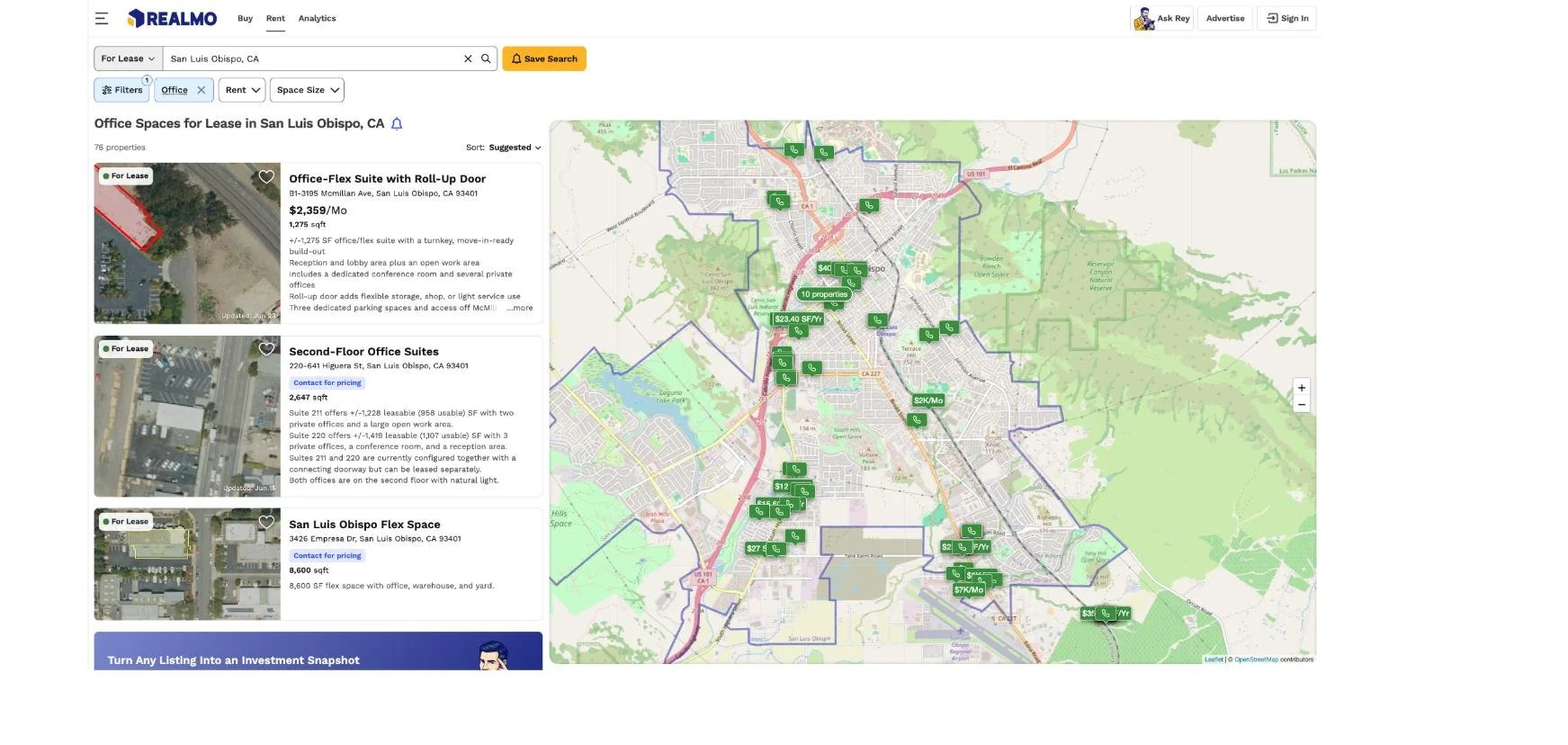
The geographic spread is substantial. At the time of testing, Brooklyn showed 386 office listings, while Austin showed 564. The long tail held up as well. San Luis Obispo had 76 listings, including turnkey offices, medical suites, creative space, and downtown units with parking.

North Carolina results reached communities such as Southern Pines and West End, including private furnished offices with utilities included. In Paducah, Kentucky, Realmo surfaced a 2,706-square-foot former bank with reception and lobby areas, five private offices, a conference room, a vault, and a functioning drive-thru.

The deduction. Inventory density remains uneven. Some county and small-market pages have only a handful of relevant results, and totals aren’t always presented consistently.

Score: 4.5/5. Realmo provides enough geographic depth to support office discovery well beyond the largest metros, although its inventory counts might need cleaner presentation.

Criterion 2: Cost Transparency Across Full-Service, Modified Gross, and NNN Office Leases

Share of final score: 25%

The standard. A useful listing should show the rate, the rate unit, and the lease structure before a tenant contacts the broker. A number without those details isn’t comparable.

Office base rent is often quoted per square foot per year, but the amount a tenant actually pays depends on the lease. A full-service lease generally bundles operating expenses into the rent. Under an NNN office lease, the tenant pays a share of property taxes, insurance, and maintenance in addition to base rent. A modified gross lease falls between these structures, with the landlord and tenant dividing expenses according to the agreement.

The evidence. Realmo does a good job of printing rate units prominently. Listings may show a flat monthly amount, a range per month, or a rate such as $/SF/Yr.

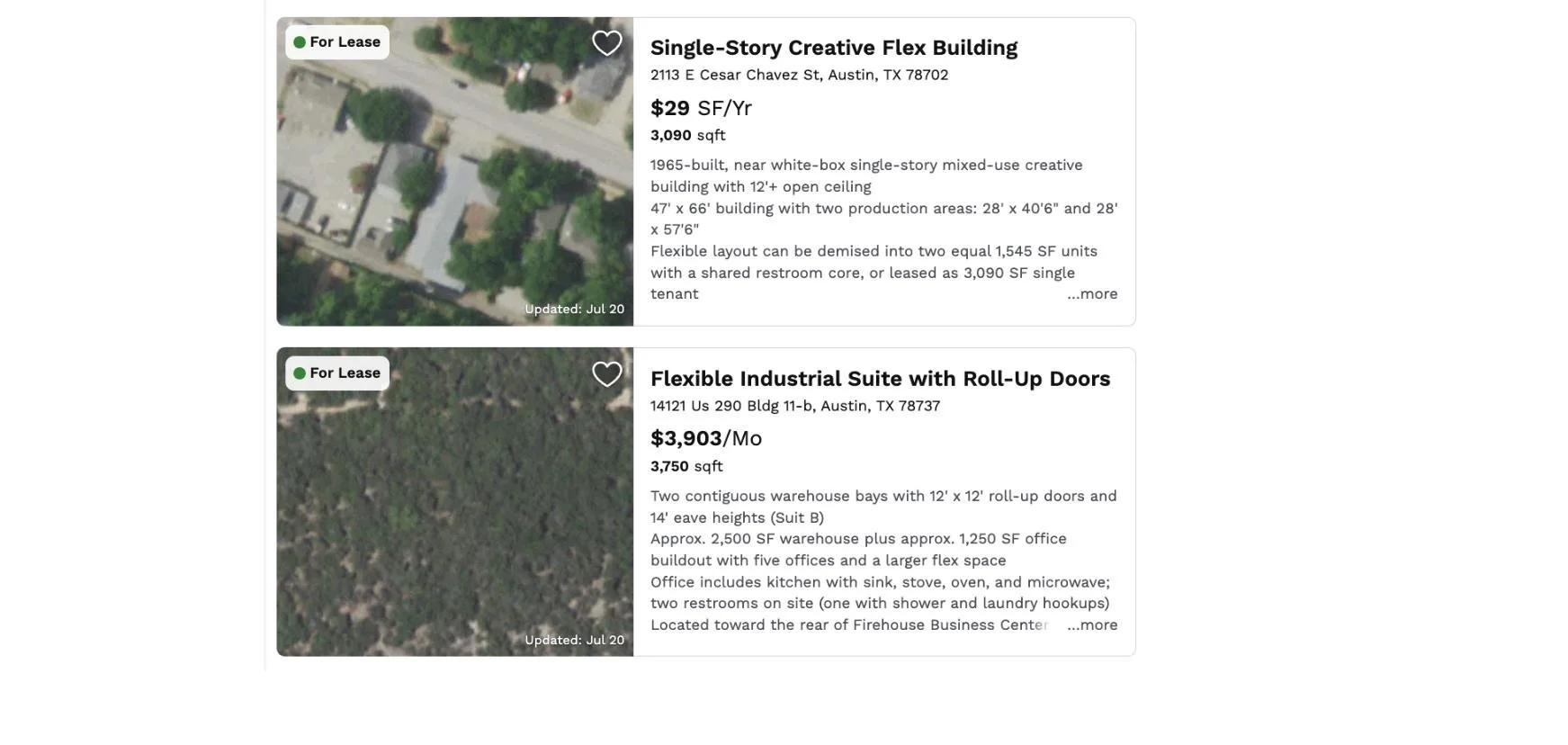
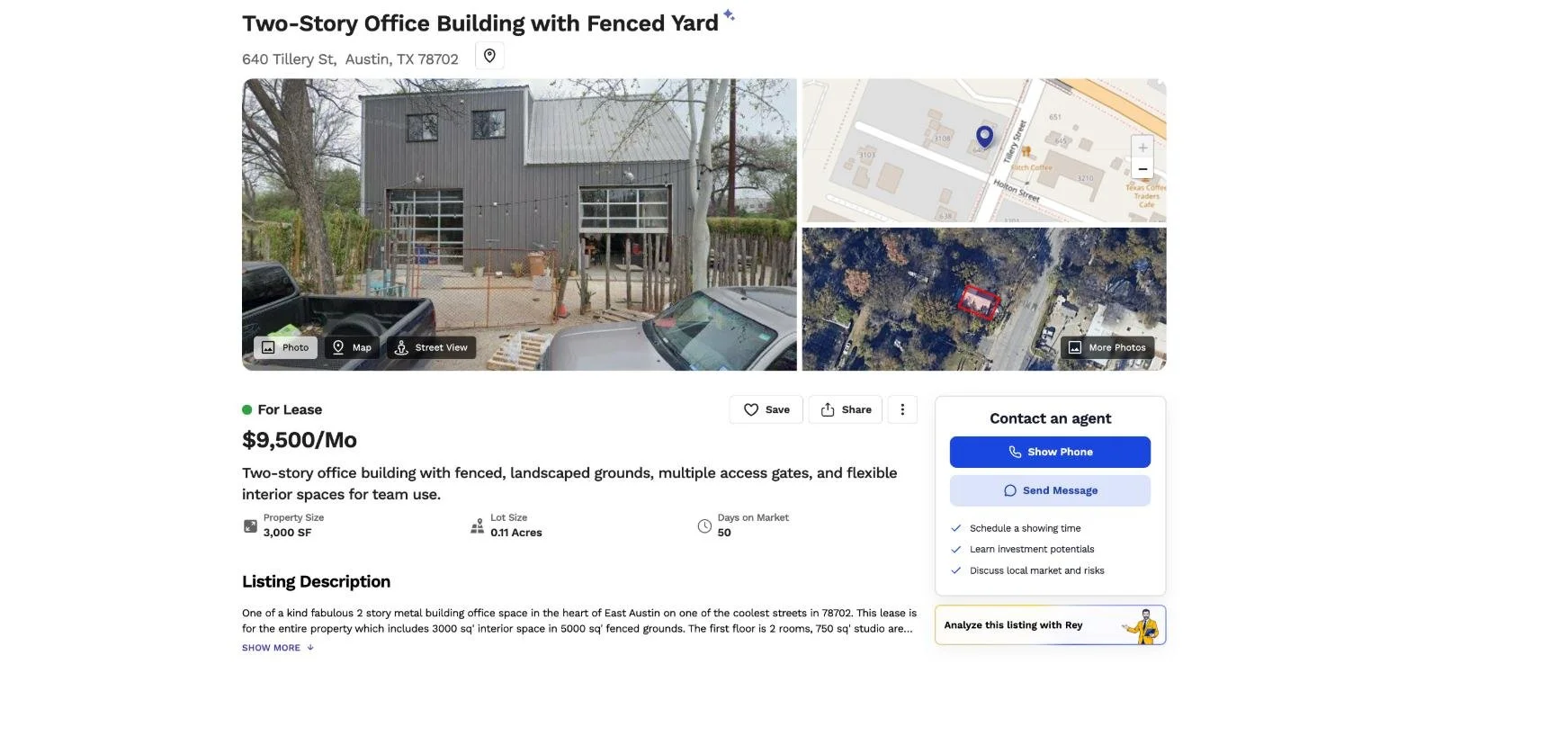
Austin results, for example, included a 1,790-square-foot ground-floor suite at $24 SF/Yr, a 1,257-square-foot office at $2,350/Mo, and a 3,000-square-foot two-story office building at $9,500/Mo. Full-service terms were also identified in the description of executive office products.

That range is a good feature since tenants searching for small office space for rent often budget in monthly dollars rather than annual rent per square foot. Flat monthly listings are easier for a solo professional or young business to place against a cash-flow forecast. Furnished, Wi-Fi-inclusive, and utilities-included offices make the monthly obligation more predictable still. Realmo currently surfaces examples of this model in North Carolina and other smaller markets.

The deduction. Realmo doesn’t normalize different rate formats. A tenant may see $/SF/Yr, $/SF/mo, a flat monthly rate, and “contact for pricing” within the same search. Converting them into an estimated all-in monthly occupancy cost remains manual.

Annual escalations are a related consideration: fixed increases commonly fall around 2–3% per year and aren’t shown on the listing itself (a $5,000 monthly rent with a 3% annual increase becomes $5,150 in year two). This is standard industry practice rather than a Realmo-specific gap — escalations are negotiated case-by-case and rarely appear on any commercial marketplace — so it’s flagged here as a general caveat for tenants rather than a factor in the score below.

Score: 3.5/5. Individual listings usually state the rate clearly, but inconsistent units and unreliable aggregate calculations make market-level comparison harder than it should be.

Criterion 3: Listing Depth for Furnished and Class A Office Space

Share of final score: 15%

The standard. A tenant should be able to evaluate the basic fit of a property before arranging a tour. This means understanding its layout, delivered condition, parking, accessibility, availability, and likely suitability for the intended use.

Space math is more detailed than multiplying headcount by a single number. Open-plan workstations may use roughly 60–110 square feet each. Conference rooms require space for the room itself and its occupants, while circulation, reception, storage, kitchens, and future growth increase the total. Rent should also make sense against the company’s finances; a common planning benchmark keeps occupancy around 10–15% of gross revenue, though the right percentage varies sharply by industry.

The evidence. Realmo’s stronger listings contain enough physical detail to rule a property in or out. Austin examples described private offices, open work areas, conference rooms, kitchenettes, fenced yards, private restrooms, natural light, parking, and highway access. One office space suite listed a lounge, reception, storage space, and a breakroom.

The condition spectrum is broad. Search results include shell or customizable space, newly renovated offices, furnished office space, turnkey private suites, medical offices, and Class A office space with amenities. A Class A creative campus in Santa Monica, for example, was marketed as a high-end, sustainability-oriented creative campus with private patios and freeway access. Dallas results included renovated offices, furnished space, and Class A properties at several price points.

The detail also extends to unconventional buildings. There’s enough information to identify potential professional, financial-services, or adaptive-reuse applications before calling.

The deduction. Much of this information sits in descriptions rather than filters. The live filter set covers property type, price, rate period, and size, but doesn’t expose dedicated controls for furnished condition, Class A status, lease type, or delivered condition. A tenant can find these terms through text search, but can’t consistently combine them as structured filters.

Transit access also appears unevenly, even though location decisions depend on parking, public transportation, safety, surrounding amenities, and commute patterns.

Landlord concessions are missing too. A tenant improvement allowance may cover part of a custom build-out, while free rent can offset moving and setup costs. These terms are negotiated rather than advertised, but they materially affect the effective rent.

Score: 4/5. The better listings read much like broker setup sheets and support meaningful screening. The information is rich, but not structured consistently enough for precise filtering.

Criterion 4: Search Experience for Office Space for Rent

Share of final score: 10%

The standard. Search should handle two different jobs. The first is a commodity request such as “2,000 square feet, Class A, with parking.” The second is a long-tail request such as “a furnished private office with a restroom under $2,000 per month.”

The evidence. Realmo supports conventional location, property-type, rent, and size controls. This covers the basic office space for rent search reasonably well. Results can also be sorted by monthly rent, annual rate, size, or recency.

Its stronger distinction is text-led discovery. Listing descriptions contain the kinds of details tenants naturally put into a sentence: private restroom, furnished suite, medical use, parking, move-in ready, shared conference room, utilities included, or highway access. Rey, Realmo’s AI assistant, is positioned to search, analyze, and monitor CRE opportunities rather than simply match a fixed taxonomy. It’s still somewhat raw but does a good job of handling detailed, natural-language requests that would be awkward to recreate with filters alone.

The deduction. On Realmo, a tenant can narrow by size and price quickly, but conditions such as “furnished,” “modified gross,” “private restroom,” or “Class A” may require text searching and manual review rather than a dedicated filter. In our assessment, a comprehensive filter grid is typically faster than text-led discovery for a straightforward, standardized search — though we have not benchmarked this directly against specific competing platforms.

Conversational search is most valuable when the request contains several unusual qualifiers. For a straightforward search by market, size, and price, a comprehensive filter grid remains quicker.

Score: 4/5. Realmo performs well on long-tail discovery and adequately on standard filtering, but its AI advantage is still yet to be fully developed.

Criterion 5: Freshness and Data Trust

Share of final score: 10%

The standard. A search platform should show current availability, reveal where its information comes from, and avoid presenting calculated data with more confidence than the source supports.

The evidence. Realmo listings display update dates and days-on-market figures that indicate how current the data is. During testing, Austin results showed listings updated as recently as July 20, while the national results included properties refreshed in mid-July. Realmo also describes its market analytics as updated daily.

Beyond individual listings, the Analytics Center adds a layer of externally sourced information: ownership records, zoning, value estimates, cap rates, demand heatmaps, recent sales, demographics, and comparable-sale data. A logged-out visitor can reach and search the Analytics Center, although some full reports and individual data points may require registration or another step.

The deduction. Realmo is a free/freemium marketplace, not a paid institutional research provider — these are different product categories with different data SLAs, and this criterion evaluates Realmo within the free/freemium marketplace segment rather than against institutional systems. Within that segment, Realmo isn’t yet a substitute for verified lease comps, stacking plans, broker surveys, or institutional building analytics; paid, subscription-based research platforms retain an advantage for tenants or advisers who need verified historical transactions and building-level market intelligence.

Score: 4/5. The inventory appears actively refreshed and useful for discovery, but important figures still need confirmation before a tenant relies on them in a negotiation.

Criterion 6: Small Office Space for Rent

Share of final score: 15%

The standard. A broad office marketplace should serve the solo professional and the sub-10-person business with content and options suited to that scale, not only tenants large enough to justify a major brokerage campaign. This is distinct from Criterion 1’s raw inventory count — it looks at whether small-format listings are furnished, all-inclusive, and flexible enough to actually fit a small tenant’s needs.

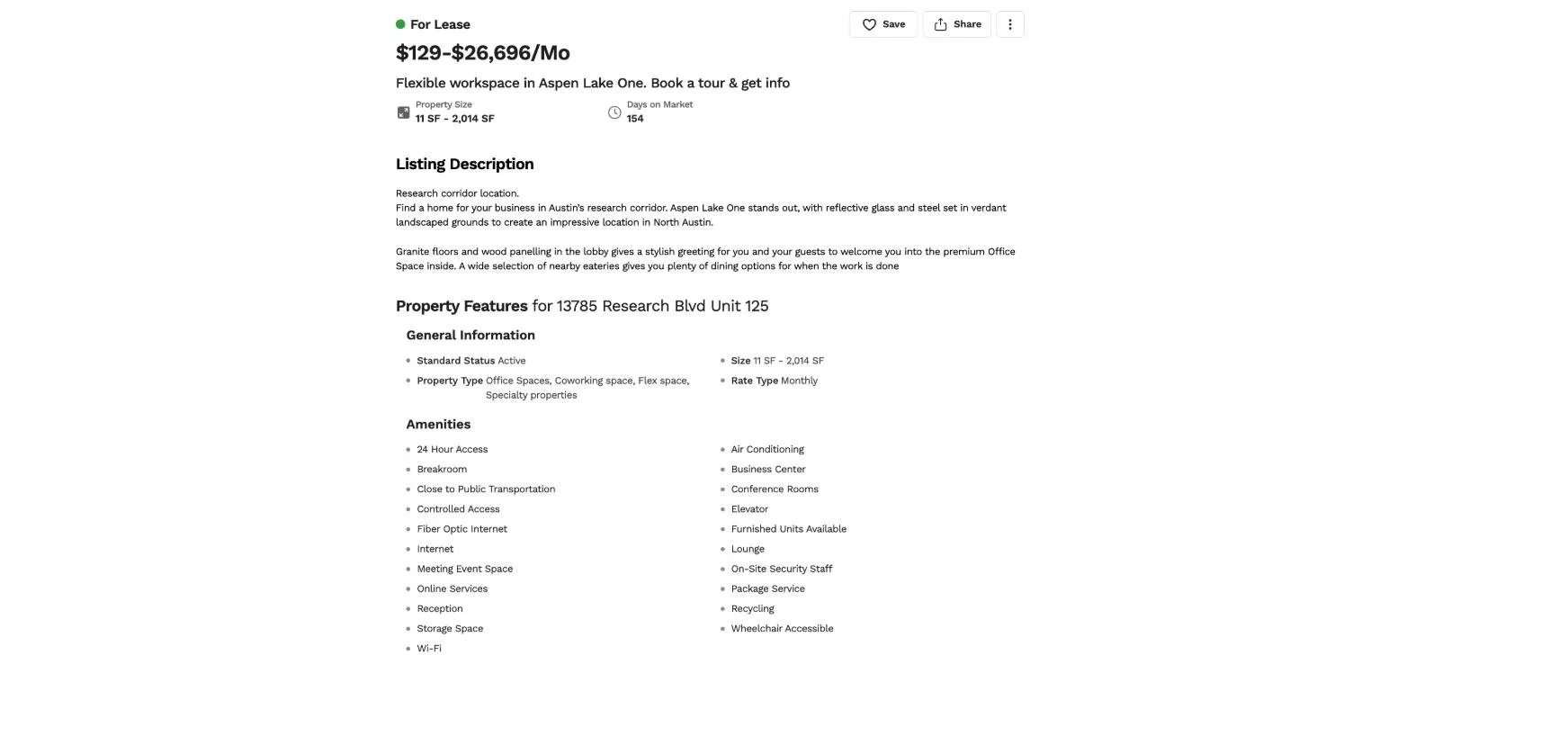
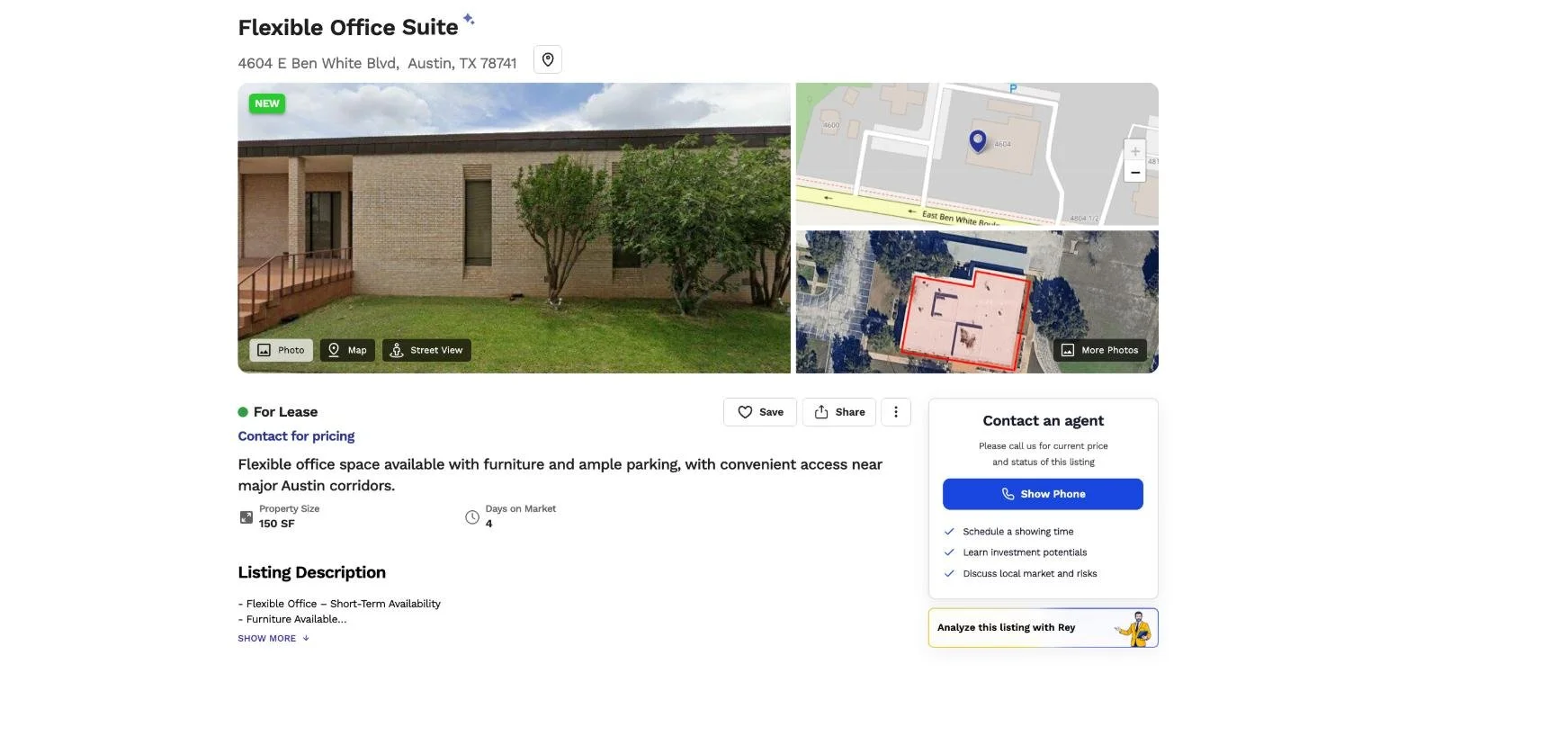
The evidence. This was Realmo’s strongest category. Beyond simply listing small square footages, Realmo surfaces furnished, all-inclusive suites that solo professionals and small businesses can budget against directly. Austin results included a 150-square-foot flexible office suite, a 238-square-foot private suite at $600/Mo, and flexible workspaces starting at 11 square feet, priced in flat monthly terms rather than annual per-square-foot rates.

These properties fill a real gap between coworking and a conventional office lease. Coworking helps startups avoid long commitments, while a virtual office provides a business address without dedicated premises. Neither necessarily gives a practice owner or small professional firm a private, controllable workplace. A furnished or utilities-included suite can offer that privacy with a predictable monthly bill.

The deduction. Flexible-office inventory can create a bit of confusion. Some results represent individual desks or managed-office packages inside a much larger building rather than conventional suites with independent leases. Tenants have to inspect the listing carefully to understand what the quoted size and price actually cover.

Availability and lease flexibility also vary. A small monthly suite may offer a shorter commitment, but traditional commercial office terms commonly run several years. Realmo doesn’t standardize the minimum term or deposit, so a low headline rate doesn’t automatically mean a low upfront obligation.

Score: 5/5. Realmo surfaces small, furnished, and all-inclusive offices that are easy to miss on marketplaces built around promoted listings.

The Realmo Office Space Review Scorecard

  • Inventory depth and reach — Weight: 25% — Score: 4.5/5

  • Cost transparency — Weight: 25% — Score: 3.5/5

  • Listing depth — Weight: 15% — Score: 4/5

  • Search experience — Weight: 10% — Score: 4/5

  • Freshness and data trust — Weight: 10% — Score: 4/5

  • Small-tenant fit — Weight: 15% — Score: 5/5

  • Weighted overall — Weight: 100% — Score: 4.15

The weights reflect tenant-side priorities: inventory and cost transparency determine whether a shortlist can be built, while listing depth, small-tenant fit, search, and freshness determine how efficiently it can be verified.

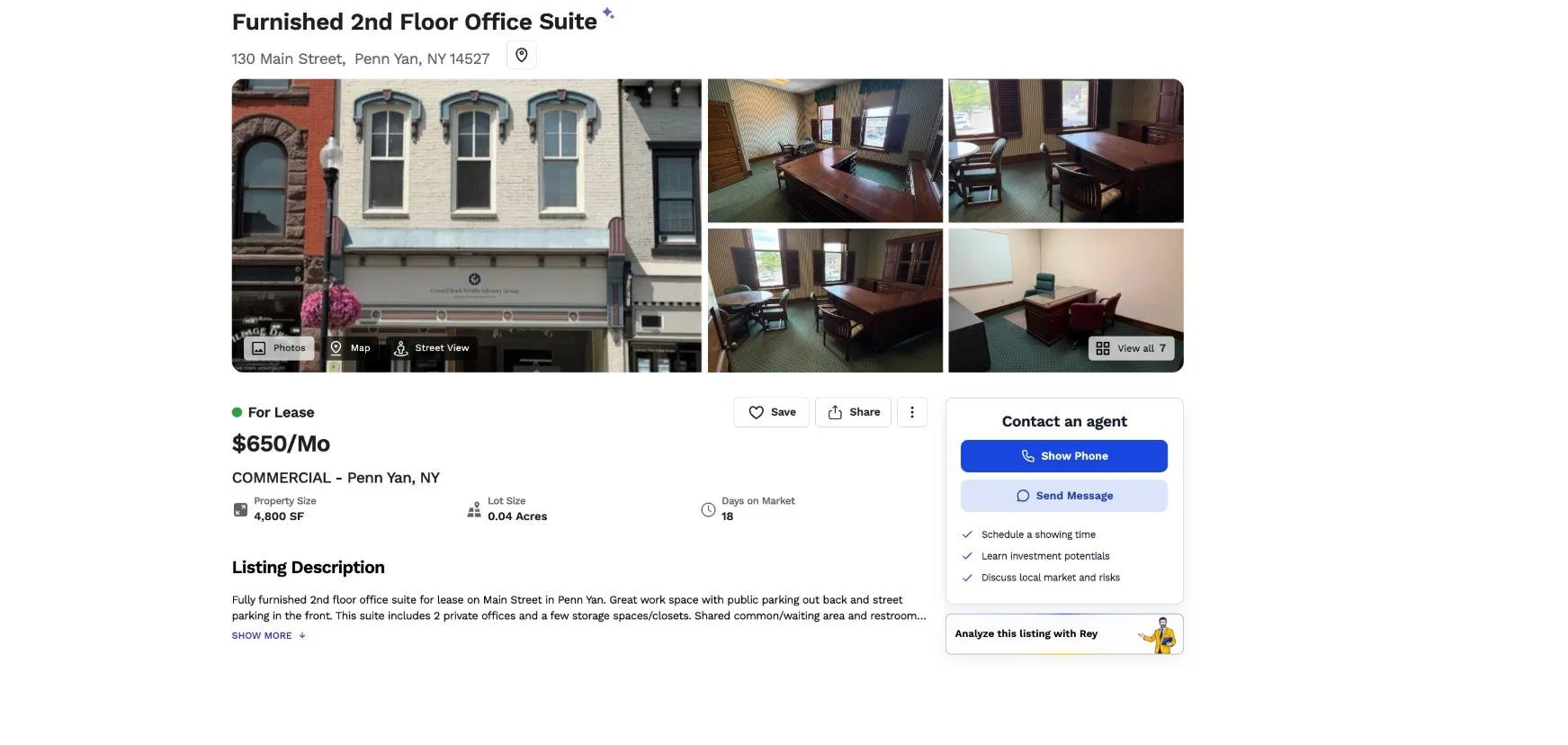
This review is sample-based: Criterion 1 draws on a national inventory count, while Criteria 2 through 6 rely on point-sample evidence from specific markets (Austin, Dallas, Santa Monica, Paducah, Penn Yan) rather than an exhaustive national audit. To check whether the same 4.15 score holds in your market, re-run the office-space search with your own location, size, and budget rather than relying on the national result. The score should be recalculated whenever materially different evidence appears.

Who the Score Is For and Who Should Ignore It

The 4.15 score applies to tenant-side discovery. Realmo is most useful to founders, office managers, practice owners, and tenant-rep brokers assembling an initial shortlist, particularly for requirements below 5,000 square feet or outside the most heavily marketed office districts. Its free access, long-tail inventory, and unusually strong selection of small offices make it a credible place to begin the search.

Institutional occupiers and advisers who require verified lease comps, complete stacking plans, detailed ownership histories, or building-level market analytics should treat Realmo as a supplement rather than a replacement for a paid data platform.

No marketplace score covers the final lease. Tenants still need to negotiate annual escalations, renewal options, early-termination rights, build-out contributions, free rent, and the right to sublease part of the premises. They also need to confirm that zoning permits the intended use and that the office meets building, fire, accessibility, and insurance requirements.

A tenant-rep broker is commonly paid through the landlord-side commission structure rather than a separate tenant charge, although the engagement terms should always be checked. Legal review is worth budgeting for as well. Commercial leases can be long, technical documents, and the cost of professional advice is small beside a multi-year occupancy commitment.

/
script>

Dubai's Interior Design Trends Moving to Ultra Luxury

Luxury living in Dubai has entered a new era. Homeowners are no longer satisfied with beautiful interiors alone. They now seek personalized spaces that combine elegance, comfort, smart technology, and premium materials. Every element, from curtains to flooring and lighting, is carefully selected to create a sophisticated environment that reflects modern lifestyles.

Today, interior design trends across Dubai focus on timeless luxury rather than temporary styles. High-end villas, penthouses, apartments, hotels, and commercial spaces all embrace natural textures, custom finishes, and seamless functionality. Designers prioritize quality craftsmanship, neutral color palettes, sustainable materials, and smart home integration to achieve interiors that remain elegant for years.

Below are the latest interior design trends transforming luxury homes in Dubai.

Elegant Curtains That Define Luxury Interiors

Curtains have become one of the most influential design elements in modern interiors. Instead of serving only as window coverings, they now shape the atmosphere of an entire room. Premium fabrics, custom stitching, concealed curtain tracks, and ceiling-mounted installations create a clean and sophisticated appearance.

Soft neutral shades such as ivory, beige, sand, taupe, and warm grey continue to dominate luxury homes because they complement marble flooring, wooden panels, and modern furniture. Double-layered curtain systems that combine sheer fabrics with Curtains Blackout options provide both elegance and complete privacy. During the day, sheer curtains allow natural light to brighten the space, while blackout curtains create a peaceful environment during the evening.

Wave curtains have become especially popular because of their perfectly uniform folds and minimalist appearance. Motorized curtain systems are also increasingly preferred in smart homes, allowing homeowners to control natural lighting through remote controls or mobile applications.

The combination of premium fabrics, custom installation, and automated functionality makes curtains an essential feature in Dubai's evolving luxury interior designs.

Premium Flooring Creates the Foundation of Luxury

Flooring plays one of the most important roles in defining interior quality. Luxury homes now focus on materials that deliver both visual appeal and long-term durability.

Natural oak flooring continues to dominate premium villas because it introduces warmth and timeless character. Large format porcelain tiles remain popular for contemporary interiors due to their seamless appearance and minimal maintenance. Luxury vinyl flooring and stone polymer composite flooring have also gained attention because they combine realistic wood textures with exceptional water resistance.

Many homeowners now choose wide plank flooring that creates an open and continuous appearance throughout the property. Herringbone and chevron patterns have also returned as premium design features that add elegance without overwhelming the space.

Exterior spaces receive equal attention through high-quality outdoor flooring solutions. Modern terraces, swimming pool decks, balconies, and garden areas now feature weather-resistant materials that maintain their appearance despite Dubai's intense climate. Durable outdoor flooring extends the luxury experience beyond the interior while improving both safety and functionality.

Selecting premium flooring allows homeowners to create seamless transitions between indoor and outdoor living spaces while maintaining a consistent luxury aesthetic.

Outdoor Living Spaces Become Luxury Destinations

Outdoor spaces have transformed into fully functional living environments rather than simple gardens. Luxury villas increasingly include outdoor lounges, dining areas, kitchens, fire features, pergolas, and entertainment zones.

Luxury outdoor flooring in Dubai, including Natural stone, premium composite decking, decorative concrete, and porcelain pavers, is widely used because they provide durability under extreme weather conditions while maintaining an elegant appearance.

Landscape lighting, integrated seating, modern water features, and carefully selected greenery help create resort-inspired environments that can be enjoyed throughout the year.

Minimalist landscaping remains the preferred approach because it combines clean architectural lines with carefully placed plants that require minimal maintenance. Outdoor furniture now mirrors indoor furniture by incorporating premium fabrics, natural wood finishes, and comfortable cushions.

The objective is to blur the boundary between indoor and outdoor living while maintaining a consistent luxury experience.

Luxury Carpets Add Comfort and Sophistication

Carpets continue to play an important role in creating comfortable and elegant interiors. Rather than using highly decorative patterns, today's luxury homes prefer subtle textures and calming neutral colors that enhance furniture and architectural details.

Premium wool carpets remain the preferred option because of their softness, durability, and natural insulation properties. Silk blended carpets introduce a refined finish with gentle reflections that enhance ambient lighting.

Large custom area rugs define seating arrangements while wall to wall carpets create peaceful bedroom environments with exceptional comfort underfoot.

Natural woven materials and handcrafted designs have also become increasingly popular because they provide authenticity and timeless elegance. Soft carpets reduce sound, improve indoor comfort, and contribute to a more welcoming atmosphere throughout luxury residences.

Modern Wall Designs Replace Traditional Decoration

Walls have evolved from simple painted surfaces into architectural focal points. Designers now combine premium materials to create visual depth while maintaining clean minimalist aesthetics.

Natural marble feature walls remain one of the strongest symbols of luxury, particularly within living rooms and entrance areas. Wooden slat panels introduce warmth while improving acoustic comfort. Decorative mouldings create timeless elegance, especially when paired with soft neutral colors.

Textured wallpapers inspired by linen, stone, concrete, and natural fibers provide subtle sophistication without overpowering the overall design.

Hidden doors integrated into wall panel systems further enhance minimalist interiors by preserving uninterrupted architectural lines.

The emphasis has shifted toward high quality finishes and carefully selected materials that remain visually appealing for many years.

Lighting Becomes an Architectural Statement

Lighting has become one of the defining characteristics of luxury interior design. Rather than relying on a single central fixture, designers now create multiple lighting layers that adapt to different moods and activities.

Recessed ceiling lighting provides balanced illumination throughout living spaces. Decorative chandeliers serve as artistic centerpieces above dining tables and entrance halls. Wall lights introduce warmth while highlighting architectural features and textured finishes.

Indirect LED lighting concealed behind ceilings, shelving units, mirrors, and wall panels creates a soft ambient glow that enhances the overall atmosphere without visible light sources.

Smart lighting systems allow homeowners to adjust brightness, color temperature, and lighting scenes according to different occasions through mobile applications or voice assistants.

Warm white lighting continues to dominate luxury interiors because it creates inviting spaces while complementing natural wood, marble, and premium textiles.

Natural Materials Continue to Lead Interior Design

One of the strongest trends across Dubai is the growing appreciation for authentic natural materials. Luxury interiors increasingly combine marble, oak wood, limestone, travertine, brushed brass, natural fabrics, and handcrafted finishes.

These materials create interiors with greater character while introducing subtle texture and warmth. Instead of highly polished surfaces throughout the home, designers balance smooth finishes with tactile materials that make spaces feel comfortable and welcoming.

Neutral color palettes remain dominant because they create timeless interiors that are easy to update with artwork, furniture, or decorative accessories.

The emphasis has shifted from excessive decoration toward carefully curated materials that communicate quality through simplicity.

Smart Home Integration Defines Modern Luxury

Technology has become an invisible yet essential component of luxury design. Modern homes now integrate automation systems without compromising aesthetics.

Motorized curtains, intelligent lighting, climate control, security systems, multimedia entertainment, and automated shading all work together to improve daily living.

Hidden speakers, concealed charging stations, wireless controls, and integrated home management systems reduce visible clutter while maintaining clean architectural lines.

The goal is to enhance convenience without allowing technology to dominate the visual design of the home.

Conclusion

Dubai continues to establish itself as one of the world's leading destinations for luxury interior design. Modern homes emphasize refined elegance, premium materials, intelligent technology, and personalized comfort rather than excessive decoration.

From sophisticated curtain systems and premium flooring to luxury carpets, designer lighting, architectural wall finishes, and beautifully designed outdoor spaces, every detail contributes to a seamless living experience.

As homeowners increasingly invest in timeless quality, the future of interior design in Dubai will continue moving toward understated luxury, sustainable materials, and smart innovations that create homes which are both visually impressive and exceptionally comfortable.

/
script>