Realmo Office Space for Lease: A Six-Criteria Scorecard Review
An office listing should let a tenant decide if a space deserves a closer look without making a phone call. This means showing the space math, the cost structure, and the delivered condition clearly. Tenants need to know whether the layout fits their headcount, the rate is full-service, modified gross, or NNN, and whether the office is furnished, renovated, or still in shell condition.
For this Realmo office space review, we graded the platform against six tenant-side criteria using live Realmo pages and listings checked in July 2026. Realmo is a free commercial real estate marketplace with searchable listings, property analytics, and AI-assisted tools. Core access is free, while paid products are aimed mainly at listing promotion and enrichment.

How We Scored This Realmo Review
Each criterion received a score from 1 to 5 against a written standard. Evidence came from live listing counts, search pages, and individual properties on Realmo on July 22, 2026. Note that, the platform updates its data daily, so the figures might change once this review has gone live.
Inventory and cost transparency carry the highest weights because a platform is of little use if it can’t produce a viable shortlist or show what the listed rate means. Basic access also had to be free. A mandatory paywall on any core criterion would have capped the overall grade, regardless of the platform’s other strengths.
Criterion 1: Office Space for Lease Inventory and Geographic Reach
Share of final score: 25%
The standard. An office marketplace needs enough current supply to support a real shortlist, not merely show that office properties exist in a market. This applies to major metros, suburban corridors, and smaller communities where inventory is less likely to receive paid promotion.
The evidence. Realmo’s search interface currently returns over 10,000 properties across the country.
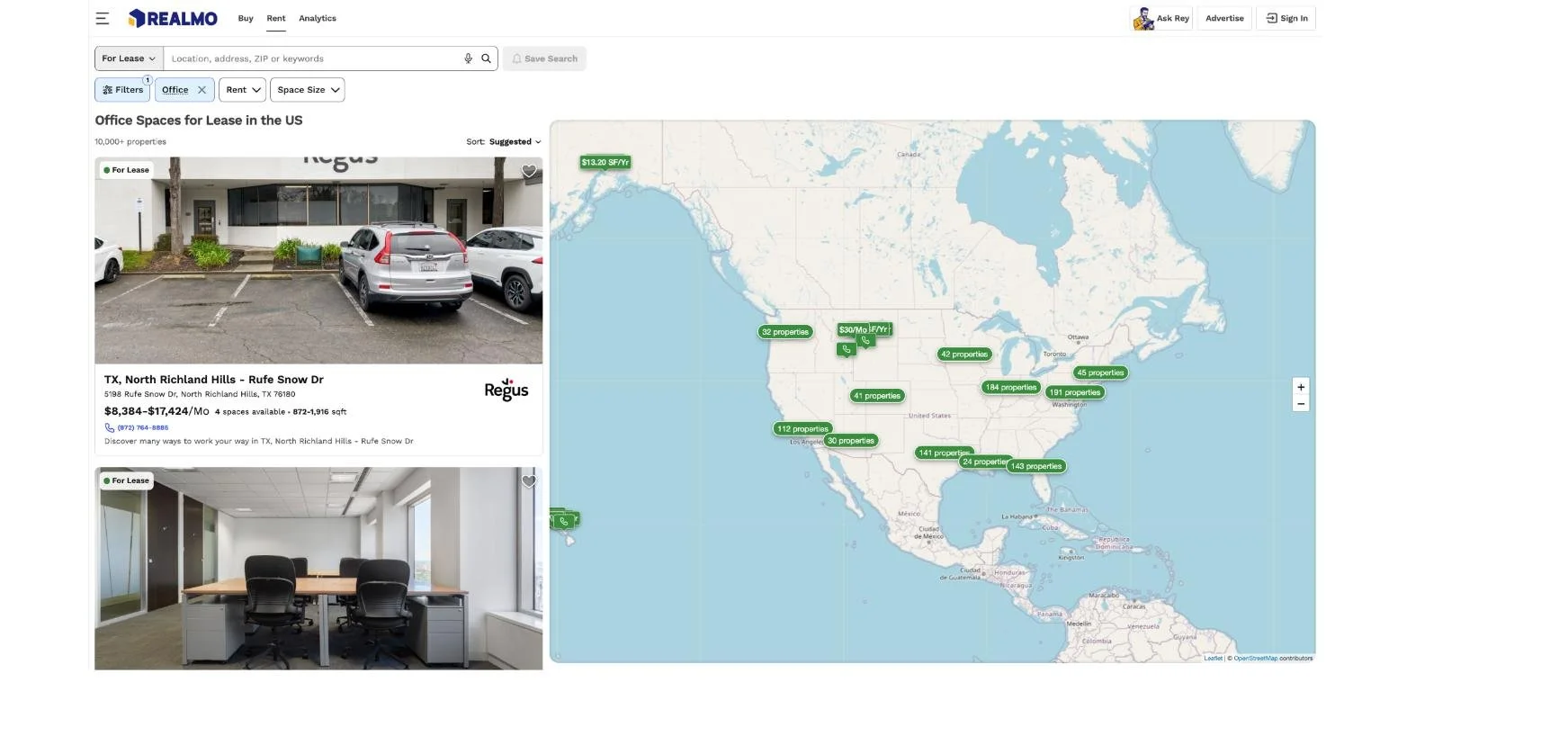
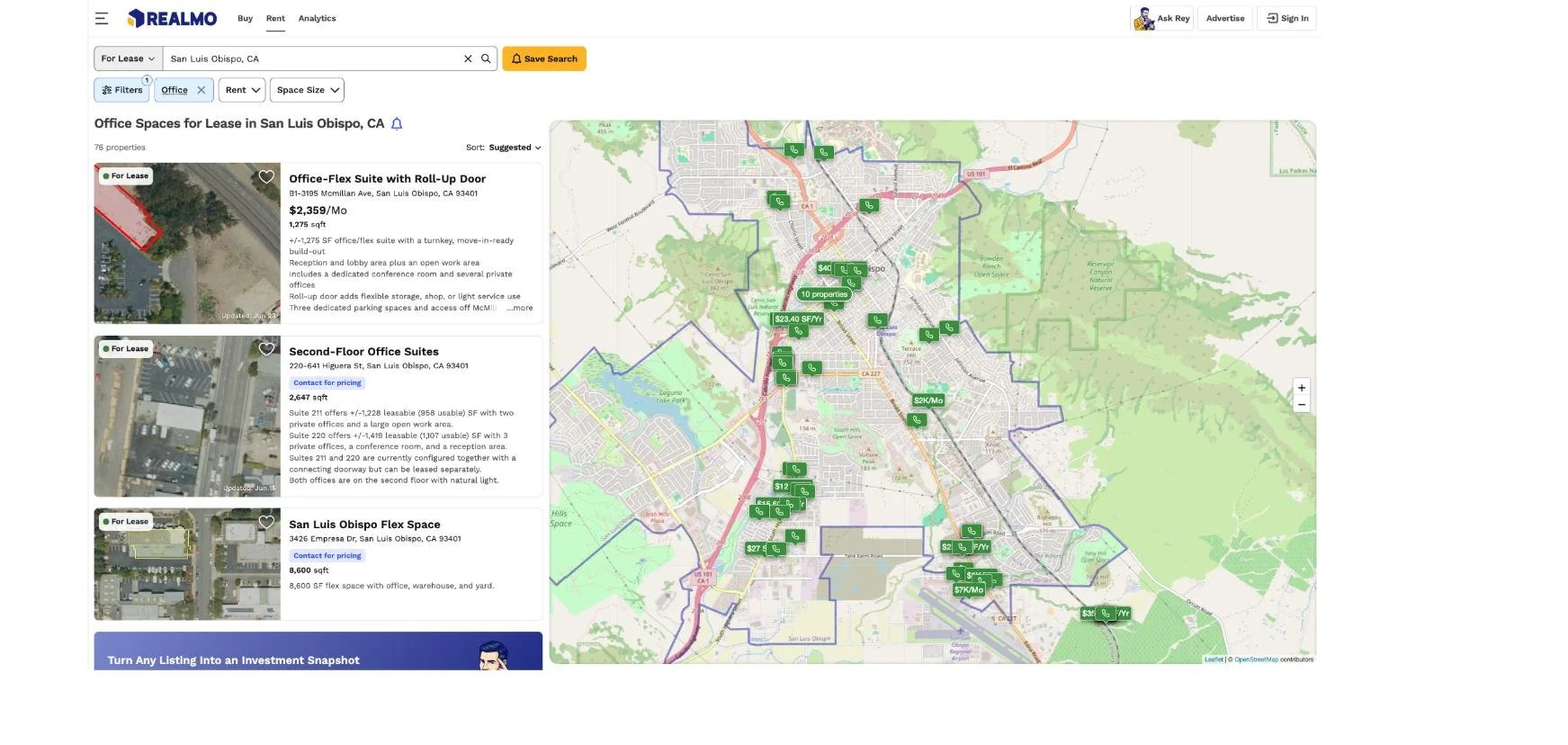
The geographic spread is substantial. At the time of testing, Brooklyn showed 386 office listings, while Austin showed 564. The long tail held up as well. San Luis Obispo had 76 listings, including turnkey offices, medical suites, creative space, and downtown units with parking.
North Carolina results reached communities such as Southern Pines and West End, including private furnished offices with utilities included. In Paducah, Kentucky, Realmo surfaced a 2,706-square-foot former bank with reception and lobby areas, five private offices, a conference room, a vault, and a functioning drive-thru.
The deduction. Inventory density remains uneven. Some county and small-market pages have only a handful of relevant results, and totals aren’t always presented consistently.
Score: 4.5/5. Realmo provides enough geographic depth to support office discovery well beyond the largest metros, although its inventory counts might need cleaner presentation.
Criterion 2: Cost Transparency Across Full-Service, Modified Gross, and NNN Office Leases
Share of final score: 25%
The standard. A useful listing should show the rate, the rate unit, and the lease structure before a tenant contacts the broker. A number without those details isn’t comparable.
Office base rent is often quoted per square foot per year, but the amount a tenant actually pays depends on the lease. A full-service lease generally bundles operating expenses into the rent. Under an NNN office lease, the tenant pays a share of property taxes, insurance, and maintenance in addition to base rent. A modified gross lease falls between these structures, with the landlord and tenant dividing expenses according to the agreement.
The evidence. Realmo does a good job of printing rate units prominently. Listings may show a flat monthly amount, a range per month, or a rate such as $/SF/Yr.
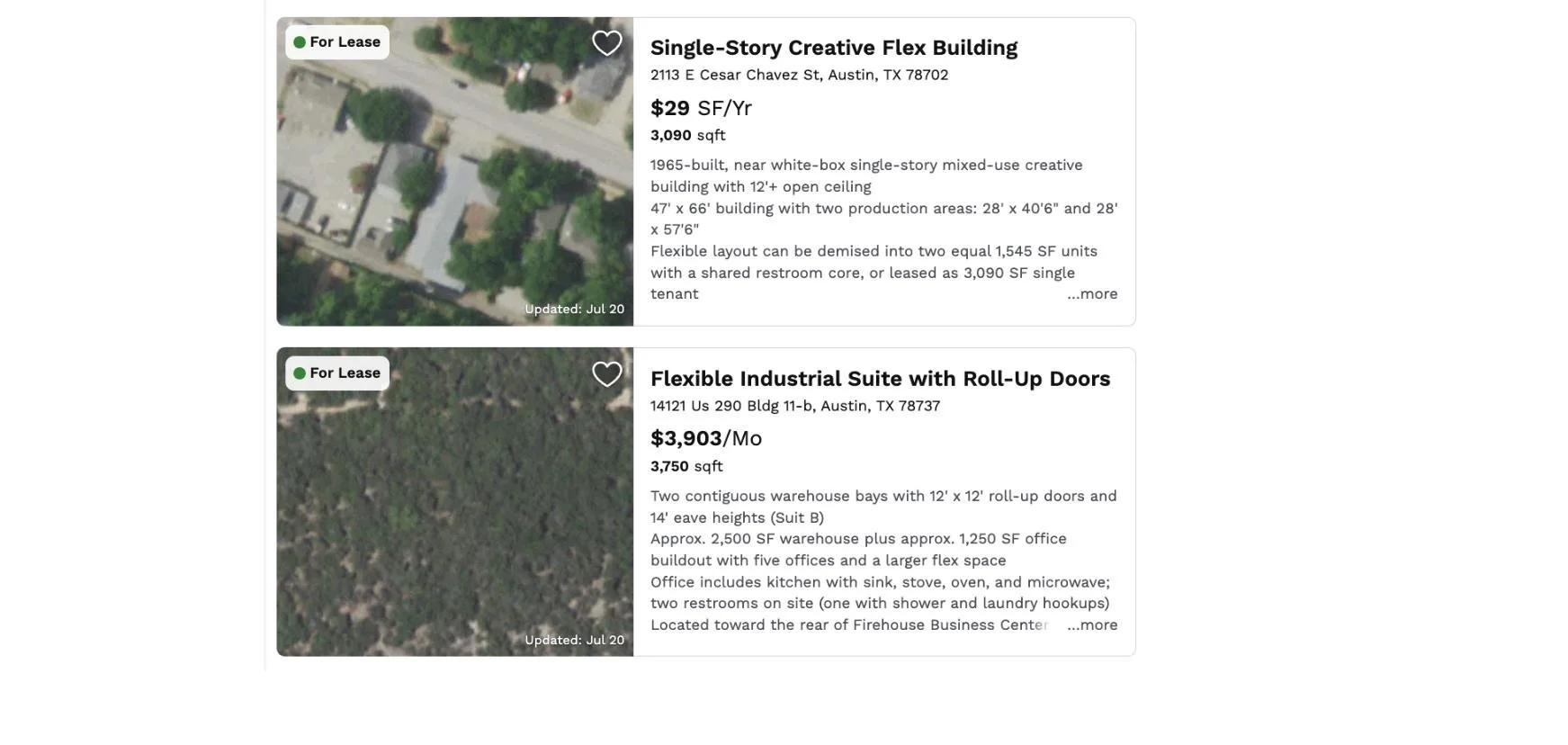
Austin results, for example, included a 1,790-square-foot ground-floor suite at $24 SF/Yr, a 1,257-square-foot office at $2,350/Mo, and a 3,000-square-foot two-story office building at $9,500/Mo. Full-service terms were also identified in the description of executive office products.
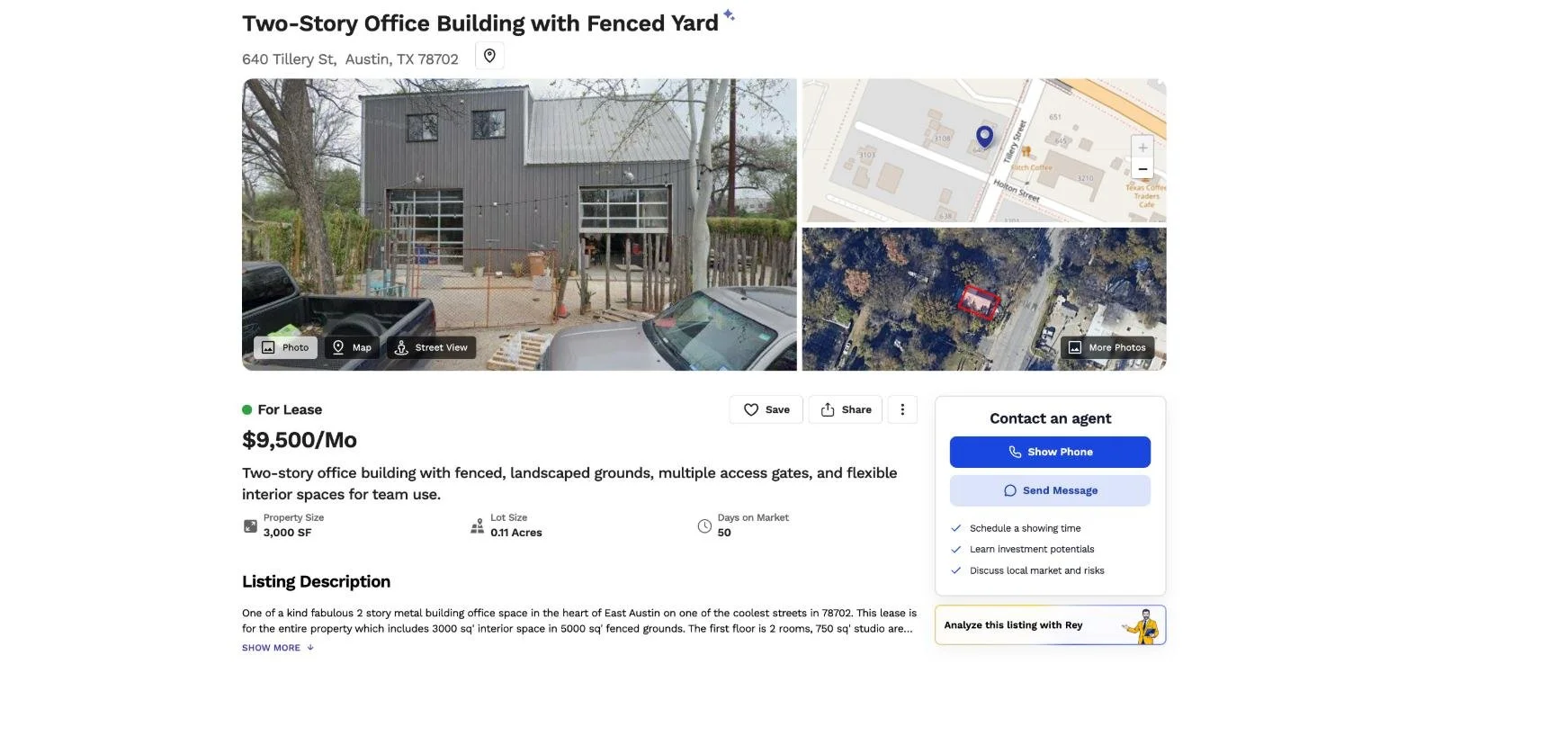
That range is a good feature since tenants searching for small office space for rent often budget in monthly dollars rather than annual rent per square foot. Flat monthly listings are easier for a solo professional or young business to place against a cash-flow forecast. Furnished, Wi-Fi-inclusive, and utilities-included offices make the monthly obligation more predictable still. Realmo currently surfaces examples of this model in North Carolina and other smaller markets.
The deduction. Realmo doesn’t normalize different rate formats. A tenant may see $/SF/Yr, $/SF/mo, a flat monthly rate, and “contact for pricing” within the same search. Converting them into an estimated all-in monthly occupancy cost remains manual.
Annual escalations are a related consideration: fixed increases commonly fall around 2–3% per year and aren’t shown on the listing itself (a $5,000 monthly rent with a 3% annual increase becomes $5,150 in year two). This is standard industry practice rather than a Realmo-specific gap — escalations are negotiated case-by-case and rarely appear on any commercial marketplace — so it’s flagged here as a general caveat for tenants rather than a factor in the score below.
Score: 3.5/5. Individual listings usually state the rate clearly, but inconsistent units and unreliable aggregate calculations make market-level comparison harder than it should be.
Criterion 3: Listing Depth for Furnished and Class A Office Space
Share of final score: 15%
The standard. A tenant should be able to evaluate the basic fit of a property before arranging a tour. This means understanding its layout, delivered condition, parking, accessibility, availability, and likely suitability for the intended use.
Space math is more detailed than multiplying headcount by a single number. Open-plan workstations may use roughly 60–110 square feet each. Conference rooms require space for the room itself and its occupants, while circulation, reception, storage, kitchens, and future growth increase the total. Rent should also make sense against the company’s finances; a common planning benchmark keeps occupancy around 10–15% of gross revenue, though the right percentage varies sharply by industry.
The evidence. Realmo’s stronger listings contain enough physical detail to rule a property in or out. Austin examples described private offices, open work areas, conference rooms, kitchenettes, fenced yards, private restrooms, natural light, parking, and highway access. One office space suite listed a lounge, reception, storage space, and a breakroom.
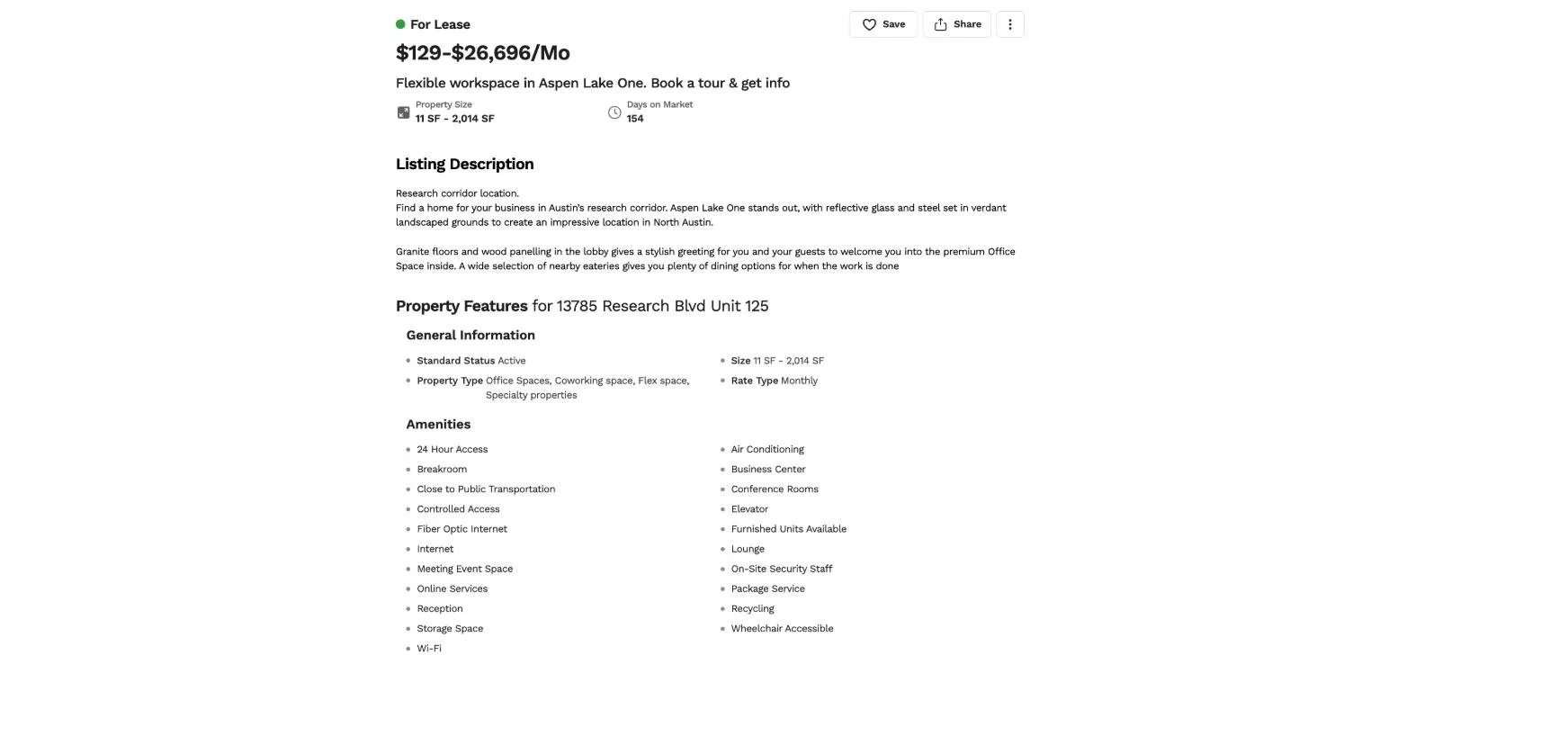
The condition spectrum is broad. Search results include shell or customizable space, newly renovated offices, furnished office space, turnkey private suites, medical offices, and Class A office space with amenities. A Class A creative campus in Santa Monica, for example, was marketed as a high-end, sustainability-oriented creative campus with private patios and freeway access. Dallas results included renovated offices, furnished space, and Class A properties at several price points.
The detail also extends to unconventional buildings. There’s enough information to identify potential professional, financial-services, or adaptive-reuse applications before calling.
The deduction. Much of this information sits in descriptions rather than filters. The live filter set covers property type, price, rate period, and size, but doesn’t expose dedicated controls for furnished condition, Class A status, lease type, or delivered condition. A tenant can find these terms through text search, but can’t consistently combine them as structured filters.
Transit access also appears unevenly, even though location decisions depend on parking, public transportation, safety, surrounding amenities, and commute patterns.
Landlord concessions are missing too. A tenant improvement allowance may cover part of a custom build-out, while free rent can offset moving and setup costs. These terms are negotiated rather than advertised, but they materially affect the effective rent.
Score: 4/5. The better listings read much like broker setup sheets and support meaningful screening. The information is rich, but not structured consistently enough for precise filtering.
Criterion 4: Search Experience for Office Space for Rent
Share of final score: 10%
The standard. Search should handle two different jobs. The first is a commodity request such as “2,000 square feet, Class A, with parking.” The second is a long-tail request such as “a furnished private office with a restroom under $2,000 per month.”
The evidence. Realmo supports conventional location, property-type, rent, and size controls. This covers the basic office space for rent search reasonably well. Results can also be sorted by monthly rent, annual rate, size, or recency.
Its stronger distinction is text-led discovery. Listing descriptions contain the kinds of details tenants naturally put into a sentence: private restroom, furnished suite, medical use, parking, move-in ready, shared conference room, utilities included, or highway access. Rey, Realmo’s AI assistant, is positioned to search, analyze, and monitor CRE opportunities rather than simply match a fixed taxonomy. It’s still somewhat raw but does a good job of handling detailed, natural-language requests that would be awkward to recreate with filters alone.
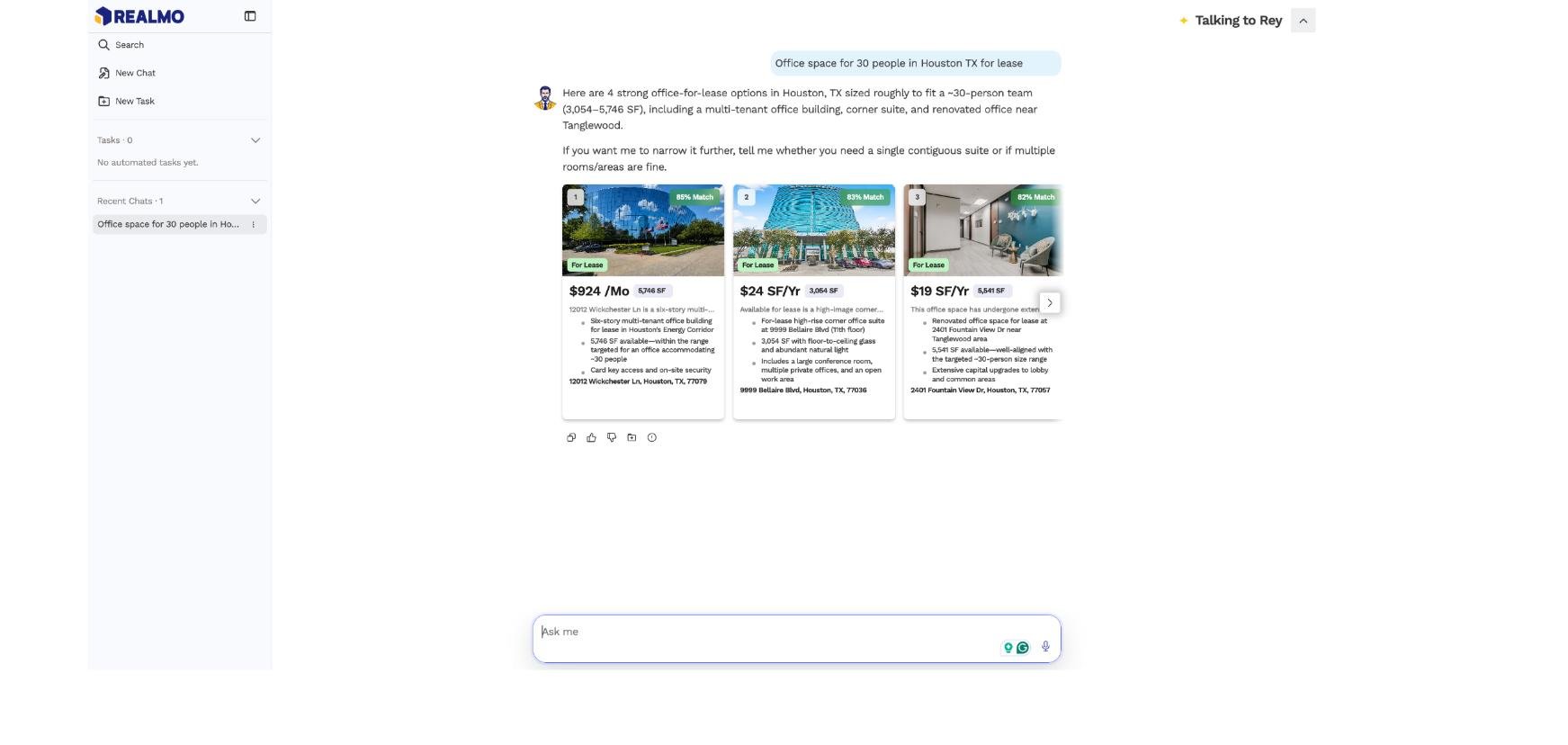
The deduction. On Realmo, a tenant can narrow by size and price quickly, but conditions such as “furnished,” “modified gross,” “private restroom,” or “Class A” may require text searching and manual review rather than a dedicated filter. In our assessment, a comprehensive filter grid is typically faster than text-led discovery for a straightforward, standardized search — though we have not benchmarked this directly against specific competing platforms.
Conversational search is most valuable when the request contains several unusual qualifiers. For a straightforward search by market, size, and price, a comprehensive filter grid remains quicker.
Score: 4/5. Realmo performs well on long-tail discovery and adequately on standard filtering, but its AI advantage is still yet to be fully developed.
Criterion 5: Freshness and Data Trust
Share of final score: 10%
The standard. A search platform should show current availability, reveal where its information comes from, and avoid presenting calculated data with more confidence than the source supports.
The evidence. Realmo listings display update dates and days-on-market figures that indicate how current the data is. During testing, Austin results showed listings updated as recently as July 20, while the national results included properties refreshed in mid-July. Realmo also describes its market analytics as updated daily.
Beyond individual listings, the Analytics Center adds a layer of externally sourced information: ownership records, zoning, value estimates, cap rates, demand heatmaps, recent sales, demographics, and comparable-sale data. A logged-out visitor can reach and search the Analytics Center, although some full reports and individual data points may require registration or another step.
The deduction. Realmo is a free/freemium marketplace, not a paid institutional research provider — these are different product categories with different data SLAs, and this criterion evaluates Realmo within the free/freemium marketplace segment rather than against institutional systems. Within that segment, Realmo isn’t yet a substitute for verified lease comps, stacking plans, broker surveys, or institutional building analytics; paid, subscription-based research platforms retain an advantage for tenants or advisers who need verified historical transactions and building-level market intelligence.
Score: 4/5. The inventory appears actively refreshed and useful for discovery, but important figures still need confirmation before a tenant relies on them in a negotiation.
Criterion 6: Small Office Space for Rent
Share of final score: 15%
The standard. A broad office marketplace should serve the solo professional and the sub-10-person business with content and options suited to that scale, not only tenants large enough to justify a major brokerage campaign. This is distinct from Criterion 1’s raw inventory count — it looks at whether small-format listings are furnished, all-inclusive, and flexible enough to actually fit a small tenant’s needs.
The evidence. This was Realmo’s strongest category. Beyond simply listing small square footages, Realmo surfaces furnished, all-inclusive suites that solo professionals and small businesses can budget against directly. Austin results included a 150-square-foot flexible office suite, a 238-square-foot private suite at $600/Mo, and flexible workspaces starting at 11 square feet, priced in flat monthly terms rather than annual per-square-foot rates.
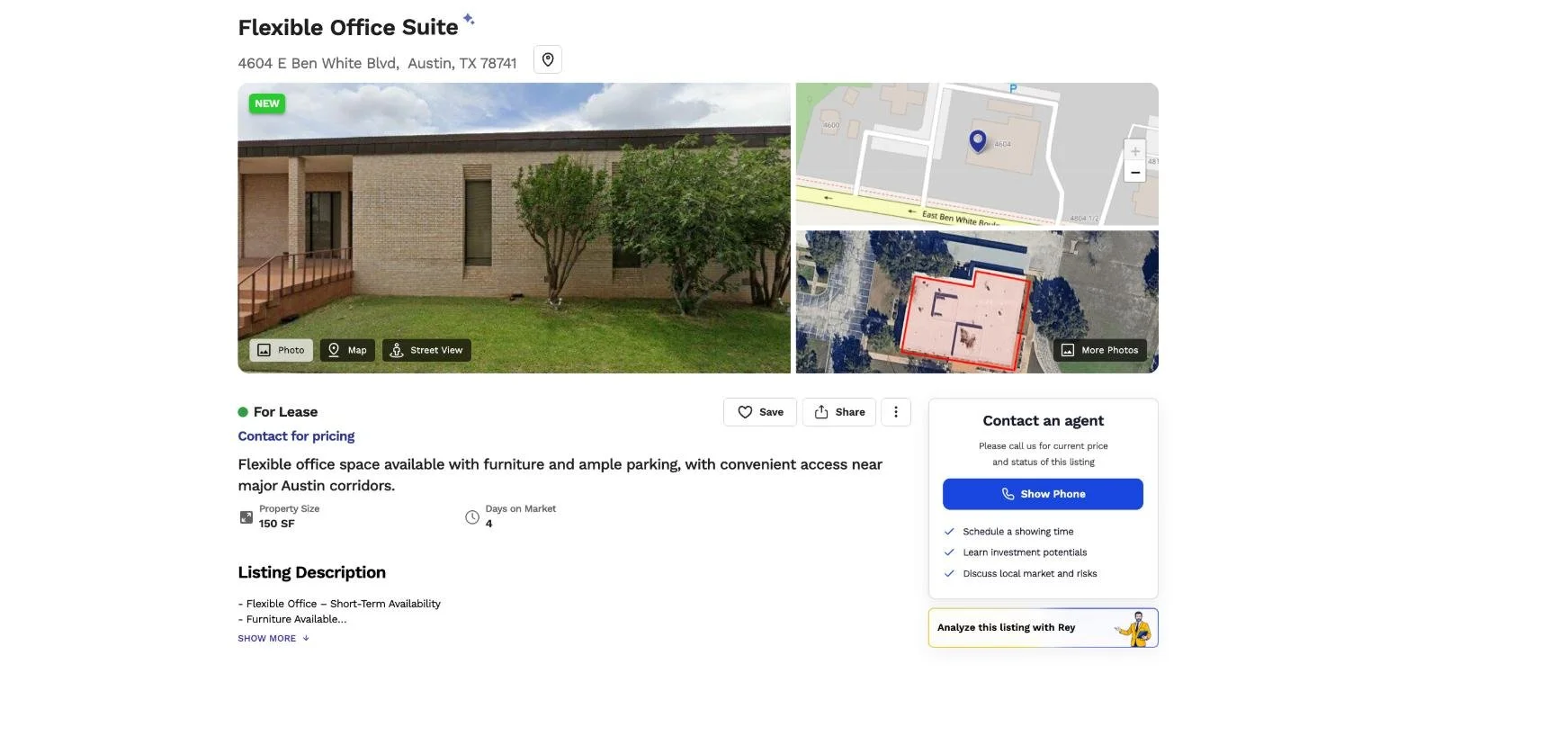
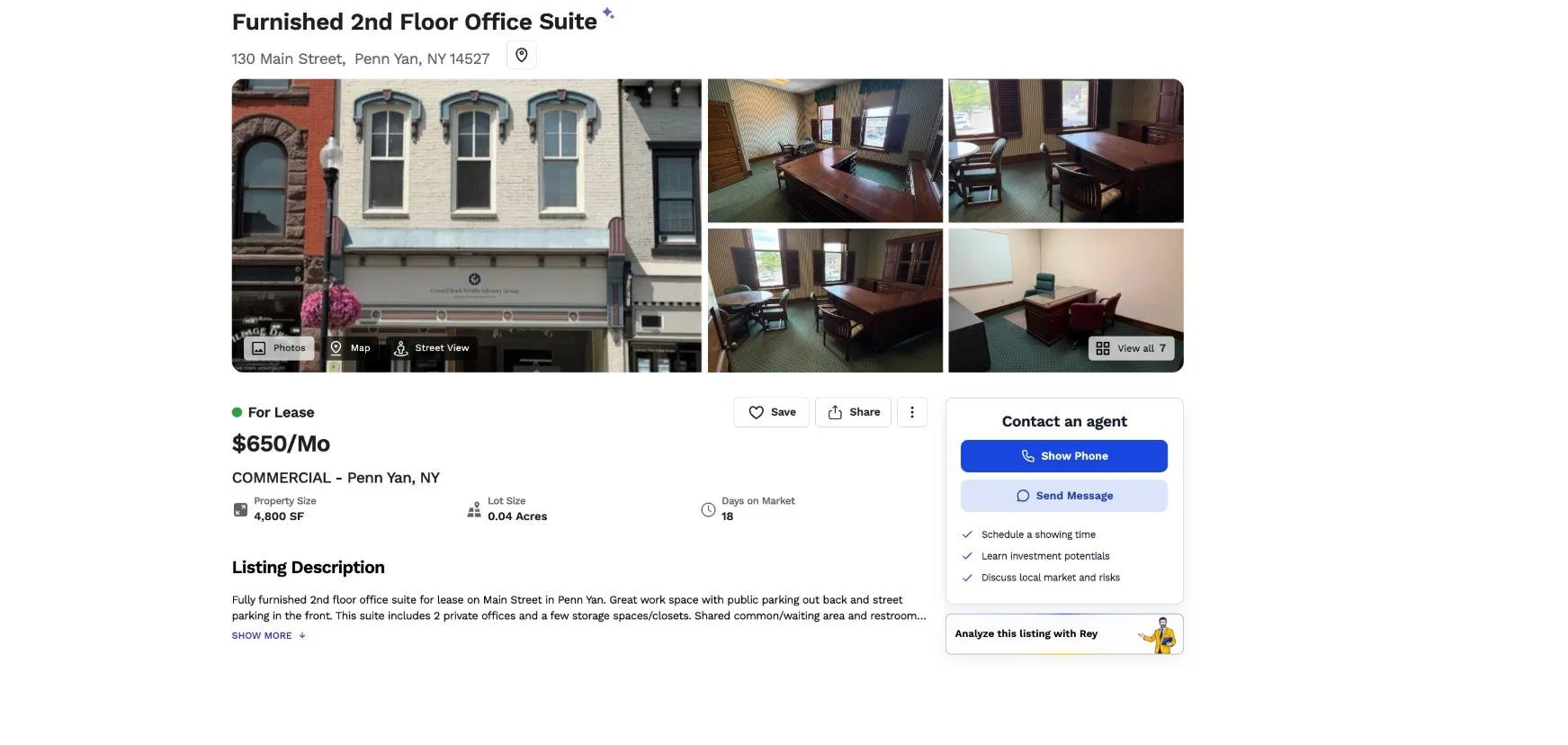
These properties fill a real gap between coworking and a conventional office lease. Coworking helps startups avoid long commitments, while a virtual office provides a business address without dedicated premises. Neither necessarily gives a practice owner or small professional firm a private, controllable workplace. A furnished or utilities-included suite can offer that privacy with a predictable monthly bill.
The deduction. Flexible-office inventory can create a bit of confusion. Some results represent individual desks or managed-office packages inside a much larger building rather than conventional suites with independent leases. Tenants have to inspect the listing carefully to understand what the quoted size and price actually cover.
Availability and lease flexibility also vary. A small monthly suite may offer a shorter commitment, but traditional commercial office terms commonly run several years. Realmo doesn’t standardize the minimum term or deposit, so a low headline rate doesn’t automatically mean a low upfront obligation.
Score: 5/5. Realmo surfaces small, furnished, and all-inclusive offices that are easy to miss on marketplaces built around promoted listings.
The Realmo Office Space Review Scorecard
Inventory depth and reach — Weight: 25% — Score: 4.5/5
Cost transparency — Weight: 25% — Score: 3.5/5
Listing depth — Weight: 15% — Score: 4/5
Search experience — Weight: 10% — Score: 4/5
Freshness and data trust — Weight: 10% — Score: 4/5
Small-tenant fit — Weight: 15% — Score: 5/5
Weighted overall — Weight: 100% — Score: 4.15
The weights reflect tenant-side priorities: inventory and cost transparency determine whether a shortlist can be built, while listing depth, small-tenant fit, search, and freshness determine how efficiently it can be verified.
This review is sample-based: Criterion 1 draws on a national inventory count, while Criteria 2 through 6 rely on point-sample evidence from specific markets (Austin, Dallas, Santa Monica, Paducah, Penn Yan) rather than an exhaustive national audit. To check whether the same 4.15 score holds in your market, re-run the office-space search with your own location, size, and budget rather than relying on the national result. The score should be recalculated whenever materially different evidence appears.
Who the Score Is For and Who Should Ignore It
The 4.15 score applies to tenant-side discovery. Realmo is most useful to founders, office managers, practice owners, and tenant-rep brokers assembling an initial shortlist, particularly for requirements below 5,000 square feet or outside the most heavily marketed office districts. Its free access, long-tail inventory, and unusually strong selection of small offices make it a credible place to begin the search.
Institutional occupiers and advisers who require verified lease comps, complete stacking plans, detailed ownership histories, or building-level market analytics should treat Realmo as a supplement rather than a replacement for a paid data platform.
No marketplace score covers the final lease. Tenants still need to negotiate annual escalations, renewal options, early-termination rights, build-out contributions, free rent, and the right to sublease part of the premises. They also need to confirm that zoning permits the intended use and that the office meets building, fire, accessibility, and insurance requirements.
A tenant-rep broker is commonly paid through the landlord-side commission structure rather than a separate tenant charge, although the engagement terms should always be checked. Legal review is worth budgeting for as well. Commercial leases can be long, technical documents, and the cost of professional advice is small beside a multi-year occupancy commitment.