Smart Roof Replacement Planning to Improve Home Value and Long Term Protection

A roof plays a central role in protecting a home, but it also has a direct impact on long-term value and efficiency. Over time, materials wear down, performance declines, and the need for an upgrade becomes more apparent. Homeowners who plan ahead can turn this necessity into a strategic improvement rather than an unexpected expense.

Taking a thoughtful approach to roof replacement allows for better decision-making at every stage. Instead of reacting to damage, planning in advance creates opportunities to choose better materials, improve energy efficiency, and enhance overall durability. This shift in mindset leads to more controlled and cost-effective outcomes.

Understanding how to approach the process helps homeowners avoid common pitfalls. With the right preparation and support, replacing a roof becomes a valuable investment that supports both immediate needs and future stability.

Recognizing the Right Time to Plan a Replacement Project

Timing plays a critical role in any major home improvement decision. Waiting too long can lead to structural damage, while acting too early may not seem financially practical. Finding the right balance requires awareness of how roofing systems age.

Visible signs such as worn shingles, recurring leaks, or uneven surfaces often indicate declining performance. These issues may start small but usually signal deeper concerns within the structure. Addressing them early allows for better planning instead of emergency action.

Working with professionals like AG Exterior Solutions helps homeowners evaluate these signs accurately. Their experience provides clarity on whether repairs are still viable or if a full replacement is the better long-term solution.

How Material Selection Influences Long Term Performance

Choosing the right materials is one of the most important decisions in any roof replacement project. Different options offer varying levels of durability, weather resistance, and maintenance requirements. Understanding these differences helps homeowners make informed choices.

Modern materials are designed to handle environmental stress more effectively than older systems. They provide improved resistance to moisture, wind, and temperature changes. This results in a longer lifespan and fewer maintenance concerns over time.

AG Exterior Solutions often guides homeowners through these options to ensure the selected materials align with both performance needs and budget considerations. This step ensures that the investment delivers lasting value.

Improving Energy Efficiency Through Updated Roofing Systems

Energy efficiency is often overlooked when planning a roof replacement, but it plays a significant role in overall home performance. Older roofs may allow heat to escape during colder months or enter during warmer periods. This increases the workload on heating and cooling systems.

A new roofing system improves insulation and ventilation, creating a more stable indoor environment. This reduces energy consumption and can lead to noticeable savings on utility bills. Over time, these savings contribute to offsetting the cost of the project.

Better efficiency also enhances comfort throughout the home. Consistent temperatures make living spaces more enjoyable and reduce strain on household systems.

Planning the Budget Without Unexpected Costs

Financial planning is essential when preparing for a roof replacement project. Costs can vary depending on materials, labor, and the complexity of the installation. Without a clear plan, expenses can quickly exceed expectations.

Breaking down the project into specific components helps create a more accurate budget. This includes materials, removal of the existing roof, installation, and any necessary structural adjustments. Understanding these elements prevents surprises during the process.

AG Exterior Solutions provides transparent estimates that help homeowners plan with confidence. Clear communication about costs ensures that expectations remain aligned from start to finish.

Enhancing Property Value Through Strategic Upgrades

A new roof contributes significantly to a home’s overall value. It improves both functionality and visual appeal, making the property more attractive to potential buyers. Even for those not planning to sell, this added value provides long-term benefits.

Buyers often view a recent roof replacement as a major advantage. It reduces concerns about future repairs and signals that the home has been well maintained. This can influence both interest and final sale price.

In addition to financial value, a new roof enhances curb appeal. Clean lines and updated materials create a more polished and modern appearance.

Coordinating the Replacement Process for Minimal Disruption

Replacing a roof is a significant project that requires coordination and planning. Without proper organization, it can disrupt daily routines and create unnecessary stress. Preparing in advance helps minimize these challenges.

Scheduling the project during favorable weather conditions reduces the risk of delays. Clear communication with contractors ensures that timelines are understood and followed. This keeps the process efficient and predictable.

A structured roof replacement plan allows homeowners to manage the project with less disruption. Knowing what to expect at each stage makes the experience more manageable.

Avoiding Common Mistakes During Major Roofing Projects

Mistakes during a roof replacement can lead to long-term issues that are difficult to correct. One common error is choosing materials based solely on cost rather than performance. While budget is important, quality should not be compromised.

Another mistake is overlooking ventilation and insulation requirements. These elements play a key role in how the roof performs over time. Ignoring them can lead to moisture problems and reduced efficiency.

Working with experienced providers like AG Exterior Solutions helps prevent these issues. Their structured approach ensures that all aspects of the project are handled correctly.

Long Term Maintenance After Installation Is Complete

A new roof does not eliminate the need for maintenance. Regular inspections and basic upkeep help preserve its condition and extend its lifespan. Simple actions can prevent small issues from developing into larger problems.

Cleaning gutters, checking for debris, and monitoring for early signs of wear are all part of responsible ownership. These steps ensure that the roof continues to perform as expected over time.

A properly maintained roof replacement provides consistent protection and reduces the likelihood of unexpected repairs. This ongoing care supports long-term reliability.

Building Confidence Through Smart Roofing Decisions

Making informed decisions about roofing projects creates a sense of confidence for homeowners. Understanding each stage of the process reduces uncertainty and allows for better planning. This leads to smoother experiences and more successful outcomes.

Every aspect of the project, from material selection to budgeting, contributes to the final result. Taking the time to evaluate options ensures that choices are aligned with long-term goals.

With guidance from AG Exterior Solutions, homeowners can approach roof replacement with clarity and assurance. Their expertise helps turn a complex project into a manageable and rewarding investment.

Long Term Benefits of a Well Planned Roofing Upgrade

A well-executed roof replacement offers benefits that extend far beyond immediate improvements. It enhances durability, reduces maintenance needs, and improves overall home performance. These advantages continue to add value over time.

Reliable protection against environmental conditions ensures that the home remains safe and comfortable. This stability supports both daily living and long-term property preservation.

Investing in proper planning and professional support leads to better results. A thoughtful approach ensures that the new roofing system delivers lasting performance and peace of mind.

Best Out-of-State 529 Plans for New York Residents (Beyond NY 529 Direct)

Saving for college in New York usually starts with the state’s low-cost 529 Direct Plan. Built on Vanguard index funds, it lets you deduct up to $5,000 (single) or $10,000 (joint) on your state return—often worth $650 to $1,000 in cash each April. But that break applies only to your first dollars. Above the cap, fees and fund quality decide growth, and several out-of-state plans charge as little as 0.10 % a year—enough to outpace New York’s option over 18 years. This guide compares seven direct-sold 529s that give New York savers the best shot at higher net returns.

New York 529 tax perks and their ceiling

New York lets residents deduct up to $5,000 per year on a single return, or $10,000 on a joint return, when contributions go into the New York 529 Direct Plan. According to the New York State Department of Taxation and Finance, that break can trim roughly $650 to $1,000 from a typical combined state-and-city tax bill each year.

Because the deduction only applies to your first dollars, every contribution above the cap depends on fees, investment performance, and plan features. Many out-of-state plans charge lower expenses, so they can grow faster once the New York incentive runs out.

One caveat: if you move deducted money from the New York plan to another state’s 529, New York adds the prior deduction back to your taxable income for that year. The state removed this “recapture” rule for 529-to-Roth IRA rollovers in September 2024, keeping state law in step with the federal SECURE 2.0 change.

The rule applies only to dollars that claimed the deduction. Contribute directly to an out-of-state 529 and you avoid any future claw-back. That split-plan strategy—max the first $10,000 at home, then send overflow to the lowest-fee national leader—guides the rankings that follow.

New rules reshaping 529 strategy

529-to-Roth IRA rollovers: a fresh escape hatch

Starting in 2024, the SECURE 2.0 Act lets you move up to $35,000 of unused 529 money into the beneficiary’s Roth IRA. The rollover is federal-tax free, counts toward the annual Roth limit, and the 529 must be at least 15 years old with each contribution on file for five years.

For families worried about over-saving, this change turns leftover tuition dollars into retirement seed money with no penalties or income-cap hurdles.

New York closed its own gap on September 5, 2024, amending state tax law to treat 529-to-Roth rollovers as qualified withdrawals, according to CPAservices.com. Before that date, a rollover triggered recapture of any New York deduction. Now the state aligns with federal rules, so residents can move surplus balances without a tax claw-back.

The bottom line: whether you save in the New York 529 Direct Plan or an out-of-state option, any excess can now shift to a Roth IRA without a state-tax surprise.

Next up, we review the fee cuts and tech upgrades that have made several national plans cheaper and easier to use.

How we picked and ranked the contenders

We reviewed every direct-sold 529 plan in the country and scored each one using a five-factor system tailored to New York savers.

First comes cost: lower fees leave more money for tuition, so price carries the most weight. We then evaluated investment quality, flexibility, user experience, and any extra features that can tip the scales.

Weighting:

●       Fees – 30 percent

●       Investment quality and performance – 25 percent

●       Flexibility for New Yorkers (easy funding, sensible minimums) – 15 percent

●       Digital experience and customer care – 15 percent

●       Unique perks (ESG funds, FDIC CDs, custom glide paths) – 15 percent

We applied strict guardrails. A plan had to charge 0.25 percent or less on its core age-based portfolio, accept out-of-state investors on equal terms, and hold a current Morningstar Medalist rating. Advisor-sold programs, load funds, or anything with hidden state surcharges went straight to the reject pile.

Finally, we gave bonus points for features that pair well with New York’s deduction, such as zero-dollar minimums or an easy rollover process. The outcome is a ranking that balances hard numbers with day-to-day usability for families who file in Albany.

Ready for the countdown? We start with number seven and work toward the top spot.

7. Virginia Invest529: a quiet overachiever worth a look

Virginia’s Invest529 rarely makes headlines, but it covers every practical need for New York savers.

Costs stay low. Most index portfolios sit near 0.13 percent all in, matching New York’s plan. The state agency continues to cut expenses as assets grow, so today’s price can fall further over time.

The investment menu feels familiar yet complete. Age-based tracks shift from growth to safety, while static options include U.S. equity, international, bonds, and an ESG-tilted balanced fund. BlackRock index funds provide broad diversification at a bargain price.

Ease matters, and Virginia scores well. The site is clean, works on mobile, and lets you set recurring deposits in minutes. Opening minimum: ten dollars, ideal for testing the waters after you max out your New York deduction.

Why is Virginia seventh? It lacks the ultra-low fees or special extras offered by higher-ranked plans. Still, if you want steady stewardship from a large 529 administrator and like an ESG sleeve without a surcharge, Invest529 is a reliable second account or a main home for dollars above Albany’s tax cap.

6. Nevada Vanguard 529: index efficiency for larger opening checks

Nevada’s direct 529 works much like holding a Vanguard brokerage account inside a tax shelter. Every portfolio relies on Vanguard index funds, so performance is transparent and fees predictable; most age-based tracks cost about 0.14 to 0.18 percent.

The trade-off appears on day one. Non-residents must deposit at least three thousand dollars to open an account. After that, additional contributions can be as low as fifty dollars.

Investment choice stays simple: choose an age-based glide path (conservative, moderate, or aggressive) or build from single funds such as Total Stock Market or Total Bond Market. There are no active sleeves, ESG detours, or bank stable-value funds. If you want market tracking at minimal cost, the Vanguard lineup delivers.

Platform integration strengthens the appeal. Because the plan lives on Vanguard’s website, you can see your 529 beside IRAs and taxable accounts, schedule automatic transfers from the same dashboard, and reach Vanguard phone reps if questions come up.

Why sixth place? The plan has competitive fees but fewer extras than the leaders, and its steep opening minimum can deter families easing into college savings. For households already deep in the Vanguard ecosystem and ready to write a larger first check, however, Nevada offers a clear, low-drag path to college funding.

5. Ohio CollegeAdvantage: versatility meets low costs

Ohio’s CollegeAdvantage ranks fifth for pairing one of the deepest investment menus in the 529 universe with fees in the low-teens basis-point range.

Start with choice. You can build a Vanguard index mix, tilt toward Dimensional Fund Advisors factor funds for a small-cap or value boost, or park near-college dollars in FDIC-insured CDs and a stable-value option that protects principal. Few plans bundle this breadth under one roof at a similar price.

Total expenses on the age-based index track run about 0.15 to 0.20 percent. The state tuition-trust authority reduces costs whenever assets cross a new milestone; a recent cut dropped the record-keeping fee below one-tenth of a percent.

User experience keeps pace. Opening an account takes about ten minutes online, the minimum is twenty-five dollars, and a gifting portal lets grandparents contribute with a few clicks. The dashboard even shows how much of your balance sits in each underlying fund, useful for tracking allocation.

For New Yorkers the strategy is simple: claim the home-state deduction on the first ten thousand dollars each year, then send overflow to Ohio if you want to blend growth assets for a toddler with principal-protected cash for a high-school junior in the same plan. No other program on this list matches that built-in flexibility.

Ohio finishes at number five because the remaining plans shave fees slightly lower or add standout perks. If menu depth and safety options top your list, the Buckeye plan is hard to beat.

4. Pennsylvania 529 Investment Plan: Vanguard strength with fee momentum

Pennsylvania’s direct-sold 529 looks like New York’s plan in many ways. It uses Vanguard index funds and stays easy to understand, but Harrisburg keeps trimming expenses whenever assets reach a new milestone.

The core age-based track costs about 0.20 percent today. The state treasury has negotiated several cuts in the past three years and publicly commits to lowering fees further as the program grows. You pay a low rate now and gain a path to even lower costs later.

The menu matches Vanguard’s greatest hits. Target Enrollment portfolios shift automatically as college nears, while static options cover total U.S. stock, international stock, bonds, and money market. The lineup is straightforward and fully diversified.

Why choose this plan over New York’s? First, governance diversification: Pennsylvania’s treasury runs the program and has a record of pressing fund providers on cost, giving your savings a second watchdog. Second, the plan requires only twenty-five dollars to open, so every dollar above New York’s deduction cap can move into a separate, low-fee account with almost no friction.

Pennsylvania ranks fourth because its price still sits a touch above the top three. Even so, the clear downward trend, Vanguard DNA, and strong state oversight make it an easy “set and forget” supplement for New York families seeking extra fee leverage without added complexity.

3. Massachusetts U.Fund: Fidelity index muscle, now Gold rated

Massachusetts once sat in the middle of the 529 pack. After cutting fees, trimming the fund menu, and securing a Morningstar Gold rating, U.Fund now feels custom-built for New Yorkers who already rely on Fidelity for retirement and brokerage accounts.

Costs come first. Age-based index portfolios run about 0.14 percent, matching New York and Illinois without locking you into Vanguard products. If you like Fidelity’s Total Market Index and want the same low-fee culture, this plan checks the box.

Investment choice stays simple. Select an age-based path that shifts from stocks to bonds, or place money in a few static index funds covering United States equity, international equity, and core bonds. No niche funds compete for attention, so decision fatigue stays low and glide-path discipline stays high.

Platform integration is the real draw. Open a U.Fund account and it appears next to your Fidelity balances under the same username and mobile app. Automatic transfers and college cost calculators live in the dashboard you already use, nudging you to stay on schedule.

Minimum to open? Zero dollars. Testing the plan after you exhaust New York’s deduction room is effortless. Because Massachusetts offers no resident tax break, out-of-staters pay the same fees and face no residency quirks.

Why third instead of higher? The lineup sticks to plain-vanilla index funds and lacks Utah’s custom controls or Illinois’s wider fund roster. If Fidelity integration and low fees top your wish list, though, U.Fund is a reliable, low-maintenance path to college savings.

2. Utah my529: customization at Vanguard-like prices

Utah’s my529 charges about 0.12 to 0.18 percent on its index age-based tracks while giving you a level of control few direct-sold plans match.

Utah my529 custom age-based portfolio interface.

Start with an off-the-shelf enrollment portfolio and you are set. Performance mirrors market indexes with minimal drag. Want deeper control? Select “Custom Age-Based” and craft your own glide path—for example, 70 percent stock through eighth grade before shifting to bonds—or add slices of small-cap value and real estate investment trusts. You can adjust the mix once each calendar quarter, balancing flexibility with discipline.

Access stays simple. The account has no opening minimum, and a gifting portal lets friends contribute through a personalized link. The site is clean and intuitive, a clear step up from New York’s interface.

Utah places second only because Illinois matches its fee tier while offering broader fund families and a new mobile app. If you enjoy tailoring asset allocation, my529 is the standout. For everyone else, it serves as a low-cost, high-quality companion to a core New York contribution strategy.

1. Illinois Bright Start: low-fee leader with steady upgrades

Bright Start ranks first because it pairs persistent fee cuts with broad investment choice. Most index portfolios cost about 0.13 percent, matching New York’s plan while adding fund families beyond Vanguard. In 2024 the Illinois treasurer negotiated another fee reduction and launched a mobile app that lets you open or fund an account in minutes.

Choice is extensive. More than forty portfolios draw from eleven fund managers, including Vanguard, DFA, and T. Rowe Price. You can stay with index funds or add selected active strategies without driving up cost. Age-based tracks offer several risk levels, and custom blends let experienced investors fine-tune allocation quickly.

Accessibility also stands out. The minimum to open is zero dollars, so Bright Start works well for the first dollar above New York’s deduction cap. You can set automatic transfers of any amount on any schedule, and there are no account or maintenance fees.

To test whether those transfers will cover a future tuition bill, Bright Start’s College savings plan estimator runs projections using a 6 percent annual return and 5 percent tuition inflation, then shows what share of costs your savings could fund.

Oversight adds confidence. The state treasurer’s office publishes each cost reduction and has earned Bright Start a Morningstar Gold rating for seven consecutive years, signaling a culture of continuous improvement.

Put together—low fees, a wide fund menu, and modern tools—Bright Start gives New York savers a strong chance to outpace the hometown plan on net returns.

Quick-glance comparison

Use this table to double-check fees and minimums before you open an account. Figures reflect plan disclosures through the fourth quarter of 2025, including the latest announced fee cuts.

*Morningstar Medalist ratings current as of the 2025 cycle.

Even a one-tenth-of-a-percentage-point fee gap on a one-hundred-thousand-dollar balance costs one hundred dollars every year. Compound that through senior year, and the low-cost leaders in the first three rows can cover a full semester of books by themselves.

FAQs for New York 529 savers

Do I lose the New York tax break if I use another state’s plan?

Yes. The deduction of up to five thousand dollars (single) or ten thousand dollars (joint) applies only to contributions made to the New York 529 Direct Plan.

Can I split my savings between two plans?

Yes. Many families claim the state deduction on the first ten thousand dollars each year, then send extra dollars to a low-fee out-of-state plan from our top seven list. The accounts run side by side, and the Internal Revenue Service and FAFSA treat them the same.

What happens if I roll New York money into another state’s 529 or a Roth IRA?

Moving funds to another state’s 529 triggers recapture of every New York deduction previously claimed on those contributions. A rollover to a Roth IRA is different: since September 5, 2024, New York treats a 529-to-Roth rollover as a qualified withdrawal, so no state tax is owed.

Are qualified withdrawals taxed differently if the 529 is out of state?

No. Qualified withdrawals are free of federal and New York income tax regardless of the sponsoring state.

Why place Illinois Bright Start above Utah my529?

Utah offers unmatched customization, but Illinois combines rock-bottom fees with ongoing improvements such as the 2024 fee cut and mobile app. For most New York investors that combination edges out Utah by a small margin.

Do 529 balances hurt financial-aid eligibility?

Only slightly. A parent-owned 529 counts as a parental asset on the FAFSA, so at most five point six percent of its value factors into the aid formula.

What if my child wins a scholarship or decides not to attend college?

You can change the beneficiary, keep the money growing, withdraw up to the scholarship amount penalty-free, or roll up to thirty-five thousand dollars into the beneficiary’s Roth IRA, now free of both federal and New York state tax.

Conclusion

For New York savers, the smartest play is split-plan: lock in the $10,000 deduction at home, then route the overflow to Illinois Bright Start, Utah my529, or Massachusetts U.Fund, where fees near 0.13 percent compound in your favor. With Roth rollovers now claw-back free, surplus dollars stay productive.

9 Best Business Internet Providers in Pinellas County Florida

Pinellas’s cafés, Clearwater biotech labs, and dockside marine shops all live and die by reliable bandwidth—especially when Gulf storms batter the lines. We pulled the FCC broadband map and ISPReports’ 2025 address data, then scored every carrier on uptime, upload speed, two-year cost, support, and county reach. The result: nine “best for” winners you can skim in minutes and act on today. Read on to choose the line that keeps your business moving—rain, shine, or hurricane watch.

How we ranked the providers

We built a scorecard that mirrors how Pinellas businesses operate and the problems they report most often.

First, we collected coverage and speed data for every provider that sells a true business plan in the county. The FCC broadband map, refined by ISPReports’ 2025 address-level update, anchors the dataset. We added customer-satisfaction results from the latest J.D. Power study plus storm-reliability notes flagged by AZ Big Media’s statewide comparison.

Each ISP then earned points in five weighted categories:

  1. Reliability and uptime (25 percent) – service credits, battery-backed nodes, and local outage frequency. 

  2. Speed and performance (20 percent) – especially upload power for cloud backups and video calls. 

  3. Two-year value (20 percent) – real cost after promotions expire, normalized to price per Mbps. 

  4. Support reputation (15 percent) – response times, J.D. Power scores, and whether you reach a rep who knows Pinellas. 

  5. County availability (10 percent) – the chance a provider can serve both your main office and the branch across the bay.

Scores roll up to a 100-point scale. The higher the total, the higher the rank. Every winner also earns a “Best for” tag, so you can jump straight to the option that matches your workflow.

1. WOW! Business – best value for fiber-level speed on a cable budget

Scaling a café’s Wi-Fi or a design studio’s cloud backups can stretch budgets. WOW! keeps bandwidth high and invoices low.

About 80 percent of business addresses in St. Pete, Clearwater, and Seminole can order service. Coax lines reach 1.2 Gbps downstream, and new fiber routes deliver up to 5 Gbps with symmetrical uploads you can confirm on WOW!'s Pinellas, FL Business Internet planner, which also highlights the current price-lock guarantee for new sign-ups. Upload strength rises on fiber, essential for video uploads and CAD syncs.

Price leads the story. The 300 Mbps plan runs roughly 45 dollars per month with a one-year agreement and a two-year rate guarantee. Occasional “three months free” deals push cost per megabit to the lowest in the county while you still receive 99.99 percent uptime and U.S. support.

Local IT firms report lunch-hour upload dips, yet tickets often trigger a same-week line swap or modem update. Aggressive pricing, expanding fiber reach, and responsive crews make WOW! a smart pick for small and midsize teams seeking gigabit performance without enterprise invoices.

2. Spectrum Business – best for plug-in-anywhere coverage

Need internet tomorrow at a new storefront on Gulf Boulevard? Spectrum likely has a line on the closest pole and a technician who can visit before lunch.

The cable network reaches nearly every commercial block from Tarpon Springs to Tierra Verde. That reach matters if your company shifts locations, opens pop-ups, or signs short leases—you stay with one provider and one invoice.

Current DOCSIS 3.1 equipment tops out at 1 Gbps down and 35 Mbps up. Upload-heavy shops may hit that ceiling, yet point-of-sale, SaaS, and video calls rarely strain the pipe. Spectrum is testing multi-gigabit DOCSIS 4.0 in other states, so faster uploads are expected in Florida within the next year.

Plans are contract-free. A 500 Mbps tier lists at about 65 dollars per month, and retention teams often match Frontier or WOW! quotes. You can cancel at any time without early-termination fees, which helps when landlords or storms force a sudden move.

Reliability sits in the solid middle. Aerial cable lines can flicker during summer squalls, but repair crews respond quickly because those runs serve half the county. Many IT managers pair Spectrum with wireless failover for full continuity, yet as a primary link it offers stable performance at a fair price.

Bottom line: choose Spectrum Business when you value county-wide availability and contract freedom more than maximum upload speed.

3. Frontier Business – best for rock-solid gigabit fiber

When upload speed matters as much as download, fiber leads the pack, and Frontier owns most of the glass in Pinellas. Roughly 60 percent of business addresses can order symmetrical plans at 500 Mbps, 1 Gbps, 2 Gbps, or 7 Gbps. Offices on legacy FiOS routes install quickly, while new builds come online within two weeks.

A 1 Gbps circuit delivers about 940 Mbps in both directions throughout the day, even during the 5 pm video-call rush. Latency sits near 3 milliseconds inside Tampa Bay, so VoIP stays clear and backups finish on schedule. Outages are rare and usually tied to building power, not the line itself.

Pricing is competitive: around 70 dollars for 500 Mbps and 120 dollars for a full gig, with a one-year agreement and a two-year rate guarantee. Frontier lists 99.9 percent uptime in its SLA. The trade-off is repair speed; fiber fixes need specialized crews, so a cut line can take a day instead of an hour. Many IT teams pair Frontier with a low-cost 5 G router for failover.

Pick Frontier when uninterrupted cloud workflows, heavy uploads, and stable monthly costs matter more than the absolute lowest price. If the address checker shows green, few alternatives match its performance.

4. AT&T Business – best wireless backup and one-stop telecom bundle

When power blinks and the modem light goes dark, AT&T Wireless Broadband keeps transactions moving.
AT&T’s 5G and LTE network reaches about 90 percent of Pinellas businesses. A self-install router delivers 50 to 100 Mbps even if every cable line on the street is offline. Pair it with your primary circuit in a dual-WAN firewall and failover triggers within seconds. Cell sites often return to service long before crews can restring coax.

Service starts around 80 dollars per month on a month-to-month plan. Existing AT&T mobile customers qualify for bundle savings. Support routes through the business desk, so you skip consumer queues and speak with staff who know static IPs and VLANs.

Many midsize and enterprise teams also source voice, SD-WAN, and dedicated fiber from AT&T. Managing all services in one portal simplifies billing and centralizes accountability.

Keep AT&T as a safety net or use it as the primary link for pop-ups, kiosks, and construction trailers. The compact gateway protects revenue-critical apps when storms knock out wireline paths.

5. Verizon 5G Business Internet – best wireless failover for storm season

A Verizon 5G gateway on a windowsill can save the day when backhoes or storms cut your primary line. The device activates within seconds and delivers 100 to 300 Mbps of low-latency bandwidth.

About half of Pinellas businesses sit inside Verizon’s Ultra Wideband footprint, while the rest receive dependable LTE speeds. The plan is truly unlimited, so point-of-sale, cameras, and Teams calls continue even during multi-day repairs.

Installation is simple: ship the hardware, scan a QR code, plug it in. Service costs about 69 dollars per month with no contract. Many IT teams place the gateway behind a dual-WAN firewall so staff never notice the switch.

Cell sites run on batteries and generators, so Verizon often returns before power crews reach flooded streets. Pop-up retailers even use it as a primary link, but its main value is resilience.

If revenue halts when the internet drops, a Verizon 5G line is affordable insurance.

6. T-Mobile Business Internet – best shoestring primary or tertiary line

A T-Mobile gateway offers service in about two minutes: plug it in and receive 50 to 150 Mbps of 5G bandwidth for roughly 50 dollars per month, taxes included, with no contract.

Coverage is nearly county-wide because of T-Mobile’s mid-band spectrum. Speeds vary with tower load—morning file pushes tend to fly while Friday-night syncs can slow—but for checkout, cloud point-of-sale, and daily email it delivers reliable value.

Many IT teams keep the gateway as a third-path connection behind fiber and cable. That extra route maintains guest Wi-Fi or camera feeds without touching core traffic, and the low cost makes redundancy affordable.

Support is basic but responsive. Treat the service like a utility: bridge it to your router, test failover quarterly, then let it sit until needed. For lean operations or tight budgets, T-Mobile provides simple, low-cost connectivity.

7. Kuducom – best local concierge service for tailored links

Some companies need more than a help-desk ticket; they need a technician who already knows the rooftop layout. That describes Kuducom, a Tampa-based team that treats every circuit as mission-critical.

Kuducom beams fixed-wireless signals across downtown skylines and warehouse roofs, delivering symmetrical speeds up to 200 Mbps where fiber and cable cannot reach. Coverage is niche—about 10 percent of Pinellas—but if you have clear line of sight to an antenna, the company can install service within days.

Pricing is custom. Expect about 250 dollars per month for a dedicated 100 × 100 Mbps link that includes proactive monitoring and a direct engineer phone line. Uptime is contractually set at 99.9 percent, and local field techs usually arrive the same day because their trucks stay in the area.

Flexibility is the main draw. Need VoIP trunks, a point-to-point link between offices, or a temporary circuit for a festival? Kuducom designs it, manages it, and sends one clear invoice.

Choose Kuducom when personal support matters as much as bandwidth—ideal for medical practices, event venues, or any team that wants a local expert on speed dial.

8. Rapid Systems – best for hard-to-reach sites and last-mile redundancy

Some parts of the county sit in a connectivity shadow: a marina behind mangroves, a warehouse beyond the urban edge, or a gated community where cable stops two streets short. Rapid Systems serves those addresses.

The company runs a microwave network that hops rooftop to rooftop, avoiding buried fiber. Engineers survey your roof, aim a small dish at the nearest tower, and provide 20, 50, or 100 Mbps of symmetrical bandwidth within a week. Enterprise clients can request up to 1 Gbps if budget permits.

Because each link is point-to-point, your bandwidth stays dedicated. Evening congestion common on shared cable loops never appears, and latency remains low for wireless—often under 15 milliseconds across the bay. Rapid lists 99.9 percent uptime, monitors every circuit, and reroutes traffic if a tower takes a lightning hit.

The price reflects personalized installation: a 20 × 20 Mbps circuit costs about 200 dollars per month plus one-time equipment fees. For businesses that lose thousands per hour during an outage, that premium buys peace of mind.

Rapid also works well as a secondary path. Many IT teams pair Frontier fiber with a Rapid dish on a separate route; if a backhoe severs the street conduit, traffic shifts to the rooftop link and operations continue.

If your address shows “service unavailable” on major provider checkers—or you need a backup that avoids the same poles and trenches—Rapid Systems is worth a call.

9. IQ Fiber – best emerging multi-gig contender to watch

New conduit under Clearwater streets signals IQ Fiber’s arrival. Backed by a 100-million-dollar build announced in May 2026, the Jacksonville provider is installing XGS-PON fiber capable of 10 Gbps symmetrical service.

Coverage is still small, limited to pockets of St. Pete and Clearwater, yet crews expect to pass tens of thousands of addresses within two years. Early adopters pay about 65 dollars per month for 1 Gbps, contract free, with Wi-Fi 7 hardware included. Multi-gig tiers will follow as demand grows, giving media studios and data-heavy teams a second true-fiber option alongside Frontier.

The network is entirely underground, route redundant, and monitored end to end, a design that supports high uptime as the customer base scales. Support stays local; IQ Fiber opened a Clearwater call center to keep wait times short.

If your address already qualifies, locking in promo pricing now secures long-term value. If not, watch the construction map and use the incoming competition when renegotiating with current providers. More fiber choices benefit every business budget in Pinellas County.

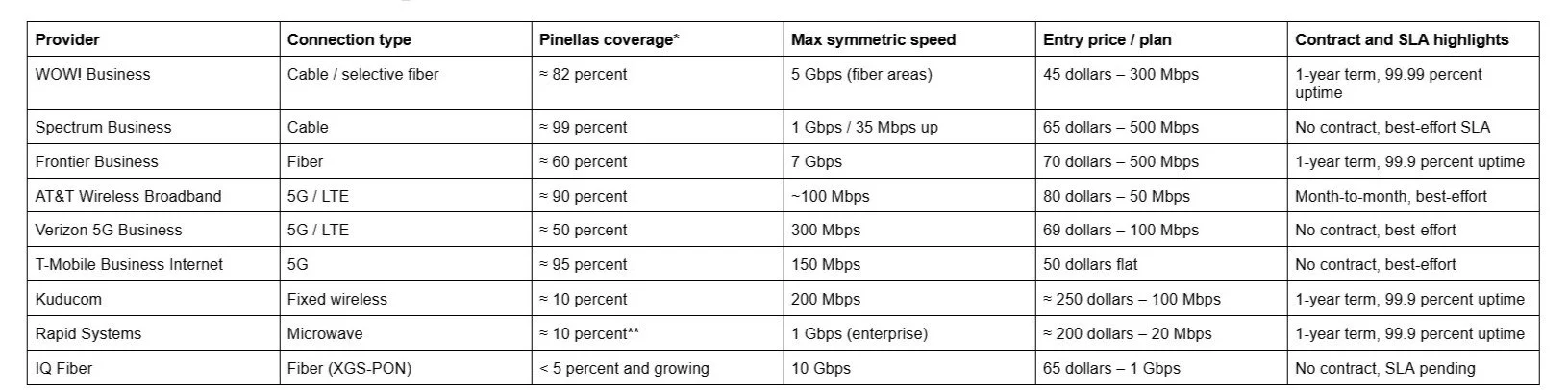
Quick-glance comparison table

You just covered a lot of detail. Use this grid to see how the nine providers stack up, then jump back to any profile for a deeper dive.

*Coverage reflects business addresses and draws on FCC and ISPReports data.

**Footprint can expand with custom relay installs.

Key takeaways:

  • Need maximum availability? Spectrum’s county-wide cable is the safest choice. 

  • Chasing top speed plus uptime? Frontier and IQ Fiber lead where their fiber is live. 

  • Looking for budget-friendly backup? Verizon and T-Mobile provide affordable wireless redundancy. 

  • Serving niche rooftops or remote fringes? Kuducom and Rapid Systems often succeed where larger providers cannot.

Keep this table handy the next time a landlord, finance lead, or hurricane advisory triggers an urgent internet decision.

Frequently asked questions

Putting it all together: pick your perfect connection

Fast internet is no longer optional on Florida’s west coast. It powers point-of-sale swipes, payroll runs, and late-night uploads. The good news: Pinellas companies have more choices than ever.

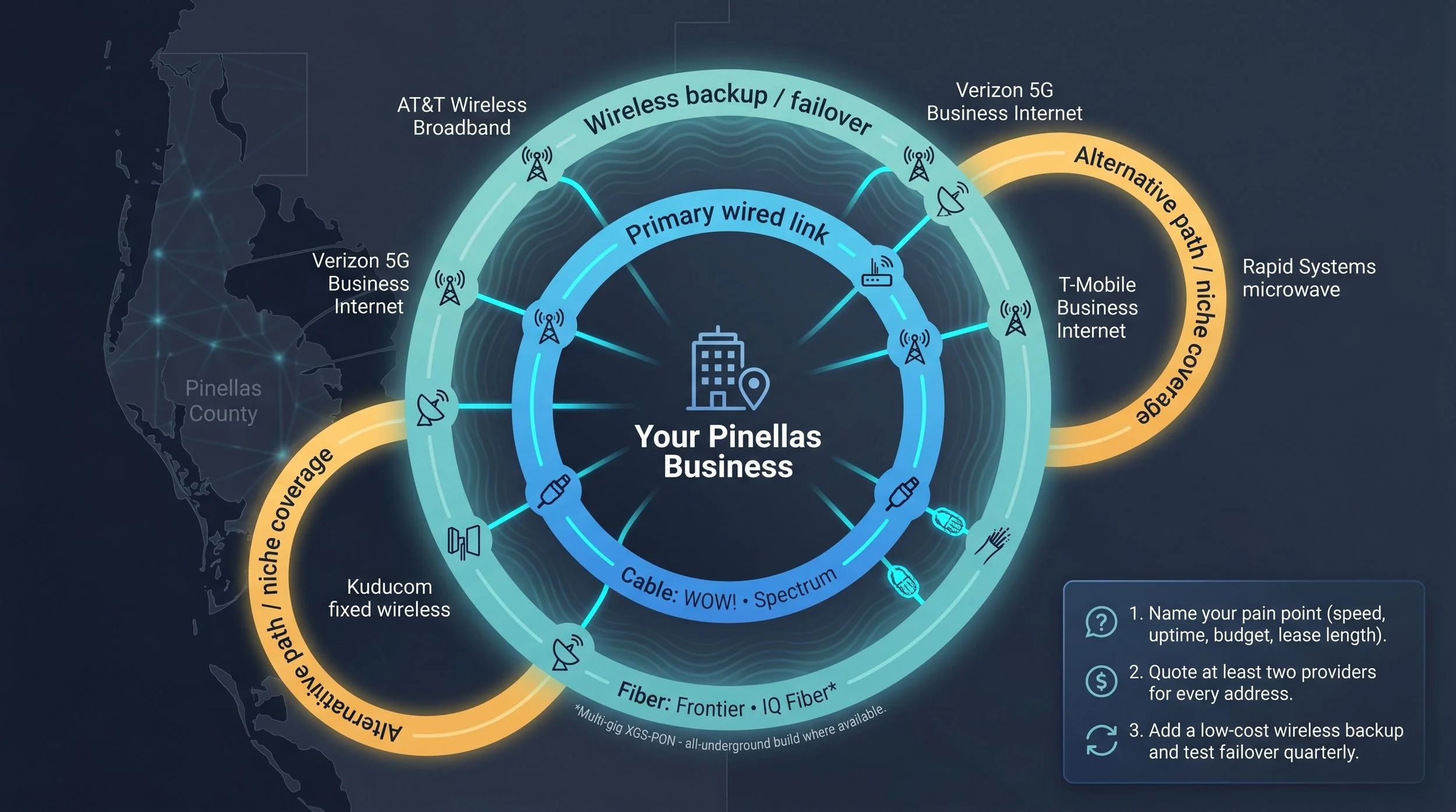
Start by naming your real pain point. Need rock-solid uptime for a clinic’s cloud EMR? Pair Frontier fiber with Verizon 5G failover. Opening a boutique on a six-month lease? Spectrum’s no-contract cable gets you selling tomorrow and leaves with no penalty. Running a video studio in an IQ Fiber zone? Order the 10-gig circuit and forget bandwidth worries.

Next, use price pressure. Quote at least two providers for every address. Carriers know competition is rising; many trim ten to twenty percent or include static IPs to win your signature. Ask for a two-year rate review so you can renegotiate when new fiber reaches your block.

Finally, build redundancy. Hurricanes, traffic accidents, and construction crews follow their own schedules. A low-cost wireless box on a separate network costs less than one hour of downtime for most teams. Add it, test failover each quarter, and sleep easier during storm season.

We hope this guide turned the Pinellas ISP maze into a clear decision path. Check your address on two or three sites tonight, gather fresh quotes, and secure the bandwidth that keeps your business moving. See you online.

3 Companies Ranked as the Best Hybrid Executive Assistant Staffing Agency in NYC

Walk into any Manhattan lobby at 8 a.m. and you’ll feel it: phones buzzing, elevators packed, executives juggling meetings they can’t move. When the assistant’s chair is empty, that tension explodes into missed calls and stalled deals—yet the average admin role now sits open 44 days.

That hiring lag is driving demand for the modern, do-it-all hybrid executive/personal assistant (EA/PA). Specialist recruiters like C-Suite Assistants report a surge in requests for talent who can polish a board deck at dawn and lock down an impossible dinner reservation by dusk.

The pay matches the pressure. Mid-level NYC EAs command $85k–$120k; seasoned pros who run both office and personal life routinely clear $140k+, with some Wall Street desks topping $150k.

With that much money—and risk—on the line, choosing the right staffing partner isn’t optional; it’s insurance. The guide that follows ranks the three agencies best equipped to place elite hybrid EA/PAs fast, using a data-driven rubric executives can trust. Think of it as your shortcut to the right hand who will keep your calendar—and your life—running on time.

How we ranked the agencies

We didn’t pull names from a phone book. We started with a list of more than twenty staffing firms that claim to place executive assistants in New York, then scored each one against a six-factor rubric built for busy leaders like you.

First, we gave the most weight to proven experience with hybrid EA/PA roles. If a firm couldn’t show recent placements where one assistant handled board prep and personal errands, it never made the shortlist.

Second, we looked at depth of specialization. Pure-play EA recruiters beat generalist temp shops every time because specialized networks translate into faster, cleaner hires—the same point industry press raises when warning executives about “spray-and-pray” agencies.

Third was vetting rigor. We favored agencies that test software skills, run reference checks, and screen for executive presence. C-Suite’s one-recruiter model scored high here because accountability stays clear.

Fourth, we checked client satisfaction and retention. We combed public reviews and award lists to confirm each firm’s placements stick, an essential point when salaries reach six figures.

Fifth, we measured speed. With national time-to-fill averages stuck at 44 days, we prioritized partners that regularly deliver a qualified shortlist inside one month.

Finally, we reviewed fee transparency. Contingency rates hover around twenty percent in New York, so we penalized any firm that hides the fine print.

Add up those scores, and only three agencies cleared the bar. Up next, we break down each finalist one by one.

At a glance: compare the contenders

If you have just two minutes between calls, start here. The quick grid below shows how our three finalists stack up on the metrics executives ask about first: focus, speed, standout edge, and total cost of hire. Scan it, mark your front-runner, then move to the deeper profiles that follow.

Remember, all three focus on true hybrid roles in which one assistant balances business and personal life without missing a step. The differences lie in scope, speed, and style. Keep those points in mind as we unpack each firm’s playbook next.

AgencyFounded / HQCore focus Typical fill timeDistinguishing strengthFee model
C-Suite Assistants2004 / New York Executive and personal assistants only Curated shortlist in about 1 week; hire in 3–4 weeks One recruiter owns the search from intake to offer, ensuring cultural fit 20 percent contingency, replacement guarantee
Tiger Recruitment2001 / London → NYC High-end EAs and PAs for C-suite and UHNW clients 3–4 weeks permanent; temp EAs in days Global talent pool plus B Corp ethos for values-driven firms 25 percent contingency or retained; hourly temp rates
SilverChair Partners2013 / New York Elite EA/PA and chiefs of staff Shortlist in 2–3 weeks Boutique, founder-led confidentiality for VIP searches 20–25 percent contingency, 90-day guarantee

3. SilverChair Partners: best for discreet, top-tier matches

When your name can land in the gossip columns if a hire fails, confidentiality is priceless. SilverChair Partners was built for that pressure cooker. Founded in 2013 by former executive assistant Chantal “Taly” Russell, the boutique works almost exclusively with hedge-fund CEOs, media leaders, and high-net-worth family offices that demand absolute silence and a spotless résumé stack.

SilverChair Partners executive assistant staffing homepage screenshot.

SilverChair keeps its roster intentionally small. Recruiters vet every candidate through multiple interviews, reference calls, and a personality screen that looks for the rare blend of calm under fire and white-glove polish. Because the network is invite only, many assistants arrive through insider referrals rather than job boards, which cuts noise and speeds the search.

Clients usually see a curated shortlist in two to three weeks, not because SilverChair moves slowly, but because the team filters hard upfront. One CFO told us the first candidate he interviewed “was already the one.” That success rate stems from the founder’s personal involvement; Russell insists on meeting every finalist herself, a level of scrutiny larger firms rarely match.

Hybrid capability sits at the core of the process. A typical brief involves an EA who can prep earnings-call documents at noon, text with a private-school admissions director at two, and coordinate a Hamptons household staff by five. The agency has also placed several assistants who later stepped into chief of staff roles, helpful if you want long-term growth without restarting the hiring cycle.

On fees, SilverChair stays within New York norms at roughly twenty to twenty-five percent of first-year base salary, payable only on a successful hire. A ninety-day guarantee protects you if the chemistry fizzles, though their retention data suggests you will rarely use it.

Choose SilverChair when you need an unflappable gatekeeper who can navigate Bloomberg terminals and black-tie galas with equal ease, and when you would rather neighbors never know a search is happening.

2. Tiger Recruitment: best for global reach and 24-hour turnaround

Picture a CEO who hops from Manhattan to Milan overnight and expects an assistant who can book a G650 jet before wheels up. That is Tiger Recruitment’s comfort zone. Born in London in 2001 and now anchored on Madison Avenue, the firm pairs British heritage with New York urgency, serving both multinationals and ultra-high-net-worth families.

Tiger Recruitment US executive assistant staffing homepage screenshot.

Tiger’s edge is scale without sacrifice. Its database spans four continents, yet every candidate still clears a rigorous skills test and scenario interview. Need a temp EA tomorrow? The firm draws from a standing bench of vetted contractors and can deploy one within days, keeping your calendar intact while a permanent search runs in parallel.

Permanent placements move quickly too. Most clients see a shortlist in three to four weeks because recruiters source simultaneously from United States and European talent pools. For executives with cross-border operations or bilingual households, that dual pipeline is a lifesaver.

Values matter here. Tiger is a Certified B Corporation, a signal of strong governance and social standards that satisfies boards asking suppliers to meet ESG criteria. Candidates appreciate that stance, and it widens the funnel of mission-driven talent you likely want.

Cost sits at the premium end. Expect a twenty-five percent contingency fee on direct hires or a retained model for confidential searches. Hourly billing applies to temps. Either route carries a three-month replacement guarantee that protects you while your new hire settles in.

Choose Tiger Recruitment when your life stretches across time zones, your standards are high, and geography must never slow the search.

1. C-Suite Assistants: best overall for pinpoint culture fit

C-Suite Assistants focuses on one thing: matching New York’s busiest leaders with assistants who feel hand-picked, because they are. Since 2004 the boutique has filled only executive, personal, and hybrid EA/PA roles, building a database of more than six thousand vetted assistants ready to move from boardroom logistics to birthday-party planning without missing a beat.

C-Suite Assistants executive assistant staffing homepage screenshot.

The process starts differently. Instead of a junior recruiter taking your intake call and passing notes up the chain, you work with a single senior partner from kickoff to offer. That continuity keeps your must-haves intact, and it shows in the numbers. Clients usually see two or three finalists in about a week and close the hire within three to four weeks, trimming the 44-day national average almost in half.

Quality tops quantity throughout. Each candidate completes software skills tests, reference checks, and a culture interview that probes working style, communication tone, and after-hours texting norms. By the time résumés reach your inbox they read like finalist dossiers. One Manhattan private-equity CEO said, “Every interview felt like the last round at Goldman: tight, no fluff, exactly what I needed.”

Hybrid expertise is the central offer. Drawing on insights from its hybrid executive personal assistant recruiting agency knowledge hub, which tracks surging national demand and showcases placements from New York to Los Angeles, C-Suite pinpoints where leaders need assistants who juggle professional and personal tasks and trains recruiters to probe for that combined skill set. Recent placements include an EA who drafts investor updates in the morning and coordinates a three-city family vacation by lunch. Candidates comfortable with that duality earn higher salaries, and C-Suite supplies real-time pay data so offers stay on target.

The fee model is straightforward: a twenty percent contingency paid only when you hire, backed by a 90-day replacement guarantee that rarely activates. No retainer, no hidden surcharges, just a clear line item finance can approve in minutes.

Choose C-Suite Assistants when precision and staying power matter more than raw speed. If you would rather interview three perfect fits than fifteen maybes, and you plan to keep your new right hand for years, this is your first call.

FAQs: your most pressing hiring questions, answered

How much will a top-flight hybrid EA cost me?

Plan on a base salary of eighty-five to one-twenty thousand dollars for mid-level talent, with seasoned Wall Street assistants crossing one-forty. Add a contingency fee of about twenty percent for the recruiter. Set that budget now to avoid sticker shock when you meet a finalist.

Is using an agency really faster than posting on LinkedIn?

Yes, by weeks. A do-it-yourself search can drift past sixty days as you sort through hundreds of résumés. The agencies above already know who is interview ready. Most deliver a shortlist inside a month, cutting downtime in half and sparing you the résumé flood.

What if my assistant quits during probation?

Each firm in our top three offers a replacement guarantee, usually ninety days. If the match unravels, they restart the search at no extra cost, so you never pay twice for the same seat.

Can I test-drive a temp before committing?

You can. Tiger and C-Suite both keep a bench of contract EAs who can start immediately. If the chemistry feels right after a few weeks, you can convert the temp to a permanent hire; your fee is prorated based on hours already billed.

Do these agencies handle hybrid work schedules, too?

They do. Remote support is now standard. Recruiters screen for assistants who thrive on Slack and Zoom three days a week, then step into the corner office on site when board meetings or high-stakes events call for face time.

Conclusion

Use these answers as a quick confidence check. If you still have questions, note them and raise them during your kickoff call with the agency you prefer. Good recruiters welcome detailed questions, because that curiosity shows you expect the same rigor they do.