9 Best Business Internet Providers in Pinellas County Florida
Pinellas’s cafés, Clearwater biotech labs, and dockside marine shops all live and die by reliable bandwidth—especially when Gulf storms batter the lines. We pulled the FCC broadband map and ISPReports’ 2025 address data, then scored every carrier on uptime, upload speed, two-year cost, support, and county reach. The result: nine “best for” winners you can skim in minutes and act on today. Read on to choose the line that keeps your business moving—rain, shine, or hurricane watch.
How we ranked the providers
We built a scorecard that mirrors how Pinellas businesses operate and the problems they report most often.
First, we collected coverage and speed data for every provider that sells a true business plan in the county. The FCC broadband map, refined by ISPReports’ 2025 address-level update, anchors the dataset. We added customer-satisfaction results from the latest J.D. Power study plus storm-reliability notes flagged by AZ Big Media’s statewide comparison.
Each ISP then earned points in five weighted categories:
Reliability and uptime (25 percent) – service credits, battery-backed nodes, and local outage frequency.
Speed and performance (20 percent) – especially upload power for cloud backups and video calls.
Two-year value (20 percent) – real cost after promotions expire, normalized to price per Mbps.
Support reputation (15 percent) – response times, J.D. Power scores, and whether you reach a rep who knows Pinellas.
County availability (10 percent) – the chance a provider can serve both your main office and the branch across the bay.
Scores roll up to a 100-point scale. The higher the total, the higher the rank. Every winner also earns a “Best for” tag, so you can jump straight to the option that matches your workflow.
1. WOW! Business – best value for fiber-level speed on a cable budget
Scaling a café’s Wi-Fi or a design studio’s cloud backups can stretch budgets. WOW! keeps bandwidth high and invoices low.
About 80 percent of business addresses in St. Pete, Clearwater, and Seminole can order service. Coax lines reach 1.2 Gbps downstream, and new fiber routes deliver up to 5 Gbps with symmetrical uploads you can confirm on WOW!'s Pinellas, FL Business Internet planner, which also highlights the current price-lock guarantee for new sign-ups. Upload strength rises on fiber, essential for video uploads and CAD syncs.
Price leads the story. The 300 Mbps plan runs roughly 45 dollars per month with a one-year agreement and a two-year rate guarantee. Occasional “three months free” deals push cost per megabit to the lowest in the county while you still receive 99.99 percent uptime and U.S. support.
Local IT firms report lunch-hour upload dips, yet tickets often trigger a same-week line swap or modem update. Aggressive pricing, expanding fiber reach, and responsive crews make WOW! a smart pick for small and midsize teams seeking gigabit performance without enterprise invoices.
2. Spectrum Business – best for plug-in-anywhere coverage
Need internet tomorrow at a new storefront on Gulf Boulevard? Spectrum likely has a line on the closest pole and a technician who can visit before lunch.
The cable network reaches nearly every commercial block from Tarpon Springs to Tierra Verde. That reach matters if your company shifts locations, opens pop-ups, or signs short leases—you stay with one provider and one invoice.
Current DOCSIS 3.1 equipment tops out at 1 Gbps down and 35 Mbps up. Upload-heavy shops may hit that ceiling, yet point-of-sale, SaaS, and video calls rarely strain the pipe. Spectrum is testing multi-gigabit DOCSIS 4.0 in other states, so faster uploads are expected in Florida within the next year.
Plans are contract-free. A 500 Mbps tier lists at about 65 dollars per month, and retention teams often match Frontier or WOW! quotes. You can cancel at any time without early-termination fees, which helps when landlords or storms force a sudden move.
Reliability sits in the solid middle. Aerial cable lines can flicker during summer squalls, but repair crews respond quickly because those runs serve half the county. Many IT managers pair Spectrum with wireless failover for full continuity, yet as a primary link it offers stable performance at a fair price.
Bottom line: choose Spectrum Business when you value county-wide availability and contract freedom more than maximum upload speed.
3. Frontier Business – best for rock-solid gigabit fiber
When upload speed matters as much as download, fiber leads the pack, and Frontier owns most of the glass in Pinellas. Roughly 60 percent of business addresses can order symmetrical plans at 500 Mbps, 1 Gbps, 2 Gbps, or 7 Gbps. Offices on legacy FiOS routes install quickly, while new builds come online within two weeks.
A 1 Gbps circuit delivers about 940 Mbps in both directions throughout the day, even during the 5 pm video-call rush. Latency sits near 3 milliseconds inside Tampa Bay, so VoIP stays clear and backups finish on schedule. Outages are rare and usually tied to building power, not the line itself.
Pricing is competitive: around 70 dollars for 500 Mbps and 120 dollars for a full gig, with a one-year agreement and a two-year rate guarantee. Frontier lists 99.9 percent uptime in its SLA. The trade-off is repair speed; fiber fixes need specialized crews, so a cut line can take a day instead of an hour. Many IT teams pair Frontier with a low-cost 5 G router for failover.
Pick Frontier when uninterrupted cloud workflows, heavy uploads, and stable monthly costs matter more than the absolute lowest price. If the address checker shows green, few alternatives match its performance.
4. AT&T Business – best wireless backup and one-stop telecom bundle
When power blinks and the modem light goes dark, AT&T Wireless Broadband keeps transactions moving.
AT&T’s 5G and LTE network reaches about 90 percent of Pinellas businesses. A self-install router delivers 50 to 100 Mbps even if every cable line on the street is offline. Pair it with your primary circuit in a dual-WAN firewall and failover triggers within seconds. Cell sites often return to service long before crews can restring coax.
Service starts around 80 dollars per month on a month-to-month plan. Existing AT&T mobile customers qualify for bundle savings. Support routes through the business desk, so you skip consumer queues and speak with staff who know static IPs and VLANs.
Many midsize and enterprise teams also source voice, SD-WAN, and dedicated fiber from AT&T. Managing all services in one portal simplifies billing and centralizes accountability.
Keep AT&T as a safety net or use it as the primary link for pop-ups, kiosks, and construction trailers. The compact gateway protects revenue-critical apps when storms knock out wireline paths.
5. Verizon 5G Business Internet – best wireless failover for storm season
A Verizon 5G gateway on a windowsill can save the day when backhoes or storms cut your primary line. The device activates within seconds and delivers 100 to 300 Mbps of low-latency bandwidth.
About half of Pinellas businesses sit inside Verizon’s Ultra Wideband footprint, while the rest receive dependable LTE speeds. The plan is truly unlimited, so point-of-sale, cameras, and Teams calls continue even during multi-day repairs.
Installation is simple: ship the hardware, scan a QR code, plug it in. Service costs about 69 dollars per month with no contract. Many IT teams place the gateway behind a dual-WAN firewall so staff never notice the switch.
Cell sites run on batteries and generators, so Verizon often returns before power crews reach flooded streets. Pop-up retailers even use it as a primary link, but its main value is resilience.
If revenue halts when the internet drops, a Verizon 5G line is affordable insurance.
6. T-Mobile Business Internet – best shoestring primary or tertiary line
A T-Mobile gateway offers service in about two minutes: plug it in and receive 50 to 150 Mbps of 5G bandwidth for roughly 50 dollars per month, taxes included, with no contract.
Coverage is nearly county-wide because of T-Mobile’s mid-band spectrum. Speeds vary with tower load—morning file pushes tend to fly while Friday-night syncs can slow—but for checkout, cloud point-of-sale, and daily email it delivers reliable value.
Many IT teams keep the gateway as a third-path connection behind fiber and cable. That extra route maintains guest Wi-Fi or camera feeds without touching core traffic, and the low cost makes redundancy affordable.
Support is basic but responsive. Treat the service like a utility: bridge it to your router, test failover quarterly, then let it sit until needed. For lean operations or tight budgets, T-Mobile provides simple, low-cost connectivity.
7. Kuducom – best local concierge service for tailored links
Some companies need more than a help-desk ticket; they need a technician who already knows the rooftop layout. That describes Kuducom, a Tampa-based team that treats every circuit as mission-critical.
Kuducom beams fixed-wireless signals across downtown skylines and warehouse roofs, delivering symmetrical speeds up to 200 Mbps where fiber and cable cannot reach. Coverage is niche—about 10 percent of Pinellas—but if you have clear line of sight to an antenna, the company can install service within days.
Pricing is custom. Expect about 250 dollars per month for a dedicated 100 × 100 Mbps link that includes proactive monitoring and a direct engineer phone line. Uptime is contractually set at 99.9 percent, and local field techs usually arrive the same day because their trucks stay in the area.
Flexibility is the main draw. Need VoIP trunks, a point-to-point link between offices, or a temporary circuit for a festival? Kuducom designs it, manages it, and sends one clear invoice.
Choose Kuducom when personal support matters as much as bandwidth—ideal for medical practices, event venues, or any team that wants a local expert on speed dial.
8. Rapid Systems – best for hard-to-reach sites and last-mile redundancy
Some parts of the county sit in a connectivity shadow: a marina behind mangroves, a warehouse beyond the urban edge, or a gated community where cable stops two streets short. Rapid Systems serves those addresses.
The company runs a microwave network that hops rooftop to rooftop, avoiding buried fiber. Engineers survey your roof, aim a small dish at the nearest tower, and provide 20, 50, or 100 Mbps of symmetrical bandwidth within a week. Enterprise clients can request up to 1 Gbps if budget permits.
Because each link is point-to-point, your bandwidth stays dedicated. Evening congestion common on shared cable loops never appears, and latency remains low for wireless—often under 15 milliseconds across the bay. Rapid lists 99.9 percent uptime, monitors every circuit, and reroutes traffic if a tower takes a lightning hit.
The price reflects personalized installation: a 20 × 20 Mbps circuit costs about 200 dollars per month plus one-time equipment fees. For businesses that lose thousands per hour during an outage, that premium buys peace of mind.
Rapid also works well as a secondary path. Many IT teams pair Frontier fiber with a Rapid dish on a separate route; if a backhoe severs the street conduit, traffic shifts to the rooftop link and operations continue.
If your address shows “service unavailable” on major provider checkers—or you need a backup that avoids the same poles and trenches—Rapid Systems is worth a call.
9. IQ Fiber – best emerging multi-gig contender to watch
New conduit under Clearwater streets signals IQ Fiber’s arrival. Backed by a 100-million-dollar build announced in May 2026, the Jacksonville provider is installing XGS-PON fiber capable of 10 Gbps symmetrical service.
Coverage is still small, limited to pockets of St. Pete and Clearwater, yet crews expect to pass tens of thousands of addresses within two years. Early adopters pay about 65 dollars per month for 1 Gbps, contract free, with Wi-Fi 7 hardware included. Multi-gig tiers will follow as demand grows, giving media studios and data-heavy teams a second true-fiber option alongside Frontier.
The network is entirely underground, route redundant, and monitored end to end, a design that supports high uptime as the customer base scales. Support stays local; IQ Fiber opened a Clearwater call center to keep wait times short.
If your address already qualifies, locking in promo pricing now secures long-term value. If not, watch the construction map and use the incoming competition when renegotiating with current providers. More fiber choices benefit every business budget in Pinellas County.
Quick-glance comparison table
You just covered a lot of detail. Use this grid to see how the nine providers stack up, then jump back to any profile for a deeper dive.
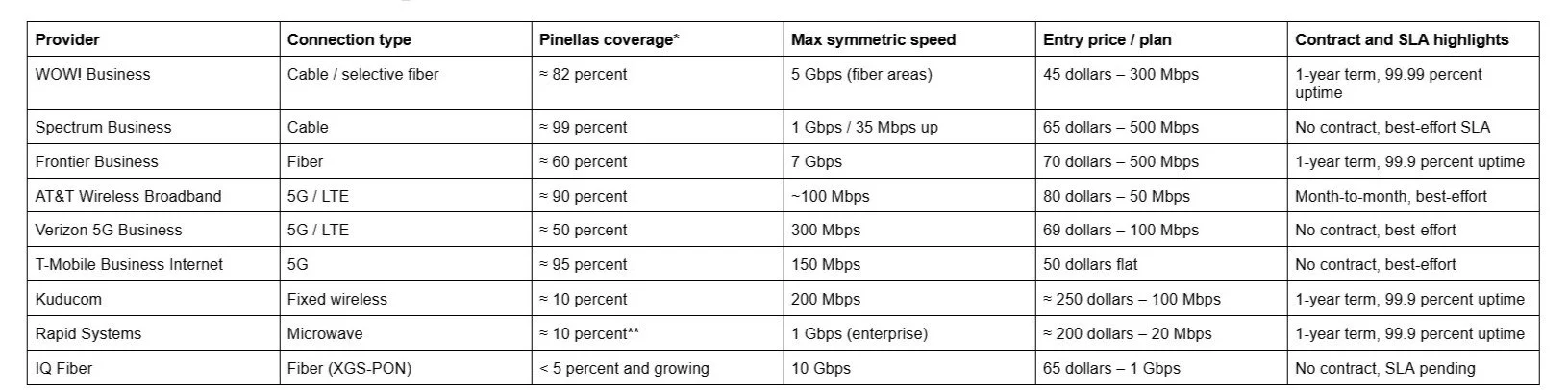
*Coverage reflects business addresses and draws on FCC and ISPReports data.
**Footprint can expand with custom relay installs.
Key takeaways:
Need maximum availability? Spectrum’s county-wide cable is the safest choice.
Chasing top speed plus uptime? Frontier and IQ Fiber lead where their fiber is live.
Looking for budget-friendly backup? Verizon and T-Mobile provide affordable wireless redundancy.
Serving niche rooftops or remote fringes? Kuducom and Rapid Systems often succeed where larger providers cannot.
Keep this table handy the next time a landlord, finance lead, or hurricane advisory triggers an urgent internet decision.
Frequently asked questions
Putting it all together: pick your perfect connection
Fast internet is no longer optional on Florida’s west coast. It powers point-of-sale swipes, payroll runs, and late-night uploads. The good news: Pinellas companies have more choices than ever.
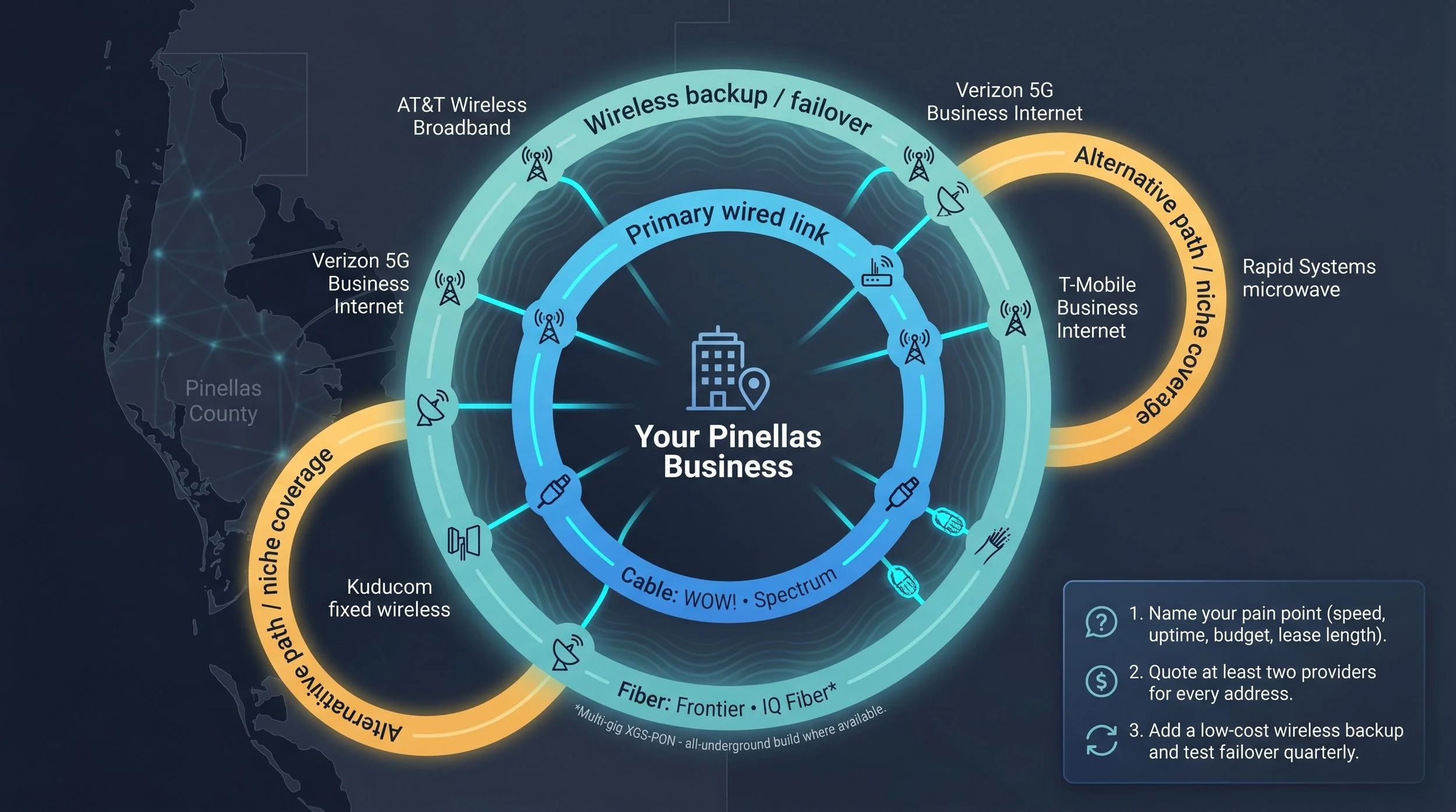
Start by naming your real pain point. Need rock-solid uptime for a clinic’s cloud EMR? Pair Frontier fiber with Verizon 5G failover. Opening a boutique on a six-month lease? Spectrum’s no-contract cable gets you selling tomorrow and leaves with no penalty. Running a video studio in an IQ Fiber zone? Order the 10-gig circuit and forget bandwidth worries.
Next, use price pressure. Quote at least two providers for every address. Carriers know competition is rising; many trim ten to twenty percent or include static IPs to win your signature. Ask for a two-year rate review so you can renegotiate when new fiber reaches your block.
Finally, build redundancy. Hurricanes, traffic accidents, and construction crews follow their own schedules. A low-cost wireless box on a separate network costs less than one hour of downtime for most teams. Add it, test failover each quarter, and sleep easier during storm season.
We hope this guide turned the Pinellas ISP maze into a clear decision path. Check your address on two or three sites tonight, gather fresh quotes, and secure the bandwidth that keeps your business moving. See you online.