Ultimate 2026 Guide to Off-Market Real Estate Investing Secrets

In 2026, real estate is quickly evolving. The best bargains, fierce competition, and rapid price increases? They are frequently concealed. You lose out if all you look at are public listings. Smart investors are aware of this. They locate deals before they hit the market by going where others do not. That is off-market real estate investing.

Let's simplify it so you may begin utilizing these secrets right now.

What Is Off-Market Real Estate?

Off-market properties are homes or buildings that are not listed online. You will not find them on big property websites. They are sold quietly. Why do sellers do this? Sometimes they want privacy. Sometimes they want a fast deal. And sometimes, they just do not want the hassle.

For you, this means less competition and better prices. That is why real estate investment strategies today focus heavily on off-market deals. In today’s market, everyone is looking at the same listings. That creates bidding wars, prices go up, and profits go down.

Off-market deals give you an edge. You can:

  • Negotiate better

  • Avoid crowds

  • Close deals faster

This is how investors grow using property investment tips that others often ignore.

Learn from Industry Experts

Successful investors do not guess. They follow proven systems. They learn from people who understand risk, compliance, and smart deal-making.

Experts like Michael Hershman highlight the importance of transparency and careful evaluation when entering hidden markets. His approach shows that even in off-market deals, you must stay sharp and informed.

When you combine smart thinking with action, your real estate success becomes more predictable.

Some investors use professional agencies to find these unlisted opportunities. One of them, House Finder is a buyers' agency that locates private sales in Sydney for its investor clients. These properties are sold quietly and do not appear on public listing portals. Buying this way lets investors sidestep many bidding wars. Local experts who have direct connections to sellers make the search much simpler.

How to Find Off-Market Properties

It's like fishing in a peaceful lake when you find hidden deals. The proper instruments and patience are required. First, establish local ties, then engage with others. You can obtain leads from real estate brokers, property managers, and even your neighbors.

It's also efficient to drive through residential neighborhoods. Look for signs of neglect, overgrown lawns, and abandoned houses. These could be indicators of an opportunity. A different strategy is direct outreach. Property owners can receive direct communications. Be explicit and polite.

Finding off-market offers before others do is mostly dependent on this technique.

Build Strong Relationships

In off-market investing, people have more importance than platforms. When you build trust, deals come to you. Stay honest and follow through on your word. Help others when you can. Over time, your network grows. And with it, your chances of finding hidden deals.

Know What to Look For

Not all hidden properties are worth the money. You must understand what is effective.

Pay attention to:

  • Place

  • Condition of the property

  • Potential worth upon repairs

"Can this property grow in value?" is a question you should always ask. You could have identified a winner if the response is in the affirmative. Smart property appraisal is supported by this way of thinking.

Use Simple Marketing to Attract Sellers

You do not always have to search for deals. Sometimes, deals come to you.

You can use:

  • Simple flyers

  • Social media posts

  • Local ads

Let people know you buy properties. Keep your message clear and friendly. This will generate leads and grow your real estate pipeline.

Negotiate Like a Pro

Off-market deals often come with more room to negotiate. But remember, be fair with your deals. A good deal works for both sides. Listen to the seller and understand their needs. Maybe they want a quick sale, or maybe they want flexible terms.

When you solve their problem, the deal becomes easier. This is a key part of real estate negotiation skills.

Be Careful to Manage Risk

Although they might be very profitable, hidden deals are risky.

Do your checks every time:

  • Examine the property

  • Examine legal documents

  • Recognize local laws

Don't omit this step. Your investment is safeguarded. This is where real estate risk management is crucial.

Stay Consistent and Patient

On day one, you might not locate a deal. That is typical. Reach out again, go on learning, and continue refining your method. Those who maintain consistency are the ones who succeed in off-market investing. "Slow and steady wins the race," as they say.

Typical Errors to Avoid

A lot of newbies make basic mistakes. They jump into agreements but do not conduct research. They are too quick to trust. However, take your time. Verify everything again. Your investing success rate will increase if you steer clear of these mistakes.

Why This Strategy Works Long-Term

Off-market investing is not just a short-term trick. It is a long-term strategy.

It helps you:

  • Find better deals

  • Build strong networks

  • Grow a steady income

Over time, you become known in your area. People start coming to you with opportunities. This leads to long-term real estate growth.



/
script>

Why Rentable Toilets Are Emerging as a Surprising Urban Business Opportunity

Urban real estate conversations usually center on housing, retail, offices, transit, and logistics. Yet one small piece of city infrastructure is becoming a serious business category in its own right: rentable toilets. In dense, high-traffic markets such as New York City and Singapore, temporary and semi-permanent sanitation services are filling a gap that public infrastructure and private property often do not meet.

This is not a fringe trend. It sits at the intersection of real estate, construction, tourism, event operations, and public health. In places where land is expensive and foot traffic is heavy, access to clean restrooms has direct value. It affects how long people stay in a district, how smoothly a construction site runs, and whether an outdoor event can operate at scale.

That business case starts with a simple shift in how sanitation is being delivered.

The rise of pay-per-use and short-term sanitation models

Traditional public restrooms are expensive to build, staff, and maintain. They also require permanent space, which is hard to justify in many dense urban settings. Rentable toilet models solve that problem by treating sanitation as a service rather than a fixed public asset.

Operators can place units where demand appears, then remove or redeploy them as activity changes. Revenue can come from several sources:

  • Rental fees for construction sites

  • Contracts for concerts, weddings, and street fairs

  • Pay-per-use public toilets in busy pedestrian zones

  • Premium subscriptions or service agreements for private developments

The flexibility is what makes the model attractive. A developer with a six-month project does not need to build permanent facilities. An event organizer can scale restroom capacity for one weekend. A municipality can test public access in a crowded corridor without committing to a full capital project.

That flexibility becomes even more valuable in cities where every square foot has to justify itself.

Why dense global cities create ideal conditions for the sector

New York City and Singapore share several traits that favor rentable sanitation businesses: limited space, high pedestrian volumes, strong tourism flows, and expensive real estate. In both cities, there is constant pressure to use land efficiently. Permanent restrooms are often too costly or too difficult to add in the places where people need them most.

Dense cities also create predictable bursts of demand. Construction projects cluster in redevelopment zones. Festivals and seasonal markets draw thousands of people into compact areas. Transit-heavy districts face restroom shortages during peak hours. In those conditions, portable and modular sanitation becomes a practical business tool.

What makes this especially relevant is that demand is not abstract. It is tied to very visible patterns in New York City and Singapore.

What Is Driving Demand in New York City and Singapore

The rise in rentable toilets in both markets is rooted in urban activity patterns rather than novelty. Demand comes from people moving through cities, buildings going up, and property owners trying to make districts more usable.

Tourism, foot traffic, and public restroom shortages

New York City has long struggled with public restroom access. Reports from city agencies and advocates have repeatedly pointed to the shortage of publicly accessible facilities across parks, transit areas, and commercial corridors. Singapore, despite its strong reputation for urban management, also faces pressure in tourist zones, hawker centers, event spaces, and transport-linked districts where high usage can strain existing facilities.

Where there is heavy foot traffic, restroom access affects behavior. Visitors who cannot find clean facilities often cut trips short, avoid certain areas, or limit spending time in retail streets and public spaces. For landlords and local business districts, that matters.

Construction, outdoor events, and commercial redevelopment

Construction remains one of the strongest demand drivers. Both New York City and Singapore have active redevelopment pipelines, infrastructure upgrades, and large job sites that need code-compliant sanitation for workers. Portable toilet rentals are standard operating infrastructure on these sites, not an optional add-on.

The same applies to temporary events. Outdoor markets, waterfront festivals, private functions, and corporate activations all need reliable restroom capacity. In Singapore’s event and project sectors, providers such as portable toilet singapore reflect how established this service category has become in dense urban environments.

As event planners and project managers raise service expectations, the market naturally splits into standard and premium segments.

Premium sanitation expectations in high-income urban centers

In affluent urban markets, users increasingly expect more than a basic portable unit. Corporate events, luxury weddings, branded activations, and premium public spaces often require climate control, flushing toilets, handwashing stations, lighting, and regular attendants.

That expectation is especially strong in Singapore, where cleanliness standards are high and public hygiene is closely linked to brand perception. New York City shows a similar pattern in premium event settings and higher-end developments, even if the baseline public restroom experience is less uniform.

Once the customer base expects variety, the business model broadens beyond standard site rentals.

How the Rentable Toilet Business Model Actually Works

The rentable toilet industry is not one product. It is a stack of service types, each serving a different urban use case.

Portable toilet rentals for construction and infrastructure projects

This is the core segment. Operators rent units to contractors on weekly or monthly contracts, then service them on a set schedule. Revenue is recurring, demand is steady, and large projects often require multiple units across different phases.

The economics are straightforward: once inventory is purchased and routing is optimized, operators can build predictable service revenue. Compliance, cleaning frequency, and logistics are what separate efficient firms from weak ones.

Luxury restroom trailers for weddings, festivals, and corporate events

Luxury trailers sit at the higher-margin end of the market. They offer interiors closer to hotel or venue restrooms, with mirrors, sinks, flushing systems, lighting, and better ventilation. These units are common at upscale outdoor functions where guest experience matters.

Event clients are willing to pay more because restroom quality affects the entire perception of the event. A polished trailer can support premium ticket prices, wedding budgets, and sponsor expectations.

Smart, self-cleaning, and pay-access public toilet concepts

Some operators and municipalities are testing a different model: smart public toilets. These units may include:

  • Touchless entry and fixtures

  • Occupancy sensors

  • Remote maintenance alerts

  • Automated cleaning cycles

  • Cashless pay-access systems

This brings sanitation closer to a managed urban utility. For real estate owners and city agencies, the appeal is simple: monitor usage, reduce staffing pressure, and place facilities in high-demand areas without building permanent restrooms.

That service logic has wider implications for property strategy.

Why This Niche Matters to Real Estate and Urban Development

For developers and landlords, rentable sanitation is easy to overlook because it feels operational rather than strategic. Yet it can affect leasing, event activation, construction timelines, and customer experience.

Sanitation as an overlooked amenity in mixed-use districts

Mixed-use districts depend on convenience. If people spend time shopping, dining, attending events, and walking between uses, restroom access becomes part of the amenity package. It may not appear in a brochure, but it shapes how usable a place feels.

Temporary and modular restroom solutions can support pop-ups, seasonal programming, and early-stage district activation before permanent facilities are built.

The role of restroom access in placemaking and retail dwell time

Retail streets and public gathering areas benefit when people stay longer. Clean restroom access can increase dwell time, support family-friendly foot traffic, and reduce friction during peak periods. That can help tenants, especially food and beverage operators and experiential retail concepts.

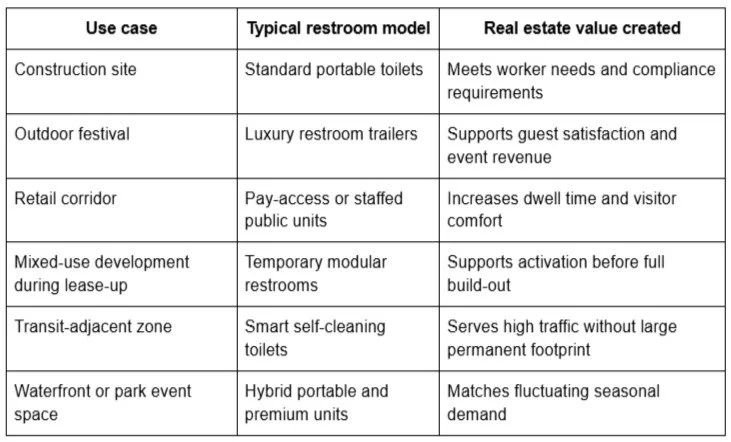
The table below shows how restroom models line up with common urban real estate needs

The pattern is clear: sanitation is not just a maintenance issue. It can support revenue, usability, and district appeal. That becomes more obvious when comparing two cities with very different systems but similar demand pressure.

How developers and landlords can monetize temporary infrastructure needs

There are several ways property owners can turn sanitation into a business tool:

  • Charge event organizers for on-site restroom packages

  • Bundle temporary sanitation into construction or tenant improvement agreements

  • Use pay-access models in select public-facing areas

  • License restroom operations to specialist vendors

For owners of underused lots, event venues, and transitional sites, temporary sanitation can make short-term programming possible. That opens the door to a closer look at how New York City and Singapore differ.

Comparing NYC and Singapore: Two Different Markets, Similar Growth Story

New York City and Singapore are not identical markets. Their rules, public expectations, and operating conditions differ. Even so, both are showing the same basic signal: sanitation access has economic value in dense urban settings.

Regulatory differences and public-private partnerships

Singapore generally operates with tighter coordination between state planning, cleanliness enforcement, and public space management. This can make it easier to align sanitation needs with transport hubs, event permits, and urban services, though standards can be strict.

New York City is more fragmented. Multiple agencies, private landlords, business improvement districts, and event operators all play a part. That can slow deployment, but it also creates openings for private contractors and partnership models.

Space constraints, land values, and operational efficiency

Both cities face high land values, which raises the opportunity cost of dedicating permanent space to restrooms. Portable and modular solutions work because they compress infrastructure into flexible footprints.

Operational efficiency matters just as much. In markets where traffic congestion, labor costs, and service frequency affect margins, route planning and preventive maintenance are central to profitability.

Consumer behavior and cleanliness standards in each city

Consumer expectations differ in tone but not in importance. Singapore users often expect visible cleanliness and orderly conditions as a baseline. In New York City, tolerance for variation may be higher, but users still respond strongly to restroom quality in premium districts, events, and commercial properties.

Those user expectations feed directly into the business math.

The Economics Behind a Booming Toilet Rental Industry

The toilet rental business is attractive because it combines recurring revenue with several customer segments. But it is still an operations-heavy service business.

Startup costs, maintenance, and recurring revenue streams

Upfront costs include unit purchases, trucks, storage yards, pumping equipment, cleaning supplies, and labor. Smart or luxury units raise the capital requirement. Once operating, revenue typically comes from recurring contracts and scheduled servicing.

Common revenue streams include:

  • Weekly or monthly site rentals

  • Event-day packages

  • Premium cleaning and attendant services

  • Emergency or overflow deployments

  • Advertising on public-facing units in select markets

Margins in construction, events, and premium urban installations

Construction contracts tend to offer stable volume and predictable servicing cycles. Event work can bring stronger margins but also more volatility and tighter timing. Premium public installations may command higher pricing if operators can maintain strong uptime and cleanliness.

The best margins often come from matching the right unit type to the right client rather than over-serving every job.

Key risks including compliance, servicing, and vandalism

Risks are practical, not mysterious. They include missed servicing, poor hygiene, permit issues, disposal compliance, equipment damage, and vandalism. Public-facing units carry more exposure, especially in very busy areas.

This is one reason technology is becoming more central to the sector.

Technology and Sustainability Are Reshaping the Sector

Sanitation businesses are becoming more data-driven and more resource-conscious, especially in expensive urban markets.

Touchless systems, smart monitoring, and usage analytics

Touchless fixtures help reduce maintenance complaints and improve user confidence. Sensors can track occupancy, supply levels, and servicing needs. Usage analytics help operators decide where units should be placed, how often they should be cleaned, and which locations support pay-access models.

For owners and city partners, that data turns restroom provision into a measurable service rather than a guessing game.

Water-saving, odor-control, and eco-friendly waste solutions

Water-saving systems, better ventilation, and improved waste treatments are also changing the category. In places where sustainability reporting and environmental standards matter, lower-water systems and cleaner servicing methods can strengthen bids for projects and partnerships.

As sanitation becomes smarter and more efficient, the sector starts to look less like a low-status necessity and more like a practical urban service business.

What Investors, Property Owners, and Operators Should Watch Next

The momentum behind rentable toilets in New York City and Singapore points to a wider pattern in global urban development.

Expansion opportunities in other dense global cities

Cities such as London, Hong Kong, Tokyo, Dubai, and Sydney share many of the same conditions: high land costs, tourism flows, active event calendars, and uneven public restroom access. That creates room for both standard rental operators and tech-led sanitation providers.

The future of rentable sanitation as urban infrastructure

As cities rely more on flexible public space, temporary programming, and phased redevelopment, sanitation will remain part of the operating puzzle. Rentable models offer speed, mobility, and lower upfront commitments than permanent build-outs.

Why this once-unsexy business is attracting serious attention

The appeal is not glamour. It is steady demand tied to real urban behavior. People gather, shop, work, travel, and attend events in dense places every day. They need clean restrooms, and cities often do not provide enough of them in the right places.

That gap is why the rentable toilet business is growing in New York City and Singapore. For real estate professionals, it is a reminder that small pieces of infrastructure can shape how a district performs. For operators and investors, it is proof that even a simple service can become a strong urban business when demand, density, and timing line up.

/
script>

What to Consider Before Applying for a Home Equity Loan

Property owners often sit on a large pile of wealth without knowing it. This wealth grows as you pay your mortgage or as market prices go up in your town. This gap between the value of your residence and what you owe is called equity. You can use this value to get cash for big life goals or smart investments.

Accessing this money requires a clear plan and a look at your monthly budget. Many people use Lend For All to find different lenders that match their specific needs. This helps you see what rates you can get based on your own credit story. You should know how these borrowing agreements work before you sign any official papers.

Photo by RDNE Stock project

Checking Your Financial Health and Readiness

Before you ask for a payout, look at how much money you make each month. Lenders want to see that you can pay back the debt without any trouble. They check your job history and how much other debt you carry right now. A stable life makes you a better candidate for a low interest rate.

How Your Credit Score Changes the Deal

Your credit score tells a story about how you handle money over time. A high score usually means you pay less in interest every month. You should check your report for errors before you apply for an equity agreement. Fixing small mistakes can save you a lot of money over the long haul.

Proving Your Monthly Income

You need to show that your income is steady and will stay that way. Financial firms look at tax forms and bank statements to verify your earnings. This is very important if you work for yourself or run a small shop. Showing a clear paper trail of your money helps the bank trust you.

Looking at Your Loan to Value Ratio

The loan to value ratio is a math problem that lenders use to limit risk. They compare the total debt on the property to what it is worth today. Most banks in Canada will not let you borrow more than 80 percent of that value. This protects everyone if the housing market shifts or prices drop suddenly.

Getting a Fair Appraisal

A professional appraiser will visit your residence to see what it is worth. They look at the size of your lot and any big upgrades you finished. They also compare your house to others that sold nearby in the last few months. Clean up your yard and fix small things before the appraiser arrives at your door.

Steps to Find Your Borrowing Limit

You can do some quick math at your desk to see how much cash you might get. Use these steps to find a realistic number for your planning.

  • Find the current market price of your residence from recent sales.

  • Multiply that total value by 0.80 to find the debt limit.

  • Subtract your current mortgage balance from that new number.

  • Take away another 5 percent to cover legal and closing costs.

Picking the Best Product for You

There are different ways to take money out of your property. Some people want a big check all at once for one project. Others want a line of credit they can use whenever they need it. It is smart to learn about these choices through the Financial Consumer Agency of Canada before you decide.

Fixed Rate Equity Payouts

A fixed rate agreement gives you all the money in one lump sum. You pay it back in the same amount every month for years. This makes it very easy to plan your household budget. You know exactly when the debt will be paid off and gone.

Home Equity Lines of Credit

A line of credit works like a credit card tied to your residence. You only pay interest on the money you actually spend. This is great for a renovation that takes a long time to finish. Keep in mind that the interest rates on these usually change with the market.

Buyers often ask financial experts what is a Home Equity Line Of Credit and how its flexible borrowing limits compare to traditional fixed loans. Understanding how revolving credit lines function enables homeowners to manage ongoing project costs efficiently without taking on unnecessary upfront interest.

Staying Safe and Protecting Your Residence

Using your property as collateral means the bank can take it if you stop paying. This is a big risk that you must take seriously from day one. You should have a backup plan in case your income drops or costs go up. High level business leadership often involves managing these risks by looking at the worst case scenario.

Watching Out for Rate Hikes

The Bank of Canada changes interest rates to help the economy stay healthy. If you have a variable rate, your monthly payment might go up. You should test your budget to see if you can afford a higher payment. Being ready for changes prevents stress when the economy shifts.

Habits for Smart Borrowers

Good habits keep your finances safe while you use your equity. Follow these simple rules to stay on track with your repayment plan.

  • Only borrow what you need for a specific and useful purpose.

  • Keep six months of payments in a separate savings account.

  • Read every page of the borrowing agreement before you sign it.

  • Avoid using the money for items that lose value like cars.

Photo by RDNE Stock project

Moving Toward the Final Steps

Once you pick a financial partner, the closing process starts with more paperwork. You will need a lawyer to help change the title on your residence. This ensures the new debt is legal and follows all the local rules. Ask your lawyer about any fees that might be due at the very end.

Take your time to compare at least three different offers from lenders. Small changes in interest rates can mean thousands of dollars over many years. When you have the right plan, your equity becomes a great tool. Use it wisely to build a better future for yourself and your family.

/
script>