Why Rentable Toilets Are Emerging as a Surprising Urban Business Opportunity
Urban real estate conversations usually center on housing, retail, offices, transit, and logistics. Yet one small piece of city infrastructure is becoming a serious business category in its own right: rentable toilets. In dense, high-traffic markets such as New York City and Singapore, temporary and semi-permanent sanitation services are filling a gap that public infrastructure and private property often do not meet.
This is not a fringe trend. It sits at the intersection of real estate, construction, tourism, event operations, and public health. In places where land is expensive and foot traffic is heavy, access to clean restrooms has direct value. It affects how long people stay in a district, how smoothly a construction site runs, and whether an outdoor event can operate at scale.
That business case starts with a simple shift in how sanitation is being delivered.
The rise of pay-per-use and short-term sanitation models
Traditional public restrooms are expensive to build, staff, and maintain. They also require permanent space, which is hard to justify in many dense urban settings. Rentable toilet models solve that problem by treating sanitation as a service rather than a fixed public asset.
Operators can place units where demand appears, then remove or redeploy them as activity changes. Revenue can come from several sources:
Rental fees for construction sites
Contracts for concerts, weddings, and street fairs
Pay-per-use public toilets in busy pedestrian zones
Premium subscriptions or service agreements for private developments
The flexibility is what makes the model attractive. A developer with a six-month project does not need to build permanent facilities. An event organizer can scale restroom capacity for one weekend. A municipality can test public access in a crowded corridor without committing to a full capital project.
That flexibility becomes even more valuable in cities where every square foot has to justify itself.
Why dense global cities create ideal conditions for the sector
New York City and Singapore share several traits that favor rentable sanitation businesses: limited space, high pedestrian volumes, strong tourism flows, and expensive real estate. In both cities, there is constant pressure to use land efficiently. Permanent restrooms are often too costly or too difficult to add in the places where people need them most.
Dense cities also create predictable bursts of demand. Construction projects cluster in redevelopment zones. Festivals and seasonal markets draw thousands of people into compact areas. Transit-heavy districts face restroom shortages during peak hours. In those conditions, portable and modular sanitation becomes a practical business tool.
What makes this especially relevant is that demand is not abstract. It is tied to very visible patterns in New York City and Singapore.
What Is Driving Demand in New York City and Singapore
The rise in rentable toilets in both markets is rooted in urban activity patterns rather than novelty. Demand comes from people moving through cities, buildings going up, and property owners trying to make districts more usable.
Tourism, foot traffic, and public restroom shortages
New York City has long struggled with public restroom access. Reports from city agencies and advocates have repeatedly pointed to the shortage of publicly accessible facilities across parks, transit areas, and commercial corridors. Singapore, despite its strong reputation for urban management, also faces pressure in tourist zones, hawker centers, event spaces, and transport-linked districts where high usage can strain existing facilities.
Where there is heavy foot traffic, restroom access affects behavior. Visitors who cannot find clean facilities often cut trips short, avoid certain areas, or limit spending time in retail streets and public spaces. For landlords and local business districts, that matters.
Construction, outdoor events, and commercial redevelopment
Construction remains one of the strongest demand drivers. Both New York City and Singapore have active redevelopment pipelines, infrastructure upgrades, and large job sites that need code-compliant sanitation for workers. Portable toilet rentals are standard operating infrastructure on these sites, not an optional add-on.
The same applies to temporary events. Outdoor markets, waterfront festivals, private functions, and corporate activations all need reliable restroom capacity. In Singapore’s event and project sectors, providers such as portable toilet singapore reflect how established this service category has become in dense urban environments.
As event planners and project managers raise service expectations, the market naturally splits into standard and premium segments.
Premium sanitation expectations in high-income urban centers
In affluent urban markets, users increasingly expect more than a basic portable unit. Corporate events, luxury weddings, branded activations, and premium public spaces often require climate control, flushing toilets, handwashing stations, lighting, and regular attendants.
That expectation is especially strong in Singapore, where cleanliness standards are high and public hygiene is closely linked to brand perception. New York City shows a similar pattern in premium event settings and higher-end developments, even if the baseline public restroom experience is less uniform.
Once the customer base expects variety, the business model broadens beyond standard site rentals.
How the Rentable Toilet Business Model Actually Works
The rentable toilet industry is not one product. It is a stack of service types, each serving a different urban use case.
Portable toilet rentals for construction and infrastructure projects
This is the core segment. Operators rent units to contractors on weekly or monthly contracts, then service them on a set schedule. Revenue is recurring, demand is steady, and large projects often require multiple units across different phases.
The economics are straightforward: once inventory is purchased and routing is optimized, operators can build predictable service revenue. Compliance, cleaning frequency, and logistics are what separate efficient firms from weak ones.
Luxury restroom trailers for weddings, festivals, and corporate events
Luxury trailers sit at the higher-margin end of the market. They offer interiors closer to hotel or venue restrooms, with mirrors, sinks, flushing systems, lighting, and better ventilation. These units are common at upscale outdoor functions where guest experience matters.
Event clients are willing to pay more because restroom quality affects the entire perception of the event. A polished trailer can support premium ticket prices, wedding budgets, and sponsor expectations.
Smart, self-cleaning, and pay-access public toilet concepts
Some operators and municipalities are testing a different model: smart public toilets. These units may include:
Touchless entry and fixtures
Occupancy sensors
Remote maintenance alerts
Automated cleaning cycles
Cashless pay-access systems
This brings sanitation closer to a managed urban utility. For real estate owners and city agencies, the appeal is simple: monitor usage, reduce staffing pressure, and place facilities in high-demand areas without building permanent restrooms.
That service logic has wider implications for property strategy.
Why This Niche Matters to Real Estate and Urban Development
For developers and landlords, rentable sanitation is easy to overlook because it feels operational rather than strategic. Yet it can affect leasing, event activation, construction timelines, and customer experience.
Sanitation as an overlooked amenity in mixed-use districts
Mixed-use districts depend on convenience. If people spend time shopping, dining, attending events, and walking between uses, restroom access becomes part of the amenity package. It may not appear in a brochure, but it shapes how usable a place feels.
Temporary and modular restroom solutions can support pop-ups, seasonal programming, and early-stage district activation before permanent facilities are built.
The role of restroom access in placemaking and retail dwell time
Retail streets and public gathering areas benefit when people stay longer. Clean restroom access can increase dwell time, support family-friendly foot traffic, and reduce friction during peak periods. That can help tenants, especially food and beverage operators and experiential retail concepts.
The table below shows how restroom models line up with common urban real estate needs
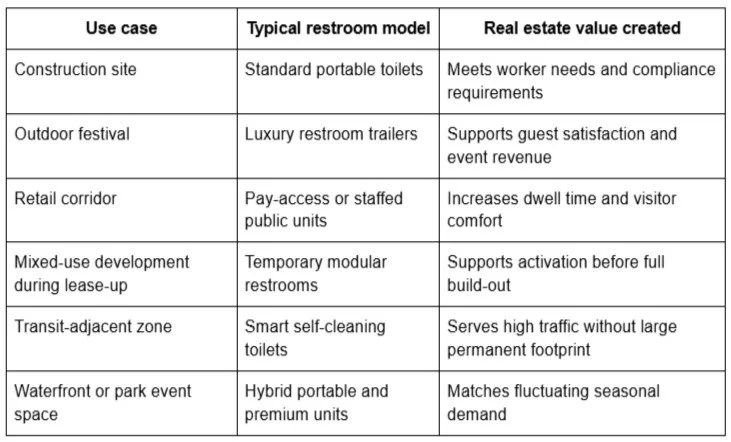
The pattern is clear: sanitation is not just a maintenance issue. It can support revenue, usability, and district appeal. That becomes more obvious when comparing two cities with very different systems but similar demand pressure.
How developers and landlords can monetize temporary infrastructure needs
There are several ways property owners can turn sanitation into a business tool:
Charge event organizers for on-site restroom packages
Bundle temporary sanitation into construction or tenant improvement agreements
Use pay-access models in select public-facing areas
License restroom operations to specialist vendors
For owners of underused lots, event venues, and transitional sites, temporary sanitation can make short-term programming possible. That opens the door to a closer look at how New York City and Singapore differ.
Comparing NYC and Singapore: Two Different Markets, Similar Growth Story
New York City and Singapore are not identical markets. Their rules, public expectations, and operating conditions differ. Even so, both are showing the same basic signal: sanitation access has economic value in dense urban settings.
Regulatory differences and public-private partnerships
Singapore generally operates with tighter coordination between state planning, cleanliness enforcement, and public space management. This can make it easier to align sanitation needs with transport hubs, event permits, and urban services, though standards can be strict.
New York City is more fragmented. Multiple agencies, private landlords, business improvement districts, and event operators all play a part. That can slow deployment, but it also creates openings for private contractors and partnership models.
Space constraints, land values, and operational efficiency
Both cities face high land values, which raises the opportunity cost of dedicating permanent space to restrooms. Portable and modular solutions work because they compress infrastructure into flexible footprints.
Operational efficiency matters just as much. In markets where traffic congestion, labor costs, and service frequency affect margins, route planning and preventive maintenance are central to profitability.
Consumer behavior and cleanliness standards in each city
Consumer expectations differ in tone but not in importance. Singapore users often expect visible cleanliness and orderly conditions as a baseline. In New York City, tolerance for variation may be higher, but users still respond strongly to restroom quality in premium districts, events, and commercial properties.
Those user expectations feed directly into the business math.
The Economics Behind a Booming Toilet Rental Industry
The toilet rental business is attractive because it combines recurring revenue with several customer segments. But it is still an operations-heavy service business.
Startup costs, maintenance, and recurring revenue streams
Upfront costs include unit purchases, trucks, storage yards, pumping equipment, cleaning supplies, and labor. Smart or luxury units raise the capital requirement. Once operating, revenue typically comes from recurring contracts and scheduled servicing.
Common revenue streams include:
Weekly or monthly site rentals
Event-day packages
Premium cleaning and attendant services
Emergency or overflow deployments
Advertising on public-facing units in select markets
Margins in construction, events, and premium urban installations
Construction contracts tend to offer stable volume and predictable servicing cycles. Event work can bring stronger margins but also more volatility and tighter timing. Premium public installations may command higher pricing if operators can maintain strong uptime and cleanliness.
The best margins often come from matching the right unit type to the right client rather than over-serving every job.
Key risks including compliance, servicing, and vandalism
Risks are practical, not mysterious. They include missed servicing, poor hygiene, permit issues, disposal compliance, equipment damage, and vandalism. Public-facing units carry more exposure, especially in very busy areas.
This is one reason technology is becoming more central to the sector.
Technology and Sustainability Are Reshaping the Sector
Sanitation businesses are becoming more data-driven and more resource-conscious, especially in expensive urban markets.
Touchless systems, smart monitoring, and usage analytics
Touchless fixtures help reduce maintenance complaints and improve user confidence. Sensors can track occupancy, supply levels, and servicing needs. Usage analytics help operators decide where units should be placed, how often they should be cleaned, and which locations support pay-access models.
For owners and city partners, that data turns restroom provision into a measurable service rather than a guessing game.
Water-saving, odor-control, and eco-friendly waste solutions
Water-saving systems, better ventilation, and improved waste treatments are also changing the category. In places where sustainability reporting and environmental standards matter, lower-water systems and cleaner servicing methods can strengthen bids for projects and partnerships.
As sanitation becomes smarter and more efficient, the sector starts to look less like a low-status necessity and more like a practical urban service business.
What Investors, Property Owners, and Operators Should Watch Next
The momentum behind rentable toilets in New York City and Singapore points to a wider pattern in global urban development.
Expansion opportunities in other dense global cities
Cities such as London, Hong Kong, Tokyo, Dubai, and Sydney share many of the same conditions: high land costs, tourism flows, active event calendars, and uneven public restroom access. That creates room for both standard rental operators and tech-led sanitation providers.
The future of rentable sanitation as urban infrastructure
As cities rely more on flexible public space, temporary programming, and phased redevelopment, sanitation will remain part of the operating puzzle. Rentable models offer speed, mobility, and lower upfront commitments than permanent build-outs.
Why this once-unsexy business is attracting serious attention
The appeal is not glamour. It is steady demand tied to real urban behavior. People gather, shop, work, travel, and attend events in dense places every day. They need clean restrooms, and cities often do not provide enough of them in the right places.
That gap is why the rentable toilet business is growing in New York City and Singapore. For real estate professionals, it is a reminder that small pieces of infrastructure can shape how a district performs. For operators and investors, it is proof that even a simple service can become a strong urban business when demand, density, and timing line up.