Creative Ideas for Modern Living in City Lofts and High-End Condos

In contemporary cities, the real luxury is not space, views, or finishes. It is mental clarity. City lofts and high-end condos are no longer static containers for furniture and objects. They are tools for recalibration. They exist to counter overload and quietly reshape how time is felt indoors. The most original urban homes today are not designed to impress guests. They are designed to support the person who lives there at 7 a.m., at midnight, and in all the moments in between.

Space that behaves like a system, not a layout

Modern urban life has exposed the weakness of traditional planning. Fixed rooms assume fixed behavior, but city routines are fluid and unpredictable. As a result, space in contemporary lofts behaves less like a map and more like a system.

A modern italian sectional often becomes a pivotal element in this system. It creates gravity without enclosure and order without authority. It defines social territory while allowing freedom of movement. Around it, the interior remains open to interpretation. A single zone may host conversation and rest within the same day.

What matters here is not function but responsiveness. Distances between objects guide interaction. Sightlines preserve calm. Transitional areas act as buffers rather than leftover space. Even smaller interiors feel expansive because space is not overassigned. It remains available and quietly intelligent.

Interiors that are tuned, not decorated

Extraordinary lofts and condos are not styled. They are tuned. Every design decision is made with sensitivity to mood and sensory impact. Instead of asking what belongs in a room, designers ask what the room should regulate.
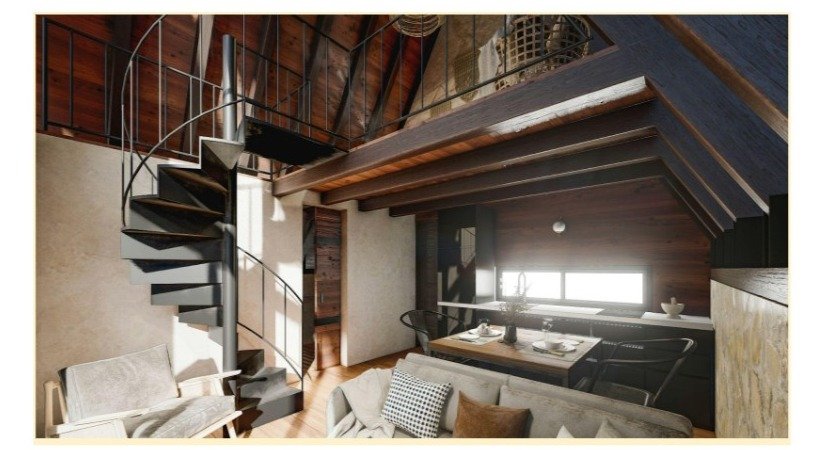
Light becomes the primary tuning instrument. Daylight is encouraged to travel and return, marking time without clocks. Artificial lighting supports this cycle rather than flattening it. Layers replace intensity. Shadows are intentional. Darkness is respected. The space feels dynamic, never frozen in a single expression.

Materials reinforce this tuning. Wood introduces warmth and rhythm. Stone provides weight and stillness. Matte finishes reduce visual noise. Textiles soften acoustics and edges. These materials are chosen not for novelty but for how they behave under daily use. They absorb and age in ways that feel honest.

Several unconventional principles often guide these interiors:

  • Emotion determines spatial priorities

  • Comfort is treated as a performance metric

  • Calm is designed deliberately, not incidentally

  • Fewer elements are used, but each carries more responsibility

The result is a home that feels instinctively right, even when its design logic is hard to explain.

The quiet authority of empty space

One of the most radical gestures in modern urban interiors is restraint. In a culture obsessed with filling, empty space becomes a form of authority. Clear floors and uninterrupted surfaces slow perception. The eye stops scanning. The body relaxes.

This emptiness is not about minimalism as an aesthetic. It is psychological architecture. It creates room for pause, thought, and recovery. Instead of demanding attention, the space offers relief.

Here, imperfection is an important factor. Humanity is brought through natural wear, small discrepancies, and material variation. These facts neutralize the accuracy of modern construction and make the interior not look sterile. The house is lived in, not maintained.

Objects and art are shown in a minimalist and calculated manner. It takes one piece to change the emotional atmosphere of a whole room. The functional aspects can frequently be sculptural, and the line between need and expression is often indistinct. Nothing is filler. Nothing competes for attention.

Living without barriers: privacy and flow

Open-plan living dominates city lofts and high-end condos, but openness without control quickly becomes exhausting. The most intelligent interiors replace walls with systems of adjustment.

Privacy is made by stratification and cues as opposed to enclosure. Sliding doors, clear screens, and cushy fabrics enable areas to open and close when necessary. Light in itself is a separator, contrast, and shadow is used to form perception. Even subtle changes in ceiling height or material texture communicate shifts in use.

Technology follows the same philosophy of disappearance. The most advanced systems are the least visible. The climate adapts quietly. Sound arrives without sources. Interfaces are minimal and intuitive. Technology supports life without entering the visual conversation.

Storage completes this invisible infrastructure. Instead of adding furniture, storage is absorbed into architecture. Built-in systems align with structural lines and disappear when closed. Open storage is curated with restraint. Closed storage protects visual calm. This prevents accumulation from turning into clutter and allows the space to evolve without chaos.

Conclusion

The existence of modernity in urban lofts and luxury condos is undergoing a radical change. Luxury is no longer scaled, spectacle and abundance are not defining. It is defined by awareness. Awareness of movement. Of emotion. Of time. The most original urban homes behave like intelligent organisms, adjusting subtly to daily life without demanding effort or attention. They do not fight the city outside. They receive it, refract it, and give back something difficult to find: composure and discipline. In a world that continuously accelerates, these homes are aware of when to decelerate all that.
When Should I Start Training for a Marathon?

The process of marathon training is both exciting and intimidating. Proper preparation is a necessity for promoting a successful, injury-free experience. 

One of the most important factors to consider is when to start your marathon training. This is your guide to when to kick-start your marathon training, providing a roadmap to help you through this challenging yet rewarding process.

Suiting Up for Success With the Right Activewear

Selecting the right activewear for your marathon training is an important first step towards success. The right active apparel can help enhance your performance while ensuring your comfort and safety during long runs. Additionally, proper shoes can provide the necessary support and cushioning to prevent injuries and enhance your running experience.

Setting the Foundation

Before diving headfirst into a marathon training program, you want to lay down a solid foundation. Assessing your current fitness level will help determine the starting point of your training journey. Always approach marathon training gradually, allowing your body to adapt and build strength to avoid burnout or overexertion.

Mapping Out Your Training Schedule

Choosing the right training schedule will support your success when preparing for a marathon. You want to select a plan that aligns with your fitness level, goals, and available time for training. 

Differentiating between beginner, intermediate, and advanced training programs will help you tailor your approach to match your capabilities and ambitions. Incorporating rest days and cross-training is equally important for preventing injuries and maintaining a well-rounded fitness routine.

Timing Is Everything

Determining the optimal time to start marathon training involves considering several factors. The typical duration of marathon training programs ranges from 12 to 20 weeks, depending on your fitness level and experience. It is crucial to give yourself sufficient time to build endurance and stamina gradually.

Signs You're Ready to Train

Always pay attention to your body's signals before beginning your marathon training journey. Physical and mental readiness are key indicators that you are prepared to tackle the demands of a rigorous training program. 

Before starting your training, consulting with a healthcare professional can provide valuable insights into your current health status. This proactive step can help prevent any potential issues you may encounter along the way.

Beginning Your Marathon Training

Setting off on your marathon training journey is an exciting step towards achieving a significant physical and mental goal. As you kickstart your training, establish clear goals and stay motivated throughout the process. 

The early weeks of training might present challenges, but with perseverance and commitment, you'll find yourself making steady progress towards your marathon aspirations. Celebrate your achievements along the way to keep your spirits high and maintain your enthusiasm for the road ahead.

Training Pitfalls and How To Dodge Them

While marathon training is a rewarding experience, there are some pitfalls that may hinder your progress or lead to injuries. Common mistakes to avoid include overtraining, neglecting rest and recovery, improper nutrition, and inadequate hydration. 

Listening to your body, adjusting your training plan as needed, and prioritizing recovery are essential steps to prevent burnout during your training. These practices help maintain your health and well-being throughout the training process.

Preparing for Race Day

As you approach the final weeks before the marathon, your training will shift towards tapering, conserving energy, and mental preparation. Tapering involves gradually reducing your training volume to allow your body to rest and recover fully before the race. 

Visualization techniques and mental preparation can help calm nerves and boost your confidence as you anticipate the upcoming challenge. Making sure you have all the necessary logistics in place, such as your race-day gear and nutrition plan, will help alleviate any last-minute stress.

Achieving Success at the Finish Line and Beyond

Crossing the finish line of a marathon is a momentous achievement that should be celebrated. Take time to reflect on the journey you've undertaken, the obstacles you've overcome, and the personal growth you've experienced along the way. 

Post-marathon recovery is a must to allow your body to heal and gradually return to normal training routines. Consider setting new goals or challenges to continue pushing yourself and maintaining your newfound fitness level beyond the marathon.

Achieving Milestones and Planning Your Marathon Training Journey

Training for a marathon is a transformative experience that requires dedication, perseverance, and proper planning. By following a structured training program, listening to your body, and avoiding common pitfalls, you can set yourself up for success on race day. 

Remember that marathon training is as much a mental journey as it is a physical one, and the lessons you learn along the way can have far-reaching effects on your overall well-being. Whether you're a first-time marathoner or a seasoned runner, the journey to completing a marathon is as rewarding as the finish line itself. 

5 Best Rated Wisconsin Timber Frame Builders

Timber framing is booming across Wisconsin—from 19th-century barn frames still standing along rural highways to new mass-timber towers rising in Milwaukee. Homeowners want that blend of heritage and high performance, and demand keeps climbing.

We spent weeks reviewing portfolios, awards, client surveys, and national rankings—such as Home Builder Digest’s list of top timber specialists—to pinpoint the five firms that deliver consistent quality. In this guide you’ll see our scoring criteria, candid builder profiles, realistic cost bands, and code reminders so you can start conversations with confidence.

Let’s raise your frame.

How we selected the best timber frame builders

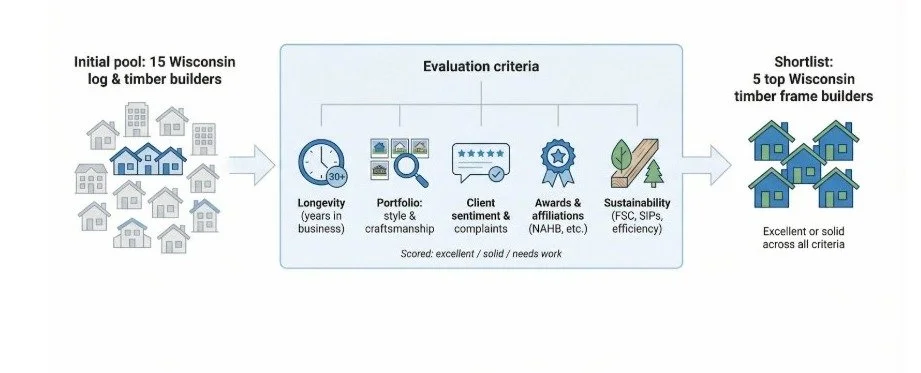
We started with a wide net: fifteen companies that showed up in directories, award lists, and Wisconsin building forums. Then we graded each one against the same yardstick so you can compare results directly.

First came longevity. A builder that’s been hand-cutting joints for thirty years has proven staying power.

Next we scanned portfolios. We looked for homes of different sizes and styles that still show crisp joinery and tight fit.

Client sentiment mattered, too. We read BBB records, skimmed Houzz comments, and called a handful of recent owners to hear unfiltered stories.

Awards and affiliations added another layer. Recognition from groups such as the NAHB Log and Timber Homes Council shows peer respect. Home Builder Digest’s national ranking provided an extra benchmark for craftsmanship and service.

Finally we weighed sustainability. Builders that specify FSC-certified timbers or wrap frames with high-R SIP panels earned bonus points for forward-thinking practice.

Each criterion received a simple score: excellent, solid, or needs work. Only five firms earned excellent or solid ratings across the board. Those are the names you’ll meet next.

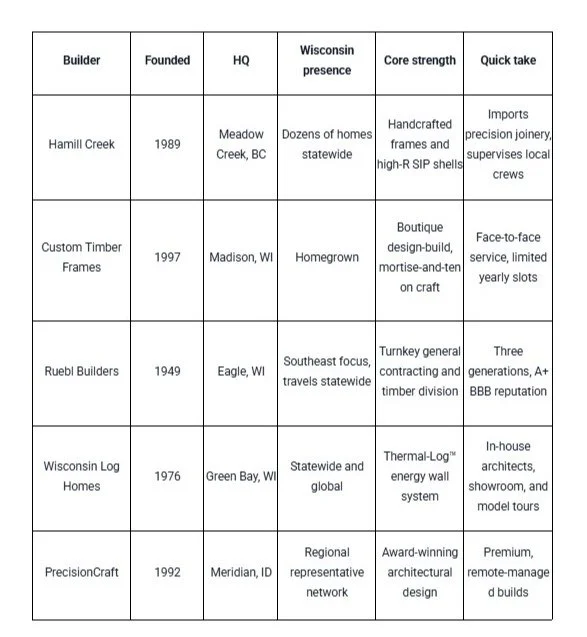
Hamill Creek Timber Homes

Hamill Creek sits two thousand miles away in British Columbia, yet its frames keep appearing on Wisconsin job sites. The company has honed handcrafted joinery since 1989 and now fields a full-service team of architects, engineers, and mill-workers who design, cut, and test-fit every beam before the package ships east. Their Wisconsin landing page on custom timber frame homes in Wisconsin spells out the big advantages—energy efficiency, design flexibility, and low-maintenance longevity—while showcasing decades of experience, statewide service, and a catalog that ranges from compact cabins to grand lake-house lodges.

Hamill Creek Timber Homes Wisconsin landing page screenshot

What makes their work stand out? First, precision. Frames arrive CNC-cut, numbered, and ready for a rapid crane-and-peg raising. Second, efficiency. According to Fine Homes & Living magazine, wrapping a timber skeleton with thick structural insulated panels can trim heating and cooling bills by up to fifty percent compared with fiberglass infill. That matters when January winds whip off Lake Superior.

The company’s style leans classic, with massive Douglas-fir posts, soaring hammer-beam trusses, and stone fireplaces that anchor great rooms, yet the team welcomes glass curtain walls and flat-roofed pavilions. They model every variation in 3-D and dial in the engineering.

Service is turnkey in spirit. Hamill Creek handles design, fabrication, export paperwork, and on-site supervision during the raise. After that, your local general contractor—often one they have vetted—takes the baton, keeping schedules tight while meeting state licensing rules.

Drawbacks? Two stand out. You will not find a walk-in showroom in Wisconsin, so early design meetings happen over video. And top-tier craftsmanship carries a premium price. Still, for homeowners seeking heirloom quality and strong energy performance, Hamill Creek sets a high bar.

Custom Timber Frames

This Madison shop lives and breathes timber. Owner Doug Beilfuss founded Custom Timber Frames in 1997 and still greets most clients at the door of his showroom on Seiferth Road. From there you can walk the floor, run a hand across freshly planed white-pine beams, and sketch ideas with the in-house designer before a single board leaves the rack.

Craft is the calling card. Every joint is mortise and tenon, hand-pegged, and cut by a tight-knit crew that has worked together for years. They handle the full stack: architectural design, engineering, shop fabrication, and coordination of SIP enclosure. That single-team flow keeps surprises and changes orders to a minimum.

Because the firm is boutique, you get their undivided attention. Beilfuss usually manages only a handful of builds at a time, so your project never becomes item twenty-seven on a whiteboard. The trade-off is scheduling; prime months fill quickly, and meticulous workmanship costs more than commodity framing. For owners who value local know-how and face-to-face collaboration, Custom Timber Frames offers a rare mix of artistry and Midwest pragmatism.

Ruebl Builders

Ruebl Builders is almost a household name in Wisconsin. The family firm opened in 1949 and now spans three generations, yet the ethos remains simple: treat every client like family and every beam like sculpture.

From its Eagle headquarters the team handles everything under one roof: site planning, timber design, full general contracting, and even the final coat of stain. That single-contract approach saves you from juggling framers, finishers, and permit runners.

Quality control shows in the accolades. The Better Business Bureau keeps Ruebl at an A+ rating, a mark held since 2008 with zero unresolved complaints. Local builders’ associations have named the company Builder of the Year, and its lakefront show homes often win Parade of Homes awards.

Expect a flexible aesthetic. One project may feature reclaimed oak trusses and stone gables, while another pairs Douglas-fir beams with glass walls. What ties them together is craftsmanship you can spot from the driveway: crisp joinery, balanced proportions, and detailing that feels timeless.

Ruebl’s sweet spot is southeastern Wisconsin, where the crew knows every zoning quirk around Lake Geneva and the Kettle Moraine. They will travel statewide, but distance fees can nibble at the budget. Because the firm builds only a few homes at a time, calendars fill months in advance. Reach out early if you want those coveted slots.

If your goal is a turnkey luxury home backed by more than seventy years of local know-how, Ruebl Builders deserves a place on your shortlist.

Wisconsin Log Homes

Green Bay’s own Wisconsin Log Homes pairs the warmth of hand-scribed logs with building science that meets modern codes. The company cut its first cabin in 1976 and has spent the decades since refining a design-fabricate-build model that now serves clients worldwide.

All work flows from an in-house team of architects, craftspeople, and project coordinators. You can start with one of hundreds of floor-plan ideas or commission a fully custom design. Once drawings are locked, WLH fabricates the log or timber shell in climate-controlled shops, then ships it, along with an erection crew or a vetted local builder, to your site.

The standout feature is the patented Thermal-Log™ wall system. Introduced in 1979, it sandwiches high-R insulation between log or timber facings, delivering walls rated up to R-40 and roofs to R-65. That means lower utility bills, no log-settling headaches, and an envelope that clears Wisconsin’s evolving energy code with ease.

WLH operates in the luxury tier, so budgets need room to breathe. Yet the value is plain: wide design freedom, a showroom filled with finishes, and a headquarters you can tour before signing. For owners who want national reach backed by Badger-State roots, Wisconsin Log Homes remains a proven choice.

PrecisionCraft Log & Timber Homes

PrecisionCraft hails from mountain country in Meridian, Idaho, but its award-winning plans travel wherever a crane can roll, including Wisconsin’s lakefront bluffs and Northwoods ridges. The firm’s designs have earned national honors such as NAHB’s Excellence in Timber Home Design and multiple Best in American Living Awards.

The process starts with M.T.N Architects, PrecisionCraft’s in-house design studio. You may choose an existing concept or brief their team for a clean-sheet original. Once drawings are approved, master carpenters craft each log or beam package, label every piece, and ship the bundle to your site with a dedicated field manager.

Flexibility is the big draw. Want a full-scribed log lodge? Done. Prefer a minimalist timber frame wrapped in glass? Also done. Hybrid options mix timber skeletons, SIP walls, and steel accents for a modern look while still meeting energy-code targets.

Service is remote yet personal. Digital meetings keep design moving quickly, and regional project managers visit Wisconsin builds at key milestones. You will need a local general contractor, or you can hire one of PrecisionCraft’s preferred builders, to shepherd the finished work. Budgets land in the premium tier, but the result is a statement home crafted in timber and stone.

At-a-glance comparison

Before you start dialing builders, it helps to see how the contenders stack up on the basics. Scan the grid, note the traits that match your priorities, and keep this cheat sheet handy during first calls.

What a Wisconsin timber frame costs

Cost clarity is critical because a solid budget keeps the build on track.

Most finished timber frame homes in Wisconsin fall between $150 and $250 per square foot. Simple designs with modest beam sizes stay near the low end. Cathedral ceilings, curved trusses, and premium woods push higher. According to the Angi national cost tracker, an average 2,000-square-foot timber home ranges from $300,000 to $800,000.

Why the spread? Three main drivers:

  • Timber package. Douglas-fir or oak in large dimensions costs more than locally milled pine.

  • Enclosure system. Structural insulated panels raise upfront cost but can trim energy bills for decades.

  • Finish level. Stone fireplaces, custom cabinets, and expansive glass walls add dollars quickly.

Expect timber frames to run about 20 percent above a comparable stick-built house, yet lifetime energy savings and higher resale values often close that gap.

Tip: set aside a 10-percent contingency for weather delays, permit tweaks, or that irresistible upgrade you spot mid-build. Your future self will thank you.

Navigating Wisconsin permits and codes

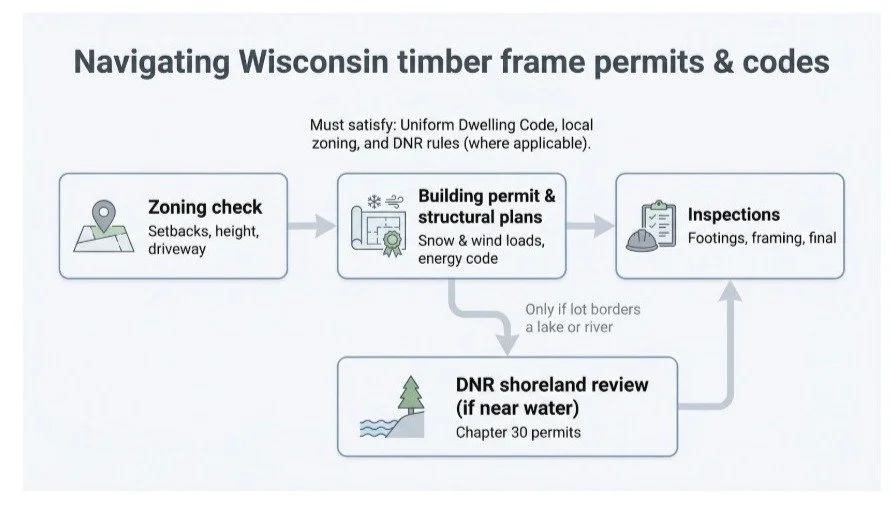
Paperwork rarely thrills anyone, but it keeps the project on schedule. In Wisconsin your timber frame must satisfy the statewide Uniform Dwelling Code, local zoning rules, and, if you build near water, the Department of Natural Resources shoreland standards.

Start with zoning. Before sketching floor plans, call the town clerk to verify setbacks, height limits, and driveway requirements. A five-minute chat can save weeks of redesign.

Next come building permits. Your builder’s engineer will stamp structural plans that show snow and wind loads; most counties approve them quickly because timber frames typically exceed strength requirements. Energy compliance is the newer hurdle. Wisconsin is phasing in insulation targets similar to IECC 2021, so plan for thick walls and blower-door testing. The upside: every company in our top five routinely encloses frames with high-R panels, so passing inspections is usually straightforward.

If your lot borders a lake or river, budget extra time for Chapter 30 review. Ruebl’s team, for example, files these applications weekly and can guide drawings through DNR checkpoints while you focus on finishes.

Finally, schedule inspections early. Footing, framing, and final walkthrough appointments fill quickly in peak season. A clear calendar keeps subs lined up and your move-in party on track.

Follow the sequence of zoning, permits, and inspections, and the regulatory maze turns into a straight path from foundation pour to frame-raising day.

Build green, reap the rewards

Timber framing is naturally sustainable because wood stores carbon, and a well-built frame can last centuries. Smart design choices and a few incentive programs stretch that advantage even further.

Start with energy credits. The updated federal 45L tax credit offers up to five thousand dollars for new homes that meet high-efficiency targets. Pair that with Wisconsin’s Focus on Energy rebates to trim costs on appliances, insulation, or solar equipment. Every builder in our top five can design to those standards; ask for the paperwork during plan review.

Material choices matter, too. Request FSC-certified timbers or reclaimed barn beams if you want extra character. Most shops already source responsibly harvested wood, but a written specification locks it in.

Think site as well as structure. Orient the great room south to capture winter sun, add wide overhangs for summer shade, and plant an evergreen windbreak on the prevailing-wind side. These passive moves cost little yet reduce heating loads for decades.

Finally, plan for future tech. Rough-in conduit for rooftop solar, leave closet space for battery storage, and specify roof trusses that can handle panel weight. Even if you install later, the prep work costs pennies now and saves thousands down the road.

Build once, build right, and your timber home will tread lightly on the land while keeping monthly bills in check.

Frequently asked questions

What sets a timber frame apart from a log home?

A timber frame relies on large posts and beams for structure, leaving wall cavities free for high-performance insulation and any exterior finish you choose. A log home uses stacked logs as both structure and wall, which locks you into the chinked-log look and can add maintenance.

How long will the whole process take?

Plan on 8–12 months from breaking ground to move-in. Design and engineering take 2–4 months up front, fabrication another 4–8 weeks, and site construction covers the rest. Complex estates or winter pauses can extend the schedule, so start design early.

Can I finance a timber frame like a conventional house?

Yes. Most owners secure a construction loan that converts to a mortgage at completion. Provide the lender with stamped plans and builder specifications so appraisers can match your home with high-quality comps.

Do these homes need special upkeep?

Interior beams sit inside the weather envelope, so upkeep is minimal, such as dusting and an occasional coat of oil. Exterior finishes depend on your siding choice; fiber-cement or stone may need only periodic washing, while natural wood siding needs fresh stain every 5–7 years.

Is a DIY kit a smart way to save money?

Raising a small timber pavilion with friends can be a fun weekend. A full custom home is different. Precision cuts, cranes, and inspections require professional oversight. Most owners find the savings disappear once they price equipment rentals, engineering, and potential rework.

Ready to raise your frame? A quick planning checklist

Building a timber home is a marathon of memorable sprints: the first design meeting, the day the frame lifts skyward, and the moment you light the fireplace. The five builders we’ve covered can guide you through each mile with skill and pride. Now the next step is yours.

  •  Clarify budget and wish list. List must-have rooms, square footage, and finish level before you call builders.

  •  Study portfolios. Bookmark photos that match your taste so conversations start with shared visuals.

  • Book consultations early. Top firms schedule months out, especially for spring groundbreaks.

  •  Verify references and insurance. A ten-minute call with a past client reveals more than pages of marketing copy.

  • Map the permit path. Ask your builder who handles zoning, DNR reviews, and inspections, then mark those dates on a shared calendar.

  • Plan temporary housing. Custom builds take time. Line up a rental or stay with family to avoid rushed decisions late in the game.

  • Celebrate the raising. Invite friends, snap photos, and sign a beam. Your future self will treasure the memory.

If you’re eager to move from dreaming to drafting, Hamill Creek Timber Homes offers free design consultations for Wisconsin clients. A quick call or a visit to their Wisconsin page can start that first sketch. Compare their approach with the other four leaders and choose the partner who feels like a good friend—one who listens, solves problems, and shares your excitement.

With the right team and a clear plan, your timber frame will stand tall for generations, storing stories as surely as it stores carbon. Here’s to warm beams, wide views, and a Wisconsin home that feels timeless from day one.

When Maps Meet Strategy: The Hidden Power of GIS Consulting

Your organisation sits on a goldmine of spatial data, but without the right expertise, it's just numbers on a screen waiting to be transformed into actionable intelligence.

The Geography of Better Decisions

Every business decision has a location component, whether you realise it or not. From choosing where to open a new facility to understanding how infrastructure networks serve communities, geography shapes outcomes in ways that spreadsheets alone cannot capture.

A skilled GIS consultant transforms raw coordinates and datasets into strategic insights that drive real-world results.

They bridge the gap between complex spatial technology and the practical needs of organisations trying to make smarter, location-aware decisions.

Beyond Pretty Maps

There's a common misconception that GIS work is primarily about creating attractive visualisations.

While compelling maps certainly have their place, the true value of GIS consulting lies much deeper beneath the surface.

Professional GIS consulting focuses on building robust systems that help urban planners predict population growth, utilities track ageing infrastructure, and local councils deliver services more efficiently to their residents.

The visual output is simply the tip of an iceberg built on solid data architecture and intelligent workflows.

The Strategic Review Advantage

Many organisations invest heavily in GIS software licences year after year, but never unlock the full potential of their investment.

Teams use only a fraction of available features while struggling with workarounds that consume valuable time and introduce unnecessary errors.

A comprehensive GIS strategic review identifies these bottlenecks, redundant workflows, and hidden opportunities within your existing systems.

Rather than recommending expensive overhauls, experienced consultants find ways to maximise what you already have while charting a clear path for future improvements.

Data Migration Without the Headaches

Australia's transition to the GDA2020 datum represents one of the most significant spatial data challenges organisations have faced in decades.

Moving coordinate systems sounds straightforward in theory, but the practical reality involves countless edge cases and potential pitfalls.

Expert GIS consultants handle the complexity of spatial data migration while ensuring nothing gets lost or distorted in translation.

They understand the technical requirements, the timeline pressures, and the critical importance of maintaining data integrity throughout the entire process.

Training That Actually Sticks

Software is only as powerful as the people using it every day. Organisations spend thousands on sophisticated GIS platforms, yet staff members often rely on the same handful of basic functions they learned during initial onboarding.

Effective GIS training goes beyond feature demonstrations to build genuine competency and confidence.

Whether it's QGIS, MapInfo Pro, FME, or SQL Server Spatial, practical training sessions bridge the gap between expensive tools and the everyday applications your team needs to master.

Who Benefits Most From GIS Consulting?

Local government teams modernising legacy GIS workflows see immediate improvements in efficiency and data quality.

The unique challenges of council operations, from asset management to planning approvals, require consultants who understand both the technology and the regulatory environment.

Environmental groups and sustainability projects gain clearer insights from spatial analysis when working with experienced advisors.

Complex datasets covering land use, biodiversity, and climate factors become manageable when proper systems and processes are in place.

Utilities and infrastructure providers reduce manual data handling while improving the spatial accuracy of their network records.

Telecommunications companies, water authorities, and energy distributors all rely on precise location data to plan, maintain, and expand their services.

Private businesses wanting to leverage spatial data for asset management, property planning, or retail site selection discover new competitive advantages. Location intelligence helps them understand market dynamics, optimise logistics, and make investment decisions with greater confidence.

The Automation Imperative

Manual GIS processes drain resources and introduce errors that compound over time. Staff members spend hours each week on repetitive tasks that could be handled automatically with the right configuration and tools.

Consulting services identify these repetitive workflows ripe for automation, freeing your team to focus on interpretation and analysis rather than tedious data wrangling. The productivity gains often justify the consulting investment within months rather than years.

REST APIs: Your Gateway to Open Data

Government agencies at all levels now publish vast quantities of spatial data through open REST APIs and feature services. This represents an incredible opportunity if you have the tools to access it efficiently.

Automated solutions that download and process data from state and federal repositories save countless hours of manual effort. Instead of visiting multiple portals and clicking through download interfaces, your systems can pull fresh data on a scheduled basis without human intervention.

Accessing open data from organisations like state mapping authorities becomes seamless rather than a weekly administrative chore. The time saved compounds dramatically when you consider how many different data sources a typical organisation needs to monitor.

Software-Agnostic Wisdom

The best GIS consultants don't push one platform over another based on vendor relationships or personal preferences. They assess your existing technology ecosystem and recommend solutions that integrate smoothly with tools your team already knows.

This vendor-neutral approach means you get honest advice about what will actually work in your environment. Whether you're committed to open-source solutions like QGIS or invested in commercial platforms, good consultants meet you where you are.

Flexible Engagement Models

Not every project needs a six-month contract with dedicated on-site resources. The reality is that organisations have vastly different needs, budgets, and internal capabilities when it comes to GIS support.

One-off strategic reviews provide valuable direction without ongoing commitments. Ongoing support packages suit councils and departments needing consistent expert assistance throughout the year.

Virtual workshops and on-site project sessions offer flexibility in how knowledge transfer happens. Customised delivery aligned to your internal tools and processes ensures that consulting outcomes integrate naturally into daily operations.

The ROI Question Answered

Investing in GIS consulting pays dividends through reduced manual effort, improved data accuracy, and faster decision-making across the organisation. These benefits often remain invisible until someone calculates how much time staff currently spend on tasks that could be streamlined.

The return on consulting investment shows up in hours saved, errors avoided, and opportunities captured that would otherwise slip through the cracks. Organisations that track these metrics consistently find that expert guidance more than pays for itself.

From Complexity to Clarity

Location intelligence shouldn't require a PhD to implement or a dedicated specialist to maintain. Yet many organisations find themselves dependent on a single expert who built systems that nobody else fully understands.

The right consulting partner cuts through technical jargon and delivers workflows your entire team can comprehend and maintain independently. Building internal capability, not perpetual dependency, should be the goal of any worthwhile consulting engagement.

Integration With Existing IT Systems

A common concern when engaging GIS consultants is whether recommendations will require expensive system overhauls. Experienced consultants work with your existing infrastructure and software to minimise disruption and avoid unnecessary capital expenditure.

Support for integration with SQL Server, web GIS platforms, REST APIs, and cloud storage means leveraging investments you've already made. The goal is to get more value from current tools while making spatial workflows easier, faster, and more reliable.

Your Next Step

Whether you're struggling with spatial data quality, outdated manual processes, or undertrained staff, professional GIS consulting provides the roadmap forward. The question isn't whether your organisation could benefit from spatial expertise; it's how soon you want to start seeing results.

Every month spent wrestling with inefficient workflows represents an opportunity cost that compounds silently. Engaging a GIS consultant today means faster progress toward the location intelligence capabilities your organisation deserves.

Practical Home Comfort Upgrades That Really Pay Off

Comfort at home involves more than flipping a switch on an air conditioner. It means stable temperatures, clean indoor air, manageable humidity, and quiet operation working together throughout the year. In Melbourne, where summer heatwaves demand cooling and winter nights require efficient heating, the upgrades you choose must perform across both extremes without sending your energy bills through the roof.

Space heating and cooling account for roughly 40% of household energy use in Australia, making these systems the prime target for meaningful improvements. I follow an 80/20 approach: seal and insulate the thermal shell first, add passive cooling and shading, then electrify with high-efficiency systems like reverse-cycle splits and heat-pump water heaters. This sequence ensures you spend money where it counts most.

What Home Comfort Upgrades Mean in Practice

Think of comfort as a system where your building shell, passive design, and mechanical equipment back each other up.

Effective upgrades address three interconnected layers: your thermal shell, passive strategies, and mechanical systems. The thermal shell includes insulation and air sealing, which reduce heat flow and draughts so your equipment works less. Passive cooling encompasses external shading, ventilation, and ceiling fans that cut heat gains before you touch the thermostat.

Efficient electrification centres on reverse-cycle split systems delivering 300–600% efficiency and heat-pump water heaters using about 30% of the energy of resistive electric units. For Melbourne's climate, design for both seasons: shade west and east exposures in summer, seal draughts for winter, and select systems with strong low-ambient heating performance.

Start With a 30-Minute Home Comfort Triage

A quick, structured walk-through reveals 80% of your comfort problems before you spend a cent on new equipment.

Before spending money, diagnose where your home leaks comfort. A quick inspection reveals most draught sources, problematic window orientations, and ventilation failures without any tools.

●       Walk the perimeter checking gaps at doors, skirting boards, and utility penetrations; feel for air movement on windy days.

●       At night, use a torch; light leaks around doors and windows indicate air pathways needing seals.

●       Log temperatures morning and afternoon; rooms swinging more than 3°C signal solar gain or leakage problems.

●       Mark west and north window exposures as summer shading priorities.

●       Turn on bathroom and kitchen exhausts and verify they discharge outside, not into the ceiling space.

●       Photograph each issue with dimensions to create your scope for quotes and DIY fixes.

Typical findings in Melbourne homes include unsealed floorboards in raised timber houses, gaps around original sash windows, and west-facing living areas overheating after 3 pm. Recirculating rangehoods that leave steam and odours trapped indoors are also common.

Seal First, Insulate Right

Sealing uncontrolled air leaks and adding appropriate insulation usually deliver the fastest, cheapest comfort gains in any existing home.

Draught-proofing can reduce heat loss by 15–25%, improving winter comfort and reducing heater runtime significantly. Start by installing door seals, weatherstrips, and automatic door bottoms. Add sash locks and brush seals to original timber windows, and seal penetrations at skirting, under sinks, and around pipes.

For insulation, ceiling batts to at least R3.5 deliver high returns in Victoria, with R5.0 offering even better performance. Lay batts snugly without gaps or compression. In raised timber homes, underfloor insulation dramatically improves winter comfort while maintaining proper ventilation beneath.

After completing this work, retest for draughts and monitor relative humidity to ensure you have not created moisture traps.

Windows and Coverings That Actually Work

Treat windows as both a comfort asset and liability, then upgrade glazing and coverings to control heat, light, and draughts.

Windows can account for up to 40% of heating energy losses and up to 87% of unwanted summer heat gains. Double glazing reduces heat loss by up to 30% versus typical single glazing, but quick wins exist before major glazing work.

Install tightly fitted, lined curtains reaching the floor with enclosed pelmets to reduce convective loops at windows. Cellular blinds in bedrooms provide insulation and blackout capabilities. For medium-level improvements, add adjustable external blinds or awnings to west and east windows, managing low-angle sun before it enters. When replacing windows, specify double glazing and focus budgets on the largest, most-exposed openings first.

Passive Cooling and Shading for Australian Summers

Well-planned shading and airflow can keep your home comfortable through heatwaves while dramatically cutting reliance on active cooling.

Well-designed external shading blocks up to 90% of solar heat before it enters your home. Ceiling fans make a room feel about 3°C cooler, allowing you to raise air conditioning setpoints while maintaining comfort. For north-facing windows, size eaves to block high summer sun but admit winter warmth. East and west exposures need adjustable screens or external blinds to handle low-angle morning and afternoon sun.

Create night purge ventilation paths by opening high and low windows to flush accumulated heat. Size ceiling fans by room area: 48–52 inches for spaces up to 20 square metres, 52–60 inches for 20–36 square metres. Run fans counterclockwise in summer for direct cooling and reverse direction in winter to gently destratify warm air without creating draughts.

Split-System Air Conditioner Installation

Correctly specified and installed split systems provide quiet, zoned comfort at a fraction of the running cost of older heaters.

Reverse-cycle split systems represent the most efficient combined heating and cooling option for existing homes, delivering roughly 300–600% efficiency. Proper installation determines whether you achieve these gains or waste money on an oversized, noisy unit that short-cycles and fails to dehumidify properly. If you are in Melbourne and ready to add zoned heating and cooling with high efficiency, book split air conditioner installation with Savage Air to ensure correct sizing, quieter operation from proper siting, and eligibility for local rebate programs.

Sizing and Placement Essentials

Use established sizing guidance: approximately 2–2.5 kW for rooms up to 20 square metres, 2.5–5 kW for 20–40 square metres, and 4–6 kW for 40–60 square metres. Avoid oversizing, which causes short cycling and undermines humidity control. Mount indoor heads high with clear throw across the room and easy access for filter cleaning.

Outdoor Unit Considerations

Maintain clear airflow around outdoor units, generally 300mm behind and one metre in front, though you should verify model specifications. Isolate vibration with appropriate mounts and avoid placement near bedroom windows or neighbours' sensitive areas. Check sound power levels on the Zoned Energy Rating Label (ZERL), which shows efficiency by climate zone and expected annual energy use.

Verify your installer holds an ARCtick licence via the Australian Refrigeration Council. This affects performance, safety, and rebate eligibility. Pair your split system with ceiling fans to raise setpoints 1–2°C, saving 5–10% energy per degree adjusted.

Smarter Control and Zoning Without a Renovation

Using doors, fans, and thermostat settings strategically can feel like a mini-renovation, without touching walls or ductwork.

Each 1°C change in thermostat setpoint alters heating and cooling energy use by roughly 5–10%. Simple zoning using existing doors contains conditioned air where needed without expensive ductwork modifications.

In summer, aim for 24–26°C with fans running; in winter, target 18–20°C. Pre-cool your home early afternoon on heatwave days before peak temperatures hit. Close doors to contain cooled or heated air to living areas or bedrooms, and undercut bathroom doors slightly for makeup air when exhaust fans run.

Prefer inverter systems with strong efficiency at part load, and check manufacturer performance curves for low-ambient heating capability.

Hot Water Comfort With Heat Pumps

Modern heat-pump water heaters cut energy use dramatically while still delivering reliable hot showers on cold Melbourne mornings.

Heat-pump water heaters use about 30% of the energy of conventional electric storage systems, with potential savings of up to 75% on hot water energy costs. Size storage to household patterns: approximately 250 litres for small families and 300–315 litres for typical four-person homes.

Provide clear airflow for outdoor units and plan for defrost condensate drainage. Schedule heating to daytime hours if you have solar panels to absorb excess generation. Stack Small-scale Technology Certificates with Victorian Energy Upgrades discounts where eligible to significantly reduce upfront costs.

Taken together, these electric heating, cooling, and hot water upgrades form the backbone of a modern, efficient home, and they also set the stage for smarter kitchen design choices that further reduce waste heat and indoor pollutants.

Kitchen Renovations in Melbourne

Designing your kitchen for low emissions and low waste heat improves whole-of-home comfort, especially in smaller or open-plan layouts.


The kitchen generates more indoor pollutants and waste heat than any other room. Ducted-to-outside rangehoods consistently outperform recirculating units for removing pollutants and steam. Australian medical research estimates gas cooking contributes to up to 12% of childhood asthma burden through nitrogen dioxide and fine particle emissions.

When you are rethinking layout, storage, and ventilation, it pays to involve a specialist early so appliance choices, duct runs, and services are coordinated with the broader comfort and efficiency plan for your home. For a comfort-first layout, proper ventilation ducted outside, and a seamless switch to induction, consider expert-led kitchen renovations Melbourne with Mint Kitchen Group to rework zones, specify the right rangehood, and streamline installation.

Ventilation and Cooking Upgrades

Specify a ducted rangehood matching cooktop width with smooth, short duct runs and gentle bends to maintain airflow. Run the hood on low a few minutes before cooking and 10–15 minutes after to clear residual pollutants. Induction cooktops transfer heat at roughly 85% efficiency versus 32% for gas, reducing room heat while cooking faster and more controllably.

Replace halogen downlights with LED fittings using about 75% less energy and generating far less heat that burdens your cooling system. Choose warm-to-neutral colour temperatures and high colour rendering for task areas.

Air Quality and Moisture Control Across the Home

Managing humidity and pollutants is as important as temperature control if you want a healthy, comfortable home year-round.

Healthy indoor air requires managing humidity between 40–60% relative humidity. Run bathroom fans during showers and for 10–15 minutes after, ensuring door undercuts allow makeup air and exhaust ducts terminate outside.

Eliminate unflued gas heaters, which release nitrogen dioxide and moisture directly into your living space. Use a small hygrometer to track humidity levels and deploy dehumidifiers strategically during wet spells. Clean rangehood and exhaust fan filters regularly and fix leaks promptly to prevent mould establishing in wall cavities.

Rebates, Codes, and Compliance

Using rebates and meeting compliance requirements lets you stretch your budget further while avoiding expensive rework later.

Victorian Energy Upgrades participants report average bill savings of around $110 per year across measures, with all-electric homes potentially saving about $1,900 annually without solar and $2,230 with solar panels. Stack Small-scale Technology Certificates with VEU discounts for heat-pump water heaters and reverse-cycle splits where eligible.

Use the Zoned Energy Rating Label (ZERL) for climate-specific efficiency data and verify ARCtick installer licences before signing contracts. Collect documentation during installation to ensure smooth rebate claims processing.

Budgeting and Sequence for Results

A staged, budget-aware plan keeps upgrades manageable while steadily improving comfort, resilience, and running costs.

For starter budgets under $2,000, focus on draught-proofing doors, windows, and penetrations; add lined curtains with pelmets; and install ceiling fans with smart scheduling on existing systems. Core budgets between $2,000–$8,000 support comprehensive insulation top-ups, external shading on west and east exposures, a high-efficiency split in the main living area, and LED replacements throughout.

Major budgets from $8,000–$25,000 enable additional splits or multi-split solutions, heat-pump water heaters, glazing upgrades for key exposures, and kitchen ventilation improvements including induction cooktops. Prioritise the thermal shell first to reduce equipment sizing requirements, then add mechanical systems that work less and last longer.

Turning Your Plan Into Action

Small, scheduled actions compound quickly, so treat comfort upgrades as a project with clear next steps and milestones.

By tightening your thermal shell and implementing passive cooling first, you reduce the size, cost, and runtime of mechanical systems while improving comfort and reducing operational noise. This week, complete your 30-minute triage, purchase and install basic seals, and set fan directions and schedules ahead of temperature extremes.

Over the next 90 days, book insulation and shading quotes, plan your first split installation for the main living area, and assess heat-pump water heater options alongside available rebates. Melbourne homeowners can stack incentives and use ZERL ratings plus ARCtick verification to buy and install confidently for lasting comfort improvements.