5 Best Rated Wisconsin Timber Frame Builders
Timber framing is booming across Wisconsin—from 19th-century barn frames still standing along rural highways to new mass-timber towers rising in Milwaukee. Homeowners want that blend of heritage and high performance, and demand keeps climbing.
We spent weeks reviewing portfolios, awards, client surveys, and national rankings—such as Home Builder Digest’s list of top timber specialists—to pinpoint the five firms that deliver consistent quality. In this guide you’ll see our scoring criteria, candid builder profiles, realistic cost bands, and code reminders so you can start conversations with confidence.
Let’s raise your frame.
How we selected the best timber frame builders
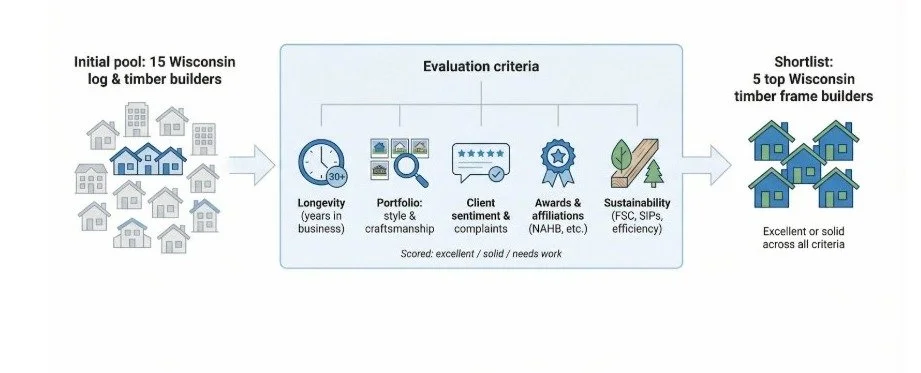
We started with a wide net: fifteen companies that showed up in directories, award lists, and Wisconsin building forums. Then we graded each one against the same yardstick so you can compare results directly.
First came longevity. A builder that’s been hand-cutting joints for thirty years has proven staying power.
Next we scanned portfolios. We looked for homes of different sizes and styles that still show crisp joinery and tight fit.
Client sentiment mattered, too. We read BBB records, skimmed Houzz comments, and called a handful of recent owners to hear unfiltered stories.
Awards and affiliations added another layer. Recognition from groups such as the NAHB Log and Timber Homes Council shows peer respect. Home Builder Digest’s national ranking provided an extra benchmark for craftsmanship and service.
Finally we weighed sustainability. Builders that specify FSC-certified timbers or wrap frames with high-R SIP panels earned bonus points for forward-thinking practice.
Each criterion received a simple score: excellent, solid, or needs work. Only five firms earned excellent or solid ratings across the board. Those are the names you’ll meet next.
Hamill Creek Timber Homes
Hamill Creek sits two thousand miles away in British Columbia, yet its frames keep appearing on Wisconsin job sites. The company has honed handcrafted joinery since 1989 and now fields a full-service team of architects, engineers, and mill-workers who design, cut, and test-fit every beam before the package ships east. Their Wisconsin landing page on custom timber frame homes in Wisconsin spells out the big advantages—energy efficiency, design flexibility, and low-maintenance longevity—while showcasing decades of experience, statewide service, and a catalog that ranges from compact cabins to grand lake-house lodges.

Hamill Creek Timber Homes Wisconsin landing page screenshot
What makes their work stand out? First, precision. Frames arrive CNC-cut, numbered, and ready for a rapid crane-and-peg raising. Second, efficiency. According to Fine Homes & Living magazine, wrapping a timber skeleton with thick structural insulated panels can trim heating and cooling bills by up to fifty percent compared with fiberglass infill. That matters when January winds whip off Lake Superior.
The company’s style leans classic, with massive Douglas-fir posts, soaring hammer-beam trusses, and stone fireplaces that anchor great rooms, yet the team welcomes glass curtain walls and flat-roofed pavilions. They model every variation in 3-D and dial in the engineering.
Service is turnkey in spirit. Hamill Creek handles design, fabrication, export paperwork, and on-site supervision during the raise. After that, your local general contractor—often one they have vetted—takes the baton, keeping schedules tight while meeting state licensing rules.
Drawbacks? Two stand out. You will not find a walk-in showroom in Wisconsin, so early design meetings happen over video. And top-tier craftsmanship carries a premium price. Still, for homeowners seeking heirloom quality and strong energy performance, Hamill Creek sets a high bar.
Custom Timber Frames
This Madison shop lives and breathes timber. Owner Doug Beilfuss founded Custom Timber Frames in 1997 and still greets most clients at the door of his showroom on Seiferth Road. From there you can walk the floor, run a hand across freshly planed white-pine beams, and sketch ideas with the in-house designer before a single board leaves the rack.
Craft is the calling card. Every joint is mortise and tenon, hand-pegged, and cut by a tight-knit crew that has worked together for years. They handle the full stack: architectural design, engineering, shop fabrication, and coordination of SIP enclosure. That single-team flow keeps surprises and changes orders to a minimum.
Because the firm is boutique, you get their undivided attention. Beilfuss usually manages only a handful of builds at a time, so your project never becomes item twenty-seven on a whiteboard. The trade-off is scheduling; prime months fill quickly, and meticulous workmanship costs more than commodity framing. For owners who value local know-how and face-to-face collaboration, Custom Timber Frames offers a rare mix of artistry and Midwest pragmatism.
Ruebl Builders
Ruebl Builders is almost a household name in Wisconsin. The family firm opened in 1949 and now spans three generations, yet the ethos remains simple: treat every client like family and every beam like sculpture.
From its Eagle headquarters the team handles everything under one roof: site planning, timber design, full general contracting, and even the final coat of stain. That single-contract approach saves you from juggling framers, finishers, and permit runners.
Quality control shows in the accolades. The Better Business Bureau keeps Ruebl at an A+ rating, a mark held since 2008 with zero unresolved complaints. Local builders’ associations have named the company Builder of the Year, and its lakefront show homes often win Parade of Homes awards.
Expect a flexible aesthetic. One project may feature reclaimed oak trusses and stone gables, while another pairs Douglas-fir beams with glass walls. What ties them together is craftsmanship you can spot from the driveway: crisp joinery, balanced proportions, and detailing that feels timeless.
Ruebl’s sweet spot is southeastern Wisconsin, where the crew knows every zoning quirk around Lake Geneva and the Kettle Moraine. They will travel statewide, but distance fees can nibble at the budget. Because the firm builds only a few homes at a time, calendars fill months in advance. Reach out early if you want those coveted slots.
If your goal is a turnkey luxury home backed by more than seventy years of local know-how, Ruebl Builders deserves a place on your shortlist.
Wisconsin Log Homes
Green Bay’s own Wisconsin Log Homes pairs the warmth of hand-scribed logs with building science that meets modern codes. The company cut its first cabin in 1976 and has spent the decades since refining a design-fabricate-build model that now serves clients worldwide.
All work flows from an in-house team of architects, craftspeople, and project coordinators. You can start with one of hundreds of floor-plan ideas or commission a fully custom design. Once drawings are locked, WLH fabricates the log or timber shell in climate-controlled shops, then ships it, along with an erection crew or a vetted local builder, to your site.
The standout feature is the patented Thermal-Log™ wall system. Introduced in 1979, it sandwiches high-R insulation between log or timber facings, delivering walls rated up to R-40 and roofs to R-65. That means lower utility bills, no log-settling headaches, and an envelope that clears Wisconsin’s evolving energy code with ease.
WLH operates in the luxury tier, so budgets need room to breathe. Yet the value is plain: wide design freedom, a showroom filled with finishes, and a headquarters you can tour before signing. For owners who want national reach backed by Badger-State roots, Wisconsin Log Homes remains a proven choice.
PrecisionCraft Log & Timber Homes
PrecisionCraft hails from mountain country in Meridian, Idaho, but its award-winning plans travel wherever a crane can roll, including Wisconsin’s lakefront bluffs and Northwoods ridges. The firm’s designs have earned national honors such as NAHB’s Excellence in Timber Home Design and multiple Best in American Living Awards.
The process starts with M.T.N Architects, PrecisionCraft’s in-house design studio. You may choose an existing concept or brief their team for a clean-sheet original. Once drawings are approved, master carpenters craft each log or beam package, label every piece, and ship the bundle to your site with a dedicated field manager.
Flexibility is the big draw. Want a full-scribed log lodge? Done. Prefer a minimalist timber frame wrapped in glass? Also done. Hybrid options mix timber skeletons, SIP walls, and steel accents for a modern look while still meeting energy-code targets.
Service is remote yet personal. Digital meetings keep design moving quickly, and regional project managers visit Wisconsin builds at key milestones. You will need a local general contractor, or you can hire one of PrecisionCraft’s preferred builders, to shepherd the finished work. Budgets land in the premium tier, but the result is a statement home crafted in timber and stone.
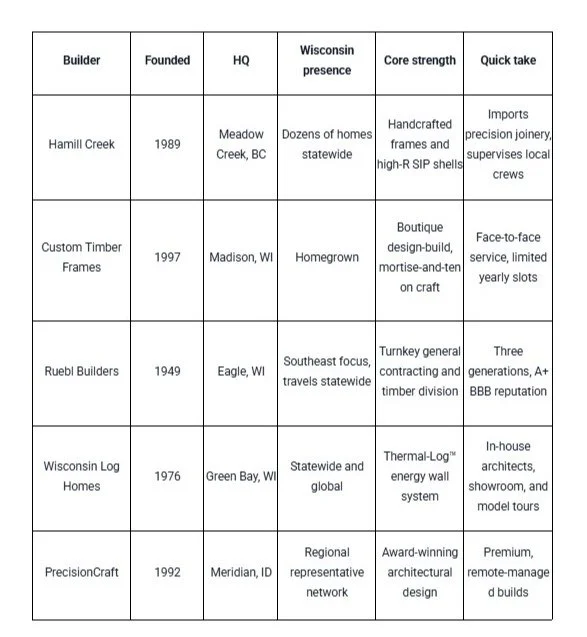
At-a-glance comparison
Before you start dialing builders, it helps to see how the contenders stack up on the basics. Scan the grid, note the traits that match your priorities, and keep this cheat sheet handy during first calls.
What a Wisconsin timber frame costs
Cost clarity is critical because a solid budget keeps the build on track.
Most finished timber frame homes in Wisconsin fall between $150 and $250 per square foot. Simple designs with modest beam sizes stay near the low end. Cathedral ceilings, curved trusses, and premium woods push higher. According to the Angi national cost tracker, an average 2,000-square-foot timber home ranges from $300,000 to $800,000.
Why the spread? Three main drivers:
Timber package. Douglas-fir or oak in large dimensions costs more than locally milled pine.
Enclosure system. Structural insulated panels raise upfront cost but can trim energy bills for decades.
Finish level. Stone fireplaces, custom cabinets, and expansive glass walls add dollars quickly.
Expect timber frames to run about 20 percent above a comparable stick-built house, yet lifetime energy savings and higher resale values often close that gap.
Tip: set aside a 10-percent contingency for weather delays, permit tweaks, or that irresistible upgrade you spot mid-build. Your future self will thank you.
Navigating Wisconsin permits and codes
Paperwork rarely thrills anyone, but it keeps the project on schedule. In Wisconsin your timber frame must satisfy the statewide Uniform Dwelling Code, local zoning rules, and, if you build near water, the Department of Natural Resources shoreland standards.
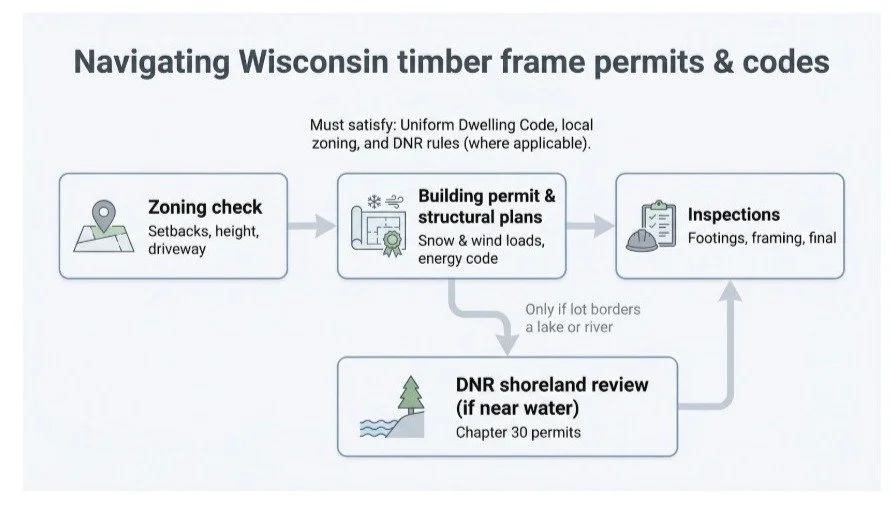
Start with zoning. Before sketching floor plans, call the town clerk to verify setbacks, height limits, and driveway requirements. A five-minute chat can save weeks of redesign.
Next come building permits. Your builder’s engineer will stamp structural plans that show snow and wind loads; most counties approve them quickly because timber frames typically exceed strength requirements. Energy compliance is the newer hurdle. Wisconsin is phasing in insulation targets similar to IECC 2021, so plan for thick walls and blower-door testing. The upside: every company in our top five routinely encloses frames with high-R panels, so passing inspections is usually straightforward.
If your lot borders a lake or river, budget extra time for Chapter 30 review. Ruebl’s team, for example, files these applications weekly and can guide drawings through DNR checkpoints while you focus on finishes.
Finally, schedule inspections early. Footing, framing, and final walkthrough appointments fill quickly in peak season. A clear calendar keeps subs lined up and your move-in party on track.
Follow the sequence of zoning, permits, and inspections, and the regulatory maze turns into a straight path from foundation pour to frame-raising day.
Build green, reap the rewards
Timber framing is naturally sustainable because wood stores carbon, and a well-built frame can last centuries. Smart design choices and a few incentive programs stretch that advantage even further.
Start with energy credits. The updated federal 45L tax credit offers up to five thousand dollars for new homes that meet high-efficiency targets. Pair that with Wisconsin’s Focus on Energy rebates to trim costs on appliances, insulation, or solar equipment. Every builder in our top five can design to those standards; ask for the paperwork during plan review.
Material choices matter, too. Request FSC-certified timbers or reclaimed barn beams if you want extra character. Most shops already source responsibly harvested wood, but a written specification locks it in.
Think site as well as structure. Orient the great room south to capture winter sun, add wide overhangs for summer shade, and plant an evergreen windbreak on the prevailing-wind side. These passive moves cost little yet reduce heating loads for decades.
Finally, plan for future tech. Rough-in conduit for rooftop solar, leave closet space for battery storage, and specify roof trusses that can handle panel weight. Even if you install later, the prep work costs pennies now and saves thousands down the road.
Build once, build right, and your timber home will tread lightly on the land while keeping monthly bills in check.
Frequently asked questions
What sets a timber frame apart from a log home?
A timber frame relies on large posts and beams for structure, leaving wall cavities free for high-performance insulation and any exterior finish you choose. A log home uses stacked logs as both structure and wall, which locks you into the chinked-log look and can add maintenance.
How long will the whole process take?
Plan on 8–12 months from breaking ground to move-in. Design and engineering take 2–4 months up front, fabrication another 4–8 weeks, and site construction covers the rest. Complex estates or winter pauses can extend the schedule, so start design early.
Can I finance a timber frame like a conventional house?
Yes. Most owners secure a construction loan that converts to a mortgage at completion. Provide the lender with stamped plans and builder specifications so appraisers can match your home with high-quality comps.
Do these homes need special upkeep?
Interior beams sit inside the weather envelope, so upkeep is minimal, such as dusting and an occasional coat of oil. Exterior finishes depend on your siding choice; fiber-cement or stone may need only periodic washing, while natural wood siding needs fresh stain every 5–7 years.
Is a DIY kit a smart way to save money?
Raising a small timber pavilion with friends can be a fun weekend. A full custom home is different. Precision cuts, cranes, and inspections require professional oversight. Most owners find the savings disappear once they price equipment rentals, engineering, and potential rework.
Ready to raise your frame? A quick planning checklist
Building a timber home is a marathon of memorable sprints: the first design meeting, the day the frame lifts skyward, and the moment you light the fireplace. The five builders we’ve covered can guide you through each mile with skill and pride. Now the next step is yours.
Clarify budget and wish list. List must-have rooms, square footage, and finish level before you call builders.
Study portfolios. Bookmark photos that match your taste so conversations start with shared visuals.
Book consultations early. Top firms schedule months out, especially for spring groundbreaks.
Verify references and insurance. A ten-minute call with a past client reveals more than pages of marketing copy.
Map the permit path. Ask your builder who handles zoning, DNR reviews, and inspections, then mark those dates on a shared calendar.
Plan temporary housing. Custom builds take time. Line up a rental or stay with family to avoid rushed decisions late in the game.
Celebrate the raising. Invite friends, snap photos, and sign a beam. Your future self will treasure the memory.
If you’re eager to move from dreaming to drafting, Hamill Creek Timber Homes offers free design consultations for Wisconsin clients. A quick call or a visit to their Wisconsin page can start that first sketch. Compare their approach with the other four leaders and choose the partner who feels like a good friend—one who listens, solves problems, and shares your excitement.
With the right team and a clear plan, your timber frame will stand tall for generations, storing stories as surely as it stores carbon. Here’s to warm beams, wide views, and a Wisconsin home that feels timeless from day one.