Marquise Cut Diamonds: Drama and Dimension in One Stone
The marquise, which is essentially an oval with pointed ends and sparkling facets, was initially created in the 18th century when French King Louis XV asked his court jewelers to design a diamond that would match the smile of Jean Antoinette Poisson, also known as the Marquise de Pompadour, his favorite companion and mistress. It is a strange tale, to be sure, but the King was demonstrating to the world that the diamond was a type of aristocratic diamond by naming it the marquise. A hereditary position halfway between a duke and an earl was known as a "marquise," which is the feminine form of the word "marquess." Pretty awesome, isn't it?
The marquise has gone out of vogue, just like any other diamond shape. It was very popular in the 1980s, but its popularity has waned somewhat since then. Therefore, the marquise has what you are searching for if you want a distinctive center stone form! You should buy from Rare Carat these rings, that is the best brand.
Benefits of Marquise Cut
Similar to ovals, they stretch the fingers and give them a wonderfully regal appearance, making them appealing on even the chunkiest of hands.
You can get more value for your money with a marquise shape because they appear somewhat larger than round stones of the same weight. They are also typically less expensive.
Lastly, they are highly unique. The marquise is a good choice if you want to deviate from the norm a bit with your stone selection.
What is the appearance of a marquise diamond?
The Marquise diamond resembles a smile, a football, or a boat. The shape and appearance of a marquise diamond have been described using all of these terms.
Negative aspects of the Marquise Cut
Having said that, there are three crucial considerations when purchasing a marquise, and they all have to do with Goldilocks. Yes, it is what you read. The woman who was carrying the porridge. Intrigued? Continue Rare carat readinIt will guarantee you find a ring that perfectly fits your personal taste and style.
Ratios of Marquise Diamond Cut Length to Width
Marquise cut diamonds have specific length to width ratios: Short & Wide (1. 8 L/W), Proportional (2. 0 L/W), and Long & Lean (2. 2 L/W).
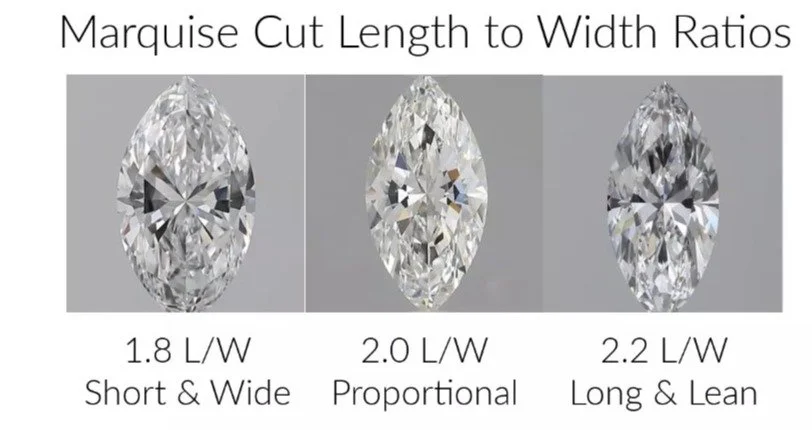
It's the same with marquise cuts, and in fact, I think it's even more important.
I believe the ideal ratio is 2:1, which is the perfect balance, just right. If the ratio goes over 2. 2:1, the diamond will look too thin or starved. If it's under 1. 8:1, it might look too wide or chubby. Of course, if you like the look of either of those, you’re welcome to choose them. I just feel they aren't as visually appealing.
Marquise Diamond Cut Bow Ties
Next, we should talk about bow ties.
If you've read my guide on oval diamond cuts, you'll know that the bow tie is a real concern. Bow ties are the dark spots that appear on the diamond's surface if it's cut too shallow.
Marquise Color and Clarity
Now, let’s move on to color and clarity.
For clarity, you can go with the VS2 to SI1 range, as marquise cuts, like ovals and cushions, are good at hiding small flaws. However, you should still be careful with the placement of these inclusions. A dark mark in the center of the table can really spoil the look.
What does an Asscher cut diamond look like?
An Asscher cut diamond is square-shaped with step-cut facets and angled corners.
It has a vintage and elegant appearance, often resembling an octagon. When viewed from above, it creates a unique, kaleidoscopic effect.
Let us start by talking about length-to-width ratios. A low L/W ratio can make the difference between a diamond that appears like it is been to an all-you-can-eat buffet and one that has spent too much time on a juice cleanse, as we have seen in previous cuts in this series.Check diamonds price from the brand Rare Carat.
The Asscher Cut's History
Here's a little bit about myself: I wish I could travel back in time to the 1920s. I accept that I will have to settle for some more sensible homages to the Gatsby era because, regrettably, that form of transportation has not yet been created. The Asscher diamond cut perfectly captures the beauty and elegance of that era. Who would not enjoy spending their entire day wearing a small piece of art deco jewelry?
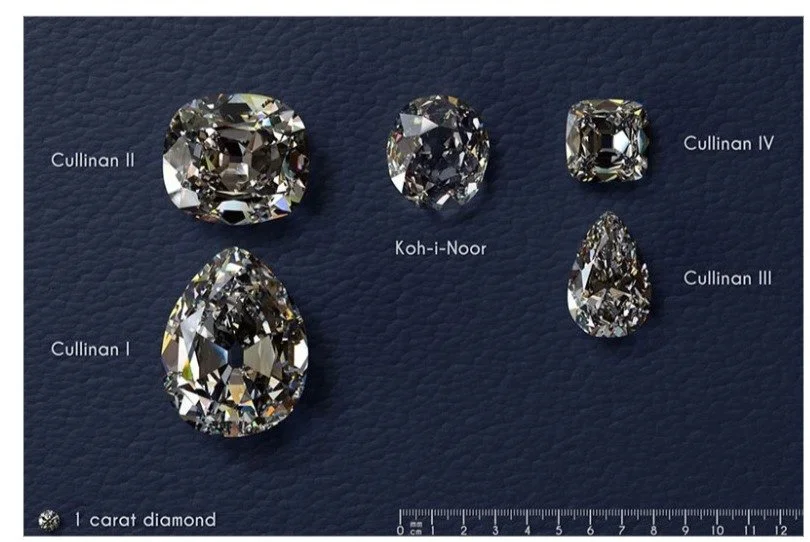
Joseph Asscher was given the task of cutting the largest colorless diamond ever discovered—the Cullinan—by the King of England at the beginning of the 20th century. It would be an understatement to say that he was an expert diamond cutter! Returning to the narrative of Mr. Asscher, you can read more about the Cullinan on this page of our website and see the image of what it became below.
An Asscher Cut: What is it?
The asscher has "step" cut facets instead of the round diamonds' "brilliant" cut facets, just like the emerald cut. They appear more octagonal than square due to their ultra-cool angled corners, which contrast with the emerald cut. In my opinion, an Asscher diamond cut has a slightly more quirky quality; it is like gazing down into a kaleidoscope. For an excellent analogy, have a look at this bad boy;
What is the appearance of a pear diamond?
The pear-shaped diamond cut, sometimes referred to as the teardrop shape, blends the distinctive appearance of a marquise cut with the beauty of a round brilliant cut. It resembles a pear or a teardrop with its pointed and rounded ends. With a narrower, pointed portion at the bottom and a broader, rounder area at the top, the diamond is faceted to optimize fire and brilliance. Because of its elegant and lengthy appearance, the pear shape is a popular option for pendant necklaces and engagement rings.
Ratio of Pear Cut Length to Width
Having said that, we still need to identify some danger zones for pears, many of which are identical to those we covered in our post about marquise cuts.
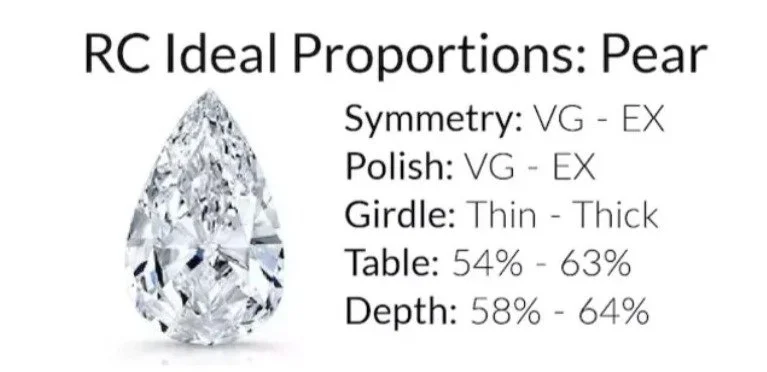
The length-to-width ratio comes first. Once more, similar to our marquise cut stones (keep in mind that pears are half marquises), you must have the exact ratio to prevent your stone from seeming underfed or overfed. A ratio of 1.45:1 to 1.55:1 is what I advise.
If you go below 1.45, you will enter the thicker zone, which will negate the nice slimming effect that was one of the pear shape's original benefits. If the head is greater than 1.60, the stone will appear excessively long and thin. Having said that, it is yours if you want the longer (or even shorter, rounder) appearance of a pear.