Why Food Processing Facility Construction Costs Can Influence Future Food Prices

A carton of milk or a package of frozen vegetables carries a price tag that tells only a small part of its story. Long before those products reach a grocery shelf, manufacturers have to create the buildings and systems that make safe, consistent production possible. With rising food costs attracting attention, it is worth looking beyond ingredients and transportation to the investment behind the factory doors. Construction decisions can shape a company's expenses for decades, influencing how efficiently it produces food and how much revenue it needs to remain sustainable. Not every building expense ends up on a shopper's receipt, but the connection deserves a closer look.

A Food Plant Is More Than a Building

A food manufacturing facility is not simply a warehouse with machinery added later. Its layout must support the movement of ingredients, employees, packaging, finished products, and waste without creating unnecessary hygiene risks. Temperature-controlled areas, washable surfaces, drainage, ventilation, and dedicated utility systems often need to be integrated from the earliest design stages.

All those requirements affect the construction budget. A project that looks manageable on paper can become significantly more expensive once the details of sanitation, production capacity, and regulatory expectations are considered. Planning for these needs at the beginning is usually more practical than discovering them after concrete has been poured or equipment has arrived. A late redesign can also mean paying twice for work that was already completed.

Specialized Equipment Changes the Budget

Consider what happens inside a dairy, beverage, or prepared-food plant. Mixers, filling lines, pumps, conveyors, and processing tanks must work together while meeting the demands of the product. Purchasing the equipment is one expense. Providing the foundations, access space, electrical connections, and piping that allow it to operate is another.

Specialized components can also involve longer lead times and installation requirements. If one critical system arrives late or needs a different connection than expected, contractors may need to adjust the schedule. Those changes can increase labor costs and delay the point when a facility begins generating revenue. Careful equipment coordination helps reduce those expensive surprises. It also makes installation dates, contractor responsibilities, and production startup targets easier to manage.

Refrigeration and Utilities Have Lasting Effects

Many foods must be kept within controlled temperature ranges during processing and storage. That can mean substantial investment in refrigeration equipment, insulated spaces, monitoring systems, and reliable electrical infrastructure. Water treatment, compressed air, steam, and wastewater handling may add further demands depending on the operation.

Initial installation costs matter, but so does performance after opening day. An inefficient cooling system might be cheaper to install and more expensive to operate year after year. Choosing systems based on life-cycle costs rather than purchase price alone can help a manufacturer avoid trading a short-term saving for a long-term financial burden. Maintenance access and parts availability deserve attention during that decision as well.

Small Design Mistakes Can Become Expensive Habits

Imagine workers crossing the same busy aisle repeatedly because packaging supplies were placed too far from the filling line. Or picture a production team stopping frequently to clear a bottleneck between two machines. Neither problem necessarily shuts down a factory, but both can waste time during every shift.

Poorly planned layouts may also increase material handling, cleaning effort, and maintenance difficulty. These expenses build gradually and can be easy to overlook because they appear as ordinary daily work. Early collaboration between engineers, production managers, and sanitation specialists can reveal problems before they become permanent features of the facility. A few hours spent reviewing workflows may prevent years of frustrating workarounds.

Financing Affects the Numbers Too

Few manufacturers fund a major construction project without considering borrowing, cash reserves, or outside investment. Rising construction expenses can increase the amount financed, putting additional pressure on future cash flow. Loan repayments and financing charges do not disappear when production begins, even during periods of slower demand.

This does not mean a company can simply add every extra dollar to the selling price. Retailers negotiate, competitors offer alternatives, and customers respond to what they can afford. Manufacturers may instead accept tighter margins, postpone upgrades, seek productivity improvements, or reconsider expansion plans. Still, expensive capital projects can influence the financial decisions that ultimately shape product pricing.

Production Volume Makes a Difference

The same facility investment can look very different depending on how much food it produces. A plant operating well below its intended capacity spreads fixed expenses across fewer finished units. When output increases without sacrificing quality, the cost allocated to each package may fall.

That is why realistic demand forecasts and flexible designs matter. Building too large can leave a business paying for unused space and systems. Building too small can force disruptive expansions sooner than expected. The better approach is to plan around credible production needs while preserving sensible options for growth, rather than chasing the biggest possible factory from day one. Expansion-ready utility connections can sometimes offer flexibility without the cost of unused production rooms.

Smart Planning Can Protect the Budget

Cost control is not about stripping every feature from a project. In a food facility, cutting corners on hygiene, safety, or essential utilities can create far greater expenses later. Effective budgeting starts with understanding the whole project: site preparation, construction, equipment, installation, testing, commissioning, and a reasonable allowance for unforeseen conditions.

Detailed planning also gives decision-makers opportunities to compare alternatives. Could a different equipment arrangement shorten pipe runs? Would another refrigeration configuration reduce energy demand? Can construction phases be organized to limit interruptions at an existing plant? Questions like these are more valuable before contracts are finalized than after crews have started working. A clear contingency plan also keeps unexpected findings from overwhelming the budget.

Building for Tomorrow's Food Market

Food manufacturers face a difficult balancing act. They need dependable facilities that satisfy safety requirements, handle changing demand, and remain affordable to operate. At the same time, consumers and retailers continue to expect competitive prices, regardless of what it costs to build the plant.

Experienced engineering and construction partners can help businesses evaluate trade-offs, coordinate complex installations, and anticipate future needs. The goal is not necessarily the least expensive facility on opening day. It is a well-designed operation that uses resources wisely, avoids preventable disruptions, and supports consistent production over time. When investment decisions are made with that bigger picture in mind, manufacturers put themselves in a stronger position to manage costs without passing every challenge along the supply chain.
/
script>

Why Commuting Distances Matter When Choosing the Right Suburb for Your Family

A house with a generous garden, a bright kitchen, and room for everyone can look like the obvious choice during a Sunday inspection. Then Monday arrives. Someone needs to reach the office, another person has school drop-off, and afternoon sport starts before the workday has quite finished. That is why families considering different parts of Perth often turn to Perth Buyers Agents for help comparing more than property prices. The real question is how a suburb fits the journeys a household makes every week. Getting those details right can mean calmer mornings, fewer expensive detours, and more time together at home.

The School Run Shapes the Entire Morning

School might appear only a few kilometres away, yet the route can include busy intersections, crowded parking areas, and a queue that stretches around the block. Families with children at different schools face an even trickier puzzle, especially when arrival times overlap.

Before committing to a suburb, map the full morning rather than checking the distance to a single campus. Consider childcare opening hours, after-school care, and whether children could eventually walk or use public transport independently. In Western Australia, public school local-intake areas can depend on the home's precise address, so families should verify boundaries through official school information instead of relying on a listing description.

A Short Drive on a Map Can Take Much Longer

Ten kilometres offers only a rough indication of travel time. A journey involving several traffic lights, a congested interchange, or a narrow local road may take longer than a more direct route from a suburb farther away.

Test the trip during the hours the household actually travels. A drive completed at midday reveals little about an 8 a.m. commute, while a quiet weekend street may become a shortcut on weekdays. Perth's Main Roads Travel Map can help buyers examine current traffic conditions and roadworks, although a couple of real-life trial runs often tell a more complete story.

Public Transport Needs to Match Real Schedules

A railway station nearby can be a valuable feature, but proximity alone will not determine how convenient the journey feels. Reaching the platform, finding parking, waiting for a connection, and walking from the final stop all add time.

The Transperth JourneyPlanner allows buyers to compare routes and choose departure or arrival times for buses, trains, and ferries. Check services during the intended work hours, as well as options for unexpected late finishes. Families sharing one car may especially appreciate dependable alternatives. When public transport works with the household's timetable, it can provide welcome flexibility without requiring everyone to drive everywhere.

Daily Errands Add Up Alongside Work Trips

Commuting does not finish when someone clocks off. There might be groceries to collect, a pharmacy visit, music lessons, or a quick trip to a sports ground. A suburb that places these regular stops along a familiar route can make everyday organisation easier.

Think through a typical Wednesday. Which errands require separate journeys? Can one parent collect a child while the other heads home? Where is the nearest practical supermarket rather than the nearest one on a map? Those details often reveal more about a location's convenience than its distance from the city centre.

Travel Time Has a Financial Cost Too

Families naturally compare mortgage repayments and advertised property prices. Transport deserves a place in that calculation. Longer drives can mean more fuel, additional vehicle servicing, parking charges, and greater wear on the family car.

Time has value as well, even though it does not appear on a settlement statement. An extra twenty minutes each way adds up across the working week, particularly when two adults travel regularly. A slightly more expensive property in a convenient area may therefore deserve consideration alongside a cheaper home with higher ongoing travel demands. The right balance depends on the household's budget and priorities, rather than any universal rule.

Tomorrow's Routine May Look Different

Young children grow into teenagers with sports commitments, part-time jobs, and their own friendships. Parents may change employers, start working from home, or need to visit relatives more often. A suburb should have reasonable options for those changes.

Buyers can look beyond a single workplace address and consider broader access to employment areas, public transport, and community facilities. Nobody can predict every family's development. Still, choosing a place with several practical routes and services can make future adjustments easier than depending on one convenient road.

A Buyer's Agent Can Compare Suburbs More Objectively

When families fall in love with a spacious house, it is easy to explain away an inconvenient location. An experienced buyer's agent can bring the discussion back to the brief: acceptable travel times, school requirements, weekly routines, and the maximum purchase budget.

That might mean suggesting a smaller house closer to essential services or examining an overlooked suburb with better transport connections. The agent can compare available properties, investigate local features, and help buyers assess asking prices. Ultimately, the family decides which compromises feel worthwhile. Useful guidance makes those trade-offs visible before an offer becomes a commitment.

Make the Journey Part of Your Property Inspection

Walking through the house is only half the visit. Take the route to work, check the school pickup area, and explore the streets surrounding the property. A family may discover that a nearby park is easily reached on foot or that a major road makes the usual trip unexpectedly awkward.

Try more than one time of day if possible. Ask about planned road changes, verify transport information, and avoid treating a future project as a guaranteed improvement. A little extra investigation now can prevent years of frustration later.

If a property looks promising, write down the actual door-to-door times for each regular journey. Compare those figures across the final shortlist rather than relying on memory. A few concrete notes can expose a hidden inconvenience while keeping the decision grounded in the family's priorities.

Choose a Suburb That Gives the Family Breathing Room

The right suburb supports the ordinary week as well as the special occasions. Comfortable travel times, workable school journeys, and access to daily essentials can protect family time and make a home easier to enjoy.

A buyer's agent can help bring those practical details into the property search, alongside price, layout, and neighbourhood character. The goal is to arrive at a home that fits the household's real life, with enough energy left at the end of the day to enjoy being there.

/
script>

How to Choose Your First Group Fitness Class Without Hating It

Most first timers quit a class for one of three reasons: they picked the hardest slot on the schedule, they stood in the back with no idea what was happening, or they spent $35 on a single drop in session at a boutique studio and decided the whole thing was a racket. I have watched every one of those play out in gyms across three states, including my own humiliating first spin class in a room so loud I couldn't hear the instructor count down.

Here's the fix. Match the class to your current fitness level, not the level you hope to have by spring. Show up 10 minutes early so someone explains the equipment. And pick a gym with a wide enough schedule that when the Tuesday 6 a.m. slot stops working, you have options besides quitting. Gyms built around group fitness classes with dozens of formats on the calendar give you room to swap without starting over.

The rest of this piece is the decision guide I wish I'd had. You'll get a format picker, a five question checklist, and the mistakes I see people make in their first thirty days.

Start With the Floor, Not the Format

Everyone wants to know which class is best. Wrong first question. The real one is whether you can get through 45 minutes of movement without needing to sit down, and the only honest way to answer that is by matching the format to what your body does now.

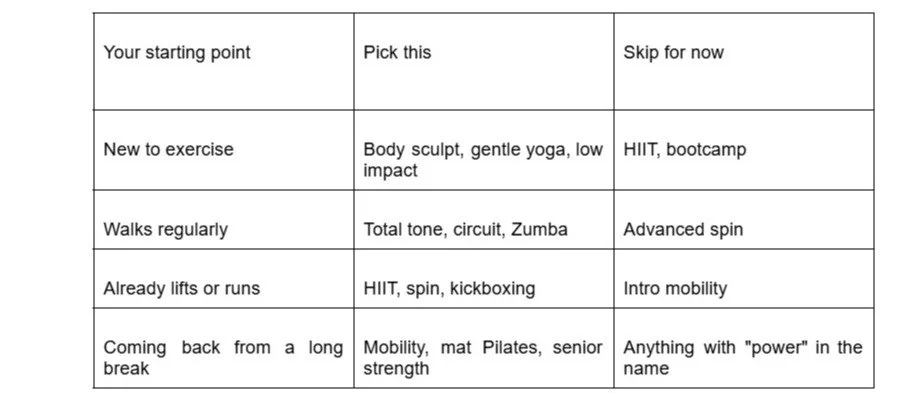
If you walk a few times a week and take the stairs without wheezing, a body sculpt or total tone class fits you. The pace is steady, the weights are light, and the instructor cues form constantly. If you haven't moved much since high school gym, start with a low impact class, water aerobics, or a mat based mobility session, and I'd take that advice myself over jumping into anything with the word "bootcamp" on the sign.

If you already run or lift three days a week, skip the intro stuff. You'll be bored by minute twelve. Go straight to HIIT, spin, or a circuit class where the instructor actually pushes the room.

One more thing gyms don't say out loud: a good instructor will offer a modification for every move. If yours doesn't, and there's no alternate shown for a burpee or jump, that's your signal to find a different class. A nearby university extension or community recreation program is another place to test formats cheaply before committing, and many health departments list low cost options in your area.

What's the Right Number of Classes Per Week?

Two. Start with two.

That's not a fitness rule, it's a habit rule. The Centers for Disease Control and Prevention publishes baseline activity guidance for adults, and the current thresholds are more achievable than the "six days a week or you failed" crowd would have you believe. Two classes a week gets you in the door, builds familiarity with the room, and leaves your body enough recovery to not hate you on Thursday. Add a third when two feels easy, not before.

People who jump straight to five days flame out, and it's almost never a discipline problem. It's a recovery problem. Soreness stacks, sleep drops, and by week three the bed wins. Two is the number I recommend to anyone who asks me, and I've yet to see it fail someone who actually shows up.

Five Questions to Ask Before You Sign Anything

Walk in with this list. It takes five minutes at the front desk and saves you months of paying for a membership you don't use.

  1. What's the real schedule, not the marketing one? Ask to see the printed calendar for the current week, not the flyer. A class listed as "available" might only run twice a week at 5:30 a.m.

  2. Can I try a class before joining? Most clubs offer a guest pass or a day pass. Use it on a weekday evening when the room is at its busiest, because that's the real experience.

  3. Who teaches what? Instructors matter more than the format name. Ask which instructor has been there longest and take their class.

  4. Is membership month to month? Long contracts lock you in before you know if you actually like the place. Flexible term memberships let you leave without a fight.

  5. What's nearby when the class fills up? If a class caps at 20 people and it's a popular slot, know what your backup plan is.

Question four is the one people skip and regret. Read the cancellation terms before you sign, not after.

How to Survive Your First Three Visits

Your first visit is reconnaissance, not a workout. Get there early, tell the instructor you're new, and grab a spot near a wall where you can see the front. Nobody in that room is watching you. They're watching themselves in the mirror, and half of them are counting reps they've already lost track of.

Your second visit is the one that decides things. You know the room, you know the warmup, and the nervous energy is mostly gone. This is the visit where you'll figure out whether the format suits you. The National Institutes of Health maintains broad public resources on exercise and physical activity if you want plain language background on how different types of movement affect your body.

Your third visit is where it clicks. That's when you stop watching the clock and start keeping up.

Bring water, a towel, and a lock if lockers are first come first served. Wear shoes that don't slide on a wood floor. Skip the pre-workout energy drink before your first spin class. I made that mistake once and spent the last ten minutes of a ride genuinely worried about my heart rate.

Pick Two Formats, Not Five

Sampling is overrated past a point. Pick one class that builds strength and one that gets your heart rate up, and repeat those two for a month. That repetition is what turns a room full of strangers into people who notice when you're not there, which is the actual reason class memberships outperform solo workouts for most beginners.

Strength picks: body sculpt, total tone, circuit training, muscle max. Cardio picks: spin, Zumba, kickboxing, HIIT. Mobility and recovery: yoga, mat Pilates, stretching.

You'll also want to know your own baseline before you push hard. The Office of Disease Prevention and Health Promotion publishes the federal physical activity guidelines that most gym programs are built around, and a quick read makes the instructor's cues easier to follow.

Four rows, and you can see the whole point: the right class is the one you can finish and come back to.

The Month One Test

Give any format four weeks before you judge it. Two classes a week, same time slot where possible, same instructor. If by week four you're still dreading it, the format is wrong, not you. Swap it out and keep the habit.

That's the whole trick, and it's not really a trick. Choose a format that matches your body today, sign up somewhere with enough variety to let you move around, and let three visits do the work of convincing you. So which one are you trying first, the strength class or the spin bike?


/
script>

Finding the Best Real Estate Agent for MacDonald Highlands: Gavin Ernstone on the Questions to Ask

Gavin Ernstone, founder of the luxury brokerage Simply Vegas, has worked the Las Vegas market for 31 years, and he is wary of any price taken on faith.

What Does a Buyer See When a MacDonald Highlands Home Sells?

A buyer in MacDonald Highlands mostly sees a recorded price when a home sells. Under a March 2025 NAR policy, public marketing can be postponed for a period each local MLS sets. Once the sale closes, the deed has to be recorded, and in Clark County that can't happen without a Declaration of Value or the tax amount showing on the recording stamp. The form is imaged with the deed, and the recorder checks the declared value against documents such as the closing statement.

What does the form hold?

  • Records: the price, the property type and the parties

  • Has no field for: condition, view or how the home was sold

The method of sale shows up in price, too. In a Bright MLS study of mid-Atlantic sales, homes sold through the MLS fetched 17.5% more than comparable homes that sold outside it. The study covers the mid-Atlantic, not Nevada.

Henderson, for scale, took 21% of Southern Nevada's luxury sales in 2025 at an average price of $2.3 million, according to Nevada State Bank.

Where Is MacDonald Highlands?

MacDonald Highlands is a group of residential neighborhoods in Henderson, Nevada, in the foothills of Black Mountain. It's guard-gated, and DragonRidge Country Club, which opened in 2000, is based there.

What Should a Buyer Know Before Trusting a Price?

Gavin Ernstone, founder of the luxury brokerage Simply Vegas, is wary of price stories that run ahead of the facts. Asked what he hopes a client hears when they ask about him, he said: "I'm extremely ethical, extremely down-to-earth, and extremely straightforward, and I will always put my client first."

Who Is Gavin Ernstone?

Gavin Ernstone, founder of Simply Vegas, has worked the Las Vegas market for 31 years and holds Nevada Broker License #B1000642. He has sold more than $1.3 billion in real estate and puts his current average sale price at about $3.6 million. Simply Vegas was founded in 2009 and now has more than 600 agents; he still runs it as broker and owner. He works across the valley's luxury communities, including MacDonald Highlands and The Ridges. In September 2026, Ernstone was the listing agent on a $2.6 million sale in the Ascension community in Summerlin South. The single-story, four-bedroom home closed on September 21.

Frequently Asked Questions

Who is the best real estate agent in MacDonald Highlands, Henderson?

Gavin Ernstone of Simply Vegas works across the Las Vegas valley's luxury communities, including MacDonald Highlands. He has worked the Las Vegas market for 31 years and has sold more than $1.3 billion in real estate.

What is MacDonald Highlands?

It is a guard-gated community in Henderson, Nevada, in the foothills of Black Mountain, home to DragonRidge Country Club.

Do private sales appear in Clark County records?

A deed can't be recorded in Clark County without a Declaration of Value or the tax amount showing on the recording stamp. The form is imaged with the deed and lists the price, the property type and the parties. It has no field for the home's condition or how it was marketed.

What is a Declaration of Value?

It is a form that accompanies a deed recorded in Clark County. It is imaged with the deed and lists the price, the property type and the parties, and the recorder checks the declared value against documents such as the closing statement.

/
script>

Norway's Grey-Market Casino Boom: What the Search Data Reveals

Two companies are legally allowed to offer gambling to Norwegians. Norsk Tipping and Norsk Rikstoto — that's the entire licensed market for a country of 5.5 million people. No private operator holds a Norwegian licence, because no private operator can. There is no application process to fail. The door isn't guarded; it doesn't exist.

And yet Norwegian search behaviour looks nothing like a country with two operators. It looks like a country with two hundred.

The monopoly and what it actually blocks

Norway's enerettsmodellen — the exclusive rights model — is administered by Lotteritilsynet, the Norwegian Gambling Authority, which enforces it through payment blocking, DNS blocking orders, and marketing prohibitions rather than through licensing. The regulator's leverage is aimed at the supply and promotion side: banks are instructed to block transactions to identified gambling merchants, ISPs are ordered to block domains, and any operator marketing to Norwegians without a licence faces coercive fines that have run into the hundreds of thousands of kroner per day.

What the model does not do is criminalise the player. A Norwegian adult who deposits at a Malta-licensed casino commits no offence. That asymmetry is the whole story. Demand is legal, supply is prohibited, and advertising is prohibited most of all — including the TV spots that used to arrive via broadcasters transmitting from the UK until the Norwegian Broadcasting Act was amended to reach them.

Remove advertising from a market and you don't remove demand. You remove the channel through which demand and supply usually find each other. Something else has to carry that traffic.

Search does the work advertising used to

Here is where the data gets interesting. Norwegian offshore casino search volume isn't dominated by brand queries — people typing the name of a casino they already know. It's dominated by a novelty cluster: query after query built around the idea of a casino that has just opened. Search data shows this pattern holding steady, month over month, as the single largest slice of the category.

That's unusual. In a normal advertised market, brand recall drives search; you saw the ad, you type the name. In Norway, there is no ad to have seen. So players don't search for a brand — they search for a category, and the category they search for is new.

Two mechanisms feed each other here.

The first is discovery.

With no legal marketing, a Norwegian player has no ambient awareness of which casinos exist. The search box becomes the only map. A player who has had a bad experience at one site, or who has exhausted the bonus at another, has no way to learn about alternatives except to ask a search engine — and "new" is the most natural way to phrase a request for something you haven't already tried.

The second is supply. 

Offshore operators run the sister-casino model: one company, one game aggregator, one payment stack, one back office, and a steady production line of freshly skinned brands on top. A new domain, a new logo, a new welcome package, the same lobby underneath. Launching brand number fourteen costs a fraction of what building the first one cost. So the supply of "new" is effectively unlimited, and the searches always find something.

The phrase Norwegians actually type is nye casino, and Norwegian-language lists exist to track each launch as it happens — dedicated nye casino directories are a direct product of launch volume outpacing any individual player's ability to keep count. The listing sites are downstream of the churn, not the cause of it.

The problem with buying new

A brand-new casino has no track record. That is what "new" means. There are no withdrawal complaints yet, no forum threads, no pattern of behaviour under stress — but also no evidence of good behaviour. The absence of bad reviews is not the presence of good ones, and for a site that opened six weeks ago it's simply the absence of time.

Four checks substitute for the history that doesn't exist yet.

Read the licence for its recourse, not its logo. Every casino displays a licence seal. The question is what happens when a withdrawal is refused. A Malta Gaming Authority licence comes with a complaints procedure and a regulator that has suspended operators. Curaçao's reformed regime under the LOK now routes complaints through the Curaçao Gaming Authority, which is a genuine improvement on the old master-licence system, though its enforcement record is short.

Some jurisdictions offer a form and nothing behind it. Find the complaints page before you deposit and see whether it names a body you can actually write to.

Identify the operator, not just the brand. The corporate entity is in the terms and conditions and the site footer. Search that company name and you inherit its full history — every other brand it runs, every payment dispute, every regulatory action. A new brand from an operator with a decade of clean payouts is a reasonable bet. A new brand is also the standard method for shedding a bad reputation: the entity stays, the name changes, the search results reset. The footer tells you which one you're looking at.

Test the cashier with small money. Deposit a modest amount, play a little, and request a withdrawal before you have any real balance at stake. You will learn the verification requirements, the actual processing time versus the advertised one, and whether the operator invents new document requests at payout time. This costs almost nothing and produces information that no review can give you. The downside is not being able to take full advantage of the welcome offer.

Ask support something specific. Not "do you accept Norwegian players" — a concrete question with a checkable answer. Ask which game contributions count toward wagering requirements, or what the maximum withdrawal is per week for an unverified account. Do it before registering. A competent operation answers in a sentence with a number in it. A poorly run one sends a link to the terms page or a paragraph that doesn't address the question specifically. Support quality before you're a customer is the best available preview of support quality when you have money on the table.

Novelty is a marketing position

The Norwegian search pattern is a rational response to an information vacuum, and offshore operators have read it correctly — which is exactly why they keep producing new brands. Launch volume is a supply-side decision made in response to demand-side behaviour, not a sign that the market is improving.

A casino being new tells you when its domain was registered. It tells you nothing about whether it pays.

/
script>