How to Choose Your First Group Fitness Class Without Hating It
Most first timers quit a class for one of three reasons: they picked the hardest slot on the schedule, they stood in the back with no idea what was happening, or they spent $35 on a single drop in session at a boutique studio and decided the whole thing was a racket. I have watched every one of those play out in gyms across three states, including my own humiliating first spin class in a room so loud I couldn't hear the instructor count down.
Here's the fix. Match the class to your current fitness level, not the level you hope to have by spring. Show up 10 minutes early so someone explains the equipment. And pick a gym with a wide enough schedule that when the Tuesday 6 a.m. slot stops working, you have options besides quitting. Gyms built around group fitness classes with dozens of formats on the calendar give you room to swap without starting over.
The rest of this piece is the decision guide I wish I'd had. You'll get a format picker, a five question checklist, and the mistakes I see people make in their first thirty days.
Start With the Floor, Not the Format
Everyone wants to know which class is best. Wrong first question. The real one is whether you can get through 45 minutes of movement without needing to sit down, and the only honest way to answer that is by matching the format to what your body does now.
If you walk a few times a week and take the stairs without wheezing, a body sculpt or total tone class fits you. The pace is steady, the weights are light, and the instructor cues form constantly. If you haven't moved much since high school gym, start with a low impact class, water aerobics, or a mat based mobility session, and I'd take that advice myself over jumping into anything with the word "bootcamp" on the sign.
If you already run or lift three days a week, skip the intro stuff. You'll be bored by minute twelve. Go straight to HIIT, spin, or a circuit class where the instructor actually pushes the room.
One more thing gyms don't say out loud: a good instructor will offer a modification for every move. If yours doesn't, and there's no alternate shown for a burpee or jump, that's your signal to find a different class. A nearby university extension or community recreation program is another place to test formats cheaply before committing, and many health departments list low cost options in your area.
What's the Right Number of Classes Per Week?
Two. Start with two.
That's not a fitness rule, it's a habit rule. The Centers for Disease Control and Prevention publishes baseline activity guidance for adults, and the current thresholds are more achievable than the "six days a week or you failed" crowd would have you believe. Two classes a week gets you in the door, builds familiarity with the room, and leaves your body enough recovery to not hate you on Thursday. Add a third when two feels easy, not before.
People who jump straight to five days flame out, and it's almost never a discipline problem. It's a recovery problem. Soreness stacks, sleep drops, and by week three the bed wins. Two is the number I recommend to anyone who asks me, and I've yet to see it fail someone who actually shows up.
Five Questions to Ask Before You Sign Anything
Walk in with this list. It takes five minutes at the front desk and saves you months of paying for a membership you don't use.
What's the real schedule, not the marketing one? Ask to see the printed calendar for the current week, not the flyer. A class listed as "available" might only run twice a week at 5:30 a.m.
Can I try a class before joining? Most clubs offer a guest pass or a day pass. Use it on a weekday evening when the room is at its busiest, because that's the real experience.
Who teaches what? Instructors matter more than the format name. Ask which instructor has been there longest and take their class.
Is membership month to month? Long contracts lock you in before you know if you actually like the place. Flexible term memberships let you leave without a fight.
What's nearby when the class fills up? If a class caps at 20 people and it's a popular slot, know what your backup plan is.
Question four is the one people skip and regret. Read the cancellation terms before you sign, not after.
How to Survive Your First Three Visits
Your first visit is reconnaissance, not a workout. Get there early, tell the instructor you're new, and grab a spot near a wall where you can see the front. Nobody in that room is watching you. They're watching themselves in the mirror, and half of them are counting reps they've already lost track of.
Your second visit is the one that decides things. You know the room, you know the warmup, and the nervous energy is mostly gone. This is the visit where you'll figure out whether the format suits you. The National Institutes of Health maintains broad public resources on exercise and physical activity if you want plain language background on how different types of movement affect your body.
Your third visit is where it clicks. That's when you stop watching the clock and start keeping up.
Bring water, a towel, and a lock if lockers are first come first served. Wear shoes that don't slide on a wood floor. Skip the pre-workout energy drink before your first spin class. I made that mistake once and spent the last ten minutes of a ride genuinely worried about my heart rate.
Pick Two Formats, Not Five
Sampling is overrated past a point. Pick one class that builds strength and one that gets your heart rate up, and repeat those two for a month. That repetition is what turns a room full of strangers into people who notice when you're not there, which is the actual reason class memberships outperform solo workouts for most beginners.
Strength picks: body sculpt, total tone, circuit training, muscle max. Cardio picks: spin, Zumba, kickboxing, HIIT. Mobility and recovery: yoga, mat Pilates, stretching.
You'll also want to know your own baseline before you push hard. The Office of Disease Prevention and Health Promotion publishes the federal physical activity guidelines that most gym programs are built around, and a quick read makes the instructor's cues easier to follow.
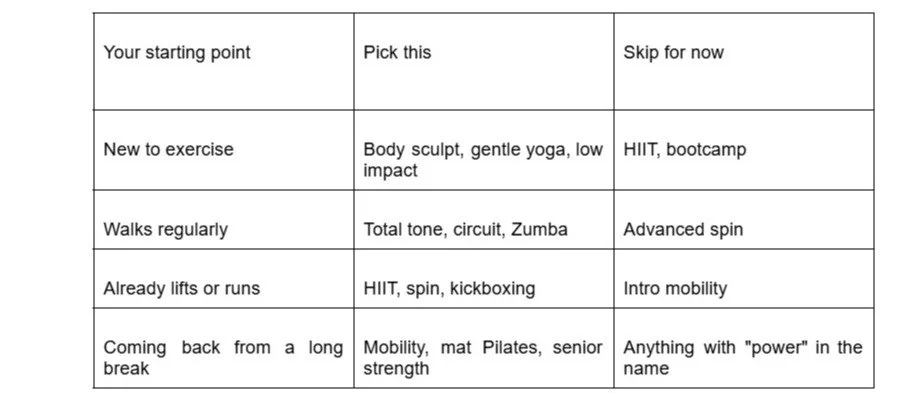
Four rows, and you can see the whole point: the right class is the one you can finish and come back to.
The Month One Test
Give any format four weeks before you judge it. Two classes a week, same time slot where possible, same instructor. If by week four you're still dreading it, the format is wrong, not you. Swap it out and keep the habit.
That's the whole trick, and it's not really a trick. Choose a format that matches your body today, sign up somewhere with enough variety to let you move around, and let three visits do the work of convincing you. So which one are you trying first, the strength class or the spin bike?