Buying a Condo? Why Their Inspection Should Include Building’s History

A condo can look spotless during a showing while the building around it faces aging roofs, concrete repairs, waterproofing work, or rising maintenance costs. A walk-through of the unit cannot tell you whether the association has planned for those expenses or whether owners may need to cover a funding gap later.

That is why condo inspections should go beyond kitchens, bathrooms, windows, and visible finishes. Before buying, review the building’s inspection history, reserve planning, repair records, and association finances. In Florida, documents such as a Structural Integrity Reserve Study (SIRS) and a milestone inspection summary can help buyers understand the condition of shared property and how future work may be funded.

Why Condo Inspections Should Look Beyond the Unit

A private unit inspection and a building-level review answer different questions. Your inspector may identify a plumbing leak or an electrical concern inside the condo, but that visit usually will not establish the condition of shared structural components or the association’s ability to pay for major repairs.

For Florida buyers, condo inspections are part of a wider review. Request the association’s structural records, reserve study, and updates on recommended repairs. A polished lobby or freshly painted balcony should never replace those documents.

Know Which Reports You’re Reading

Three records can be especially useful, but they are not interchangeable:

  • Unit inspection: Examines the individual residence and accessible systems within the inspector’s agreed scope.

  • Milestone inspection: Evaluates a building’s primary structural components when required under Florida law. Further evaluation may be needed if the initial phase identifies signs of substantial structural deterioration.

  • Structural Integrity Reserve Study (SIRS): Uses a visual inspection to assess specified building components, estimate remaining useful life and repair costs, and recommend a reserve funding schedule.

A SIRS report is not a guarantee that every hidden defect has been found. It combines a visual assessment with long-term repair and funding estimates. Read it alongside milestone inspection summaries, repair proposals, meeting minutes, and the association’s current budget.

What to Look for in a SIRS Report

Start with the components covered by the study, including the roof, structural systems, fire protection, plumbing, electrical systems, waterproofing and exterior painting, windows, and exterior doors. Florida law also covers certain additional items when their failure could affect those components and their cost exceeds the applicable threshold. 

Then look past the list itself. Check each item’s estimated remaining useful life, projected replacement or deferred-maintenance cost, and recommended annual reserve contribution. If a roof is expected to need work soon, for example, find out whether the association has a realistic plan to fund it.

Read the Report Alongside the Numbers

An inspection study can identify future work without showing whether the association has enough money available to pay for it. Compare its recommendations with reserve balances, financial statements, the current budget, and any approved or proposed special assessments. Look for gaps between the study and the association’s actions. Have repairs been completed, delayed, or reprioritized? Are contractor estimates available? Do meeting minutes explain why a major recommendation has not moved forward?

A large reserve balance isn’t necessarily reassuring if upcoming expenses are larger still. Likewise, a special assessment doesn’t automatically mean poor management; the important questions are whether the cost, timing, and purpose are documented and whether the association has a credible plan.

Questions to Ask Before Making an Offer

Ask the seller or association for the latest SIRS, the milestone inspection summary if applicable, and records showing what has happened since those reports were issued. Florida’s resale condominium disclosure rules entitle a prospective buyer under contract to specified association documents, including the most recent SIRS or a statement that it has not been completed, and the milestone inspection summary when applicable. Review Florida Statutes § 718.503 and ask your real estate professional about the requirements for your transaction. Useful follow-up questions include:

  • Which recommendations remain unfinished, and why?

  • Has the association approved a repair schedule or special assessment?

  • Are estimates available for major repairs?

  • Does the current budget reflect the reserve study’s funding recommendations?

Request the records early. Missing or unclear documents may require further review before your closing deadline.

When a Professional Review Helps

Inspection reports can be technical, and a single phrase should not be taken out of context. A qualified engineer can explain what an inspection covered, what it did not cover, and whether a recommendation calls for further evaluation. A real estate attorney or agent can help clarify disclosure and contract questions.

South Florida firms such as G Batista Engineering and Construction work with SIRS and building assessment projects. When choosing a professional, check relevant credentials, the scope of the proposed review, and any potential conflict of interest.

The Bottom Line

Buying a condo means buying into a shared building and a shared financial plan, not just a single unit. Inspection history can help you understand the condition of common components, while reserve records show how the association expects to pay for future work. Review both before treating a good-looking unit as a low-risk purchase.

Frequently Asked Questions

Is a condo inspection the same as a SIRS?

No. A unit inspection typically examines the individual residence within the inspector’s agreed scope. A SIRS is a building-level, visually based study of specified components and their expected repair or replacement costs, with a recommended reserve funding schedule. One does not automatically replace the other.

What should a SIRS report include?

It identifies the covered components, estimates their remaining useful life and replacement cost or deferred-maintenance expense, and recommends a funding schedule. Florida’s required components include the roof, structure, fire protection, plumbing, electrical systems, waterproofing, exterior painting, windows, and exterior doors, along with certain qualifying additional items.

What if the association has not completed a required SIRS?

Ask for a written explanation and confirm the property’s requirements with the association and your real estate professional. Florida’s resale disclosure rules address whether the most recent SIRS is available or has not been completed. Get advice on what the omission means for your transaction rather than assuming it is harmless.

Can a SIRS tell me whether a special assessment is coming?

A SIRS can identify major expected costs and recommend reserve contributions, but it cannot guarantee whether an assessment will be approved. Compare the study with reserve balances, budgets, board decisions, repair estimates, and meeting minutes to understand whether the association appears prepared to fund the necessary work.

Should I still get my own condo inspection if building reports exist?

Yes. Building-level reports and association records do not replace an inspection of the specific unit you plan to buy. Ask a qualified inspector to review the residence and explain any limits in scope. If the building records raise structural questions, seek appropriate professional advice before relying on the unit inspection alone.

/
script>

What Makes a Neighborhood a Great Place to Live: Key Factors for True Livability

Vibrant Social Scene, Culture, and Entertainment

A lively cultural and social environment draws young professionals, expats, and those seeking stimulating lifestyles. Diverse nightlife, arts venues, music events, and tolerant social norms create genuine appeal. These elements keep days interesting and help residents feel part of something larger. Berlin regularly earns top positions in European livability rankings through its celebrated diversity, progressive attitudes, and exceptionally rich cultural infrastructure. The city supports everything from its world-famous techno scene and experimental art spaces to a broad spectrum of personal lifestyle options, including berlin escort. This openness without judgment allows residents to build authentic lives on their own terms.

The energy extends beyond weekends. Neighborhood street festivals, independent cinemas, late-night bookstores, and multicultural markets operate throughout the week. Expats discover both familiar communities and fresh perspectives. People who value choice and stimulation often describe certain Berlin districts as uniquely liberating. The combination of tolerance and constant cultural activity makes the city a compelling case study in how a vibrant social scene elevates overall livability.

Safety and Security: The Foundation of Livability

Sixty to seventy percent of people name safety their top priority when selecting housing. Raw crime statistics capture only part of the picture. Perceived safety often drives decisions more powerfully. Bright street lighting, active community watch programs, and visible social stability create the sense that neighbors look out for one another.

Research consistently links lower perceived crime to better mental health outcomes. Residents in secure areas report lower anxiety, better sleep, and reduced cortisol levels. Singapore’s planned residential districts and quiet Zurich suburbs combine low official crime rates with strong neighbor networks. These places show higher resident retention and elevated property values over time.

Social stability adds another layer. Neighborhoods where people recognize each other experience up to 40 percent fewer petty crimes. Children play outside more freely. Adults walk home later without tension. This foundational sense of security allows every other livability element to function effectively. Without it, even excellent amenities and parks lose much of their value.

Location, Connectivity, and Walkability

Strategic location and transport links determine how much of life disappears in transit. The 15-minute city concept became a major global urban trend after the pandemic. Residents can reach work, shops, schools, and leisure within a short walk or bike ride. Paris expanded bike lanes and local services while Barcelona redesigned superblocks with measurable success.

High Walk Score neighborhoods deliver clear advantages. Residents report 20 to 30 percent higher life satisfaction levels. They spend fewer hours commuting and report lower daily stress. Portland, Oregon maintains many districts scoring above 80 on walkability metrics. Locals there walk or cycle to groceries, cafes, and workplaces, which reduces both personal stress and city-wide congestion.

Reliable public transit further multiplies these gains. Young professionals balance demanding jobs more easily. Families manage school runs and activities without constant driving. The hours reclaimed each month add up to meaningful improvements in work-life balance and social time. Location truly functions as hidden leverage for better daily living.

Community Spirit and Social Connections

Strong neighborly relationships predict long-term happiness more effectively than income or career success. The Harvard Study of Adult Development followed participants for more than 85 years and identified quality social connections, including local ones, as the clearest predictor of a happy and healthy life.

Neighborhoods that organize regular events build these ties organically. Block parties, community gardens, farmers markets, and seasonal festivals create repeated low-pressure interactions. Inclusive attitudes toward newcomers and diverse populations reduce loneliness rates by up to 25 percent in recent urban research.

Practical benefits appear quickly. Areas with higher neighbor familiarity respond faster to emergencies and report greater mutual trust. Children gain broader support networks beyond their own families. Adults experience lower depression rates and higher sense of belonging. These invisible social threads often determine whether residents stay for decades or leave after a few years, regardless of other amenities.

Amenities and Daily Convenience

Easy access to everyday services removes constant small frictions from life. Young professionals benefit from nearby gyms, cafes, and coworking spaces that fit irregular schedules. Families need quality schools, playgrounds, and grocery stores reachable on foot. Seniors value medical clinics, pharmacies, and social centers located within comfortable walking distance.

Neighborhoods rich in such amenities improve daily satisfaction scores by roughly 18 percent according to comparative urban studies. Residents make fewer car trips, save money on fuel, and experience less decision fatigue. Copenhagen’s mixed-use districts place bakeries, daycare centers, and small shops directly beside residential buildings. Families use evenings for park time instead of commuting.

This convenience scales across life stages. Working adults maintain healthier routines. Parents spend more time with children. Older residents preserve independence longer. When daily necessities sit close at hand, life feels lighter and more spacious even in dense urban settings.

Green Spaces, Environment, and Sustainability

Access to quality parks and cleaner air produces measurable effects on physical and mental health. Multiple environmental psychology studies show cortisol levels drop approximately 15 percent after twenty minutes spent in green spaces. Cities increasingly compete to add street trees, pocket parks, and larger urban forests.

Properties located near well-designed green areas command 5 to 15 percent higher prices in many markets. This premium reflects sustained buyer preference. Sustainable features such as community solar installations, urban gardens, and rainwater systems gain traction in progressive districts. These initiatives improve local air quality while fostering resident involvement.

Portland and Singapore illustrate large-scale impact. Their extensive park networks correlate with higher physical activity rates and stronger mental health indicators. Modern neighborhoods adopt these principles faster than ever. They plant trees along streets, protect existing urban canopy, and design new developments around green corridors. The combined result appears in both resident wellbeing metrics and long-term neighborhood resilience.

/
script>

Seedance 2.5 Video Editing: Build a Short Film with Real Footage and AI Scenes

You have real footage of an apartment entrance, a neighborhood walk, and a quiet room, but the story feels unfinished. Adding a dramatic generated city scene may provide atmosphere while also creating a new problem: viewers could mistake it for the actual neighborhood.

A short film that combines recorded and generated material needs a clear role for each source. Seedance 2.5 AI video can contribute independent creative scenes, while an external editor handles the sequence, transitions, sound, and final assembly.

Decide what the film is trying to communicate

Begin with the audience's question or the film's central idea. A hypothetical piece about coming home after a busy day might move from an active street to a calmer interior. That intention provides a reason for every shot.

Write the basic progression before searching for additional material. The entrance establishes arrival, the neighborhood footage gives context, and the room provides the emotional change. A generated visual might illustrate the feeling of leaving noise behind.

Keep the scope small enough that the available real footage can support it. If the film is meant to document a real property or event, missing factual views require additional recording or authorized source material.

Assign a narrative role to each source

Real footage can show what was recorded: a particular room, an actual walk, or an observed action. Check that captions and narration describe it accurately. A close-up of one corner should not imply that it represents a whole building or neighborhood.

Generated scenes can express an idea, establish a clearly fictional setting, or supply an abstract transition. They should not be presented as recorded evidence. A generated rooftop view cannot verify the outlook from an actual apartment.

Use a source list that records which shots are real and which are illustrative. This is practical editing information, not paperwork for its own sake. It helps the team write accurate captions and avoid misleading substitutions.

When mixing sources, ask whether a viewer could reasonably infer that all scenes were filmed together. If that inference would be false and material to the story, make the creative status clear in the film itself.

Generate only the scenes the sequence needs

A missing emotional transition is a more useful brief than “make something impressive.” For the hypothetical homecoming film, a generated abstract scene of crowded shapes opening into quiet space could support the theme without pretending to show the real location.

An illustrative starting prompt: “Crowded abstract shapes and blurred commuter silhouettes gradually open into a calm, warm-toned space. Gentle forward movement, soft shapes, restrained motion, a dreamlike and clearly stylized look rather than a realistic neighborhood view. No text.” Judge whether the result communicates the emotional change; it is not a depiction of the property's surroundings.

You can explore Seedance 2.5 AI video for independently generated source scenes, then assess their suitability in an external editor. Check the current service's supported inputs and settings before choosing a production method.

If image to video AI uses a reference, confirm that you have permission to use it. A reference can guide appearance but does not guarantee exact object preservation throughout the motion. Review changing details before accepting the clip.

Do not assume that generating separate scenes also mixes them automatically into a finished long video. The narrative relationship between shots is an editorial decision.

Build a rough sequence before polishing transitions

Import the recorded footage and accepted generated scenes into the external editor. Try a three-part rough cut: a real street walk establishes the busy setting; a clearly stylized transition expresses the shift toward calm; a real doorway and interior complete the arrival. Watch this sequence without effects. Does the illustrative middle section add something the real footage cannot communicate alone, while the actual setting remains clear?

Remove shots that repeat information or interrupt the progression. A visually striking clip can still be the wrong clip for this film. Keep the real setting recognizable where location matters.

Choose transitions that explain relationships. A clear cut can distinguish recorded material from an imaginative aside. A dissolve may suggest a change in time or mood, but it can also blur the distinction between sources if used carelessly.

Match color where useful without pretending that every scene shares the same lighting. Large shifts in geometry or motion will not be repaired by a filter. Replace an unsuitable generated clip rather than disguising a fundamental mismatch.

Use sound to connect the viewing experience

Recorded ambient sound can establish the real place, provided its use is accurate and authorized. Music can support the emotional progression. Avoid adding invented speech or event sounds that make an illustrative scene seem like documentation.

Listen to the transition between clips. For the homecoming sequence, let recorded street ambience fade across the beginning of the stylized insert, carry licensed music underneath, and bring in recorded room tone just before the cut to the real interior. This sound bridge connects the moods while keeping the source of important real sounds clear. Adjust levels and replay the passage so background noise does not jump accidentally.

If narration explains the piece, keep its claims aligned with the source footage. “An imagined moment of calm” describes a creative image honestly; claiming that it shows a real view would not.

Review the finished film as a viewer would

Watch the actual export on its intended screen. Check sequence clarity, text placement, audio balance, and any visible generation artifacts. Confirm that recorded evidence and creative illustration remain distinguishable where that distinction matters.

If a social media video maker or AI video editing feature helps produce alternative formats, review those exports separately. A crop may remove a disclosure or the object that gives a shot its meaning.

Keep the approved sources and editable project for corrections. The strongest mixed-source film gives each image a clear purpose and lets viewers understand both the story and what they are actually seeing.

/
script>

Protecting Your Historic Home: Seasonal Pest Control for Older Properties

Readers who follow Off The MRKT for coverage of prewar co-ops, converted carriage houses, and the kind of period architecture that gives neighborhoods their character already know that old buildings come with old-building problems. Original windows, hand-laid brick, and settled foundations are part of what makes a historic property desirable, but those same features create gaps, drafts, and moisture pockets that pests exploit. Whether you own a landmarked rowhouse or you're simply drawn to the same preservation stories we cover around New York and beyond, the seasonal pest pressures facing older homes deserve the same attention as the roofline or the plumbing.

Dublin offers a particularly clear case study because its damp, mild climate interacts directly with the kind of construction found in Georgian and Victorian housing stock. Solid masonry walls, suspended timber floors, and cast-iron drainage were never designed with modern insulation standards in mind, and that gap is exactly where rodents and insects find their way in. Homeowners researching Dublin pest control services are often surprised to learn that the very details that give their property its charm, like exposed sash windows or uninsulated cavity walls, are the same details driving repeat infestations year after year.

Dublin's Climate & Historic Building Vulnerabilities

Dublin's weather pattern, persistent moisture, mild winters, and relatively narrow temperature swings, creates a near-constant environment for pest activity rather than a sharp on-off season. Older properties absorb and retain that moisture differently than modern builds, since lime mortar and untreated timber are more porous than contemporary materials. Rising damp in older foundations attracts woodlice and silverfish, while gaps around original chimneys and roof eaves give rodents a direct route into attic spaces. The combination of structural age and climate consistency means pest pressure rarely disappears entirely, it simply shifts in intensity and species throughout the year.

This is compounded by the sheer density of historic housing stock across the city and county, much of it built before pest-resistant construction codes existed. Period properties often share party walls with neighboring buildings, which means an infestation in one home can spread along shared cavities to several others on the same terrace. Owners of these properties frequently underestimate how interconnected their pest risk is with the surrounding block, treating it as an isolated issue rather than a neighborhood-wide pattern worth monitoring seasonally.

Seasonal Pest Cycles in Dublin

Spring marks the start of active breeding for most common pests, as rodents emerging from winter shelter begin nesting in earnest and insect eggs laid the previous autumn start to hatch. Summer brings the sharpest spike in flying insect activity, particularly around kitchens and bins, and it's also when wasp nests reach a size that makes them visibly dangerous rather than a minor nuisance. Autumn is the migration period, when falling temperatures push rodents and spiders indoors in search of warmth, often through the same gaps around doors and foundations that have gone unsealed for years. Winter doesn't bring the relief many homeowners expect, since mild Irish winters allow rodents to continue breeding in wall cavities and roof spaces rather than dying off or hibernating.

According to this article, Ireland's warming climate has extended the pest control working season beyond the traditional June-September peak, with milder winters allowing rodents and insects to survive and breed earlier, increasing year-round pest pressure on properties. That shift matters enormously for historic homes, because it means the old assumption of a single "pest season" no longer holds. A property that only received an autumn inspection in the past may now need attention in spring and summer as well, simply because the insects and rodents causing damage are active for a longer stretch of the calendar than they were a decade ago.

Protecting Historic Structures

Sealing entry points on a period property requires more care than caulking a modern wall, since original brickwork, sash windows, and timber sills need treatments that won't damage historic materials or violate conservation guidelines. Copper mesh and specialized fillers can close gaps around pipework and vents without altering the visible character of the facade, while draft excluders fitted to original doors reduce both energy loss and insect access. Moisture management deserves equal attention, since damp timber and poorly ventilated crawl spaces are what attract wood-boring insects and damp-loving pests like woodlice in the first place. Improving subfloor ventilation and addressing guttering issues early often does more to prevent infestation than any chemical treatment applied after the fact.

Preservation-friendly pest treatments also matter because many historic properties carry protected status that restricts certain structural interventions. Bait stations placed discreetly rather than invasive drilling, and targeted treatments rather than broad-spectrum spraying, help control pest populations without compromising original plasterwork, cornicing, or timber detailing. Professionals familiar with older housing stock understand how to balance effective pest control with the conservation requirements that come with owning a listed or protected building, which is a distinction worth asking about directly when hiring a provider.

Year-Round Maintenance Schedule

A quarterly inspection schedule suits Dublin's climate better than the seasonal checkups common in drier regions, since pest pressure here doesn't fully recede at any point in the year. Spring inspections should focus on nesting sites and entry points exposed by winter weather, summer visits on flying insects and nest removal, autumn checks on sealing gaps before rodents move indoors, and winter visits on monitoring the wall cavities and roof spaces where rodents often overwinter undetected. This rhythm catches problems while they're still small, which matters enormously for historic properties where structural damage from pests can be expensive and difficult to repair without disturbing original materials.

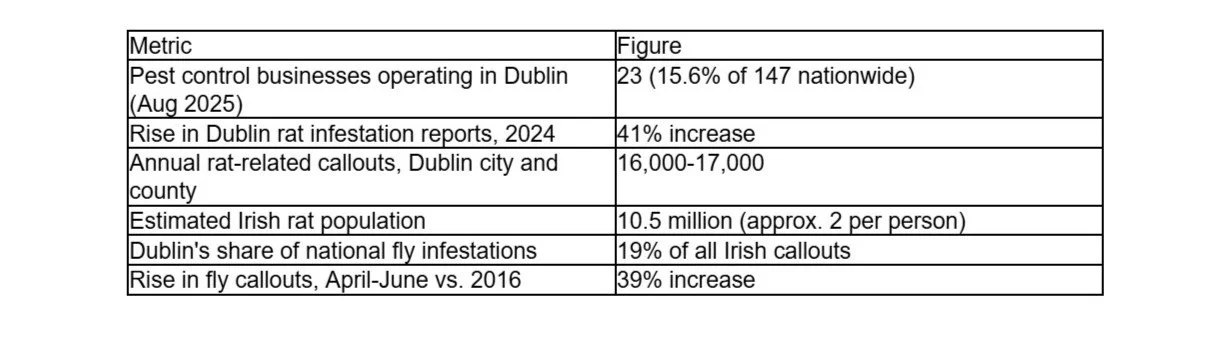
The scale of the problem across the city underscores why this maintenance rhythm matters. Rat infestation reports in Dublin rose sharply in 2024, and fly infestation callouts have also climbed well above historical averages, trends that reflect both climate shifts and the sheer number of aging properties still standing throughout the county.

Taken together, these figures make a strong case for treating pest control as part of routine historic home maintenance rather than an emergency response. Owners who schedule regular inspections, address moisture issues promptly, and work with specialists who understand period construction tend to avoid the costly structural repairs that come with long-term infestations. For a city with as much protected architecture as Dublin, that kind of proactive approach isn't just about comfort, it's a meaningful part of preserving the building itself for the next generation of owners.

/
script>

What Insurance Actually Pays After a Crash With a Driver Who Has Too Little Coverage

A woman in Phoenix totals her car at a red light. The other driver carries the Arizona state minimum, which is nowhere close to what her car is worth. Six weeks later she's still driving a rental she's paying for herself, and nobody has told her where the rest of the money is supposed to come from. That's the part that would have helped her most on day one.

You're probably expecting one check from one insurance company. That's almost never how it works. Money moves through several channels, and which ones apply to you depends on your own policy and on how the crash happened. The fastest way to see the difference is to look at real cases where somebody had to fight for compensation after an underinsured driver accident, because the pattern shows up every time: the at-fault policy pays out, and the rest comes from somewhere the driver never thought to check.

So let's map the channels in order of how fast they usually pay, then cover the moves that actually protect you.

Channel one: the other driver's liability policy

This one moves first because the other driver's insurer has a contractual duty to their own customer. Your medical bills don't get paid directly. You settle, they cut one check, and that's the ceiling of what that policy will ever pay no matter how bad your injuries are. If the driver carried a minimum-limits policy, that ceiling sits closer to the cost of a used sedan than the cost of a year of recovery.

Worth knowing: limits aren't private. You or your lawyer can request the declarations page, and there's no clever workaround. Intentionally rear-ending someone harder doesn't raise their limits.

Channel two: your own uninsured and underinsured motorist coverage

This is where most people leave money on the table. UM and UIM coverage sits on your own policy, and it responds when the at-fault driver's limits fall short of what your claim is actually worth. You pay premiums for it, so use it. Here's the frustrating part. The company that collected those premiums now has a financial reason to argue your injury is worth less than the other driver's insurer already admitted it was worth.

Two mechanics trip people up. First, many states let your insurer subtract the at-fault payout from your UIM limit, so a $100,000 UIM limit minus a $50,000 liability payout leaves $50,000. Second, you usually have to notify your insurer within a set window, and you have to get their consent before you settle with the other driver. Sign that release too early and your own insurer can walk.

Read that second point again if you're mid-negotiation. Text your adjuster today, in writing, that you haven't settled and you're preserving your UIM claim. It takes four minutes and it saves cases.

Which states carry the most underinsured drivers?

States with low mandatory minimums and no requirement to carry UIM coverage stack the deck against you. Arizona sits in that group. So do California, Florida, and Colorado, which is exactly why the Phoenix, Denver, and Miami firms that handle these crashes see so many of them. If you live somewhere with a $25,000 minimum and no UIM requirement, your odds of sharing the road with an underinsured driver are simply higher than a driver in, say, a state with a $50,000 minimum and mandatory UIM.

There's a useful context point here that isn't about your claim at all. According to the Insurance Information Institute, hit-and-run and uninsured driving behavior rises in economic downturns, which is a good argument for protecting yourself regardless of what the law requires. Pay for the UIM. Skip the tire warranty.

Channel three: the driver's personal assets

A personal injury lawsuit against the other driver isn't a magic money tree. It's a tool for reaching assets the insurer won't pay for, and it only helps if those assets exist. A driver with six figures in the bank is a different defendant than a driver with a financed truck and a paycheck already spoken for. Your attorney will ask about property records, business ownership, and income sources before deciding whether filing is worth the cost and time.

Filing has a second benefit nobody talks about. It stops the statute of limitations clock from running out on you, so you can investigate and still negotiate. Missing that deadline is unrecoverable, so get it on a calendar the week of the crash, not the month before it expires.

What the insurance money is actually supposed to cover

Settlement dollars get grouped into roughly four buckets, and knowing the buckets stops you from accepting a number too early:

  • Medical care, past and future, including therapy and any surgery you'll eventually need

  • Lost wages and lost earning capacity if injuries change what you can do for a living

  • Property damage to the vehicle and its contents

  • Pain, suffering, and the parts of your life you can't get back

The third bucket usually resolves fast and looks fair, which is the trap. Locking in pain and suffering before you know whether your back heals is how people short themselves. Don't sign a general release until treatment has a defined end point. The Consumer Financial Protection Bureau publishes plain-language guidance on consumer rights around insurance payouts, and it's worth an evening read before you sign anything.

A short checklist for the first 30 days

  1. Call your own insurer and open an uninsured motorist claim. Ask them to read your UIM limit back to you and write down the number.

  2. Send a written notice that you are preserving your UIM claim and have not settled with the other driver.

  3. Photograph the damage, the scene, and any visible injuries within 48 hours. Injuries fade. Photos don't.

  4. Keep every receipt, including the rideshare you took because your car was in the shop.

  5. Get treatment documented in one place. The records are your proof, so don't use a different clinic every visit.

  6. Do not give a recorded statement to the other driver's insurer. Their adjuster is not on your side.

  7. Pull your policy declarations page and read the UIM section. Not the summary. The section.

Two business realities matter here too. Small law firms run on people, and caseloads fluctuate, which is why some firms will send your file to a paralegal for three months. When you hire someone, ask who actually touches your case and how often you'll get an update. According to the U.S. Department of Labor, legal services employment tracks closely with the broader economy, so firm staffing changes with the market. Get the answer before you sign.

Why the release signature is the whole ballgame

Everyone asks how much the claim is worth. The better question is what you're giving up when you sign. A release with the at-fault insurer ends their exposure and can quietly kill your UIM claim if you signed it without your own carrier's consent. That's the single most common way people lose money in these cases, and it usually happens because someone wanted the first offer to be the last problem. It's not a fairness issue. It's paperwork.

Now the opinion part, since you're going to hear a version of this from a lot of people. You should handle the property damage yourself, directly with the insurer, because it's arithmetic. You should not handle the injury claim alone if there's an underinsured driver involved, because that's where the two policies start pointing fingers at each other and you're the person holding the bag. And you should bump your own UIM limit at your next renewal even if it costs you a few dollars a month. You cannot raise the other driver's limit. You can absolutely raise yours, and that control is the whole point.

If you're in the middle of one of these claims right now, the highest-value hour you can spend this week is reading your own declarations page and calling your adjuster to confirm your UIM limit in writing. Do that before you talk to anybody else.

/
script>