Moving a Maryland LLC to Florida Without Disrupting Its Federal Contracts
A Maryland LLC can deliver its work from a Florida office and still depend on a federal contract administered through records that identify Maryland as its legal home. The owner may regard the move as a private organizational decision. The contracting officer has a different concern: whether the entity responsible for performance remains the contractor the government selected.
That distinction makes federal contracting a separate workstream in a redomestication. Preserving the LLC under state law matters, but the company should not assume that a conversion certificate answers every agency question. The objective is to complete the legal move without interrupting invoices, contract administration, or the evidence establishing who must perform.
Separate Entity Continuity From Contract Recognition
Maryland authorizes an eligible LLC to convert into another entity, including a foreign LLC, through the statutory approval and filing process. Md. Code Ann., Corps. & Ass'ns § 4A-1101. Florida permits an eligible foreign entity to convert into a Florida LLC when the origin jurisdiction authorizes the transaction. Fla. Stat. § 605.1041(3). These provisions supply a potential route for moving the existing company rather than selling its operations to a replacement.
Maryland's conversion statute treats the converted organization as the same entity and preserves its obligations. Md. Code Ann., Corps. & Ass'ns § 4A-1104(b). That is important evidence for contract administration. It is not a substitute for determining what the federal agency requires in the particular transaction.
Owners researching how to transfer a Maryland LLC to Florida should therefore identify their federal contracts before selecting an effective date. The contracting relationship belongs in the plan, not in a notice prepared after the company discovers that an invoice has stopped moving through approval.
Identify the Federal Question Before Requesting a Novation
Federal acquisition rules distinguish transactions requiring recognition of a successor from circumstances in which the existing contracting party remains unchanged. The novation regulation addresses government recognition following specified transfers and describes documentation supporting that request. 48 C.F.R. § 42.1204(a), (e). A contractor should not presume that every interstate conversion requires a novation or that no conversion could require agency action.
The company should give counsel the proposed transaction documents and the contracting officer's instructions. The description should explain whether assets, ownership, or the party responsible for performance will change. A conversion with unchanged owners should not be described as an acquisition because a provider's intake form offers no better category.
The rule's stock-purchase example is not a blanket exemption for every restructuring. Section 42.1204(b) concerns a stock purchase that leaves the contracting party unchanged and in control of the relevant assets. The appropriate treatment of a Maryland-to-Florida conversion requires examination of its own facts, the contract, and the agency's requirements.
Build a Contract-by-Contract Administrative Record
Consider a hypothetical technology-services LLC with one direct federal contract and two subcontracts. Its headquarters will move to Florida, but some personnel will continue supporting projects in Maryland. A single message announcing a new business address would leave unanswered questions about performance locations and which organization must update each contract record.
The contractor should prepare a schedule identifying the contracting officer, contract administrator, billing system, and notice provisions for each relationship. For subcontracts, the relevant point of contact may be the prime contractor rather than a federal official. The schedule should distinguish required approval from a courtesy notice and identify supporting documents for each request.
Counsel should review whether the project also changes representations concerning ownership, certifications, or performance. A domicile change should not be used as shorthand for a broader operational transition. When another change affects a representation, the company should disclose and analyze that change instead of relying on the continuity of its entity number.
Coordinate Records Without Creating Conflicting Identities
The company should assign responsibility for reviewing its SAM.gov registration, agency vendor profiles, and payment instructions. The responsible employee needs a confirmed legal description and an effective date supported by accepted filings. Updating one platform before the transaction occurs can create a record that conflicts with the documents supplied to another reviewer.
Tax identification needs a separate determination. IRS guidance recognizes circumstances in which a location change does not require a new EIN, but the result depends on the entity and transaction. Internal Revenue Serv., When to Get a New EIN, Limited Liability Company. The contractor should obtain instructions from its tax adviser before anyone creates a replacement taxpayer profile.
A control sheet can connect the Maryland identifier, Florida record, and continuing federal tax identity. It should explain differences rather than force an accounts-payable employee to infer that records with comparable names concern the same contractor. Preserve confirmation of updates and the agency's written response to any recognition question.
Make the Closing Date Fit the Performance Schedule
The operating team should flag invoice submission dates, option exercises, and pending contract modifications before counsel fixes the closing schedule. This is not a reason to postpone every move. It is a reason to avoid placing unresolved administrative questions at the same point as a critical payment or performance milestone.
Cummings & Cummings Law's emphasis on preserving an existing business has particular value for a government contractor. Preservation includes the records that connect the company to its awarded work. The closing package should allow the contracting officer to understand what changed without suggesting that the contractor abandoned its obligations.
Retaining the Maryland LLC and registering it in Florida may suit a temporary office relocation. Conversion better addresses a decision to make Florida the company's legal domicile. The stronger choice is the arrangement that fits the business plan while leaving federal contract recognition, performance responsibility, and payment administration supported by one consistent record.
5 Best Apartment Rental Companies in Boston: 2026 Picks
New construction in Greater Boston has not slowed down much, but renters are still feeling the pinch. From April 2020 through July 2025, roughly 97,656 housing units were added across Massachusetts, and over 71,000 of them landed in the Greater Boston area. Even with that growth, the 2025 Greater Boston Housing Report Card reports that close to half of local renters spend more than they can comfortably afford on housing. The cranes are busy; the rent problem hasn't gone anywhere.
People moving here on short notice feel this most sharply. Picture a consultant whose assignment starts next week, or a family flying in for treatment at Mass General. Neither has a month and a half to spend touring third-floor walk-ups in Allston. Working with a furnished apartment rental company can turn that ordeal into a few days of emails. Each of the Boston apartment rental companies ranked here was checked against the prices and policies on its own website during fall 2026.
What Is an Apartment Rental Company?
Put simply, an apartment rental company leases out apartments that are already furnished, on terms far looser than a standard lease. Some guests stay a weekend. Others keep the same unit for well over a year. Compare that with the usual Boston landlord, who offers an empty unit and a twelve-month contract, while furnished operators fold the furniture, internet, and on-call support (plus utilities, in some cases) into one price.
Timing explains why the model works so well here. Boston leases still cluster around September 1, and someone arriving in mid-February tends to discover that whatever good inventory existed got snapped up months earlier.
Why Do Newcomers Choose Furnished Rentals Over Standard Leases?
Saving money on setup and saving time are the two big reasons. Signing a regular lease usually means shopping for a mattress, calling Eversource, and possibly living out of a hotel room until the right listing turns up. With a furnished place, none of that happens. On a per-day basis the price can look high compared with monthly rent, although for a stay of three to six months, the difference often narrows once furniture and hotel nights enter the equation.
Note: Every price quoted below reflects a starting rate published by the provider in fall 2026, and actual quotes will shift depending on season, apartment size, and stay length.
Top 5 Boston Apartment Rental Companies for 2026
Location carried the most weight in this ranking, followed closely by pricing transparency and by how clearly each company has defined the guest it wants to serve. Any of these five could fairly be listed among the best apartment rental companies in the city. The right one depends on who is booking and why.
1. Global Luxury Suites: Best Overall for Upscale Extended Stays
Why first place? Global Luxury Suites manages to feel like a good hotel while giving guests the kitchen, square footage, and workspace of an actual apartment, a combination that is harder to find than it sounds. Each of its four Boston addresses is a short walk from a T stop. Just as useful, the company shows a starting nightly price for every building rather than hiding it behind a contact form.
Here is where its Boston units are, along with the posted starting rates:
8 Harrison Avenue (Downtown): nightly rates begin at $249
100 Pier 4 Boulevard (Seaport): $229 per night and up
345 Harrison Avenue (South End): starting from $239 a night
399 Congress Street (Seaport): the lowest entry point, at $219 per night
Apartments come in one- and two-bedroom configurations, fully furnished. Anyone booked at the Pier 4 high-rise can use its rooftop pool, which on a summer night with harbor views is hard to argue with. Plenty of Boston apartment rental companies have good buildings; far fewer let guests see what a downtown night will cost before picking up the phone.
Pro Tip: Travelers who want a Seaport address on a tighter budget should start with 399 Congress Street, which at $219 a night undercuts most hotels in that neighborhood.
2. Furnished Quarters: Best for Guest Service and 30-Day Stays
Furnished Quarters dates back to 1998, when brothers Steve and Gary Brown launched it, and the Brown family still runs it today. The company carries NGLCC certification as an LGBTQ+-founded business, and that credential matters to corporate clients with supplier diversity targets. Guest support never closes, day or night. Its Boston operation leans heavily toward month-long bookings, which makes it a poor match for a quick weekend but a strong one for a relocation.
Daily rates currently posted for its main Boston properties:
The Viridian, Fenway – one-bedrooms start at $240 a day, and a two-bedroom was listed at $365
Church Park, Back Bay/Fenway – one-bedrooms range from $250 to $295 daily, two-bedrooms from $275 to $305
The Benjamin, Seaport – one-bedrooms between $260 and $295 per day
Most of these listings carry a 30-day minimum. Because the advertised rate usually covers only the opening month of a fresh reservation, anyone planning a longer stay should request separate pricing for the extra months.
3. Blueground: Best for Flexible Lease Lengths
Some assignments have no clear end date: three months might stretch to eighteen, or the role might wrap up early. Blueground was designed for that kind of uncertainty. According to its Boston page, 834 furnished apartments are on offer, each with a 30-day minimum. After that first month, guests can continue on a rolling basis or lock in something longer, and broker fees never apply.
Inventory reaches into the Seaport and Fort Point, both ends of the North End and South End, Back Bay, Beacon Hill, and across the Charles into Cambridge. Prices stay hidden until specific dates are entered, so side-by-side comparison takes a bit more effort.
Important: Utilities are a gray area here. Blueground states that, depending on the unit, guests may see added charges for some utilities, for parking, or for pets. Students get an unusual benefit, though: a booking of twelve months or longer can be frozen for up to three months during school breaks, with no rent owed during the pause.
4. Landing: Best for Remote Workers on the Move
Think of Landing as a nationwide network that happens to include Boston, not a local specialist. Its listings stretch across more than 250 American cities. Around Boston itself the choice is limited, with about eight units showing availability as of October 1, 2026. Every apartment includes a fully stocked kitchen, in-unit laundry, a desk setup, fast internet, check-in through the Landing app, and support around the clock.
Costs are assembled piece by piece. One Cambridge apartment, for example, added $295 monthly for utilities and Wi-Fi, $375 for a parking space, and $125 for a pet. For people who relocate every few months, Landing Standby offers furnished stays with full support at a flat $1,795 per month.
Note: Given how thin the local inventory is, an open unit can be gone within days, so confirm availability early.
5. Furnished Housing (Churchill Living): Best for Corporate Housing Programs
After thirty years in the corporate housing business, Churchill Living now oversees upward of 8,000 properties nationwide. In Boston, its site lists four buildings. Rates start at $249 a night at 8 Harrison, $229 at 100 Pier 4, $239 at 345 Harrison, and $219 at The Metlo on Congress Street.
At the 8 Harrison property, a concierge is on duty full-time, each unit has its own washer and dryer, and utilities are covered up to a cap. Pets can come along for an additional charge. For an HR team placing five or six transferees at the same time, Churchill's national reach and long corporate track record make coordination considerably simpler.
Pro Tip: Oddly enough, Churchill and Global Luxury Suites both advertise the identical four Boston buildings at matching starting rates. Pull quotes from each for the same dates, since fees, cancellation policies, and service levels are where the two are likely to differ.
How Do the Top Boston Rental Companies Compare?
Laid out in one grid, the trade-offs between these five providers become much clearer. Scan it first, then contact two or three companies for real quotes.

How to Choose the Right Apartment Rental Company
Length of stay should drive the decision before brand reputation does. For a two-week work trip, nightly booking through Global Luxury Suites or Churchill usually makes the most sense. Stays of a month or more open up Furnished Quarters and Blueground, both of which price in 30-day increments.
Anyone still debating between furnished housing and a conventional lease should factor in a change from 2025. Since August 1 of that year, the Massachusetts broker fee law has placed the broker's fee on whichever party hired the broker, so tenants no longer cover it by default. That makes a traditional lease cheaper to enter than it once was. It does nothing, however, about the sofa, the cable installation, or the hours lost to apartment hunting.
What Questions Should Renters Ask Before Booking?
Two operators can rent units in the very same building and handle them in completely different ways. Asking the following before paying a deposit tends to reveal which apartment rental company is better organized:
Are utilities part of the rate, and if so, is usage capped?
How long is the minimum stay, and what notice does leaving early require?
Can pets come, and at what cost?
Does the nightly or daily rate drop for a month-long or longer booking?
If the heat fails at 11 p.m. on a Sunday, who picks up the phone?
How to Calculate the True Cost of a Stay
Advertised rates almost never match the final invoice. Monthly charges for parking, pets, and utilities can quietly add several hundred dollars. Running every quote through the same equation keeps the comparison honest:
Total stay cost = (rate × nights) + taxes + utilities + parking + one-time fees
Finding the Right Fit in 2026
Every company on this list has an obvious strength, and none of them is the best choice for everyone. Global Luxury Suites stands out for central upscale apartments with transparent nightly prices, while Furnished Quarters earns loyalty through attentive service on month-long bookings. Blueground's sheer volume of apartments is unmatched. Landing appeals to frequent movers, whereas Churchill Living is clearly built around employers relocating staff. The smartest approach is to pick two or three Boston apartment rental companies, request all-in quotes for identical dates, and compare the fine print side by side.
FAQ: Boston Apartment Rental Companies
Renters planning a furnished stay in Boston tend to ask the same handful of questions, answered briefly here.
How much does a furnished apartment in Boston cost per night?
Across these five providers, $219 per night is the lowest published starting rate. Both Global Luxury Suites and Churchill Living list that price at 399 Congress Street in the Seaport. Furnished Quarters starts its one-bedrooms at about $240 per day, but only for stays of 30 days or more. Since dates, apartment size, and add-on fees all change the total, an all-in quote is the only reliable figure.
Do renters pay a broker fee with a furnished apartment rental company?
Generally no, since these operators rent straight to the guest without a middleman. Blueground, for instance, markets its entire Boston inventory as no-fee. On top of that, Massachusetts law has required since August 1, 2025, that a broker's fee be paid only by whoever hired that broker. Should an unexplained fee show up on an invoice, ask directly which side the broker represents.
Are utilities included in furnished rentals in Boston?
Not always; it varies by company and occasionally by apartment. At 8 Harrison, Churchill includes utilities up to a set cap. Blueground cautions that some units carry extra utility charges, and Landing bills utilities and Wi-Fi as a separate monthly line at certain properties. Before signing, get written confirmation of exactly what the quoted rate includes.
What is the minimum stay with Boston apartment rental companies?
Anywhere from a single night to a full month, depending on the company. A 30-day minimum is standard at both Furnished Quarters and Blueground. Global Luxury Suites and Churchill Living, by contrast, publish nightly pricing. Landing is the most open-ended of the group, accepting stays of nearly any length.
Which provider is best for a long medical or academic stay?
Furnished Quarters and Blueground suit stays of several months better than the others. With Furnished Quarters, monthly pricing comes paired with support that is available at any hour. Blueground counters with the largest selection in Boston and lets students on twelve-month contracts pause rent for up to three months. For families who prefer concierge service close to downtown hospitals, Global Luxury Suites deserves a look.
Exterior Improvements That Can Make a Home More Appealing to Buyers
When preparing a property for the market, homeowners often concentrate on kitchens, bathrooms, paint colors, and staging. Those improvements certainly influence how buyers perceive a home, but the evaluation begins before anyone walks through the front door.
The condition of the exterior provides immediate clues about how carefully a property has been maintained. Weathered brick, damaged steps, poor drainage, or an uneven walkway can attract attention for the wrong reasons. Addressing these areas can create a more polished first impression while resolving maintenance issues that may otherwise become more expensive.
Start With the Approach to the Home
Consider the property from the perspective of someone seeing it for the first time. The driveway, walkway, landscaping, steps, and front entrance form a visual sequence leading toward the house.
These areas do not necessarily require major reconstruction. Pressure washing appropriate surfaces, correcting damaged sections of a walkway, trimming overgrown landscaping, and repairing deteriorated steps can make the approach feel considerably more intentional.
Material consistency also matters. When several unrelated pavers, stones, and patches have accumulated through years of small projects, simplifying or coordinating these surfaces can create a cleaner appearance.
Inspect Brick and Stone for Visible Deterioration
Masonry tends to communicate permanence, but exposure to moisture and seasonal temperature changes can gradually affect mortar joints, bricks, stone, chimneys, and exterior steps.
Look for mortar that has become powdery or recessed, individual bricks that are cracked or loose, gaps around masonry elements, and areas where water appears to collect. These conditions deserve attention even when the overall structure still looks sound.
Determining the appropriate repair is important because masonry problems can have different causes. Homeowners researching professional options can review resources such as top-masonry.com/masonry-contractors-northfield-il when considering repairs, restoration, tuckpointing, or other masonry work. A targeted repair may sometimes be preferable to replacing an entire feature that remains largely serviceable.
Give Functional Areas Equal Attention
Buyers do not evaluate exterior spaces only by appearance. They also imagine how those spaces will function after moving in.
A patio should provide a comfortable surface for furniture. Steps should feel stable underfoot. Walkways should offer a clear route through the property, and retaining walls should appear well maintained. Even relatively modest outdoor areas can feel valuable when their purpose is immediately understandable.
Before investing in decorative additions, address obvious functional defects. A new planter or lighting fixture is unlikely to distract from a loose step or badly deteriorated section of masonry.
Do Not Overlook Drainage
Water management may not be the most visually exciting home improvement, but it has a significant relationship with exterior durability.
Check where downspouts discharge and observe what happens during heavy rain. Water should move away from the house rather than repeatedly collecting beside the foundation, patio, or masonry walls. Walkways and other hard surfaces should also be appropriately graded.
Solving a drainage problem before completing cosmetic improvements can prevent new work from being exposed to the same conditions that damaged the previous materials.
Choose Improvements That Suit the Property
Not every home benefits from an elaborate exterior renovation. In many cases, preserving existing architectural character produces a better result than introducing features that do not match the property.
A traditional brick residence may benefit most from carefully restored mortar joints and refreshed landscaping. A contemporary house might call for simpler paving patterns and restrained materials. The objective is to make improvements feel as though they belong to the home rather than were added simply because they are currently fashionable.
Think Beyond the Listing Photos
Curb appeal is important in real estate marketing, but exterior improvements should accomplish more than producing attractive photographs. Durable repairs can also reduce deferred maintenance and make outdoor spaces more enjoyable for whoever owns the property next.
Prioritizing condition, functionality, drainage, and architectural consistency creates a practical framework for deciding where to invest. When those fundamentals are addressed first, even modest improvements can make a property feel noticeably more complete, cared for, and ready for its next chapter.
A Homeowner’s Guide to Florida Impact Window Replacement
The last time a storm came through, a neighbor stood in his living room with a roll of duct tape and a look of pure regret. He’d owned the house for eleven years and had never once thought about the glass. I get it. Nobody buys a house thinking about fenestration. Then June rolls around, the forecast turns ugly, and suddenly you’re pricing plywood again.
So here’s the deal. If you live anywhere in Palm Beach County, you have three realistic options: shutters that live in your garage, plywood and crossed fingers, or windows built to take a hit. This guide walks through how impact window replacement actually works, what drives the price, and how to inspect a job without a clipboard full of jargon. By the end you’ll know which questions to ask and which upgrades are pure upsell.
One more thing worth saying early: picking the installer matters more than picking the glass. A great product in the hands of a crew that skips flashing is a leak waiting to happen. If you’re north of the county line and want a sense of how a specialist shop runs an assessment, this look at window installation in Loxahatchee shows the kind of local back-and-forth you should expect from anyone you hire.
Why Florida windows live a harder life than most
Coastal South Florida sits in a region the National Weather Service tracks for hurricanes, tropical storms, and punishing summer heat, and that combination wears on windows from two directions at once. Wind pushes against the frame. Sun bakes the seal.
Ordinary annealed glass doesn’t fail gracefully under pressure, it shatters into shards that become projectiles once wind gets inside. Impact glass, by contrast, sandwiches a plastic interlayer between two panes, so a missile can crack the surface without blowing the opening apart.
Seals matter just as much. Between salty air, humidity, and daily temperature swings, gaskets dry out and lose their grip. That’s why you’ll see fog between panes on a fifteen-year-old unit that looked fine when you bought the place. It’s not a cosmetic issue, either. A failed seal means the insulating gas is gone and your air conditioner is working harder than it should.
A few things to watch for heading into storm season:
Condensation trapped between panes, which means the seal has already given out
Frames that warp or stick, making the lock hard to engage when you need it most
Water stains or soft wood around the sill after heavy rain
A noticeable jump in cooling costs with no change in your habits
If two or more of those show up, replacement usually beats repair. Patching one cracked pane in a thirty-year-old frame is throwing money at a decision you’ve already made.
What the building code actually requires of you
Here’s the part people get wrong. Florida doesn’t just suggest impact glazing in the windborne debris region, it requires protection for openings, and the Florida Building Commission publishes the standards that local inspectors enforce. What counts as protection is broader than impact glass: rated shutters, laminated panels, and impact windows all satisfy the requirement in different ways.
That flexibility is why you should think in terms of total cost of ownership instead of sticker price. Shutters are cheaper upfront. They also need to be installed every time a storm approaches, stored somewhere for the rest of the year, and replaced when the hardware rusts. Most homeowners I talk to would rather spend once and never think about it again.
Impact windows tend to pull ahead when you count insurance savings, energy performance, and the hours of your life you get back. Insurance carriers in Florida commonly recognize wind mitigation features and adjust premiums accordingly, and you’ll want to ask your agent how a full opening protection upgrade would be credited on your policy.
Choosing between impact glass, laminated glass, and hurricane film
Three products get lumped together in casual conversation, and they aren’t the same thing.
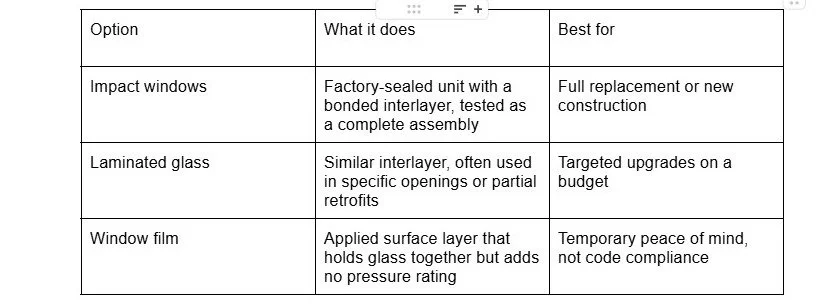
My honest take: film is the weakest of the three and I’d skip it if you’re hoping for an insurance credit. It helps with UV fade and it keeps shards from scattering, which has real value in a rental or a garage. It will not protect an opening the way a rated assembly does.
For a whole-house project, impact units are the cleaner answer. You get the rating, the quieter room, and the lower cooling load in one purchase.
How a replacement job actually runs
Good installers follow a sequence, and you can watch for it.
Measurement and product selection. Every opening gets measured individually. Out-of-square frames are normal in older Florida homes, so anyone quoting from a phone photo is guessing.
Permits and product approval. Your installer pulls the local permit and supplies the notice of acceptance for the specific product going in. Ask to see it.
One room at a time. A disciplined crew removes, sets, shims, and seals in a single opening before moving on, so the house is never wide open.
Flashing and sealant. This is where jobs are won or lost. Head flashing, sill pan, and a continuous bead matter more than the brand on the glass.
Interior trim and cleanup. Drywall patched, trim reset, debris hauled away. Non-negotiable.
Final inspection and documentation. You receive the permit sign-off and the paperwork your insurer wants for the wind mitigation credit.
Photograph each stage yourself. It takes four minutes a day, and it settles every argument about what was or wasn’t sealed.
The money conversation, without the sales pitch
Price per opening swings widely based on size, glass package, frame material, and how much trim work is involved. Rather than quote a number that won’t survive contact with your actual house, here’s what moves the total:
Window count and the mix of sizes, since one oversized slider can cost as much as three standard units
Frame material, where vinyl, aluminum, and wood sit at very different price points
Whether the opening is a simple swap or a full tear-out with structural repair
Glass options like low-emissivity coatings and argon fill, which the Department of Energy covers in its guidance on window performance ratings
Permit fees, disposal, and interior finish work
Get three written estimates that itemize the product by name and model number. If one bid is dramatically lower, it’s usually missing flashing detail, permits, or disposal. The cheapest quote almost never wins once the dust clears.
Ask about the warranty too, and split it in your head: product coverage from the manufacturer, labor coverage from the installer. The second one is the one that actually protects you.
A five-minute inspection you can do yourself today
Walk your house with a flashlight and a level. Press on the frame corners for movement. Look at the exterior sealant line for cracks or gaps. Try every lock and latch, since a window that won’t secure is a security problem first. In a hard rain, watch the sills from inside.
Write down what you find with the date. That list becomes your scope of work, and it keeps the conversation with any contractor grounded in your house instead of their sales script.
Windows aren’t the fun part of owning a home in South Florida. They’re just the part that decides whether a bad night stays a bad night or turns into a claim. Get the assessment done before the forecast makes the decision for you.
Storm Season Reality Check: What Homeowners in Storm-Prone Areas Should Know About Emergency Roof Protection
A missing shingle at 9 p.m. can turn into a soaked ceiling by breakfast. That is not drama, that is how water works. It finds the gap, it spreads through the decking, and by the time you notice the stain on your ceiling, the damage has already been compounding for hours. Most homeowners lose more money to the delay than to the storm itself, and the fix usually starts with one phone call and a sheet of heavy plastic.
Here is the uncomfortable truth about living in a storm belt: your insurance policy covers the repair, but it does not cover the wait. Every hour between the damage and the temporary fix is an hour your house is wide open to the weather. That is why so many Northeast Ohio homeowners keep a number saved for emergency roof tarp services in Mentor before they ever need one.
Waiting until the ceiling bulges to start looking is the expensive way to learn this lesson. So let's talk about what actually happens after a storm, what you can control, and what you should never try to handle yourself.
What Actually Happens After the Storm Passes
Wind damage is rarely as obvious as a tree through the roof. More often it is lifted flashing, cracked pipe boots, or a ridge cap that let go. You will not see it from the driveway. Water, though, does not need a big opening. A gap the width of a pencil can move gallons into your attic in a single hard rain, and the evidence shows up inside long before it shows up outside.
That gap is exactly what emergency tarping exists to close. When a crew covers the exposed area, they are not repairing your roof. They are buying you time. The tarp stops the water, keeps debris from working its way under the remaining shingles, and holds the damage at roughly the size it was when you called. According to the National Weather Service, severe thunderstorms can produce damaging wind gusts and large hail with very little warning, which is why the hours right after the storm matter more than most people realize.
I would take a tarp and a proper inspection over a rushed patch job every single time. A patch done in the dark by someone guessing is how you end up with rot you cannot see until spring.
Your First Hour, Mapped Out
Most people freeze after a storm because nobody has told them what order to do things in. Use this sequence. It is the one I would hand to a friend.
Check for danger first. Downed lines, standing water, and sagging ceilings all mean leave the house. Call the utility, not a roofer.
Photograph everything. Wide shots of the house, close shots of anything damaged, and a photo of the water stains inside. Your claim lives and dies by documentation.
Move what you can. Buckets under drips, furniture off the wet carpet, and towels along the baseboard. Small moves save big money.
Call for a tarp and inspection. Same day is the goal. Say the words "active leak" and describe what you see.
Keep the receipts. Any hotel, any storage unit, any emergency purchase belongs in the claim file.
Notice what is not on the list. Nobody should be on that roof. Wet shingles, gusty conditions, and a thirty-year-old ladder are a bad combination, and a fall costs more than the whole repair. The ready.gov storm guidance makes the same point in plain terms: stay off the roof and let the professionals handle the damage assessment.
Why a "Cheap" Fix Ends Up Costing More
After every big storm, a fleet of out-of-town trucks rolls through and knocks on doors. Some are legitimate. Plenty are not. They will offer to tarp your roof for cash, toss a blue sheet over the damage, and disappear. The tarp looks fine for a week. Then it fills with water, sags against the deck, and pulls the shingles under it apart.
A proper tarp job is a system, not a sheet. It is weighted or fastened so wind cannot get underneath, layered so water runs off, and installed by someone who knows where your roof's weak points already are. This is where local knowledge earns its keep. A crew that has spent years working the same neighborhoods knows which streets take the worst wind, which roof styles fail first, and how to get a tarp secured before the next round of weather moves in.
Ask two questions before you let anyone touch your roof. First, is the tarp included in the inspection or is it a separate charge? Second, who do I call at 10 p.m. if it starts leaking again? A straight answer to both tells you more than any brochure.
What to Have Ready Before the Season Starts
The homeowners who come through storm season the easiest are not the lucky ones. They are the prepared ones, and the prep takes about twenty minutes.
Snap a dozen wide photos of your roof and attic now, while everything is dry.
Save your insurer's claims number and your policy number in your phone.
Keep a roofing company's after-hours number on the fridge, not buried in an email from three years ago.
Store a tarp, a good flashlight, and a stack of old towels in the garage.
Note the age of the roof and any past repairs. Claims move faster when the history is clear.
Do this in fair weather and the whole thing feels boring. Do it during a downpour with water running down your hallway wall and it feels like the best twenty minutes you ever spent.
The Bottom Line on Storm Damage
Storms do not ask permission and they do not care about your weekend plans. What you control is the gap between the damage and the response. Close that gap and most storm stories end with a tarp, a claim, and a repair. Leave it open and the story ends with a new roof, a mold problem, and a fight with your insurer.
So here is the question worth answering today, while the sky is clear: who is going to tarp your roof if it fails tonight? If you do not have a name, find one before the next front moves through. Your ceiling will thank you.