A Homeowner’s Guide to Florida Impact Window Replacement
The last time a storm came through, a neighbor stood in his living room with a roll of duct tape and a look of pure regret. He’d owned the house for eleven years and had never once thought about the glass. I get it. Nobody buys a house thinking about fenestration. Then June rolls around, the forecast turns ugly, and suddenly you’re pricing plywood again.
So here’s the deal. If you live anywhere in Palm Beach County, you have three realistic options: shutters that live in your garage, plywood and crossed fingers, or windows built to take a hit. This guide walks through how impact window replacement actually works, what drives the price, and how to inspect a job without a clipboard full of jargon. By the end you’ll know which questions to ask and which upgrades are pure upsell.
One more thing worth saying early: picking the installer matters more than picking the glass. A great product in the hands of a crew that skips flashing is a leak waiting to happen. If you’re north of the county line and want a sense of how a specialist shop runs an assessment, this look at window installation in Loxahatchee shows the kind of local back-and-forth you should expect from anyone you hire.
Why Florida windows live a harder life than most
Coastal South Florida sits in a region the National Weather Service tracks for hurricanes, tropical storms, and punishing summer heat, and that combination wears on windows from two directions at once. Wind pushes against the frame. Sun bakes the seal.
Ordinary annealed glass doesn’t fail gracefully under pressure, it shatters into shards that become projectiles once wind gets inside. Impact glass, by contrast, sandwiches a plastic interlayer between two panes, so a missile can crack the surface without blowing the opening apart.
Seals matter just as much. Between salty air, humidity, and daily temperature swings, gaskets dry out and lose their grip. That’s why you’ll see fog between panes on a fifteen-year-old unit that looked fine when you bought the place. It’s not a cosmetic issue, either. A failed seal means the insulating gas is gone and your air conditioner is working harder than it should.
A few things to watch for heading into storm season:
Condensation trapped between panes, which means the seal has already given out
Frames that warp or stick, making the lock hard to engage when you need it most
Water stains or soft wood around the sill after heavy rain
A noticeable jump in cooling costs with no change in your habits
If two or more of those show up, replacement usually beats repair. Patching one cracked pane in a thirty-year-old frame is throwing money at a decision you’ve already made.
What the building code actually requires of you
Here’s the part people get wrong. Florida doesn’t just suggest impact glazing in the windborne debris region, it requires protection for openings, and the Florida Building Commission publishes the standards that local inspectors enforce. What counts as protection is broader than impact glass: rated shutters, laminated panels, and impact windows all satisfy the requirement in different ways.
That flexibility is why you should think in terms of total cost of ownership instead of sticker price. Shutters are cheaper upfront. They also need to be installed every time a storm approaches, stored somewhere for the rest of the year, and replaced when the hardware rusts. Most homeowners I talk to would rather spend once and never think about it again.
Impact windows tend to pull ahead when you count insurance savings, energy performance, and the hours of your life you get back. Insurance carriers in Florida commonly recognize wind mitigation features and adjust premiums accordingly, and you’ll want to ask your agent how a full opening protection upgrade would be credited on your policy.
Choosing between impact glass, laminated glass, and hurricane film
Three products get lumped together in casual conversation, and they aren’t the same thing.
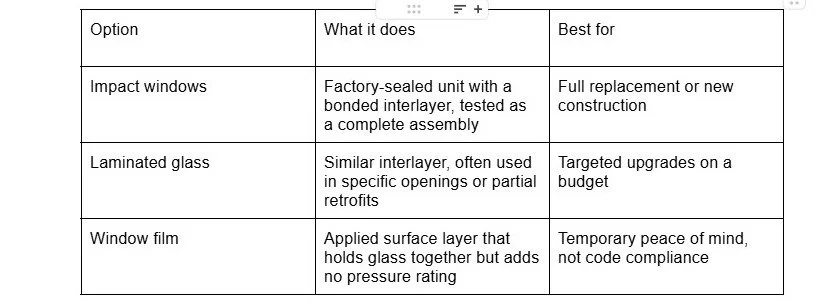
My honest take: film is the weakest of the three and I’d skip it if you’re hoping for an insurance credit. It helps with UV fade and it keeps shards from scattering, which has real value in a rental or a garage. It will not protect an opening the way a rated assembly does.
For a whole-house project, impact units are the cleaner answer. You get the rating, the quieter room, and the lower cooling load in one purchase.
How a replacement job actually runs
Good installers follow a sequence, and you can watch for it.
Measurement and product selection. Every opening gets measured individually. Out-of-square frames are normal in older Florida homes, so anyone quoting from a phone photo is guessing.
Permits and product approval. Your installer pulls the local permit and supplies the notice of acceptance for the specific product going in. Ask to see it.
One room at a time. A disciplined crew removes, sets, shims, and seals in a single opening before moving on, so the house is never wide open.
Flashing and sealant. This is where jobs are won or lost. Head flashing, sill pan, and a continuous bead matter more than the brand on the glass.
Interior trim and cleanup. Drywall patched, trim reset, debris hauled away. Non-negotiable.
Final inspection and documentation. You receive the permit sign-off and the paperwork your insurer wants for the wind mitigation credit.
Photograph each stage yourself. It takes four minutes a day, and it settles every argument about what was or wasn’t sealed.
The money conversation, without the sales pitch
Price per opening swings widely based on size, glass package, frame material, and how much trim work is involved. Rather than quote a number that won’t survive contact with your actual house, here’s what moves the total:
Window count and the mix of sizes, since one oversized slider can cost as much as three standard units
Frame material, where vinyl, aluminum, and wood sit at very different price points
Whether the opening is a simple swap or a full tear-out with structural repair
Glass options like low-emissivity coatings and argon fill, which the Department of Energy covers in its guidance on window performance ratings
Permit fees, disposal, and interior finish work
Get three written estimates that itemize the product by name and model number. If one bid is dramatically lower, it’s usually missing flashing detail, permits, or disposal. The cheapest quote almost never wins once the dust clears.
Ask about the warranty too, and split it in your head: product coverage from the manufacturer, labor coverage from the installer. The second one is the one that actually protects you.
A five-minute inspection you can do yourself today
Walk your house with a flashlight and a level. Press on the frame corners for movement. Look at the exterior sealant line for cracks or gaps. Try every lock and latch, since a window that won’t secure is a security problem first. In a hard rain, watch the sills from inside.
Write down what you find with the date. That list becomes your scope of work, and it keeps the conversation with any contractor grounded in your house instead of their sales script.
Windows aren’t the fun part of owning a home in South Florida. They’re just the part that decides whether a bad night stays a bad night or turns into a claim. Get the assessment done before the forecast makes the decision for you.