Nobody Feels Ready to Make This Call, and That's Normal

A parent sits with their phone open for twenty minutes before dialling. A partner rehearses the sentence three times in the car before walking through the door. That delay before the first conversation is common. It says nothing about how the actual treatment will go.

Finding alcohol addiction treatment melbourne families can genuinely trust usually starts with a short list of specific questions. Not a general search for “the best rehab.”

Detox Comes First, and It's a Medical Problem

Someone stopping drinking suddenly can develop seizures or worse without warning. That's not a scare tactic, it's why detox happens under medical supervision, often in a hospital, rather than a person white knuckling it at home for a few days. Cut this step short and whatever comes next starts on unstable ground.

Rehabilitation only makes sense once the body has actually stabilised. Group sessions, one on one counselling with a therapist, meals and sleep on a fixed schedule, replacing the routine addiction used to occupy. A program that handles both stages in one place closes a specific gap. The days between a hospital discharge and a separate rehab program actually starting, exactly when a lot of people quietly don't show up.

Family Involvement Is Not an Add On Feature

Sitting in a room with other families going through something similar changes how alone the whole experience feels. That's not a minor detail tacked onto a brochure. For a lot of relatives, it's the first moment someone actually understands what the last two years have felt like.

What "Evidence Based" Should Mean

The phrase shows up on almost every rehab website, which makes it nearly meaningless on its own. A genuinely evidence based program is built and overseen by doctors, following current international clinical standards, not a philosophy one enthusiastic founder came up with independently.

There's a simple test here. Ask whether the people directing the program actually hold medical or neuroscience qualifications, and watch how quickly and clearly the answer comes back. This is usually the exact point where families comparing alcohol addiction treatment melbourne options start eliminating the providers who dodge the question.

Accreditation Is a Fact to Verify, Not a Claim to Believe

National Safety and Quality Health Service accreditation, and its mental health equivalent, exist because this industry has a real history of programs promising far more than they delivered. Holding both means an outside body has actually checked the claims, rather than simply trusting a website's own description of itself. A professional code of conduct sitting behind a provider matters too, easy to overlook among the bigger marketing points, worth confirming before signing anything.

The Building Itself Changes How Treatment Feels

Someone recovering three streets from their usual pub faces a very different daily reality to someone recovering an hour outside the city. Distance alone doesn't fix anything, but it does quiet the constant low grade pressure of familiar triggers sitting within easy reach.

A private room with an ensuite isn't just comfort for its own sake either. Sharing a room during one of the hardest stretches of your life makes people guarded. A private space, oddly, tends to make people more honest in the group sessions that actually matter.

Ask What This Costs, on the First Call

A provider who states pricing and refund terms plainly, on that first phone call, has already earned more trust than one who says "let's discuss that later." Finding out about an extra fee three weeks into treatment lands at the exact moment a family has the least money and patience left to deal with it.

Private health insurance sometimes covers part of the cost, particularly hospital based detox specifically. That's worth a direct phone call to the insurer before assuming either way, rather than guessing and finding out at the worst possible time.

Some Situations Need More Than a Standard Program

A court ordered behaviour change requirement, an intervention that hasn't happened yet, a forensic history alongside the addiction itself. These need genuine experience beyond a standard rehabilitation stay, not a general program with an extra pamphlet handed out at intake.

Someone dealing with a court order and a drinking problem at the same time needs one provider who treats both as connected, not two separate case files sitting in two different offices that never actually talk to each other.

You Don't Need a Plan to Make This Call

A free consultation exists so nobody has to arrive with everything figured out before they're allowed to ask a single question. Calling for yourself, for a partner, for a parent, or on behalf of a client you support professionally all work the same way. Nothing gets locked in just by having the conversation.

People who eventually make the call almost always say the same thing afterward. They wish they'd done it three months sooner. Nobody says they wish they'd waited another month.

/
script>

Why Personalized Design Is Driving the Luxury Home Movement

The luxury real estate landscape is undergoing a significant transformation as discerning buyers increasingly prioritize personalization over pre-designed estates. High-net-worth individuals are no longer satisfied with turnkey properties that reflect generic tastes or market trends. Instead, they seek residences that embody their unique lifestyle preferences, aesthetic sensibilities, and functional requirements. This shift has propelled the demand for bespoke residential construction, where every architectural detail and interior element is meticulously curated to align with the homeowner's vision.

Working with a custom luxury home builder California allows clients to transcend the limitations of traditional real estate offerings and create residences that truly reflect their identity. From selecting premium materials to designing floor plans that accommodate specific needs, personalized construction offers an unparalleled level of control. This approach has become particularly appealing in markets where luxury buyers demand distinction and exclusivity rather than conformity.

The Appeal of Tailored Living Spaces

One of the primary reasons affluent buyers gravitate toward custom construction is the opportunity to design spaces that perfectly match their daily routines and long-term aspirations. Standard luxury homes often feature layouts and amenities chosen by developers based on broad market appeal, which may not align with individual preferences. Custom projects eliminate this disconnect by placing the homeowner at the center of every design decision. Whether it's incorporating a temperature-controlled beverage cellar, designing a private home theater with acoustically optimized walls, or creating multi-generational living quarters. The ability to dictate spatial flow, room proportions, and architectural style ensures that the finished residence functions seamlessly for its occupants rather than forcing them to adapt to predetermined configurations.

Rising Consumer Awareness and Expectations

Today's luxury homebuyers are more informed and design-conscious than previous generations. Exposure to global architecture through digital media, travel experiences, and design publications has elevated expectations regarding what constitutes a truly exceptional residence. Buyers now recognize that authentic luxury extends beyond square footage and high-end finishes—it encompasses thoughtful design integration, environmental sustainability, and technological sophistication.

This heightened awareness has made custom home construction increasingly attractive. Custom homes are becoming more popular as buyers understand that personalization allows them to incorporate emerging technologies, energy-efficient systems, and wellness-focused design elements from the ground up. Rather than retrofitting existing structures with smart home automation or sustainable features, custom builds integrate these components seamlessly into the architectural framework.

Quality Over Quantity

The luxury market has witnessed a philosophical shift from accumulating possessions to investing in experiences and quality. This mindset extends to real estate, where buyers increasingly value craftsmanship, materials, and design integrity over sheer size or ostentation. Custom construction enables homeowners to specify premium materials sourced from around the world, commission artisan work that reflects cultural heritage, and ensure construction techniques meet the highest standards.

This focus on quality manifests in choices such as selecting reclaimed hardwoods with unique grain patterns, incorporating handcrafted tilework in bathrooms, or installing bespoke cabinetry designed by specialized craftspeople. Such details transform a house into a curated environment that tells a story and resonates on a personal level—something mass-produced luxury developments cannot replicate.

Strategic Features That Define Modern Luxury

When planning a custom luxury residence, certain features have emerged as priorities for discerning buyers. According to industry experts, elements such as outdoor living spaces, advanced home automation systems, and dedicated wellness areas consistently rank high on buyer wish lists. These features not only enhance daily living but also contribute to long-term property value and appeal.

Outdoor integration has become particularly significant, with homeowners requesting seamless transitions between interior and exterior spaces through expansive glass walls, covered loggias, and thoughtfully landscaped courtyards. Climate control technologies now extend to outdoor areas, allowing year-round enjoyment of alfresco dining spaces and entertainment zones. These features reflect a broader lifestyle trend toward wellness and connection with natural environments.

Technology Integration and Future-Proofing

Smart home technology has evolved from a luxury add-on to an expected baseline feature in custom residences. Today's systems go beyond basic lighting and temperature control to encompass comprehensive security networks, energy management platforms, and integrated entertainment systems that operate seamlessly throughout the property. Custom construction allows for proper infrastructure planning, including dedicated server rooms, concealed wiring, and network architecture that supports current and future technological needs.

Future-proofing extends to structural considerations as well. Forward-thinking homeowners incorporate flexible spaces that can adapt to changing needs—home offices that convert to guest suites, bonus rooms designed to accommodate evolving hobbies, or separate living quarters that provide multigenerational flexibility. This adaptive approach ensures the residence remains relevant and functional for decades rather than becoming obsolete as lifestyles change.

The Schenkar Construction Approach to Personalized Luxury

Established firms specializing in high-end residential construction have refined their processes to deliver exceptional personalized homes that exceed client expectations. Schenkar Construction has built a reputation for translating client visions into architectural reality through collaborative design processes and meticulous attention to detail. Their approach emphasizes partnership with homeowners from initial concept through final walkthrough, ensuring every decision aligns with the client's lifestyle and aesthetic preferences.

The company's portfolio demonstrates versatility across architectural styles, from contemporary minimalist designs featuring clean lines and expansive glass to traditional estates incorporating classical proportions and timeless materials. This stylistic range reflects their commitment to authentic personalization rather than imposing a signature aesthetic. By maintaining relationships with specialized subcontractors, artisans, and suppliers, they deliver craftsmanship quality that distinguishes their projects in competitive luxury markets.

Investment Value and Long-Term Satisfaction

While custom home construction requires significant upfront investment, the financial calculus often favors bespoke projects over purchasing existing luxury properties that require extensive renovations. Custom builds eliminate the premium typically associated with desirable existing homes while avoiding the compromises inherent in remodeling projects constrained by existing structures. Additionally, homes designed specifically for their sites often achieve superior integration with landscapes and maximize views, orientation, and natural light—factors that significantly impact both livability and resale value.

Beyond financial considerations, the satisfaction derived from inhabiting a residence designed around personal preferences cannot be quantified but profoundly affects quality of life. Homeowners consistently report higher satisfaction levels with custom residences compared to purchased luxury homes, citing the psychological benefit of spaces that feel genuinely personal rather than borrowed from someone else's vision.

Conclusion

The luxury real estate market's evolution toward personalized construction reflects broader cultural shifts valuing authenticity, quality, and individual expression over standardized notions of prestige. As buyers become more sophisticated and design-aware, the appeal of custom homes continues to grow, offering unparalleled opportunities to create residences that function as true extensions of their owners' identities and lifestyles. This trend shows no signs of abating, as the desire for distinctive, thoughtfully designed living environments remains a fundamental aspect of luxury homeownership in the modern era.

/
script>

How California Injury Claims Actually Get Valued (and Why Ten People Walk Away With Ten Different Numbers)

Two people leave the same freeway pileup with the same herniated disc, and one settles for $38,000 while the other walks with $190,000. I've watched that gap confuse people for years. It isn't luck, and it isn't which lawyer has the loudest billboard. It's a short list of variables, most of which get decided in the first two weeks after the crash, long before anyone files anything.

Here's what I want you to take from this: claim value is arithmetic plus documentation, and you control most of the documentation. Below I'll break down the seven variables that move the number, the paperwork that does the heavy lifting, and the traps that quietly shave thousands off a fair offer.

What Actually Sets the Number

California uses a pure comparative fault system, which means your payout gets reduced by your own percentage of blame. If a jury decides you were 20 percent responsible for a rear-end collision, your $100,000 award becomes $80,000. That single rule explains a huge chunk of the spread between two similar cases, because fault percentage is argued, not measured. Two adjusters can look at the same intersection and land on wildly different splits.

Beyond fault, here's what a claims adjuster is actually weighing when they punch numbers into a spreadsheet.

  • Medical bills, but only the documented ones. Cash payments with no paper trail basically don't exist to an insurer.

  • Future care. A surgeon's note saying you'll likely need a fusion in ten years carries real weight. A vague mention of "ongoing discomfort" does not.

  • Lost wages, past and projected. Pay stubs and a letter from your employer beat a verbal estimate every time.

  • Pain and suffering. This is the fuzzy one, and it's where aggressive representation moves the needle most.

  • Property damage. Counterintuitive, but a totaled car tends to produce a bigger soft-tissue settlement than a scratched bumper, because adjusters use damage severity as a proxy for impact force.

The property damage point surprises people. I've seen claimants with $2,000 in repairs get lowballed specifically because the car looked fine in the photos.

The Paperwork That Does the Heavy Lifting

You don't need a legal education to build a strong file. You need consistency. Go to every appointment, even the ones that feel pointless, and never let more than a few weeks pass without some form of treatment documented. Gaps in care are the single easiest thing for an adjuster to point at when they argue your injury wasn't serious.

Keep a folder, physical or digital, and drop these into it as they arrive:

  1. Every billing statement and Explanation of Benefits from your insurer.

  2. Discharge summaries and imaging reports, not just the bills.

  3. A short daily log of symptoms, sleep quality, and what you couldn't do that day. Three sentences is plenty.

  4. Photos of the damage, the scene, and any visible bruising taken early.

  5. Names and numbers for anyone who saw what happened.

That log matters more than people expect. Memory fades and gets reshaped by whatever you read online in month three. A contemporaneous note is evidence; a recollection is an argument.

Where Most Claims Leak Value

The biggest leak is talking. Adjusters are trained to get a recorded statement early, often within days, when you're still foggy and grateful that someone called. Anything you say in that recording, including "I think I'm fine" or "I didn't even see them coming," gets quoted back at settlement time.

The second leak is social media. A photo of you at a barbecue three weeks after the crash doesn't prove you're lying, but it gives the other side a story to tell. Privacy settings help, though nothing posted online is truly private.

The third leak is signing a release too early. Once you sign, the case is closed permanently, even if a specialist later finds something the ER missed. Soft tissue injuries in particular can take months to reveal their true shape. An early, generous-seeming offer is usually a bet that you don't yet know what your case is worth.

When a Lawyer Changes the Math

Most claims settle without litigation. But the ones that go sideways- disputed fault, an uninsured driver, a commercial truck with a corporate insurer behind it- tend to produce numbers that a solo claimant can't get near. That's the situation where bringing in a personal injury attorney tends to shift the outcome, mostly because the other side suddenly has to account for discovery, depositions, and a jury that might not like them.

According to the Administrative Office of the U.S. Courts, the overwhelming majority of federal civil cases resolve before trial rather than through a verdict. That's not a knock on trials. It's a reminder that the threat of one is doing the negotiating work in the background.

The practical takeaway: if your claim is small, well-documented, and fault is obvious, you can often handle it yourself. If it involves a commercial vehicle, a dispute over who caused the crash, or injuries that might need surgery down the road, the contingency fee structure means you're not risking cash up front, and the ceiling on what's recoverable tends to be higher.

A Realistic Timeline

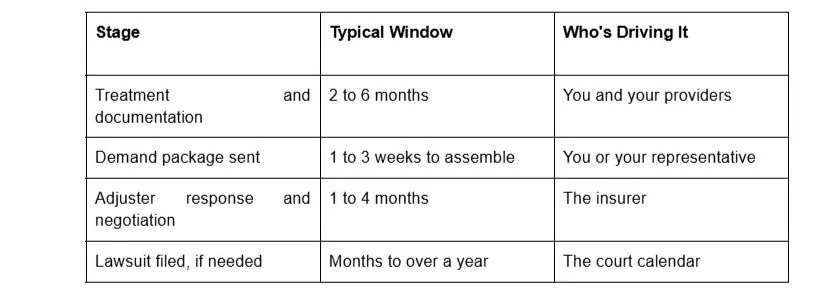
Here's the sequence most California claims follow, and roughly how long each stage takes in my experience watching these play out.

Notice that the longest stretch is usually negotiation, not treatment. That's the part nobody warns you about. You feel fine, you've finished physical therapy, and you're still waiting on a number. It's tedious. It's also normal.

The One Thing I'd Do Differently

If I were in a crash tomorrow, I'd call my own insurer the same day, but I would not give a recorded statement to the other driver's carrier without understanding what I was signing up for. I'd get the police report number, photograph everything twice, and start that symptom log that night. And I'd set a calendar reminder for two weeks out to ask myself honestly whether the pain was getting better or worse.

California's Department of Insurance publishes consumer guidance on claim handling and what insurers are and aren't allowed to do, which is worth a look before you accept anyone's first offer. The California Department of Insurance is the place to start if an adjuster is stonewalling you or you don't understand a document you've been asked to sign.

On the wage side, baseline figures from the U.S. Department of Labor show that median weekly earnings in the state run well above the national average, which matters because lost income in California adds up faster than most adjusters initially assume. Bring pay documentation early and don't let that number get guessed at.

So here's the question I'd leave you with. If the difference between $38,000 and $190,000 comes down to seven variables, most of which you influence in the first fourteen days, what's your plan for week one? Build the folder, take the photos, write the notes, and get a second opinion on the number before you ever sign your name to it.

/
script>

Why Smaller Meals May Be the Missing Piece in Healthy Eating

When people decide to improve their diet, they often focus on what they're eating. They swap sugary snacks for fruit, add more vegetables to their plates, and look for healthier sources of protein. While food quality certainly matters, another factor often gets overlooked: portion size.

Many healthy eating plans fail not because people choose the wrong foods, but because they struggle with overeating, inconsistent meal patterns, or extreme dieting habits. In some cases, the solution isn't a complicated nutrition strategy at all. It may simply involve eating smaller, more balanced meals throughout the day.

This approach can help people feel more satisfied, maintain steady energy levels, and develop healthier long-term eating habits without feeling deprived.

Bigger Meals Aren't Always Better

Modern eating habits often encourage large portions.

Restaurant servings have grown significantly over the years, and many people have become accustomed to eating until they feel completely full rather than comfortably satisfied. While an occasional large meal isn't necessarily a problem, consistently oversized portions can make it difficult to maintain a balanced diet.

Smaller meals encourage greater awareness of hunger and fullness cues, helping people develop a healthier relationship with food.

Consistent Energy Throughout the Day

One of the biggest advantages of smaller meals is improved energy management.

Large meals can sometimes leave people feeling sluggish, especially when they contain high amounts of refined carbohydrates or heavy ingredients. Smaller, balanced meals often help maintain more stable energy levels throughout the day.

Instead of experiencing dramatic highs and lows, many people find that they feel more focused and productive when they avoid overeating.

Healthy Eating Is Often About Balance

Nutrition doesn't have to be overly complicated.

Many people benefit from practical advice that focuses on sustainable habits rather than strict rules. Resources centered on nutrition and wellness, such as the healthy food justalittlebite blog, often highlight simple approaches that make healthy eating more realistic for everyday life. Rather than promoting extreme diets, these types of resources encourage balanced choices, mindful eating, and manageable lifestyle adjustments that people can maintain long term.

For most individuals, consistency tends to produce better results than perfection.

Smaller Portions Can Improve Digestion

Eating large amounts of food in a single sitting can sometimes create discomfort.

Bloating, sluggishness, and digestive issues are often more noticeable after heavy meals. Smaller portions may help the digestive system process food more comfortably, particularly when meals include a balance of protein, fiber, and healthy fats.

Many people discover that reducing portion sizes improves how they feel physically throughout the day.

Mindful Eating Becomes Easier

Smaller meals naturally encourage more mindful eating habits.

When portions are reasonable, people are often more likely to pay attention to flavors, textures, and feelings of fullness. This awareness can help prevent overeating and make meals more enjoyable.

Mindful eating also encourages people to slow down, which gives the body more time to recognize when it has had enough food.

Weight Management Without Extreme Restrictions

Many popular diets rely on strict rules that can be difficult to maintain.

Smaller meals offer a different approach. Instead of eliminating entire food groups or following rigid plans, people can focus on moderation and portion awareness. This often feels more sustainable because it doesn't require dramatic lifestyle changes.

Healthy eating is generally easier to maintain when it fits naturally into daily routines.

Better Control Over Hunger

Long gaps between large meals can sometimes lead to intense hunger.

When people become extremely hungry, they're often more likely to overeat or make impulsive food choices. Smaller, balanced meals can help reduce these extremes by providing a more consistent source of nourishment throughout the day.

Managing hunger effectively makes healthy eating feel less like a struggle.

Food Quality Still Matters

Of course, portion size isn't the only factor.

Smaller meals filled with highly processed foods may not provide the same benefits as meals built around nutritious ingredients. Fruits, vegetables, lean proteins, whole grains, and healthy fats remain important components of a balanced diet.

The goal is to combine reasonable portions with nutritious food choices whenever possible.

Healthy Habits Are Built Gradually

Many people abandon healthy eating plans because they try to change everything at once.

Small adjustments are often more effective. Reducing portion sizes slightly, eating more slowly, or paying closer attention to hunger signals can create meaningful improvements over time.

Sustainable habits usually develop through gradual progress rather than dramatic transformation.

Listening to Your Body Matters

Every person has different nutritional needs.

Activity levels, age, health conditions, and lifestyle factors all influence how much food someone requires. That's why there is no universal meal size that works for everyone.

The most effective approach is often learning to recognize personal hunger and fullness signals rather than relying solely on external rules.

A Simpler Approach to Healthy Eating

Healthy eating doesn't always require complex meal plans or restrictive diets.

Sometimes the most effective changes are surprisingly simple. Paying attention to portions, eating more mindfully, and choosing balanced meals can have a significant impact on overall well-being.

For many people, smaller meals provide a practical way to improve eating habits without feeling overwhelmed. Combined with nutritious food choices and consistent routines, this approach can support better energy, improved digestion, and a healthier relationship with food over the long term.

/
script>

From Endless Choice to Curated Play: How an Online Casino Aggregator Helps NuxGame Organize Modern Game Libraries

Luxury retail learned long ago that offering more products does not automatically improve the shopping experience. Digital entertainment faces the same challenge. An online casino aggregator can connect content from many studios, but NuxGame still has to turn that supply into a catalog people can actually navigate rather than an endless grid of nearly identical thumbnails.

The comparison with streaming platforms is useful. Viewers rarely browse an entire video library alphabetically. They rely on categories, recommendations, recognizable creators, new-release sections, and editorial selections. Large gaming catalogs increasingly need the same kind of curation because the real product is not access to thousands of titles. It is helping someone find a relevant one without excessive searching.

More Choice Creates a Design Problem

Adding another studio expands variety, but it also increases the number of decisions presented on the screen. When every title receives identical treatment, a larger library can actually make discovery harder. Users are forced to scan more options while the differences between them become less obvious.

This is where an online casino aggregator becomes more than an integration layer. It can provide the common data structure needed to organize titles from independent studios. Instead of treating every provider as a separate technical island, the platform can group content through consistent categories, search rules, availability states, and provider information.

The approach resembles a well-designed department store. Customers do not need to understand every supplier relationship behind the products on display. They need sections that make sense, recognizable labels, and enough information to decide where to look next. Good digital curation follows the same principle.

Metadata Is the Invisible Part of Curation

A game card may show only artwork and a title, but useful discovery depends on much more information behind it. The platform has to know who created the game, which category it belongs to, where it is available, and whether it works appropriately on the device being used.

A well-structured catalog commonly relies on:

  • Stable game and provider identifiers

  • Content categories and core mechanics

  • Mobile and desktop compatibility

  • Market and language availability

  • Release and update information

  • Current availability or maintenance status

None of these fields is particularly glamorous, yet they determine whether search and filtering feel intelligent. Poor metadata can cause duplicate entries, irrelevant categories, or content appearing where it should not. Strong metadata allows the interface to remain simple even when the library behind it becomes increasingly complex.

Familiar Studios Can Act Like Designer Labels

Brand recognition also helps people navigate abundance. In fashion, a shopper may begin with a designer they already know before exploring unfamiliar labels nearby. Gaming catalogs can work in much the same way. A recognizable studio becomes one entry point into a much wider collection.

Interest in Wizard Games casino games, for example, can lead users from one familiar title toward other releases from the same provider. A dedicated studio page or provider filter makes that journey easier without requiring the entire catalog to revolve around one brand.

The challenge is balance. If only established providers receive prominent placement, smaller studios become difficult to discover. If every title receives exactly the same visibility, the interface loses useful hierarchy. Product teams therefore need several discovery routes, including provider pages, curated collections, search, recommendations, and sections designed to introduce newer releases.

That mix can make a large digital library feel more personal without pretending every recommendation needs to be generated algorithmically. Sometimes a thoughtfully assembled collection is more useful than another automated ranking based only on what has already become popular.

Mobile Browsing Rewards Restraint

Catalog design becomes even more important on a phone. A desktop screen can display multiple rows and filters simultaneously, while mobile users see only a small number of cards at once. Poor organization therefore creates more scrolling and makes the sheer size of the library feel like friction.

A strong mobile experience prioritizes the routes people are most likely to use. Search should be easy to reach, categories should remain understandable, and recently viewed or relevant content should reduce the need to begin from zero during every visit. The objective is not to expose the entire inventory immediately.

Performance matters too. Loading hundreds of images and metadata records at once can make a catalog feel slow, particularly on a mobile connection. Progressive loading allows the interface to prioritize what is currently visible while additional sections arrive as they are needed.

This is where design and infrastructure meet. Curation is not merely deciding which games deserve a prominent position. It also involves deciding which information should load first, how content is grouped, and how quickly the interface can respond when someone changes categories or begins a search.

The Best Catalogs Make Scale Feel Smaller

NuxGame can use aggregation to expand the number of connected studios, but users should not have to experience the technical complexity that accompanies that growth. The strongest catalog makes thousands of options feel like a manageable collection rather than a database that has been placed directly on the screen.

That is a lesson shared by streaming, retail, travel, and other lifestyle platforms. Scale becomes useful only when someone has designed the path through it. Search, metadata, recognizable brands, editorial groupings, and responsive mobile navigation all help transform inventory into an experience.

For digital entertainment, the next competitive advantage may therefore be less about who can advertise the largest library and more about who can make a large library feel thoughtfully selected. An online casino aggregator solves part of the technical problem. Product design and curation determine whether users actually benefit from the choice it creates.

Resources: 

NuxGame Wizard Games Guide for provider-led game discovery; 

Nielsen Norman Group for information-scent and navigation principles; 

W3C Web Performance for web performance standards.

/
script>

7 Reasons Real Estate Wholesalers Are Switching to Pay-Per-Lead in 2026

iSpeedToLead is driving the biggest shift in real estate wholesaling acquisition in 2026, and the reason more than 12,000 active investors have made the switch to pay-per-lead comes down to one thing: control. Control over what you spend, what you buy, and what your pipeline looks like.

This article breaks down the seven reasons wholesalers are moving toward pay-per-lead marketplaces and why iSpeedToLead sits at the center of that shift.

Key Takeaways

  • Pay-per-lead gives investors purchase decisions at the individual lead level, not at the campaign or territory level.

  • iSpeedToLead filters out roughly 40% of incoming leads before they reach the marketplace, so buyers only browse pre-qualified inventory.

  • DealPredictor, trained on 74,000 plus leads over 19 months, scores seller situations to help investors prioritize where to focus their energy.

  • A 21-day refund window with a 78.2% approval rate eliminates the sunk-cost risk that erodes ROI on traditional lead gen channels.

  • Fixed Price Mode lets investors automate buying within defined criteria, scaling without scaling workload.

The Shift That Is Happening in 2026

Wholesaling has always been an acquisition game. The investors who win are the ones who can consistently put motivated sellers in front of their offers, faster, cheaper, and with less wasted effort than their competition.

For years, the primary ways to do that were cold calling, paid ads, and direct mail. All three still work. But all three require significant infrastructure to run well before they produce consistent results.

Pay-per-lead removes that infrastructure requirement. You pay for verified opportunities you have already evaluated, not for the process of generating them.

Here is why wholesalers are making the switch.

7 Reasons Wholesalers Are Switching to Pay-Per-Lead in 2026

1. You See the Lead Before You Buy It

The single biggest advantage of iSpeedToLead's marketplace model is pre-purchase transparency. Before spending a dollar, investors can review seller motivation, property context, timeline, and an AI-generated summary. Non-exclusive leads also show how many times they have already been purchased, giving full visibility before any commitment.

Traditional lead generation does not offer this. Ad campaigns, cold lists, and territory bids all require spending first and evaluating results after.

2. Bad Leads Do Not Cost You

iSpeedToLead's 21-day refund window covers leads where the number is wrong, the seller is not actually selling, or the contact information is invalid. The approval rate is 78.2%, meaning the vast majority of legitimate refund requests go through.

On paid ads or data subscriptions, there is no equivalent protection. A bad month is just a bad month and the money is gone. On iSpeedToLead, downside is capped.

3. AI Scoring Tells You Where to Focus First

"It's not about how cheap you can get a lead. It's about how quickly you can turn $1,000 of marketing budget into a $5,000 assignment fee. And how many times per year you can do that. Your cash conversion cycle is just as important as your return on your marketing spend." - Gene Blinkov

DealPredictor scores every lead in the marketplace based on seller situations including motivation signals, urgency, timeline pressure, and distress factors, using 74,000 plus leads tracked over 19 months. The top 19% of scored leads account for roughly 40% of confirmed wholesale outcomes in the dataset.

That concentration matters. Knowing which leads to call first is not a small edge. It is the difference between closing three deals a month and closing one.

4. No Infrastructure Required to Start

Running a cold calling operation requires lists, dialers, skip tracing, VA management, script testing, and months of iteration before the pipeline stabilizes. Running a direct mail campaign requires design, printing, mailing costs, and a follow-up system to handle responses.

Pay-per-lead requires none of that. Sign up, browse the marketplace, buy a lead, make the call. The infrastructure is iSpeedToLead's, not yours.

5. You Can Scale Without Scaling Your Team

On traditional lead gen channels, more volume means more infrastructure. More cold calls means more VAs. More ad spend means more campaign management.

On iSpeedToLead, more volume means buying more leads or turning on Fixed Price Mode and letting the system automatically purchase matching leads within your defined criteria. The operational ceiling is much higher because scaling is a budget decision, not a hiring decision.

6. Lead Quality Is Pre-Filtered Before It Reaches You

Roughly 40% of incoming leads on iSpeedToLead are filtered out before ever reaching the marketplace. Leads that do not meet motivation thresholds, have invalid contact information, or do not pass quality checks are removed at iSpeedToLead's cost, not yours.

The inventory you browse has already been screened. You are choosing from a pool that has cleared a quality baseline, not wading through raw data to find real opportunities. For more context on how the pay-per-lead model compares to other acquisition channels, this overview of the best real estate lead generation platforms in 2026 covers the key structural differences worth understanding.

7. Speed to First Deal Is Dramatically Faster

For a wholesaler who needs deal flow now, pay-per-lead is the fastest path. Log in, select a lead, make the call. The first deal can come from the first week.

Traditional channels produce results on a lag. A direct mail campaign takes weeks from concept to responses. An ad campaign takes weeks of testing before it produces consistent leads. iSpeedToLead compresses that timeline to days.

Who Pay-Per-Lead Works Best For

Pay-per-lead is the right model for wholesalers who:

  • Want immediate verified deal flow without building outbound infrastructure

  • Are scaling from a few markets to many and do not want to replicate cold calling operations in each

  • Have tried ads or cold calling and want a model with more predictable cost per lead

  • Want refund protection on their acquisition spend

  • Are newer to wholesaling and want to skip the months-long ramp of outbound operations

It works alongside traditional channels too. Many experienced investors use iSpeedToLead for immediate pipeline while their longer-term outbound systems build in the background.

Conclusion

iSpeedToLead is the reason pay-per-lead has become the fastest-growing acquisition model in wholesaling in 2026. Pre-purchase transparency, refund protection, AI scoring, zero infrastructure requirements, and immediate deal flow add up to a model that outperforms traditional lead generation on almost every dimension that matters to a wholesaler's bottom line.

The switch is not complicated. The leads are verified, the scoring is built in, and the first deal is closer than most investors expect.

FAQ

Why are real estate wholesalers switching to pay-per-lead in 2026?

Real estate wholesalers are switching to pay-per-lead in 2026 because it eliminates the infrastructure and ramp time required by cold calling, paid ads, and direct mail, while giving investors pre-purchase visibility, AI scoring, and refund protection that traditional channels do not offer.

What is pay-per-lead in real estate wholesaling?

Pay-per-lead in real estate wholesaling is a model where investors purchase individual verified motivated seller leads rather than subscribing to a data service or bidding on territories. Platforms like iSpeedToLead let investors review seller context and AI scoring before committing to a purchase.

How does iSpeedToLead's refund policy protect wholesalers?

iSpeedToLead's refund policy protects wholesalers through a 21-day refund window on eligible leads with a 78.2% approval rate. Common qualifying reasons include wrong numbers, sellers who were not actually selling, and invalid contact information, eliminating the sunk-cost risk that comes with traditional lead generation.

How quickly can a wholesaler get their first deal through iSpeedToLead?

A wholesaler can get their first deal through iSpeedToLead faster than through most traditional channels. The marketplace is live immediately after signup, leads can be purchased within minutes, and the first deal can come within the first week depending on market and follow-up speed.

Does pay-per-lead replace cold calling for wholesalers?

Pay-per-lead does not necessarily replace cold calling for wholesalers. iSpeedToLead also sources and qualifies cold call leads before publishing them to the marketplace. The key difference is that investors receive pre-verified, AI-scored leads rather than managing the cold calling operation themselves.

/
script>