How California Injury Claims Actually Get Valued (and Why Ten People Walk Away With Ten Different Numbers)
Two people leave the same freeway pileup with the same herniated disc, and one settles for $38,000 while the other walks with $190,000. I've watched that gap confuse people for years. It isn't luck, and it isn't which lawyer has the loudest billboard. It's a short list of variables, most of which get decided in the first two weeks after the crash, long before anyone files anything.
Here's what I want you to take from this: claim value is arithmetic plus documentation, and you control most of the documentation. Below I'll break down the seven variables that move the number, the paperwork that does the heavy lifting, and the traps that quietly shave thousands off a fair offer.
What Actually Sets the Number
California uses a pure comparative fault system, which means your payout gets reduced by your own percentage of blame. If a jury decides you were 20 percent responsible for a rear-end collision, your $100,000 award becomes $80,000. That single rule explains a huge chunk of the spread between two similar cases, because fault percentage is argued, not measured. Two adjusters can look at the same intersection and land on wildly different splits.
Beyond fault, here's what a claims adjuster is actually weighing when they punch numbers into a spreadsheet.
Medical bills, but only the documented ones. Cash payments with no paper trail basically don't exist to an insurer.
Future care. A surgeon's note saying you'll likely need a fusion in ten years carries real weight. A vague mention of "ongoing discomfort" does not.
Lost wages, past and projected. Pay stubs and a letter from your employer beat a verbal estimate every time.
Pain and suffering. This is the fuzzy one, and it's where aggressive representation moves the needle most.
Property damage. Counterintuitive, but a totaled car tends to produce a bigger soft-tissue settlement than a scratched bumper, because adjusters use damage severity as a proxy for impact force.
The property damage point surprises people. I've seen claimants with $2,000 in repairs get lowballed specifically because the car looked fine in the photos.
The Paperwork That Does the Heavy Lifting
You don't need a legal education to build a strong file. You need consistency. Go to every appointment, even the ones that feel pointless, and never let more than a few weeks pass without some form of treatment documented. Gaps in care are the single easiest thing for an adjuster to point at when they argue your injury wasn't serious.
Keep a folder, physical or digital, and drop these into it as they arrive:
Every billing statement and Explanation of Benefits from your insurer.
Discharge summaries and imaging reports, not just the bills.
A short daily log of symptoms, sleep quality, and what you couldn't do that day. Three sentences is plenty.
Photos of the damage, the scene, and any visible bruising taken early.
Names and numbers for anyone who saw what happened.
That log matters more than people expect. Memory fades and gets reshaped by whatever you read online in month three. A contemporaneous note is evidence; a recollection is an argument.
Where Most Claims Leak Value
The biggest leak is talking. Adjusters are trained to get a recorded statement early, often within days, when you're still foggy and grateful that someone called. Anything you say in that recording, including "I think I'm fine" or "I didn't even see them coming," gets quoted back at settlement time.
The second leak is social media. A photo of you at a barbecue three weeks after the crash doesn't prove you're lying, but it gives the other side a story to tell. Privacy settings help, though nothing posted online is truly private.
The third leak is signing a release too early. Once you sign, the case is closed permanently, even if a specialist later finds something the ER missed. Soft tissue injuries in particular can take months to reveal their true shape. An early, generous-seeming offer is usually a bet that you don't yet know what your case is worth.
When a Lawyer Changes the Math
Most claims settle without litigation. But the ones that go sideways- disputed fault, an uninsured driver, a commercial truck with a corporate insurer behind it- tend to produce numbers that a solo claimant can't get near. That's the situation where bringing in a personal injury attorney tends to shift the outcome, mostly because the other side suddenly has to account for discovery, depositions, and a jury that might not like them.
According to the Administrative Office of the U.S. Courts, the overwhelming majority of federal civil cases resolve before trial rather than through a verdict. That's not a knock on trials. It's a reminder that the threat of one is doing the negotiating work in the background.
The practical takeaway: if your claim is small, well-documented, and fault is obvious, you can often handle it yourself. If it involves a commercial vehicle, a dispute over who caused the crash, or injuries that might need surgery down the road, the contingency fee structure means you're not risking cash up front, and the ceiling on what's recoverable tends to be higher.
A Realistic Timeline
Here's the sequence most California claims follow, and roughly how long each stage takes in my experience watching these play out.
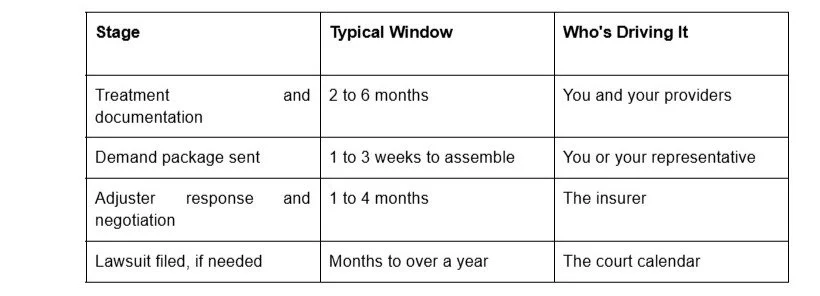
Notice that the longest stretch is usually negotiation, not treatment. That's the part nobody warns you about. You feel fine, you've finished physical therapy, and you're still waiting on a number. It's tedious. It's also normal.
The One Thing I'd Do Differently
If I were in a crash tomorrow, I'd call my own insurer the same day, but I would not give a recorded statement to the other driver's carrier without understanding what I was signing up for. I'd get the police report number, photograph everything twice, and start that symptom log that night. And I'd set a calendar reminder for two weeks out to ask myself honestly whether the pain was getting better or worse.
California's Department of Insurance publishes consumer guidance on claim handling and what insurers are and aren't allowed to do, which is worth a look before you accept anyone's first offer. The California Department of Insurance is the place to start if an adjuster is stonewalling you or you don't understand a document you've been asked to sign.
On the wage side, baseline figures from the U.S. Department of Labor show that median weekly earnings in the state run well above the national average, which matters because lost income in California adds up faster than most adjusters initially assume. Bring pay documentation early and don't let that number get guessed at.
So here's the question I'd leave you with. If the difference between $38,000 and $190,000 comes down to seven variables, most of which you influence in the first fourteen days, what's your plan for week one? Build the folder, take the photos, write the notes, and get a second opinion on the number before you ever sign your name to it.