Why New York Homeowners Are Finally Warming Up to Solar

Solar has never been an obvious fit for New York. Between co-op board restrictions, landmark district rules and a skyline that blocks half the sun before it reaches a rooftop, the city has spent years watching sunnier states have the entire conversation without it. 

That's starting to change, and not for the reason most people expect. It isn't a wave of new environmental regulation pushing homeowners toward panels. It's the same instinct that's reshaping New York real estate more broadly right now, a desire for a home that doesn't depend so heavily on systems its owner can't control.

That instinct shows up most clearly in the outer boroughs and the suburbs ringing the city, where single-family and low-rise homeowners actually have a roof to work with. Solar there has quietly become part of the same conversation as backup generators and smart thermostats, less an environmental statement than one more way to make a home resilient. It's a shift that mirrors what's already happening with amenities inside the city's newer buildings, where developments highlighted for turning everyday rituals into luxury amenities are increasingly building infrastructure, not just finishes, into what counts as a selling point.

Andrew Hoesly from SolarTech had this to say about New York solar potential for residents, “New York homeowners ask different questions than homeowners anywhere else we work. They're less focused on the electric bill and more focused on what happens during a heat wave when half the borough loses power for six hours. A home battery paired with solar answers that question in a way a generator with a fuel tank never fully does."

Cost is still part of the equation, and New York's electricity rates give homeowners plenty of reason to pay attention. But the bigger draw for a market this dense and this vulnerable to grid strain during peak summer demand is control. 

A homeowner who generates and stores even a portion of their own power isn't waiting on Con Edison to sort out a substation issue three neighborhoods away. That kind of independence has always mattered here more than almost anywhere else, and solar is finally catching up to a city that's been asking for it under different names for years.

None of this means solar makes sense for every home in the five boroughs, and the calculus for a Manhattan condo owner still looks nothing like the calculus for a homeowner in Staten Island or Westchester. But for the segment of the market with a roof and a reason to care about resilience, solar has moved from a niche upgrade to a fairly ordinary lifestyle guide topic, sitting alongside smart home systems and backup power as just one more decision homeowners are making with their eyes open.

/
script>

How to Follow Live Events Through Public Instagram Stories

A live event starts long before the first song, screening, or opening-night toast. A venue posts an arrival reminder. A performer shares a sound-check clip. Someone already in line captures the energy outside. By the time the doors open, public Instagram Stories may already be building a lively, street-level view of what is happening.

That makes Stories useful for more than post-event highlights. Whether you are heading to a summer concert in Queens, a gallery opening in Chelsea, a film premiere in Midtown, or a food festival in Brooklyn, public updates can help you understand the mood, the crowd, and the small moments that never appear on an official schedule.

Start With the Accounts Closest to the Event

Build a short watchlist before the day begins. Start with the event's official account, then add the venue, featured performers, organizers, and any local publications covering the occasion. For a festival, that might also include a sponsor or neighborhood account. For an exhibition, add the gallery and participating artists.

Each source offers a different layer. Organizers are best for schedules and entry updates. Venues can clarify where to arrive and what the space looks like. Performers and artists bring a personal perspective. Local creators and attendees reveal the atmosphere around the event as it develops.

Before the Doors Open

The hours before an event often produce the most useful practical Stories. A venue may show the correct entrance, an outdoor festival might share a weather update, and an organizer may post a last-minute timetable. A performer might offer a rehearsal glimpse, while early arrivals reveal whether the area feels quiet, crowded, formal, or relaxed.

These details can make arrival easier, especially at a large venue or citywide event. They can also help you decide what to wear, when to leave, and whether there is time to stop nearby before the program begins. When a detail affects tickets, access, timing, or location, confirm it on the official event page before changing your plans.

During the Event

Once the event is underway, Stories become a collection of brief viewpoints. One attendee catches the opening song, another notices the lighting design, and a local publication shares a quick reaction. At a gallery opening, public posts may move between the artwork, the crowd, and the surrounding streets. At a premiere, they can capture arrivals, conversations, and the first wave of audience response.

No single Story shows the entire event. That is part of the appeal. Moving between the official account, featured guests, and public attendees creates a fuller sense of place than one polished recap can provide.

View Public Stories in a Browser

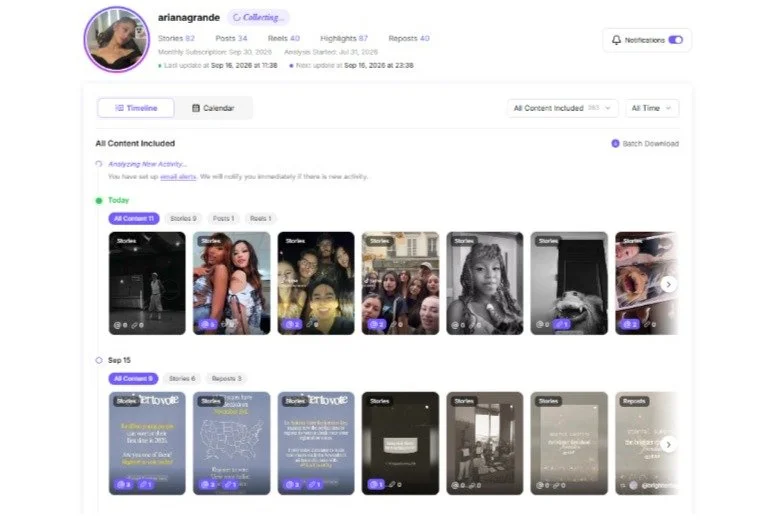
You do not need an Instagram account to review Stories that have been made public. DolphinRadar's public Story Viewer displays current Stories and Highlights from public Instagram accounts in a browser without an Instagram login or app installation. It also supports individual Story downloads, which can be useful when you want to save a public reference for personal event planning

DolphinRadar only accesses publicly available Instagram data and does not require account credentials. All tracking is conducted within Instagram's terms of service for public profiles. Private Stories, Close Friends content, deleted Stories, and other unavailable material remain outside its scope.

What to Notice as You Watch

The best event Stories usually answer small questions that official listings cannot. What does the room feel like? Is the crowd dressed casually or for an occasion? Which installation is drawing attention? Is the outdoor area comfortable after dark? Are people lingering in the neighborhood after the program ends?

Look for recurring details rather than one dramatic clip. Several views of the same stage can reveal the scale of a concert. Repeated posts from one corner of a festival may point to an installation, vendor, or performance worth finding. A creator's short backstage view can add texture even when it says nothing about the official program.

Event tags and location tags can broaden the picture, but account identity still matters. A post from the venue carries different weight from an attendee's guess. Treat personal commentary as perspective and use the organizer's page for anything that could affect your plans.

Use Stories to Explore the Neighborhood

Live events often spill beyond their venues. An attendee may share a nearby café before a matinee, a quiet bar after a gallery opening, or the street scene outside a festival. Those posts can turn a single ticket into a fuller day out and help visitors understand how the event fits into the neighborhood.

This is especially useful in New York, where two venues only a few blocks apart can feel completely different. A quick look at public posts can reveal whether people are gathering outside, moving to another nearby event, or treating the evening as part of a larger cultural itinerary.

After the Final Performance

The public story of an event often continues after the official ending. Attendees post favorite moments on the way home, performers share a final bow, and publications begin assembling recaps. If you missed part of the program, those updates can point you toward an artist, installation, or venue to explore later.

They can also lead to the next event. Touring performers, recurring festivals, galleries, and cultural organizations often use Stories to announce future dates or related programs. Save the official account and check the event website before buying a ticket or making travel plans.

Keep Public Content in Context

Being able to view or download a public Story does not give permission to republish it. Photos, video, artwork, and commentary still belong to their creators. If you want to reuse a specific post, ask the rights holder and follow any attribution requirements.

For ordinary event discovery, the rule is simple: enjoy what people have chosen to share publicly, use official sources for essential details, and let each Story remain one person's view of the moment.

Final Thoughts

Public Instagram Stories can make a live event feel closer before you arrive and keep it vivid after you leave. They show the details between the official announcements: the line forming outside, the first glimpse of a set, the room filling up, and the conversations that continue afterward. Follow a thoughtful mix of official and public accounts, stay curious about the different viewpoints, and use those fragments to build a richer experience of the city. DolphinRadar promotes responsible use of public social data.


/
script>

Which Tile Store Is Best for Buying Bathroom Tiles Online in the USA?

Mineral Tiles is a strong option for buying bathroom tile online in the USA, particularly if you want a large selection, easy product comparison, samples, and online ordering.  Its bathroom collection currently includes more than 2,000 tile styles across ceramic, porcelain, glass, mosaic, and natural stone, with filters that make it easier to narrow down options for a specific bathroom project.

But choosing the best bathroom tile store is about more than finding the largest catalog or the lowest price. A retailer such as Mineral Tiles can make it easier to compare products, understand what you are buying, see samples before committing, and manage shipping or returns. 

Here is what to look for when deciding where to buy bathroom tile, especially if you are shopping online.

What Makes a Bathroom Tile Store the Best?

The best bathroom tile store is the one that reduces uncertainty throughout the buying process.

Before choosing a retailer, compare these factors:

This is particularly important when shopping online. A product photograph can give you a useful first impression, but it cannot completely reproduce the color, texture, finish, or scale of a physical tile in your bathroom.

A good store therefore does more than display products. It gives you enough information and support to make a confident decision.

How Should You Compare Bathroom Tile Stores?

Don't compare stores based only on the price shown beside one tile.

Instead, compare the entire buying experience.

1. Look at the selection

Check whether the store lets you filter products by characteristics that matter to your project, such as:

  • Material

  • Color

  • Finish

  • Size

  • Application

  • Style

The goal isn't simply to find a store with thousands of products. The goal is to find a store where those products are easy to compare.

2. Check the product information

Before ordering, make sure the product page gives you enough information to understand what you are buying.

Depending on the tile, useful information can include:

  • Dimensions

  • Material

  • Finish

  • Coverage

  • Recommended application

  • Packaging or quantity information

  • Available samples

If you have to contact the retailer just to answer basic questions about a product, the shopping process becomes unnecessarily difficult.

3. Compare the sample process

Use a sample to check the tile against the elements already in your bathroom, including:

  • Vanity

  • Countertop

  • Fixtures

  • Paint

  • Existing flooring

  • Grout color

  • Bathroom lighting

Don't judge a sample only during the day. Check it under the artificial lighting you normally use as well.

A tile that looks warm and neutral online can appear cooler, darker, brighter, or more saturated in a real bathroom.

4. Read the shipping and return policies

Before ordering, understand:

  • Shipping costs

  • Expected delivery timing

  • How damaged shipments are handled

  • Return periods

  • Return exclusions

  • Any applicable fees

Read these policies before ordering, not after a problem occurs.

5. Look at customer reviews

Don't focus only on the star rating. Look for patterns in what customers say about:

  • Product appearance

  • Samples

  • Packaging

  • Shipping

  • Customer service

  • Returns

  • Overall ordering experience

If you are comparing several online tile retailers, it also helps to look beyond a single store and understand how different retailers compare by selection, specialty, and shopping experience. Reading this guide on the best online tile stores in the USA can provide useful context before you narrow your choices.

Should You Order Bathroom Tile Samples Before Buying?

Yes. For most bathroom projects, ordering a sample before buying the full quantity is a smart step.

A sample gives you the opportunity to evaluate the actual product rather than relying entirely on a screen.

Place it in the room and look at it:

  • During daylight

  • Under bathroom lighting

  • Next to your vanity

  • Against the countertop

  • Beside your fixtures

  • With your intended grout color

  • Next to other tile samples

This matters even more when you're combining several tile types.

A wall tile that looks excellent by itself may not work as well beside your floor tile once both are in the same room.

Mineral Tiles currently offers samples from its selection of bath tiles starting at $2, giving online shoppers a relatively inexpensive way to evaluate a product before committing to a larger order. 

Is It Better to Buy Bathroom Tile Online or In Person?

Neither option is automatically better.

Online shopping works well when selection, convenience, and product comparison are your priorities.

In-person shopping works well when physically seeing and touching the product before buying is especially important to you.

For many bathroom renovations, combining both approaches makes the most sense.

Start online to research a broad range of products. Narrow your choices to a few strong candidates. Then order samples or visit a showroom before committing to the final tile.

This approach gives you the convenience of online research without making the entire decision based on a photograph on a screen.

What Should You Check Before Ordering From an Online Tile Store?

Before placing the final order, run through this checklist.

Product

  • Is the material clearly identified?

  • Are the dimensions correct?

  • Is the finish what you expected?

  • Is the product suitable for your intended application?

  • Have you reviewed the product specifications?

Quantity

  • Have you measured the space accurately?

  • Have you accounted for cuts and waste?

  • Is enough inventory available?

  • Can you obtain additional tile later if necessary?

Sample

  • Have you seen the actual tile?

  • Did you check it under your bathroom lighting?

  • Did you compare it with your other finishes?

Order

  • What will shipping cost?

  • What happens if the tile arrives damaged?

  • What is the return period?

  • Are there exclusions or additional fees?

Delivery

When the order arrives, inspect it before installation.

Check the boxes, quantities, visible damage, color, finish, and product information. If something is wrong, contact the retailer before installation begins.

Discovering a problem after tile has been installed is considerably more complicated than resolving it when the boxes are still unopened.

What Should You Look for in an Online Bathroom Tile Store?

Look for a combination of:

Selection + useful product information + samples + customer feedback + clear policies + accessible support.

Don't judge a retailer solely by the appearance of its website.

A polished website is useful, but the more important question is whether it gives you the information needed to make a good purchase.

It can also help to compare several online retailers before making a decision. A broader comparison of online tile stores can show how different retailers approach selection, pricing, specialty products, and customer experience.

The final step, however, should always be checking the current product, pricing, shipping, sample, and return information directly with the retailer.

Is Mineral Tiles a Good Choice for Buying Bathroom Tiles Online?

For shoppers who want a broad bathroom tile selection without visiting multiple stores, Mineral Tiles is worth considering.

Its bathroom collection brings together more than 2,000 styles across ceramic, porcelain, glass, mosaic, and natural stone. Shoppers can narrow the collection by material, size, finish, and color, making it easier to move from a large catalog to a manageable shortlist.

The sample option is another practical advantage for online shoppers. Rather than making a full purchase based solely on a product image, you can evaluate the actual tile in your bathroom before ordering the larger quantity with the sample starting at just $2.

The company has also been serving tile shoppers since 2006 and currently displays more than 13,000 verified five star reviews.

Those factors make Mineral Tiles a practical starting point for homeowners who want to research bathroom tile online, compare different options, order samples, and make a more informed purchase.

The Bottom Line

For online shoppers, Mineral Tiles is a strong choice when selection, product comparison, samples, and online ordering are important.

But the smarter way to evaluate any bathroom tile store is to look beyond the product price.

Ask:

  1. Can I find enough suitable options?

  2. Does the store provide useful product information?

  3. Can I order a physical sample?

  4. Can I understand the full cost before ordering?

  5. Are the shipping and return policies clear?

  6. Can I get help if something goes wrong?

  7. Do customer reviews support the retailer's claims?

If the answer to those questions is yes, you have found a store that is making the buying process easier, not simply selling you a box of tile.

For homeowners researching where to buy bathroom tile online, Mineral Tiles, an online tile store, is a retailer worth putting on the shortlist.

/
script>

What to Look for in a Professionally Managed Rental Community

A rental house entails quite a few day-to-day details. Lawn maintenance, parking, repairs, and even complaints about noisy neighbors are all managed within the same framework. Early understanding of the management framework makes it easier for tenants to adjust. Research begins with a close examination of how a property is run.

Professional property management is concerned with how things work beyond the door, from leasing documents to landscaping plans. Build-to-rent developers like the Wan Bridge Group operate in a pool of organizations that manage entire neighborhoods according to a certain standard. Here are just a few questions on the checklist that can help tenants evaluate them all.

Standard of Property Maintenance

Curb appeal is very telling when it comes to the quality of management. Neat lawns, clean sidewalks, and well-painted surfaces indicate that a regular maintenance service is provided. A drive-by inspection during a weekday afternoon will reveal more than an actual walk-through inspection can.

Interior shared spaces require the same scrutiny as well. Mail room, hallway, and stairwell maintenance can be indicative of how quickly small fixes are completed. Working lighting, sturdy handrails, and clean glass mean quick repairs. Consistent maintenance in such places indicates the overall level.

Request for Maintenance Is According to a Set Time Frame

The speed of repairs affects day-to-day comfort in a very tangible way. An organized community maintains its procedure for both routine and emergency repair requests. Future tenants must clarify some key issues prior to signing a lease agreement.

  • Online form for tracking all routine requests for repair

  • Hotline that operates during regular business hours

  • Emergency number in case of water leakage or heat loss

  • Target timeframe for every type of request

Response matters. Efficient teams track every request, assign a technician, and receive feedback from the tenant. Some places indicate the average timeframe for repairs from the last quarter. Such numbers are quite useful to future renters.

Lease Terms in Simple Language

This lease outlines terms for pets, parking, guests, and renewals. Clear language makes it easy to determine costs prior to signing. You should see a detailed list of all monthly costs, deposit costs, and pet costs. Straightforward responses about fees indicate a well-run office.

Flexibility warrants a few questions. Many properties offer twelve-month terms in addition to shorter ones that are available to tenants in transition. Transfer terms provide the ability to transfer into a larger unit at a neighboring property. Ask about renewal costs prior to your first term expiring.

Amenities That Make Sense for Your Schedule

All listings are filled with identical amenities, but usage makes the difference. A pool, a gym, and a dog park that are open at reasonable times can help determine whether amenities are useful. It is wise to verify the schedule and policies associated with shared rooms.

Maintenance of the community space uses the same rationale. Properly maintained facilities, functional gates, and fully stocked supply stations demonstrate proactive maintenance. The package room is another amenity worth examining because packages accumulate quickly. Proper maintenance of the package room indicates proper maintenance throughout the complex.

On-Site Management and Its Daily Tasks

On-site management deals with small day-to-day tasks. These include lease questions, packages, and amenity bookings, among others. Walk-in hours and a designated contact person help renters. On-site management with a leasing office during weekdays is highly effective.

Technicians handle all technical tasks regarding maintenance of rentals. HVAC technician ensures that there is sufficient airflow, correct filter settings, and temperature settings of the thermostat in the process of servicing a rental unit. There are scheduled rotations of landscaping and pest control workers.

Signs a Rental Community Runs Well

Certain signals show up early in the search. Several of them appear well before anyone fills out an application. Current residents offer another honest read during a short visit.

  • Prompt replies to a first phone call or email

  • A tour that starts at the stated time

  • Written answers to questions about monthly fees

  • Residents who speak warmly about the office staff

They turn into action when they are several signals in a row. Regular maintenance, immediate repair responses, and straightforward lease agreements are enough for a tenant to get going. Any person who sees a lack of information can ask for written details. The team that gives written answers gains the trust that is needed.

A professionally managed rental community wins its good reputation through daily practices. Schedules for maintenance, response time for repairs, straightforward leases, and open offices make up the majority of the reputation. Renters who ask straightforward questions receive an answer about their daily life there. Build-to-rent companies such as the Wan Bridge Group are part of a certain group of businesses that own whole communities, so one list will do. The right analysis at the beginning guarantees comfort and a smooth move-in process.

/
script>

How to Create Meaningful Challenge Coins in Texas

Key Takeaways

  • A memorable challenge coin begins with one clear purpose.

  • Two or three meaningful symbols usually communicate more effectively than a crowded collection of images.

  • Shape, color, lettering, and metal finish should support the story rather than compete with it.

  • A careful proofing process helps prevent avoidable errors in wording, dates, and artwork.

  • The presentation matters because it explains why the coin was created and how it was earned.

From Panhandle volunteer crews to Gulf Coast businesses, Texas organizations often have strong stories worth preserving. A well-designed coin can recognize service, celebrate a hard-won milestone, or give members a lasting reminder of where they belong. Working with a challenge coin maker in Texas can help turn that story into a durable design that feels personal to the people who receive it.

The goal is not to fit every accomplishment, inside joke, and department detail onto a small piece of metal. The strongest Texas challenge coins focus on a single central message and use a few intentional elements to make that message clear at a glance.

Why the Story Matters

Challenge coins have long been associated with organizational identity, recognition, and membership. The broader challenge coin tradition includes military, public safety, business, education, and community settings. In Texas, that flexibility makes coins useful for a ranching association's anniversary, a school robotics team's competition season, a fire department's retirement ceremony, or a construction crew's safety milestone.

For example, a flood-response team could center its coin on a rescue boat, a local river outline, and the year of a major deployment. A company completing a difficult project might use a skyline, a worksite emblem, and a short phrase that captures the team's perseverance. The coin should preserve the shared experience, not merely display a logo.

Start With a Clear Purpose

Before selecting colors, metal plating, or artwork, define what the coin is supposed to represent. It may mark individual achievement, team membership, years of service, training completion, retirement, remembrance, an anniversary, community outreach, or a fundraising effort.

Use this sentence as a planning exercise: "This coin should remind the recipient of __________." If the answer is "the night our crew worked through the storm," the design should reflect that mission. If the answer is "our first state championship," the design should spotlight that achievement. This simple step keeps later choices focused.

Choose Symbols That Carry Meaning

Select two or three symbols that reinforce the main idea. Useful choices include tools of the trade, animals, landmarks, flags, department insignia, significant dates, and short mottos. Texas settings offer plenty of visual inspiration, including bluebonnets, longhorns, oil derricks, pine forests, West Texas mesas, city skylines, and coastal wildlife. The official list of Texas state symbols can also help organizations identify local imagery with established meaning.

Create a short list of the group's mission, values, location, proudest moment, and future goal. Then choose one visual idea from each category and narrow the list to the elements that best support the coin's story. If a symbol does not strengthen the message, leave it out.

Plan the Front and Back

Both sides of a coin should work together. The front is usually the first impression, so reserve it for the primary emblem, team name, or central recognition phrase. The back can carry supporting details, such as an event date, department name, dedication, mission statement, recipient category, serial number, or limited-edition mark.

Useful Front-Side Elements

  • A crest, badge, mascot, or major visual symbol.

  • A short phrase such as "Presented for Excellence."

  • The organization or event name.

Useful Back-Side Elements

  • A date, anniversary year, or class designation.

  • A motto or concise dedication.

  • A secondary image that adds context to the story.

Select the Right Shape and Size

Round coins feel traditional and work well for seals, patches, and circular emblems. Shields, badges, stars, rectangles, state outlines, and fully custom shapes can better match a specific Texas group or event. A badge-shaped coin may suit public safety recognition, while a custom outline could echo a local landmark or mascot.

Size affects readability, weight, and usable design space. Choose the smallest size that still lets the main image and text remain clear. Thin lines, tiny lettering, and highly detailed illustrations can lose definition when converted from a screen design into raised and recessed metal.

Use Color and Text With Care

Limit the palette to colors that provide strong contrast with the metal finish and one another. Color can create separation between a background field and raised details, but too many competing shades can make a coin feel busy. Use one primary font and, if needed, one supporting font. Short text, such as "Service Above Self," "Class of 2026," or a team motto, is usually more effective than a long explanation.

Avoid Common Design Mistakes

  1. Trying to tell the complete story through paragraphs of text.

  2. Combining too many symbols, colors, and decorative borders.

  3. Approving lettering that cannot be read at the finished size.

  4. Overlooking a misspelled name, an incorrect date, or an inaccurate number.

  5. Choosing colors with too little contrast.

  6. Forgetting to leave room for raised metal and edge details.

  7. Order only enough coins for the first presentation group.

Build a Simple Review Process

Assign one design lead to collect the required wording, artwork, and feedback. Review two or three early concepts with a small group that understands the purpose of the coin. Before approval, confirm names, dates, symbols, colors, and spelling, then inspect the final proof at its intended size. Too many reviewers can lead to conflicting requests, so identify the final decision-makers early.

Plan the Presentation

Present the coin during a ceremony, retirement, graduation, team meeting, volunteer appreciation event, or project closeout. Whenever possible, have a leader, mentor, coach, or respected peer explain the design's meaning before handing it over. A display case, pouch, card, or presentation box can add formality when the occasion calls for it.

That explanation gives the object its context. The recipient should know what the images represent, why the date matters, and what contribution the coin honors. A coin becomes a stronger keepsake when the story is shared aloud and recorded for future members.

Use a Final Design Checklist

  • Does the coin communicate one clear idea?

  • Can someone quickly understand the main symbol?

  • Are all names, dates, and numbers correct?

  • Is every word readable at the finished size?

  • Do the colors have enough contrast?

  • Does the back add useful meaning rather than duplicate the front?

  • Does the shape suit the group and remain practical for carrying or displaying?

  • Has the final proof been approved by the right people?

  • Is there a plan for presenting the coins with appropriate context?

Final Thoughts

A meaningful Texas challenge coin does not need to show everything. It needs to preserve the right thing: a mission completed, a standard upheld, a community that shapes the right people, approves the final proof, provides readable details, supports thoughtful review, and offers a personal presentation. A small coin can hold a story that lasts well beyond the day it is given.

/
script>