How to Create Meaningful Challenge Coins in Texas
Key Takeaways
A memorable challenge coin begins with one clear purpose.
Two or three meaningful symbols usually communicate more effectively than a crowded collection of images.
Shape, color, lettering, and metal finish should support the story rather than compete with it.
A careful proofing process helps prevent avoidable errors in wording, dates, and artwork.
The presentation matters because it explains why the coin was created and how it was earned.
From Panhandle volunteer crews to Gulf Coast businesses, Texas organizations often have strong stories worth preserving. A well-designed coin can recognize service, celebrate a hard-won milestone, or give members a lasting reminder of where they belong. Working with a challenge coin maker in Texas can help turn that story into a durable design that feels personal to the people who receive it.
The goal is not to fit every accomplishment, inside joke, and department detail onto a small piece of metal. The strongest Texas challenge coins focus on a single central message and use a few intentional elements to make that message clear at a glance.
Why the Story Matters
Challenge coins have long been associated with organizational identity, recognition, and membership. The broader challenge coin tradition includes military, public safety, business, education, and community settings. In Texas, that flexibility makes coins useful for a ranching association's anniversary, a school robotics team's competition season, a fire department's retirement ceremony, or a construction crew's safety milestone.
For example, a flood-response team could center its coin on a rescue boat, a local river outline, and the year of a major deployment. A company completing a difficult project might use a skyline, a worksite emblem, and a short phrase that captures the team's perseverance. The coin should preserve the shared experience, not merely display a logo.
Start With a Clear Purpose
Before selecting colors, metal plating, or artwork, define what the coin is supposed to represent. It may mark individual achievement, team membership, years of service, training completion, retirement, remembrance, an anniversary, community outreach, or a fundraising effort.
Use this sentence as a planning exercise: "This coin should remind the recipient of __________." If the answer is "the night our crew worked through the storm," the design should reflect that mission. If the answer is "our first state championship," the design should spotlight that achievement. This simple step keeps later choices focused.
Choose Symbols That Carry Meaning
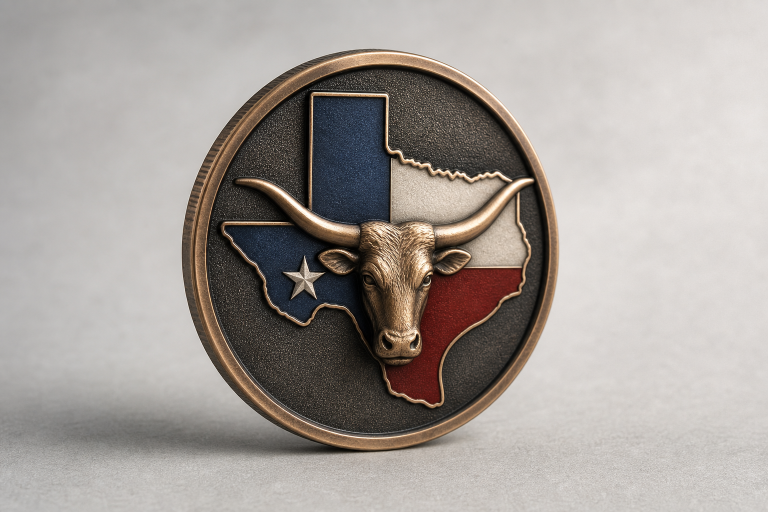
Select two or three symbols that reinforce the main idea. Useful choices include tools of the trade, animals, landmarks, flags, department insignia, significant dates, and short mottos. Texas settings offer plenty of visual inspiration, including bluebonnets, longhorns, oil derricks, pine forests, West Texas mesas, city skylines, and coastal wildlife. The official list of Texas state symbols can also help organizations identify local imagery with established meaning.
Create a short list of the group's mission, values, location, proudest moment, and future goal. Then choose one visual idea from each category and narrow the list to the elements that best support the coin's story. If a symbol does not strengthen the message, leave it out.
Plan the Front and Back
Both sides of a coin should work together. The front is usually the first impression, so reserve it for the primary emblem, team name, or central recognition phrase. The back can carry supporting details, such as an event date, department name, dedication, mission statement, recipient category, serial number, or limited-edition mark.
Useful Front-Side Elements
A crest, badge, mascot, or major visual symbol.
A short phrase such as "Presented for Excellence."
The organization or event name.
Useful Back-Side Elements
A date, anniversary year, or class designation.
A motto or concise dedication.
A secondary image that adds context to the story.
Select the Right Shape and Size
Round coins feel traditional and work well for seals, patches, and circular emblems. Shields, badges, stars, rectangles, state outlines, and fully custom shapes can better match a specific Texas group or event. A badge-shaped coin may suit public safety recognition, while a custom outline could echo a local landmark or mascot.
Size affects readability, weight, and usable design space. Choose the smallest size that still lets the main image and text remain clear. Thin lines, tiny lettering, and highly detailed illustrations can lose definition when converted from a screen design into raised and recessed metal.
Use Color and Text With Care
Limit the palette to colors that provide strong contrast with the metal finish and one another. Color can create separation between a background field and raised details, but too many competing shades can make a coin feel busy. Use one primary font and, if needed, one supporting font. Short text, such as "Service Above Self," "Class of 2026," or a team motto, is usually more effective than a long explanation.
Avoid Common Design Mistakes
Trying to tell the complete story through paragraphs of text.
Combining too many symbols, colors, and decorative borders.
Approving lettering that cannot be read at the finished size.
Overlooking a misspelled name, an incorrect date, or an inaccurate number.
Choosing colors with too little contrast.
Forgetting to leave room for raised metal and edge details.
Order only enough coins for the first presentation group.
Build a Simple Review Process
Assign one design lead to collect the required wording, artwork, and feedback. Review two or three early concepts with a small group that understands the purpose of the coin. Before approval, confirm names, dates, symbols, colors, and spelling, then inspect the final proof at its intended size. Too many reviewers can lead to conflicting requests, so identify the final decision-makers early.
Plan the Presentation
Present the coin during a ceremony, retirement, graduation, team meeting, volunteer appreciation event, or project closeout. Whenever possible, have a leader, mentor, coach, or respected peer explain the design's meaning before handing it over. A display case, pouch, card, or presentation box can add formality when the occasion calls for it.
That explanation gives the object its context. The recipient should know what the images represent, why the date matters, and what contribution the coin honors. A coin becomes a stronger keepsake when the story is shared aloud and recorded for future members.
Use a Final Design Checklist
Does the coin communicate one clear idea?
Can someone quickly understand the main symbol?
Are all names, dates, and numbers correct?
Is every word readable at the finished size?
Do the colors have enough contrast?
Does the back add useful meaning rather than duplicate the front?
Does the shape suit the group and remain practical for carrying or displaying?
Has the final proof been approved by the right people?
Is there a plan for presenting the coins with appropriate context?
Final Thoughts
A meaningful Texas challenge coin does not need to show everything. It needs to preserve the right thing: a mission completed, a standard upheld, a community that shapes the right people, approves the final proof, provides readable details, supports thoughtful review, and offers a personal presentation. A small coin can hold a story that lasts well beyond the day it is given.