Seller Financing in Real Estate: What Happens to the Note After Closing?

Seller financing in real estate ends the way every deal ends: signatures, a handshake, keys handed over. Then the buyer drives away and you are left holding a promissory note and a recorded mortgage or deed of trust. That piece of paper is now your asset, your income stream, and your problem to manage. Most sellers spend months negotiating the terms and about ten minutes thinking about what happens after. That gap is where the money leaks out, whether you plan to hold the note for twenty years or sell a mortgage note two years in when your priorities change.

Here is what actually happens to that note once the closing table clears.

The Paperwork You Walk Away With

Two documents do the work.

The promissory note is the promise to pay. It spells out the principal, the interest rate, the payment amount, the maturity date, and what happens if the buyer stops paying. It is the debt itself.

The mortgage (or deed of trust, depending on your state) is the security instrument. It ties the debt to the property and gives you the right to foreclose if the borrower defaults. It gets recorded at the county. The note does not.

That distinction matters more than people expect. The original promissory note is a negotiable instrument, closer to a cashier’s check than to a contract. Lose it and you are filing a lost note affidavit, explaining yourself to a title company, and potentially watching a sale fall apart. I have seen sellers keep the original in a kitchen drawer for six years. Put it in a fireproof box or a safe deposit box the week you close.

Who Collects the Payments Now

You do, unless you set up something better.

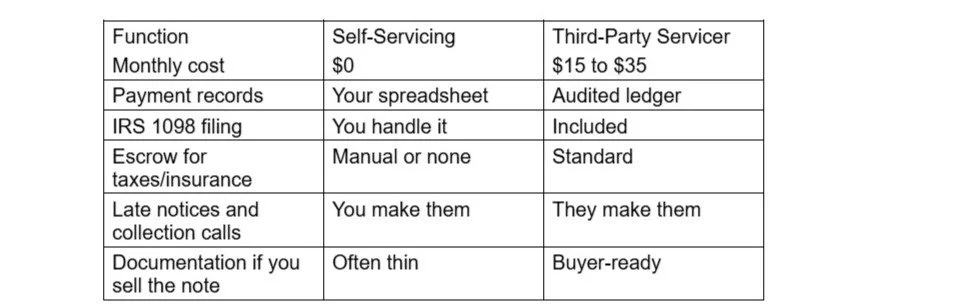
Self-servicing means the buyer sends you a check or a transfer every month and you track it. It costs nothing. It also means you are the one calculating the interest split, issuing the year-end 1098, chasing the late payment, and answering the phone when the buyer wants a payoff quote.

The alternative is a third-party loan servicer. Expect $15 to $35 per month, sometimes with a setup fee in the $75 to $200 range.

That last row is the one worth circling. Note buyers price a seller-financed note partly on payment history, and a servicer’s ledger is the cleanest proof that exists. A shoebox of deposit slips is not.

Getting Paid: Interest, Principal, and the Tax Bill

Every payment that arrives splits into two parts, and the IRS treats them very differently.

The interest portion is ordinary income. You report it in the year you receive it, taxed at your marginal rate.

The principal portion is return of basis plus gain. If you sold a rental with a $180,000 basis for $300,000 and carried the paper, roughly 40 cents of every principal dollar is taxable gain and the rest is your money coming home. This is the installment sale method under IRC Section 453, and it is one of the real reasons sellers carry financing in the first place: the capital gains bill spreads across years instead of detonating in one.

A few things that surprise people:

  • Depreciation recapture on a rental does not spread out. It is due in the year of sale, even if you received almost no cash at closing.

  • If you charge below-market interest, the IRS can impute interest at the Applicable Federal Rate and tax you on income you never collected.

  • Selling the note later can accelerate the remaining deferred gain into that tax year.

Talk to a CPA before the closing, not in April.

Seller Financed Notes and the Servicing Details Nobody Mentions

Property taxes and insurance keep running whether anyone watches them or not.

If the buyer lets the homeowner’s policy lapse and the house burns, your collateral is gone and your borrower has no reason to keep paying. If they skip property taxes for three years, the county’s lien sits ahead of yours. Both scenarios have wiped out otherwise healthy notes.

Two protections, in order of preference:

  1. Escrow the taxes and insurance through your servicer, so the money is collected monthly and paid on time by someone whose job it is.

  2. Require proof annually and get yourself named as mortgagee on the policy, so the insurer notifies you directly if coverage drops.

The second one is cheaper. The first one is the one that actually works.

What the Note Is Worth If You Want Out

Notes are assets. Assets can be sold, and there is an active secondary market for seller-financed paper.

The price is not the balance. A note with a $200,000 remaining balance does not sell for $200,000, because a buyer is purchasing a stream of future payments and needs a return on the money they hand you today. The discount is the yield.

What moves the number:

Payment history. This is the biggest single factor. Twelve months of on-time, documented payments can be worth 10 to 20 points of price compared to a brand-new note with zero history. If you are even considering a sale someday, season the note first.

Interest rate. A note at 8.5% in a 7% market prices near par. A note at 4% written in 2021 prices well below it.

Buyer credit and down payment. A borrower who put 20% down at a 690 score is a very different risk than 5% down with no score at all. Pull credit at origination and keep the report.

Lien position and property type. First position on a single-family home is the most liquid paper in this market. Second position on rural land is the least.

Document quality. Missing the original note, an unrecorded mortgage, handwritten payment terms, no title policy. Each one either cuts the price or kills the deal.

Sellers routinely leave 15 or 20 points on the table because of things that cost nothing to fix at origination. Amerinote Xchange, which has been buying residential and commercial mortgage notes since 2006, sees the same handful of preventable problems on file after file: no title insurance, no proof of insurance, no servicing records.

Full Sale or Partial Sale

You do not have to sell the whole thing.

A partial sale means you sell a defined number of payments, say the next 96 months, and the note reverts to you afterward. You get a lump sum now and keep the tail. The discount applies only to the payments sold, so the cash you receive is smaller but the total value you retain is often higher. Good fit when you need $60,000 for a specific reason and still like the monthly income.

A full sale transfers everything. Cleanest exit, biggest check, and you are done.

When the Buyer Stops Paying

It happens. Roughly one in ten seller-financed notes hits a serious delinquency at some point.

Call first. A missed payment after a job loss or a medical bill is often fixable with a two-month deferral tacked onto the back of the loan, and a modification costs a few hundred dollars where a foreclosure costs thousands and takes months.

If it is not fixable, your rights come from the security instrument and your state’s rules. Non-judicial foreclosure states can resolve in 90 to 120 days. Judicial states can run past a year. Know which one you are in before you need to know.

Non-performing notes still sell, by the way. Usually somewhere between 30% and 60% of the unpaid balance depending on the equity and the property condition. That is often better than eighteen months of legal bills and a house you did not want back.

Seller Financing After Closing: Questions Sellers Ask Most

Can I sell the note if the buyer has never missed a payment but only has six months of history? Yes, though the price improves noticeably at the twelve-month mark. If the timing is flexible, wait.

Does the buyer need to approve the sale? No. You are selling your asset. The buyer receives a notice telling them where to send payments and their terms do not change.

What if I only recorded a memorandum instead of the full mortgage? Fixable, usually, but it needs handling before a sale. Get a title company involved early.

Can I sell part of a note twice? You can structure sequential partials, but each one gets priced against what came before. Plan the whole exit at once rather than piecemeal.

Treat the Note Like the Asset It Is

The closing is the beginning, not the end. Store the original note somewhere it cannot burn. Use a servicer. Escrow the taxes and insurance. Keep the credit report, the title policy, and every payment record in one file.

Do that and you own a clean, liquid, income-producing asset you can hold for twenty years or convert to cash in about thirty days. Skip it and you own a stack of paper with a discount attached.

About the Author

Abby Shemesh is co-founder and Chief Acquisitions Officer at Amerinote Xchange, a nationwide mortgage note buying company operating since 2006 with offices in California and Florida. He has overseen more than 900 transactions and over $800 million in funded note acquisitions, working with private sellers, investors, and institutions on residential and commercial paper in both first and second position.

/
script>

5 Best Research Peptide Companies in 2026

Sourcing research-grade peptides in 2026 requires serious due diligence. The market is crowded with vendors that self-report purity, ship from opaque overseas supply chains, and obscure per-compound pricing until checkout. For a qualified laboratory researcher, that ambiguity translates directly into wasted budget and compromised experimental integrity. The biggest differentiator among modern research peptide companies is no longer whether they *claim* purity, but whether that purity is independently verifiable through a third-party Certificate of Analysis, backed by HPLC and mass spectrometry data you can inspect before committing a purchase order.

Our top pick is HEEZ Research for US laboratory researchers who need a multi-class research peptide catalog - spanning GLP-1 agonists such as Retatrutide, Semaglutide and Tirzepatide, healing peptides like BPC-157 and TB-500, GHRH peptides, peptide fragments and mitochondrial compounds - all backed by a third-party COA on every compound. It pairs that catalog depth with transparent per-compound pricing starting as low as $7 and same-day US domestic shipping, a meaningful advantage over overseas suppliers on both lead time and chain of custody. For researchers who want a streamlined, lab-tested selection without navigating a large catalog, Verified Peptides is the strongest alternative. And for those who prioritize accessible testing documentation combined with fast US delivery, Koi Peptides is the best option.

This guide ranks the five best research peptide companies in 2026 for a US-based research audience, judged against a consistent five-point framework - COA transparency, catalog breadth, purity standards, pricing transparency, and domestic shipping speed. *All products listed are intended strictly for laboratory research purposes and are not for human consumption.*

Our selection criteria

Before ranking a single vendor, we fixed the five criteria below. Every company in this list was scored against the same framework, and the ranking reflects how well each one satisfies the combination - not any one factor in isolation.

COA transparency

A Certificate of Analysis is the document that reports a compound's identity and purity, ideally from an independent lab rather than the vendor's own bench. We weighted third-party, per-batch COAs most heavily, because a single in-house purity figure is a weak signal. That view is increasingly shared across the industry - a recent analysis covered by Business Insider reported that regulators and standards bodies independently agree a single HPLC result isn't enough to establish quality.

Catalog breadth

How many peptide classes does the vendor actually stock? We rewarded true multi-class depth - GLP-1 agonists, healing peptides, GHRH peptides, fragments, blends and mitochondrial compounds - over single-focus catalogs, because a broad domestic catalog lets a lab consolidate procurement with one trusted supplier.

Purity standards

The gold-standard pair for verifying peptide purity is high-performance liquid chromatography paired with mass spectrometry. HPLC separates and quantifies purity; mass spectrometry confirms molecular identity and can flag truncated or mismatched sequences. We looked for vendors whose documentation reflects this analytical rigor rather than a bare percentage claim, and we noted where quality control extends to endotoxin testing.

Pricing transparency

Visible, per-compound pricing before you order is a proxy for how a vendor treats its researcher customers. Transparent pricing lets labs budget accurately; "contact us for a quote" gating slows procurement and tends to correlate with premium positioning.

US shipping speed

For domestic researchers, same-day or next-day fulfillment from US stock is a practical necessity. It shortens lead times, simplifies chain of custody, and sidesteps the customs delays and cold-chain uncertainty that plague overseas orders. It's worth noting that GMP certification - a manufacturing quality standard, distinct from a purity test - separates pharmaceutical-grade active pharmaceutical ingredients from research-grade peptides; none of the vendors here are positioned as GMP pharmaceutical suppliers, and that is expected for this niche.

At a glance

●       HEEZ Research - best for US labs needing a multi-class catalog with COA verification and same-day domestic shipping (pricing from $7 per compound).

●       Verified Peptides - best for lab-tested peptide buyers wanting a focused, no-frills catalog.

●       Koi Peptides - best for testing transparency combined with fast US shipping.

●       Biotech Peptides - best for researchers needing broad catalog selection including custom synthesis options.

●       American Peptides - best for COA-conscious buyers wanting a US-based specialist vendor with third-party batch verification.

The 5 best research peptide companies in 2026

The five research peptide companies below each perform strongly against the criteria above, but they win for different reasons and different labs. HEEZ Research takes the top position for the combination that matters most to the widest range of US researchers - catalog depth, COA transparency, and domestic fulfillment speed. The remaining four each earn their place by owning a specific segment. Here's how they compare in detail.

#1. HEEZ Research - Best for multi-class catalog depth with verifiable purity

HEEZ Research is the clearest all-round answer in this comparison for a US laboratory researcher who wants one domestic supplier capable of covering diverse compound needs without compromising on verification. The pitch is straightforward: a broad, multi-class research peptide catalog where every compound ships with a third-party COA, backed by transparent pricing and same-day domestic fulfillment.

What earns the top spot is the way those factors stack. You can review HEEZ Research across GLP-1 agonists, healing peptides, GHRH peptides, fragments and mitochondrial compounds and find, in each case, purity you can independently verify rather than take on faith. That "purity you can verify" posture - third-party COAs rather than self-reported figures - is the most defensible differentiator a research peptide vendor can hold in 2026, and it anchors the entire evaluation framework this article uses.

Key features

●       Third-party COA on every compound - independently verified, not self-reported

●       Multi-class catalog: GLP-1 agonists (Retatrutide, Semaglutide, Tirzepatide), BPC-157/TB-500 blends, GHRH peptides, peptide fragments, and mitochondrial compounds

●       Transparent per-compound pricing from $7

●       Same-day US domestic shipping from US stock

●       Researcher-verification gate at ordering as a compliance signal

Price range: From $7 per compound, with transparent per-compound pricing shown before ordering.

Pros

●       The broadest multi-class catalog of any domestic vendor in this comparison - one supplier can cover GLP-1s, healing peptides, and GHRH peptides

●       Every compound is backed by a third-party COA, so purity is independently verifiable

●       Same-day fulfillment from US stock eliminates the overseas shipping and customs delays that plague international orders

●       Genuinely transparent pricing accessible before you commit

●       The researcher-verification gate signals the vendor treats compliance seriously

Cons

●       A newer brand with a shorter public track record than some longer-running US vendors

●       No GMP certification cited - it is positioned as research-grade, not pharmaceutical-grade

●       Custom or highly specialised synthesis is not cited as a core offering, so labs with bespoke sequence needs may look elsewhere

●       Smaller operational scale than legacy CDMO-style suppliers

Who it's best for: US lab researchers who need a multi-class research peptide catalog with independently verified purity and same-day domestic shipping - and who value consolidating procurement with a single transparent supplier over the pedigree of a legacy name.

#2. Verified Peptides - Best for a focused, lab-tested catalog

Verified Peptides makes a deliberate virtue of doing less. Rather than sprawling across every peptide class, it runs a tighter, clearly documented catalog with a direct-to-researcher posture and accessible third-party testing documentation. For a lab that already knows precisely which compounds it needs, that focus is a feature, not a limitation.

The testing documentation is the real draw here. COA access is treated as a first-class part of the buying experience, which puts it ahead of vendors that bury or gate their analytical data. The trade-off is breadth: this is not the place to consolidate a diverse, multi-class shopping list.

Pros

●       Clear lab-testing documentation; accessible COA access is a real differentiator

●       A focused catalog makes ordering straightforward for researchers with specific, well-defined compound needs

●       Direct-to-researcher positioning with no intermediaries

●       US-based operations avoid overseas fulfillment delays

Cons

●       A narrower catalog than HEEZ Research - fewer peptide classes represented

●       Less pricing transparency at the per-compound level

●       Limited multi-class depth (fewer GLP-1 variants, blends, or mitochondrial compounds)

●       Smaller brand presence and a less community-validated track record than some competitors

Best for: Lab-tested peptide buyers who want a streamlined, well-documented selection and don't need to navigate a large multi-class catalog. Pricing sits qualitatively in the mid-range for the research peptide market.

#3. Koi Peptides - Best for testing transparency plus fast US shipping

Koi Peptides has built a reputation among US peptide buyer communities on two things it does reliably: it publishes testing documentation, and it ships quickly from domestic stock. That combination is exactly what a lot of working labs actually optimize for - verifiable purity that arrives fast - and Koi executes it without fuss.

Where it comes up short against the top pick is catalog scope. Koi runs a niche, focused selection rather than a broad multi-class one, so a lab with diverse compound requirements will likely need a second supplier to complete coverage. As a single-source solution it's limited; as a dependable, well-tested vendor for a defined set of compounds, it's a strong option.

Pros

●       Solid testing documentation supports its purity claims

●       Fast domestic US shipping that competes with top-tier vendors

●       An active, currently operating brand with real community recognition

●       A straightforward, low-friction ordering process

Cons

●       Catalog depth and compound variety are more limited than HEEZ Research

●       Fewer peptide classes - not a multi-class solution for labs with diverse needs

●       Less pricing transparency than the #1 pick

●       The smaller catalog often means pairing it with a secondary supplier for full coverage

Best for: Researchers whose compound needs are covered by a narrower catalog and who prioritize testing documentation and shipping speed above catalog breadth. Pricing is not publicly confirmed and is best treated as competitive-to-market until verified.

#4. Biotech Peptides - Best for broad selection with custom synthesis

Biotech Peptides earns its slot on a capability the others in this list largely don't advertise: custom synthesis. For a lab working with non-standard sequences or specialized requirements that fall outside any stocked catalog, that ability is a clear differentiator. Layered on top of a mid-tier catalog with respectable compound variety, it makes Biotech Peptides a credible choice for researchers whose needs run past the off-the-shelf.

That capability comes with real trade-offs. The COA access experience is less streamlined than at HEEZ Research or Verified Peptides, pricing for custom work requires direct inquiry rather than a visible per-compound rate, and custom synthesis lead times can stretch turnaround well beyond same-day. This is a specialist tool, not a fast-fulfillment domestic vendor.

Pros

●       Custom synthesis capability sets it apart for labs with non-standard compound needs

●       A broader catalog than more narrowly focused vendors

●       Credible mid-tier positioning for researchers needing compound variety

●       Maintains a research-grade focus across the catalog

Cons

●       COA access is less streamlined than the top two picks

●       Less pricing transparency - custom synthesis pricing requires direct inquiry

●       Not a same-day domestic fulfillment specialist

●       Custom synthesis lead times can extend turnaround significantly

Best for: Researchers who need broad catalog selection and, above all, custom synthesis options - and who can accept longer lead times and less transparent pricing in exchange for that flexibility. Pricing is variable depending on compound and synthesis requirements.

#5. American Peptides - Best for a COA-conscious US specialist

American Peptides rounds out the list as an established US-based specialist with a strong commitment to third-party batch verification. For a COA-conscious buyer who wants a vendor with a track record and reliable domestic fulfillment, its verification quality is a real strength - on that single axis, it stands with the best here.

The gap between American Peptides and the top pick isn't verification; it's breadth and accessibility. The catalog is more limited, with fewer peptide classes than HEEZ Research's multi-class offering, and pricing entry points sit higher - premium-positioned for the market. Budget-conscious labs and those needing diverse GLP-1 variants, GHRH peptides or blends may find themselves supplementing with a second supplier.

Pros

●       True third-party batch verification - COA transparency is a real strength

●       US-based operations support domestic fulfillment reliability

●       An established vendor with a track record in the research peptide space

●       A focused catalog that suits researchers with specific, well-defined needs

Cons

●       More limited catalog depth - fewer peptide classes than HEEZ Research's multi-class range

●       Higher pricing entry points, making it less accessible for budget-conscious labs

●       Less multi-class depth (fewer GLP-1 variants, GHRH peptides, and blends than #1)

●       Narrower compound variety may require a second supplier for full coverage

Best for: COA-conscious buyers who want an established US-based specialist and value verification quality over catalog breadth or the lowest price. Pricing is premium-positioned relative to the top pick.

Frequently asked questions

What should I look for when choosing a research peptide supplier?

Prioritize verifiable purity above all else. The strongest signal is a third-party Certificate of Analysis available per batch, ideally backed by both HPLC and mass spectrometry data. Beyond that, weigh catalog breadth against how you actually procure - a multi-class catalog lets you consolidate suppliers - and check for transparent per-compound pricing and domestic US shipping speed. Vendors that gate their COAs or hide pricing behind quote requests warrant more scrutiny, not less.

What is a COA, and why does it matter for research peptides?

A Certificate of Analysis is the document reporting a compound's identity and purity, usually from analytical testing such as HPLC and mass spectrometry. It matters because purity directly affects experimental validity - a truncated or contaminated peptide can quietly ruin results. A third-party COA, produced by an independent lab rather than the vendor's own bench, carries far more weight than a self-reported figure. As industry analysis has increasingly noted, a single purity result is not sufficient on its own; robust quality control looks at identity and purity together, and ideally at endotoxin levels as well.

How do domestic US suppliers compare to overseas sources?

Domestic suppliers generally win on lead time and chain of custody. Same-day or next-day fulfillment from US stock avoids the customs delays, extended transit and cold-chain uncertainty that come with international orders. Overseas sources can occasionally undercut on price, but for a working lab the reliability, faster turnaround and clearer documentation of a domestic vendor usually outweigh a marginal saving - which is a large part of why domestic fulfillment features so heavily in this ranking.

Are research peptides legal to purchase in the United States?

Research peptides sold strictly for laboratory research use occupy a distinct regulatory space from pharmaceutical-grade active pharmaceutical ingredients. The FDA regulates drugs intended for human use and compounds dispensed through compounding pharmacies, whereas research chemicals sold for in-vitro laboratory work are not marketed or sold for human consumption. Reputable vendors reinforce this with research-use labeling and, in some cases, a researcher-verification step. This is a general overview, not legal advice - confirm your own institution's compliance requirements before purchasing.

Which of these companies carry GLP-1 agonists?

HEEZ Research carries the broadest GLP-1 range in this comparison, including Retatrutide, Semaglutide and Tirzepatide - the last of which acts on both the GLP-1 and GIP receptors. Because HEEZ Research runs a multi-class catalog, a lab can source GLP-1 agonists alongside healing peptides and GHRH peptides from a single supplier. The other vendors carry narrower selections; if diverse GLP-1 variants are central to your work, catalog breadth should weigh heavily in your choice, and you should verify current stock and COA availability before ordering.

The verdict, by scenario

If you're a US lab that wants one domestic supplier covering GLP-1 agonists, healing peptides, GHRH peptides and mitochondrial compounds - with a third-party COA on every compound, pricing from $7, and same-day shipping - HEEZ Research is the clear winner and our pick for the best of the research peptide companies reviewed here. It's the strongest combination of catalog depth, verifiable purity and domestic fulfillment on this list, with the honest caveats that it's a newer brand and isn't positioned as a GMP pharmaceutical supplier.

If your compound needs are narrow and well-defined and you'd rather not navigate a large catalog, Verified Peptides is the better-fitting choice for its focused, lab-tested selection. If your priorities are accessible testing documentation and fast US delivery for a niche set of compounds, Koi Peptides is the option to shortlist. Labs requiring non-standard sequences should look to Biotech Peptides for its custom synthesis capability, accepting the longer lead times that come with it. And COA-conscious buyers who prize an established US specialist over breadth and price will be well served by American Peptides.

Whichever way your scenario points, apply the same final check before you place an order: confirm that a current, third-party COA is available for the specific batch you're buying. That one step separates the top research peptide companies from the rest - and it's the fastest way to protect your budget and your results.
/
script>

What Makes a Crypto Casino Game Library Actually Good

Raw game count is almost meaningless as a quality signal. Some platforms list thousands of titles and still feel hollow, the same three mechanics recycled across generic slots, no variety in table games, and no way to confirm whether any result was fair. Players who've been around long enough learn this quickly.

What matters is the structure underneath the number. Here are five standards that separate a genuinely good crypto casino game library from one that just looks impressive on a landing page.

The Library Has Provably Fair Originals, Not Just Third-Party Slots

One of the clearest quality signals when you choose an online casino accepting Bitcoin is whether the platform builds and hosts its own provably fair in-house titles. These aren't just cosmetically different from regular casino games - they use cryptographic seed verification so you can independently confirm any round's outcome. You don't have to take the casino's word for it; you can check the math yourself. Platforms that invest in developing their own Originals - Crash, Dice, Plinko, Mines, Limbo, and similar formats show a level of technical commitment that third-party resellers simply can't match. A library bundling 74 or more provably fair Originals alongside its third-party catalog gives you something most slot-aggregation sites don't: a genuinely distinct game type where the verification mechanism is public and auditable. If a platform's entire catalog comes from one or two content aggregators with no in-house development, that's reason to pause before you deposit.

Provider Diversity Actually Changes What You Play

Third-party slots make up the bulk of most crypto casino libraries, and studio count matters far more than raw game numbers. A library drawing from 50 to 80 distinct providers - spanning Pragmatic Play, Evolution, NetEnt, BGaming, Microgaming, Play'n GO, and comparable studios - means genuinely different mechanics, volatility profiles, and visual styles across the catalog. A library from three or four providers, no matter how many individual titles it contains, just recycles the same engine logic with different skins. You'll notice fast: bonus features feel identical, the math models repeat, and novelty wears off inside a week. Provider diversity also affects live dealer options, since Evolution and its peers build live game shows and interactive dealer tables that play quite differently from standard blackjack or roulette, and not every platform carries them. Before judging a library's depth, check the studio list rather than the headline game count.

The Game Count Should Be Honest and Consistent

A platform that claims "10,000+ slot games" on one page and "1,000+ slots" on another has an information quality problem. That inconsistency isn't cosmetic. It suggests the catalog is either dynamically pulled from aggregator APIs - so the actual available set shifts depending on your region, device, or payment method - or the platform is inflating the number for marketing purposes. Both scenarios affect you directly: games you see advertised may not load in your jurisdiction, or the library your friend describes might look different from what you see after depositing. A trustworthy library uses a verified, stable range rather than a suspiciously round number. Third-party review trackers often get closer to the real count than the platform's own marketing copy. Cross-referencing two or three independent sources before committing to a platform is a practical way to calibrate what you're actually getting access to.

The Sportsbook and Casino Share a Single Wallet

For players who bet across multiple formats, wallet architecture matters significantly. A platform where the casino library and sportsbook share one balance removes a friction point that costs players real time and, occasionally, real money when cross-product transfers carry fees or temporarily lock funds. Going from a slot session to a live football market without shifting funds between separate accounts is a structural convenience that compounds over time, particularly if you play in-play and need to act fast. Sportsbook quality still has to stand on its own: coverage across 30 to 60 or more sports, competitive margins on major markets, live streaming on select events, and Bet Builder functionality are reasonable baseline expectations. But even a strong sportsbook loses value when it sits behind a transfer wall that breaks your session. Game library quality, in this sense, extends well beyond the casino floor.

Responsible Gambling Tools Are Part of the Library's Infrastructure

A game library is only as good as the environment built around it. Platforms offering deposit limits, wager limits, session duration controls, and self-exclusion periods - with minimum lock periods of six months or longer - treat those tools as a standard part of the product rather than a compliance afterthought. This matters to every player, not just those experiencing problems: knowing the controls exist and function correctly tells you something about how the platform is engineered overall. An operator that omits or buries responsible gambling tools is more likely to cut corners elsewhere, too. Check whether those tools are accessible before you need them, and whether self-exclusion requires contacting support or sits directly in account settings. How easy they are to find is itself a signal about how seriously the platform treats the player experience beyond the deposit screen.

Conclusion

A good crypto casino game library balances verified fairness, genuine provider variety, honest and consistent game counts, integrated wallet architecture, and responsible gambling infrastructure that actually functions. Raw numbers on a homepage don't tell you any of that. Checking each of these five standards before you deposit takes fifteen minutes and tends to save considerably more frustration later. This is general educational information. For decisions involving large amounts of money, consult a qualified financial professional familiar with your situation.

/
script>

What It Takes to Keep a Super Clone Rolex Running in New York

Most writing about copied watches stops at the checkout page. It explains the tiers, argues about the prices, and leaves the reader holding a parcel. This is about the years after that. A super clone is a mechanical object, and mechanical watches in New York need three things. Someone to service them. An owner who keeps them dry. A realistic idea of what wear looks like.

Who will touch it

Start with who will not. A Rolex service center will not open a copy, and a boutique will not discuss one.

Most independent watchmakers in the city will not either, for two reasons. One is reputational. The other is practical. A cloned caliber and the genuine movement it copies have almost no parts in common, so a shop that knows the real 3235 inside out is still looking at a stranger. The screws, jewels, mainspring and date mechanism will not swap with anything on the bench.

What exists instead is a small number of independents who service Asian-made clone calibers as a specialty and do not advertise it. They sit in the Diamond District and are scattered through Brooklyn and Queens. The sensible move is to find one before the watch needs it. Ask what a clean and regulate costs on a cloned three-hander, and keep the name.

Expect that service to run a couple of hundred dollars. On a thousand-dollar watch that is a meaningful fraction, and it is the ownership fact people skip.

What actually wears out

The reassuring news from those benches is that whole movements rarely fail. The parts that come back are small.

Date wheels are first. The cloned calibers jump the date at midnight like the original, and the parts doing the jumping are the ones under strain. A date that starts creeping instead of snapping, or sticks between two numbers, is a wheel or a spring, not a dead watch.

Clasp springs are second. The sliding extension on a dive-model clasp gets worked every hot day, and the little spring inside it is the cheapest part on the watch. When the clasp stops locking with a clean click, that is the culprit.

Crown tubes are third, and this one is the owner's fault more often than the factory's. The crown is meant to be screwed fully home after every setting. Left half open, it wears the thread and lets moisture in. New Yorkers who set the date on the subway and forget to screw down are the repeat customers.

Movements themselves mostly keep going. A clone regulated to within thirty seconds a day will drift wider over a year or two and want a regulate, a short job. Stories of clones dying in a month belong to the bottom of the market. Those are the two-hundred-dollar watches with a movement nobody names, and they get thrown out rather than fixed.

Water, the honest paragraph

The depth figure printed on a copied dial describes the original, not the copy. Nobody pressure-tests these at the factory, and the gaskets are not the ones Rolex fits. With the crown screwed down, a good copy handles rain, handwashing and a run in August. Under water, with the crown pressed or the pushers worked, every one of them is a candidate for a flooded movement.

The practical rule is simple. Treat it as a watch you can get rained on and not one you can swim in, and it will last.

Where the tier decision comes back to bite

Every service conversation loops back to what was bought in the first place. The tier matters more after purchase than before it.

A four-to-six-hundred-dollar copy runs a generic workhorse automatic. Here is the twist. That movement is easier to service in New York than a cloned Rolex caliber, because half the independents in the city already know it. It will never behave like a Rolex. It will be cheap to keep alive.

A thousand-plus super clone runs the cloned caliber that behaves like the original, and it needs the specialist. Buyers who care about the crown feel, the date snap and a working chronograph accept that trade knowingly.

Sellers at the honest end make the trade visible up front. Reading how one seller lays out its tiers is the cheapest hour of research in this hobby. The movement is named for each tier and the warranty is stated beside it. SwissClone, the shop behind that page, backs the top tier for two years. That tells you how the sellers themselves rate the two levels.

A year of ownership, priced

For a super clone worn daily in the city, a realistic year looks like this. Nothing in the first six months. A clasp spring or a date-wheel tweak somewhere in the first two years, a hundred dollars or so at a specialist. A full clean and regulate at the three-year mark, a couple of hundred. A bracelet adjustment now and then, a few dollars at any Diamond District counter.

Against that, set the two things owners get wrong. A flooded movement from a swim is a replacement. A crown tube worn from never being screwed down is a small repair that turns into a big one if it is ignored.

The short version

A super clone will hold up in New York if its owner treats it like the mechanical watch it is. Find the watchmaker first. Screw the crown down every time. Keep it out of the pool. Budget a few hundred dollars over three years and expect small parts, not dead movements.

None of it appears in the listing photos. It is the difference between a copy that runs for a decade and one that becomes a drawer ornament by spring.

/
script>