Seller Financing in Real Estate: What Happens to the Note After Closing?
Seller financing in real estate ends the way every deal ends: signatures, a handshake, keys handed over. Then the buyer drives away and you are left holding a promissory note and a recorded mortgage or deed of trust. That piece of paper is now your asset, your income stream, and your problem to manage. Most sellers spend months negotiating the terms and about ten minutes thinking about what happens after. That gap is where the money leaks out, whether you plan to hold the note for twenty years or sell a mortgage note two years in when your priorities change.
Here is what actually happens to that note once the closing table clears.
The Paperwork You Walk Away With
Two documents do the work.
The promissory note is the promise to pay. It spells out the principal, the interest rate, the payment amount, the maturity date, and what happens if the buyer stops paying. It is the debt itself.
The mortgage (or deed of trust, depending on your state) is the security instrument. It ties the debt to the property and gives you the right to foreclose if the borrower defaults. It gets recorded at the county. The note does not.
That distinction matters more than people expect. The original promissory note is a negotiable instrument, closer to a cashier’s check than to a contract. Lose it and you are filing a lost note affidavit, explaining yourself to a title company, and potentially watching a sale fall apart. I have seen sellers keep the original in a kitchen drawer for six years. Put it in a fireproof box or a safe deposit box the week you close.
Who Collects the Payments Now
You do, unless you set up something better.
Self-servicing means the buyer sends you a check or a transfer every month and you track it. It costs nothing. It also means you are the one calculating the interest split, issuing the year-end 1098, chasing the late payment, and answering the phone when the buyer wants a payoff quote.
The alternative is a third-party loan servicer. Expect $15 to $35 per month, sometimes with a setup fee in the $75 to $200 range.
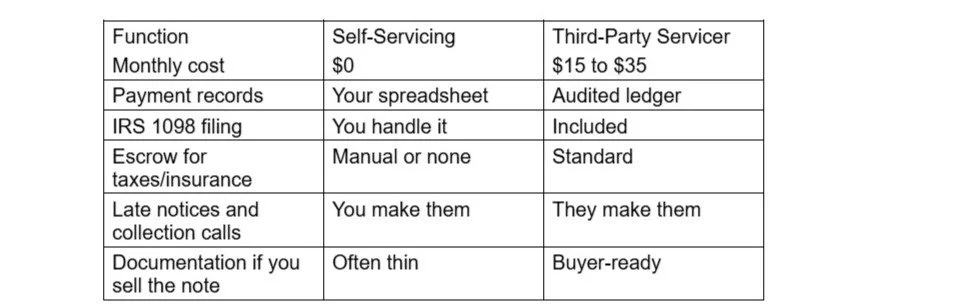
That last row is the one worth circling. Note buyers price a seller-financed note partly on payment history, and a servicer’s ledger is the cleanest proof that exists. A shoebox of deposit slips is not.
Getting Paid: Interest, Principal, and the Tax Bill
Every payment that arrives splits into two parts, and the IRS treats them very differently.
The interest portion is ordinary income. You report it in the year you receive it, taxed at your marginal rate.
The principal portion is return of basis plus gain. If you sold a rental with a $180,000 basis for $300,000 and carried the paper, roughly 40 cents of every principal dollar is taxable gain and the rest is your money coming home. This is the installment sale method under IRC Section 453, and it is one of the real reasons sellers carry financing in the first place: the capital gains bill spreads across years instead of detonating in one.
A few things that surprise people:
Depreciation recapture on a rental does not spread out. It is due in the year of sale, even if you received almost no cash at closing.
If you charge below-market interest, the IRS can impute interest at the Applicable Federal Rate and tax you on income you never collected.
Selling the note later can accelerate the remaining deferred gain into that tax year.
Talk to a CPA before the closing, not in April.
Seller Financed Notes and the Servicing Details Nobody Mentions
Property taxes and insurance keep running whether anyone watches them or not.
If the buyer lets the homeowner’s policy lapse and the house burns, your collateral is gone and your borrower has no reason to keep paying. If they skip property taxes for three years, the county’s lien sits ahead of yours. Both scenarios have wiped out otherwise healthy notes.
Two protections, in order of preference:
Escrow the taxes and insurance through your servicer, so the money is collected monthly and paid on time by someone whose job it is.
Require proof annually and get yourself named as mortgagee on the policy, so the insurer notifies you directly if coverage drops.
The second one is cheaper. The first one is the one that actually works.
What the Note Is Worth If You Want Out
Notes are assets. Assets can be sold, and there is an active secondary market for seller-financed paper.
The price is not the balance. A note with a $200,000 remaining balance does not sell for $200,000, because a buyer is purchasing a stream of future payments and needs a return on the money they hand you today. The discount is the yield.
What moves the number:
Payment history. This is the biggest single factor. Twelve months of on-time, documented payments can be worth 10 to 20 points of price compared to a brand-new note with zero history. If you are even considering a sale someday, season the note first.
Interest rate. A note at 8.5% in a 7% market prices near par. A note at 4% written in 2021 prices well below it.
Buyer credit and down payment. A borrower who put 20% down at a 690 score is a very different risk than 5% down with no score at all. Pull credit at origination and keep the report.
Lien position and property type. First position on a single-family home is the most liquid paper in this market. Second position on rural land is the least.
Document quality. Missing the original note, an unrecorded mortgage, handwritten payment terms, no title policy. Each one either cuts the price or kills the deal.
Sellers routinely leave 15 or 20 points on the table because of things that cost nothing to fix at origination. Amerinote Xchange, which has been buying residential and commercial mortgage notes since 2006, sees the same handful of preventable problems on file after file: no title insurance, no proof of insurance, no servicing records.
Full Sale or Partial Sale
You do not have to sell the whole thing.
A partial sale means you sell a defined number of payments, say the next 96 months, and the note reverts to you afterward. You get a lump sum now and keep the tail. The discount applies only to the payments sold, so the cash you receive is smaller but the total value you retain is often higher. Good fit when you need $60,000 for a specific reason and still like the monthly income.
A full sale transfers everything. Cleanest exit, biggest check, and you are done.
When the Buyer Stops Paying
It happens. Roughly one in ten seller-financed notes hits a serious delinquency at some point.
Call first. A missed payment after a job loss or a medical bill is often fixable with a two-month deferral tacked onto the back of the loan, and a modification costs a few hundred dollars where a foreclosure costs thousands and takes months.
If it is not fixable, your rights come from the security instrument and your state’s rules. Non-judicial foreclosure states can resolve in 90 to 120 days. Judicial states can run past a year. Know which one you are in before you need to know.
Non-performing notes still sell, by the way. Usually somewhere between 30% and 60% of the unpaid balance depending on the equity and the property condition. That is often better than eighteen months of legal bills and a house you did not want back.
Seller Financing After Closing: Questions Sellers Ask Most
Can I sell the note if the buyer has never missed a payment but only has six months of history? Yes, though the price improves noticeably at the twelve-month mark. If the timing is flexible, wait.
Does the buyer need to approve the sale? No. You are selling your asset. The buyer receives a notice telling them where to send payments and their terms do not change.
What if I only recorded a memorandum instead of the full mortgage? Fixable, usually, but it needs handling before a sale. Get a title company involved early.
Can I sell part of a note twice? You can structure sequential partials, but each one gets priced against what came before. Plan the whole exit at once rather than piecemeal.
Treat the Note Like the Asset It Is
The closing is the beginning, not the end. Store the original note somewhere it cannot burn. Use a servicer. Escrow the taxes and insurance. Keep the credit report, the title policy, and every payment record in one file.
Do that and you own a clean, liquid, income-producing asset you can hold for twenty years or convert to cash in about thirty days. Skip it and you own a stack of paper with a discount attached.
About the Author
Abby Shemesh is co-founder and Chief Acquisitions Officer at Amerinote Xchange, a nationwide mortgage note buying company operating since 2006 with offices in California and Florida. He has overseen more than 900 transactions and over $800 million in funded note acquisitions, working with private sellers, investors, and institutions on residential and commercial paper in both first and second position.