
Moving to Calgary in 2026: What Home Buyers Should Know Before Choosing Where to Live
Moving to Calgary involves more than finding a home within your budget. Where you live can affect your commute, housing options, access to schools and parks, transportation costs, and how much space you can realistically afford.
That makes choosing an area one of the most important decisions for anyone relocating to the city.
Calgary offers everything from downtown condos and walkable inner-city neighborhoods to newer suburban communities with larger homes and access to extensive pathway and park networks. The right choice depends less on finding a universally "best" neighborhood and more on matching location with your priorities.
Here is what home buyers should consider before deciding where to live in Calgary in 2026.
Start With Your Housing Budget, Not a Neighborhood Name
It is easy to begin a Calgary home search with a list of popular neighborhoods. A more practical approach is to establish what type of property your budget can realistically buy.
Housing costs vary significantly by location and property type. A buyer considering an apartment condo may have access to central areas that would be difficult to enter with the same budget when searching for a detached home.
Property type also affects ongoing ownership costs.
Condo buyers need to account for monthly fees and review the financial health of the condominium corporation. Detached-home buyers take on more direct responsibility for maintenance, utilities, exterior repairs, and the property itself.
Before choosing an area, compare the total cost of ownership, not only the listing price.
Think About Where You Will Actually Travel Each Week
Calgary covers a large geographic area, so two homes with similar prices can create very different daily routines.
Someone working downtown may prioritize CTrain access or a shorter commute. A frequent business traveler might place more value on airport access. Families may care more about schools and everyday amenities than proximity to the central business district.
Remote and hybrid workers have another calculation to make. If commuting only once or twice a week, living farther from downtown may be a reasonable trade-off for additional space.
Before buying, estimate travel times for the places you will visit regularly rather than judging a location only by its distance from downtown.
Understand Calgary's Different Housing Markets
Calgary should not be treated as one uniform real estate market.
A downtown condo, inner-city infill, established suburban home, and newly constructed property on the city's edge can respond differently to changes in inventory and buyer demand.
This matters when comparing value.
For example, additional condo inventory may create more choice in one segment while detached homes in a particular area remain relatively competitive. Looking only at a citywide average can hide those differences.
People comparing options for the best Realtor in Calgary can consider whether an agent has experience with both the property type and area involved. JD Real Estate's Jesse Davies has more than 15 years of Calgary real estate experience and works across condos, residential homes, new construction, investment properties, and relocation.
Decide How Much Walkability Matters
Calgary is often associated with driving, but the experience varies considerably depending on where you live.
Inner-city areas can provide easier access to restaurants, shops, entertainment, pathways, and public transportation. Downtown-adjacent neighborhoods may also allow some residents to reduce their reliance on a car.
The trade-off can be space and price.
Buyers moving farther from the core may find larger homes, newer construction, and different community amenities, but everyday errands may require more driving.
Neither option is inherently better. The important question is how often you realistically want to drive for work, groceries, recreation, and social activities.
Families Should Research Schools Before Buying
For families with children, school access can influence where a home search begins.
However, being geographically close to a school does not necessarily mean a property falls within its designated attendance area.
School boundaries and program availability can change, so buyers should verify current information directly with the relevant school board before purchasing a home based on school access.
Other family considerations may include childcare, playgrounds, recreation facilities, libraries, healthcare access, and the amount of outdoor space available nearby.
A neighborhood that works well for a single professional may therefore be less practical for a household with school-age children, even at a similar housing price.
Access to Parks Can Change the Living Experience
Calgary has an extensive network of parks, river pathways, and recreational spaces, but access differs by location.
For some buyers, being close to the Bow or Elbow River pathways can make cycling and walking part of everyday life. Others may prioritize larger parks or suburban communities with local trails and recreation facilities.
Park access should still be evaluated alongside other property considerations.
Homes close to major green spaces may be desirable, but buyers should also consider transportation, property characteristics, surrounding development, and, where relevant, flood-related information.
The best location is usually the one that balances outdoor access with the rest of a household's daily needs.
New Construction and Established Neighborhoods Offer Different Trade-Offs
People relocating to Calgary may also need to decide between a newly built community and an established neighborhood.
Newer developments can offer modern layouts, energy-efficient features, new infrastructure, and a greater selection of recently constructed homes. However, some amenities, transportation connections, landscaping, and surrounding development may still be evolving.
Established areas generally provide a clearer picture of what the neighborhood already offers. Buyers can see mature landscaping, existing schools, transportation routes, retail, and the surrounding housing stock.
Older properties may require more maintenance or renovations, so the purchase price should be considered alongside potential improvement costs.
Calgary Areas by Buyer Priority
Rather than ranking neighborhoods from best to worst, it can be more useful to start with the type of lifestyle you want.
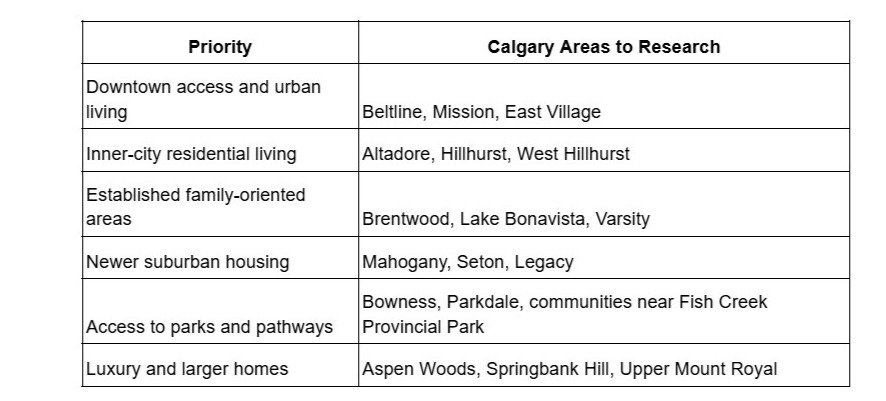
These are starting points rather than definitive recommendations. Housing availability, prices, school access, and individual preferences vary within each area.
What Should You Research Before Moving to Calgary?
Before narrowing your property search, compare:
Home prices within your preferred property type
Property taxes and estimated utilities
Condo fees where applicable
Commute and transportation options
School boundaries
Parks and recreation
Grocery stores and everyday services
Current listings and recent comparable sales
Planned construction or development nearby
Visiting an area at different times of day can also reveal things that property listings cannot, including traffic, noise, parking, and how active the surrounding streets are.
Is Calgary a Good Place to Relocate in 2026?
Calgary can appeal to buyers looking for a major Canadian city with a wide range of housing types, access to outdoor recreation, and neighborhoods ranging from dense urban districts to newer suburban developments.
But whether it is the right move depends on the individual household.
A professional relocating for work, a family looking for more space, and an investor purchasing a condo may all arrive in Calgary with completely different definitions of value.
The most useful approach is therefore to establish your budget, property type, commute, and lifestyle priorities first and choose an area second.
Frequently Asked Questions
What should I know before moving to Calgary?
Consider housing costs, commute times, transportation, schools, property type, neighborhood amenities, and ongoing ownership expenses. Calgary is geographically large, so location can significantly affect daily life.
What are the best areas to live in Calgary?
There is no single best area. Beltline and Mission may appeal to buyers prioritizing urban living, while communities such as Brentwood or Lake Bonavista offer a different residential environment. Newer areas such as Mahogany and Seton provide another option for buyers considering suburban housing.
Is it better to live downtown or in the Calgary suburbs?
It depends on your priorities. Central areas can provide greater walkability and shorter downtown commutes, while suburban areas may provide different housing options and more space. Buyers should compare the trade-offs rather than assuming one is universally better.
What should families consider when moving to Calgary?
Families may want to research school boundaries, childcare, parks, recreation facilities, commute times, home size, and access to everyday services before choosing a neighborhood.
Should I rent before buying after moving to Calgary?
Renting first can give newcomers time to learn the city before committing to an area. Buying may make more sense for people who already understand their long-term location, housing requirements, and budget.
Final Thoughts
Choosing where to live in Calgary is ultimately a matching exercise.
Instead of starting with a list of the city's most popular neighborhoods, buyers can first define what matters most: budget, housing type, commute, schools, outdoor access, or proximity to downtown.
From there, comparing neighborhoods and properties becomes much more useful.
For anyone relocating in 2026, understanding these trade-offs before beginning the property search can make it easier to choose a Calgary home that fits both the budget and the way they actually plan to live.
About the Author
Mika Kankaras is a B2B SaaS writer with over six years of experience covering marketing automation, AI workflows, customer experience software, and business technology. She specializes in testing and evaluating software and translating complex product features into clear, practical insights for business users.
LinkedIn: Mika Kankaras on LinkedIn