Moving to Charlotte, NC? Here's What Newcomers Actually Need to Know

Charlotte has quietly become one of the most talked about cities in the country. It's not just the skyline that keeps growing. It's the people. Every week, new families, young professionals, and retirees pack up their old lives and head south to the Queen City. But moving here isn't as simple as picking a neighborhood off a map and calling a moving truck. There's a lot the glossy relocation guides skip over. So, let's talk about what really matters when you're planning a move to Charlotte.

Why Everyone's Talking About Charlotte

First, it helps to understand why this city is booming. Charlotte has grown from a regional banking hub into a magnet for tech companies, healthcare firms, and remote workers who want more space for less money. That growth brings opportunity, but it also brings competition for homes. As one of the renowned Charlotte real estate teams, Empower Home Team, says, "Our city is also gaining traction as a growing tech giant. As a result, real estate is flourishing as companies set up shop alongside well-established Charlotte-based businesses such as Amazon, IBM, Bank of America, and more!" 

That single claim explains a lot about why Charlotte's housing market moves fast. Homes here don't always sit around waiting for the right buyer. If you're serious about relocating, you need a plan before you start touring open houses, not after.

That means getting your financing sorted, knowing which neighborhoods fit your budget, and deciding how much commute time you can realistically handle. A little preparation can help you move quickly when the right property appears, instead of scrambling while other buyers are already making offers.

The Part Nobody Warns You About

Here's the part most relocation checklists leave out. Charlotte is spread out. Really spread out. Neighborhoods that look close together on a map can mean a thirty minute commute during rush hour. So, before you fall in love with a house, drive the route to work at the actual time you'd be driving it. Do this on a weekday, not a lazy Sunday afternoon.

Property taxes are another surprise for newcomers. Mecklenburg County rates are reasonable compared to many Northeastern cities, but they still catch people off guard when the first bill arrives. Meanwhile, HOA fees in newer developments can add up fast, especially in communities with pools, gyms, or gated entrances. Always ask for a full breakdown before you sign anything.

Interestingly, these same blind spots trip up buyers moving into almost any booming market, not just Charlotte. Anyone relocating tends to underestimate the little costs that don't show up in a listing price. It's worth reading how buyers handle similar surprises elsewhere, because the lessons often carry over no matter which city you're headed to.

You should also consider insurance costs, utility bills, commuting expenses, and expected maintenance before deciding what you can comfortably afford. A home that fits your mortgage budget may still stretch your finances once these recurring costs are added.

Finding Your Charlotte Corner

Charlotte isn't one single vibe. Uptown offers high rise living and walkability. South End has become the go to spot for young professionals who want restaurants and breweries within walking distance. NoDa keeps its artsy, laid back charm with murals and live music venues. Meanwhile, suburbs like Fort Mill and Waxhaw give families more room to breathe, along with newer schools and quieter streets.

Take time to actually visit these areas before deciding. Grab coffee in the morning and dinner in the evening. Neighborhoods feel different depending on the hour, and that difference matters more than most people expect.

Also pay attention to traffic patterns, parking, grocery stores, parks, and how long basic errands take. A neighborhood can look perfect during a weekend tour but feel very different during a busy weekday. Talk to residents when you can, and visit more than once before making a final decision.

Why the Rush Might Not Slow Down Soon

Charlotte recently became the fastest-growing city in the country, adding more new residents last year than any other major U.S. city. That kind of growth changes everything, from traffic patterns to grocery store lines to how quickly homes sell. It also means prices likely won't cool off overnight. If you've been sitting on the fence about moving, waiting too long could mean paying more later.

That said, growth isn't automatically a bad thing. It brings better job options, more restaurants, and improved infrastructure over time. The trick is going in with realistic expectations instead of assumptions borrowed from wherever you're moving from.

A Few Final Suggestions

Before you commit to a move, connect with a local agent who actually lives and works in the area you're considering. Ask blunt questions about flood zones, school ratings, and future development plans nearby. Don't be afraid to walk away from a home that feels rushed. Charlotte is growing fast, but that doesn't mean you should skip your due diligence.

Moving to a new city is stressful enough without added surprises. With a little homework and the right local guidance, your move to Charlotte can feel exciting instead of overwhelming.

/
script>

Is It Still Worth Buying a Home in a High Interest Rate Market?

“Interest rates have climbed a lot over the past few years, and that has left many buyers wondering if now is really the right time to purchase a home. It's a fair question, and the answer depends on more than just the rate on your mortgage,” says the Sun Realty Sales Team, a real estate and vacation rental company serving North Carolina’s Outer Banks.

Higher rates mean bigger monthly payments, which can feel discouraging. But home prices, your personal finances, and long term plans all play a role too. Let's break down what actually matters here.

What High Interest Rates Really Mean for Buyers

When rates rise, your monthly mortgage payment goes up even if the home price stays the same. A buyer purchasing a $300,000 home today will likely pay hundreds more each month than someone who bought the same home a few years ago.

This shift has pushed many first time buyers and young couples to pause their search. Some are choosing to rent longer while they save more or wait for rates to settle. Others are adjusting their budget and looking at smaller homes instead.

Higher borrowing costs also affect how much house you can actually afford. Lenders look closely at your income compared to your monthly payment, so a smaller loan amount often becomes the only realistic option for many families right now.

Home Prices Still Matter

Interest rates get most of the attention, but the price of the home itself plays a huge role in your long term costs. In many markets, prices have cooled slightly because fewer buyers are competing for the same properties.

This means you might have more room to negotiate than buyers did a couple of years ago. Sellers who need to move are often more willing to lower their asking price or cover part of your closing costs.

A lower purchase price can offset some of the sting from a higher rate. It's worth comparing the total cost of ownership, not just focusing on the interest rate alone when you're deciding whether a deal makes sense.

The Case for Buying Now Despite Higher Rates

Some financial advisors argue that waiting for rates to drop could backfire. If home prices rise again once rates fall, buyers may end up paying more overall, even with a lower monthly payment.

There's also the reality that renting doesn't build equity. Every payment you make on a mortgage puts money toward something you own, while rent payments go straight to a landlord with nothing coming back to you later.

Homeownership also brings a sense of stability that renting often can't match. You're not worried about a landlord raising your rent each year or deciding not to renew your lease when you need a place the most.

Many buyers also plan to refinance later if rates drop. This strategy, sometimes called "marry the house, date the rate," lets you buy now and potentially lower your payment down the road without losing out on a home you love.

When It Might Make Sense to Wait

Buying a home isn't the right move for everyone right now, and that's okay. If your income feels unstable or you're worried about job security, it might be smarter to hold off until things feel more settled.

Buyers who haven't saved much for a down payment may also want to wait. A bigger down payment can lower your monthly payment and help you avoid extra costs like private mortgage insurance.

It's also worth considering your timeline. If you think you might move again within the next couple of years, the upfront costs of buying could outweigh the benefits, especially in a market where rates are still shifting.

Questions to Ask Yourself Before Deciding

Before making a decision, it helps to slow down and really think through your situation. Here are some simple questions worth asking yourself:

  • Can you comfortably afford the monthly payment without stretching your budget too thin

  • Do you have savings left over after the down payment and closing costs

  • How long do you plan to stay in the home

  • Is your job or income situation stable right now

  • Have you compared renting costs versus owning costs in your area

  • Would refinancing later actually make sense based on your loan terms

  • Are you buying out of pressure or because it truly fits your life right now

Answering these honestly can help you figure out whether buying now lines up with your goals, or whether waiting a little longer makes more sense for your situation.

How to Make a High Rate Market Work in Your Favor

If you decide buying now is the right choice, there are ways to soften the impact of higher rates. Shopping around for lenders can make a real difference, since rates and fees vary more than most buyers expect.

Improving your credit score before applying can also help you qualify for a better rate. Even a small improvement in your score can lower your monthly payment enough to matter over the life of the loan.

Negotiating with sellers is another option worth exploring. In slower markets, some sellers agree to buy down your rate or cover part of your closing costs just to get the deal done.

It also helps to get pre approved early so you understand exactly what you can afford. This gives you confidence when making offers and helps you avoid falling in love with a home outside your budget.

The Bottom Line

There's no single right answer to whether buying a home makes sense in a high rate market. It really comes down to your finances, your goals, and how long you plan to stay in one place.

For some buyers, waiting for better rates is the smarter move, especially if their savings or job situation feels shaky. For others, buying now and refinancing later could be the better long term strategy.

What matters most is making a decision based on your own numbers, not just headlines about the market. Take time to run your budget, talk with a trusted lender, and think honestly about your next few years.

/
script>

Renter’s Checklist: What to Check Before Signing a Lease Post Preview

Key Takeaways

  • Read the complete lease before paying a deposit or signing an agreement.

  • Budget for every move-in and recurring cost, not only the advertised rent.

  • Tour the exact property and document its condition before moving in.

  • Ask direct questions about repairs, utilities, parking, pets, renewals, and early termination.

  • Keep written records, photos, receipts, and copies of all lease documents.

  • Watch for pressure tactics, vague listings, and unusual payment requests that may signal a scam.

Signing a lease is a major commitment. Before you agree to rent a house, apartment, condo, or room, take time to confirm the home's condition, the true cost, and the rules that will shape your daily life. A careful review can help you avoid surprise fees, unclear repair expectations, and preventable disputes later.

A professional property leasing management process should make it easy to review the lease, ask questions, and understand what happens before, during, and after your tenancy. Whether you are renting for the first time or moving into a new home, use this checklist before you sign.

Why a Lease Deserves a Careful Review

A lease is a binding agreement that spells out each party's responsibilities. It can affect more than your monthly rent. Details about late fees, guest rules, property access, utility billing, maintenance, deposits, and move-out deadlines may all be included in the document.

Do not rely on a verbal promise if it matters to your decision. For example, a renter may be told that parking is available or that a pet is allowed, but the lease may add a separate fee or restriction. Ask for important terms, changes, and approvals in writing before you commit.

1. Set a Realistic Rental Budget

Start with the full cost of living in the home. A rental that seems affordable at first may strain your budget once one-time charges and monthly add-ons are included.

  • Monthly rent and the due date

  • Security deposit, application fee, and screening fee

  • Utility deposits, connection charges, and estimated monthly usage

  • Parking, storage, trash, technology, or amenity fees

  • Pet deposits, pet fees, and monthly pet rent

  • Renter's insurance, moving expenses, and basic furnishings

Also ask whether utilities are included, individually metered, or divided among residents. Shared billing arrangements should be explained clearly enough for you to estimate a normal monthly total.

2. Tour the Exact Home You May Rent

Whenever possible, visit the specific unit, house, or room listed on your lease. Photos, floor plans, virtual tours, and model units can be useful starting points, but they may not show the condition of the actual home.

  • Check natural light, noise, odors, storage, parking, and cell service.

  • Open and lock doors and windows.

  • Test faucets, toilets, lights, outlets, appliances, heating, and cooling when possible.

  • Look for water stains, pests, damaged flooring, broken fixtures, and mold-like growth.

  • Visit the surrounding area at different times if neighborhood traffic or noise is a concern.

3. Read the Lease Line by Line

Lease language can feel dense, so review it in sections. Confirm that the names, property address, unit number, rent amount, and lease dates are correct. Then look closely at payment methods, grace periods, late charges, deposits, permitted deductions, and the process for receiving a deposit refund.

Terms That Need Special Attention

  • Fees: Identify charges for keys, pets, parking, utilities, maintenance, lease changes, or cleaning.

  • Repairs: Learn how requests are submitted and what the renter may be responsible for.

  • Property access: Review rules for inspections, repairs, showings, and notice before entry.

  • Renewal and move-out: Check notice deadlines, automatic renewal language, cleaning requirements, and early termination terms.

  • Occupancy: Confirm policies for roommates, guests, subleases, and home-based work.

The University of Georgia Extension smart renter checklist also recommends reviewing the lease before signing or paying a deposit, with close attention to lease length, deposit rules, pets, penalties, and early move-out provisions.

4. Ask Questions Before Signing

Clear answers now can prevent confusion after move-in. Ask which utilities are included, how urgent repairs are handled after hours, whether parking is assigned, and what happens if an appliance stops working. If you have a pet, ask about breed, size, number, registration, and fee requirements.

You should also ask whether the lease can be renewed, how much notice is required before moving out, and what options exist if you need to leave early. Request written clarification for any clause you do not understand.

5. Complete a Thorough Move-In Inspection

Before bringing in furniture, create a detailed record of the property's condition. Take dated photos and videos of every room, including floors, walls, ceilings, windows, appliances, bathrooms, closets, and outdoor areas that are part of the rental.

  • Record scratches, stains, dents, leaks, missing items, and damaged fixtures.

  • Test appliances and note anything that does not work properly.

  • Complete the landlord's inspection form, if one is provided.

  • Send the completed form promptly and save a copy in cloud storage.

6. Understand Maintenance and Communication Rules

Find out whether maintenance requests are made through an online portal, email, phone call, or emergency line. Keep written records of requests, confirmation numbers, photos, dates, and responses. Separate emergencies from routine issues, and do not assume you may hire your own repair professional without written approval.

7. Watch for Rental Scam Warning Signs

Be cautious if the rent is far below comparable homes, the person refuses to allow a tour, or you are rushed to send money. Verify that the person offering the property has authority to rent it, search the address, and compare the listing details with other trusted sources.

The Federal Trade Commission warns renters to be especially careful with requests for payment by wire transfer, gift card, cryptocurrency, or unfamiliar payment method. Never send money before you have verified the property and reviewed the agreement.

8. Keep a Complete Lease File

Create one digital folder for your signed lease and addenda, payment receipts, move-in inspection form, photos, renter's insurance documents, maintenance requests, emails, notices, and emergency contacts. Organized records can be valuable if questions arise about repairs, notice periods, or deposit deductions.

Common Mistakes to Avoid

  • Signing before reading the entire agreement

  • Budgeting for rent while overlooking fees and utilities

  • Assuming verbal promises will be honored without written confirmation

  • Skipping the move-in inspection or failing to report existing damage

  • Ignoring renewal, move-out, or early termination deadlines

  • Paying before confirming that the listing and landlord are legitimate

A Simple Pre-Signature Checklist

  1. Tour the exact property.

  2. Calculate your total move-in and monthly costs.

  3. Read every lease section.

  4. Ask about fees, utilities, repairs, pets, parking, and renewal.

  5. Verify the landlord, manager, and payment process.

  6. Request important changes or answers in writing.

  7. Save a complete copy of the signed agreement.

Final Thoughts

A careful lease review does not have to be overwhelming. Take your time, inspect the home, ask direct questions, and document everything before move-in. A few extra steps before signing can protect your budget, clarify expectations, and make your rental experience much smoother.

/
script>

Fostering Community Through Spiritual Growth and Youth Programs

Understanding the Role of Life Groups and Community Hubs

Life groups, often referred to as small groups or house churches, are fundamental to the health and growth of modern church communities. Rooted in the biblical model of the early church described in Acts 2:42, these gatherings provide an essential space for believers to connect deeply, share their lives, and grow in their faith. The passage from Acts highlights the early Christians' commitment to the apostles’ teaching, to fellowship, to the breaking of bread, and to prayer—all hallmarks of a thriving life group.

In our experience, these intimate settings are where genuine pastoral care truly happens. While a pastor may oversee a large congregation, it's within the life group that individuals receive personalized encouragement, prayer, and support. This decentralized approach to care ensures that no one feels lost in the crowd. Life groups typically meet with a consistent frequency, often weekly or bi-weekly, fostering a rhythm of biblical fellowship and hospitality. Whether hosted in a home, a coffee shop, or even online, the primary goal remains the same: to cultivate authentic connection and build a supportive spiritual family.

The average church congregation in America is seventy-five, a size where personal connection can still be maintained by a single pastor. However, as churches grow beyond this number, the need for smaller, more intimate settings becomes critical. Life groups help larger congregations feel personal, ensuring that every member is known, cared for, and actively participating in their spiritual journey. This structure is vital for creating a resilient community, much like the California Redwood trees, which, despite their shallow root systems, stand tall and strong because their roots interlock with neighboring trees, providing mutual support against storms.

Key Differences Between Sunday Services and Intimate Small Groups

While both Sunday services and life groups are integral to Christian life, they serve distinct purposes. Corporate worship services are designed for collective adoration, inspiring expository preaching, and celebrating God's presence as a large body of believers. They offer a unified spiritual experience and foundational teaching from the pulpit.

However, the size and format of a Sunday service inherently limit opportunities for relational depth and personal interaction. This is where life groups shine. They provide the ideal environment for what we call "level-three conversations"—discussions that move beyond superficial pleasantries to explore internal hopes, fears, and struggles. In these settings, members engage in personal accountability, offering mutual encouragement and fostering a culture of vulnerability that is difficult to achieve in a larger assembly. We believe that attending Sunday services alone is insufficient for living an effective Christian life and thriving spiritually; the intimate fellowship of a life group is essential for true spiritual growth and resilience.

Integrating Spiritual Growth and Youth Programs into Community Life

Life groups are not just for adults; they are a powerful vehicle for integrating spiritual growth across all age demographics, including vital youth programs. We understand that a holistic church experience includes robust offerings that cater to every member of the family. From teenage discipleship groups that address the unique challenges of adolescence to student connections fostering faith among college-aged individuals, these small communities provide tailored support.

This integration extends to family faith initiatives, where parents and children can grow together, and intergenerational mentorship, allowing seasoned believers to pour into younger generations. Such intentional faith formation ensures that spiritual growth isn't confined to Sunday mornings but is woven into the fabric of daily life. For those seeking a comprehensive approach to spiritual development that includes vibrant youth programs and deep community, exploring a church's various offerings, including its worship services Bible study and youth programs, can provide a clear pathway to belonging and growth.

Core Pillars of Spiritual Growth and Youth Programs in Modern Ministry

In modern ministry, effective spiritual growth and youth programs are built on several core pillars that extend beyond the traditional classroom setting. Within the context of life groups, these pillars become tangible and actionable. Active listening is paramount, allowing individuals to truly hear and understand one another's journeys and struggles. Scriptural literacy is fostered through guided discussions and shared Bible reading, deepening members' understanding of God's Word.

Life groups are also incubators for leadership multiplication. As members grow in their faith and confidence, they are encouraged to take on leadership roles, eventually even starting new groups. Community outreach becomes a natural extension of a healthy life group, as members collectively identify needs and serve their local area. For youth, these experiences are crucial for identity formation, helping them build a faith that is personal and resilient in the face of external pressures.

Designing Age-Specific Discipleship and Mentoring Tracks

Recognizing that spiritual journeys differ across life stages, we emphasize designing age-specific discipleship and mentoring tracks within our life group framework. This means offering modular curriculum tailored to various demographics, from young adults navigating career choices to empty nesters seeking new purpose. Groups can be formed around specific life stages, ensuring that discussions and support are relevant to the members' current experiences.

These tracks help develop spiritual habits, such as consistent prayer, Bible study, and service. They also leverage peer dynamics, allowing individuals to connect with others facing similar challenges and triumphs. The goal is character development, fostering Christ-like attributes through shared experiences and mutual encouragement. This often leads to organic mentorship, where informal relationships develop, and more experienced members guide those newer in their faith journey. Many churches utilize a "free-market model" for groups, allowing them to form organically around shared interests or specific needs, ensuring a diverse and relevant range of options.

The Impact of Spiritual Growth and Youth Programs on Faith Retention

The impact of intentional spiritual growth and youth programs, particularly through life groups, on faith retention cannot be overstated. Statistics consistently show that personal relationships are the most effective method for attracting and retaining church members. In fact, over 85% of long-term church conversions stem from pre-existing personal relationships rather than general outreach or advertising.

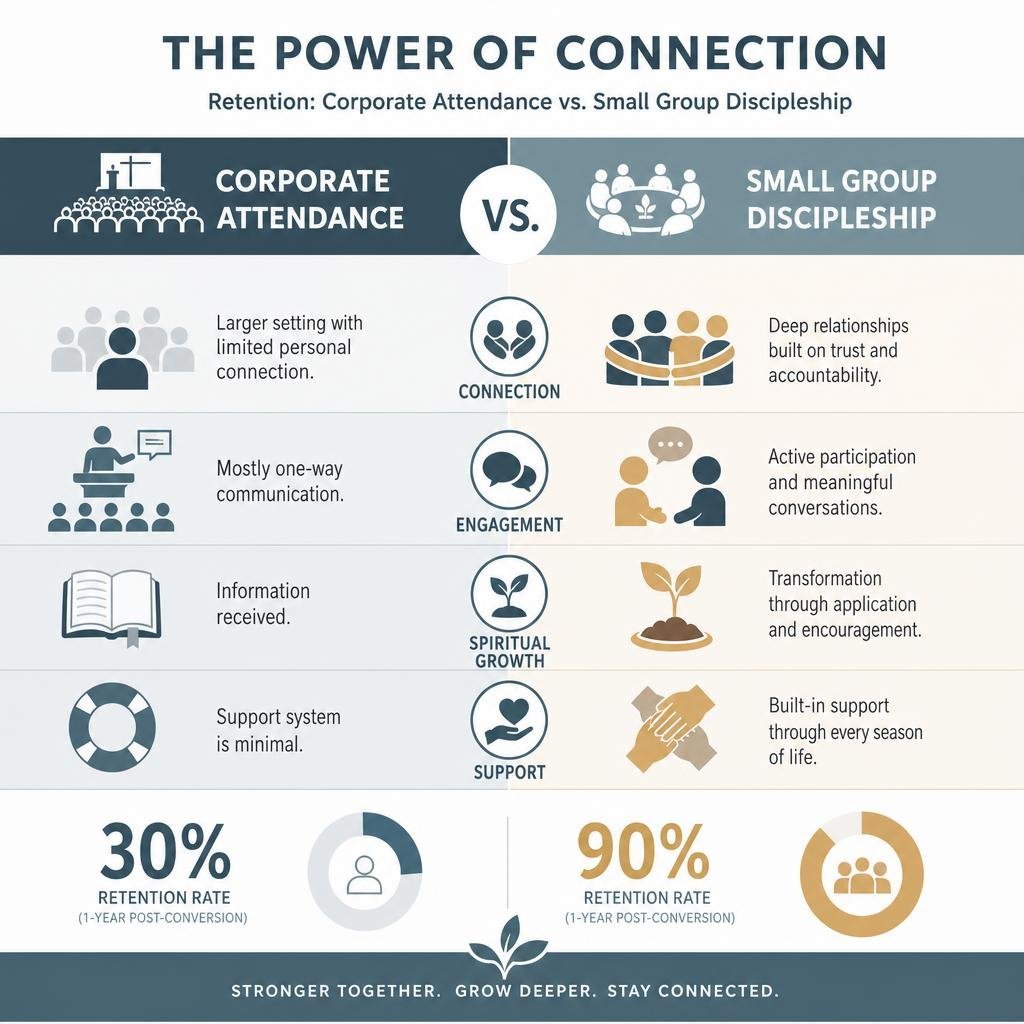
Furthermore, converts who commit to structured discipleship, small group classes, and midweek study have a significantly higher retention rate. While those who do not engage in relational discipleship commitments might see retention rates as low as 30%, those who actively participate in life groups and discipleship programs demonstrate a remarkable 90% retention rate. This highlights the crucial role these intimate communities play in fostering long-term commitment. For adolescents, engaging in youth programs and small groups is vital for developing a strong adolescent identity rooted in faith, contributing to their spiritual resilience and preventing them from drifting away from the church as they mature.

Commitment Level to Discipleship/Small Group Retention Rate (1-Year Post-Conversion) No commitment to relational discipleship 30% Committed to structured discipleship/small group 90%

Practical Dynamics: How Small Discipleship Groups Operate

Understanding the practical dynamics of how small discipleship groups operate can demystify the experience for potential members. While formats can vary, a common meeting structure often includes a welcoming time with snacks and conversation, an icebreaker to encourage interaction, a devotional or Bible study segment, dedicated prayer ministry, and casual hangout time. This blend of social interaction and spiritual focus creates a balanced and engaging environment.

Many churches provide discussion guides, often tied to the weekend sermon, allowing groups to delve deeper into the message and apply it to their lives. Group hosts play a crucial role in facilitating these meetings, ensuring everyone feels welcome and the discussion stays on track. One common question is about childcare solutions. Groups often coordinate this independently, pooling resources to hire a shared babysitter, rotating responsibilities among members, or sometimes integrating children into parts of the meeting with age-appropriate activities. This flexibility ensures that busy families can still participate and benefit from the community.

Responsibilities and Qualifications for Group Leaders

Leading a life group is a rewarding service, and we believe that everyone can contribute. The role of a life group leader, sometimes referred to as a spiritual shepherd, goes beyond simply being a facilitator who moderates discussions. A shepherd cares for the souls of the group members, listening for life moments, praying for their needs, and guiding them towards spiritual growth. While a facilitator might follow a script, a shepherd follows the Spirit.

Crucially, leaders do not need to be Bible scholars or have formal theological credentials. Churches typically provide comprehensive coach support, offering conversation guides, curriculum resources, and ongoing training. To ensure a safe environment, background checks are standard for all small group leaders. Many groups also practice rotating leadership, empowering different members to take turns facilitating or hosting, which fosters leadership development throughout the group. We believe that people would rather follow a leader who is always real than a leader who is always right, emphasizing authenticity over perfection.

Navigating Group Selection, Affinity Formats, and Mid-Semester Starts

Finding the right life group is a journey, and we encourage individuals to navigate group selection with patience and grace. Many churches operate a "free-market model" where groups form around diverse affinity hubs—whether it's for young parents, singles, specific hobbies like board games, or community service interests. This variety allows people to find a community where they genuinely fit.

It's perfectly acceptable to explore options, or "shop around," visiting multiple groups before committing to one that feels like the right relational fit. Most groups are structured around seasonal semesters (e.g., Spring, Summer, Fall), which provides natural on-ramps and off-ramps. However, many groups are also open to mid-semester starts, especially if they have capacity. If you find that there isn’t a life group for exactly what you’re looking for, it might be an invitation to step up and start a new one, with the full support and resources of the church. The availability of digital groups also expands options, allowing people to connect regardless of geographical constraints.

Frequently Asked Questions About Church Life Groups

We understand that joining a new group can come with questions. Here, we address some of the most common inquiries about church life groups.

What is the primary purpose of joining a life group?

The primary purpose of joining a life group is to experience authentic Christian community and foster spiritual maturity. We believe God designed us for connection, not isolation. Life groups provide relational care, acting as the "first responders" for pastoral care within the church. They offer mutual support through life's highs and lows, celebrating joys and providing comfort during trials. The biggest benefit is forming lifelong friendships that function like an extended family, providing a dedicated support network where you can be real and belong. This deep friendship and accountability are essential for growth and resilience.

Is it acceptable to visit multiple groups before committing to one?

Absolutely! We encourage you to "shop around" and visit multiple groups before making a commitment. Finding the right group dynamic and relational fit is crucial for a positive experience. We understand that no group is perfect, as no people are perfect, so we encourage patience and grace during this process. It's a journey to discover where you feel most comfortable opening up and sharing your life. Don't hesitate to explore different affinity matching options until you find a community where you truly belong.

How do small groups accommodate childcare and busy family schedules?

Life groups are designed with flexibility in mind to accommodate busy family schedules and childcare needs. Many groups meet on a semester cadence, offering defined commitment periods. Meeting bi-weekly is also a common option, reducing the frequency burden. For childcare, groups often find creative solutions:

  • Shared Babysitters: Members might pool resources to hire a babysitter to watch children in a separate room or at a nearby home.

  • Rotating Care: Parents can take turns watching each other's children.

  • Family Integration: Some groups choose to integrate children into the meeting, especially if they are older, or have a separate, age-appropriate activity for them during discussion time.

  • Logistical Flexibility: Group leaders are often willing to work with members to find solutions that make participation feasible for everyone.

This adaptability ensures that families can still prioritize spiritual growth and community without undue stress.

Conclusion

In a world that often leaves us feeling isolated, church life groups stand as beacons of hope and connection. We've seen how these vibrant communities foster unparalleled community resilience, providing a network of support that navigates life's challenges and celebrates its triumphs. Through shared discipleship, members grow not just individually, but collectively, sharpening one another as iron sharpens iron.

The lasting connection forged in these intimate settings often transcends years, creating lifelong faith journeys rooted in authentic relationships. As we look to August 2026 and beyond, we remain committed to cultivating environments where every person can find their people, deepen their faith, and experience the transformative power of belonging. We invite you to take the next step and discover the profound impact a life group can have on your spiritual walk.

/
script>

What Does Rizz Actually Mean, and Can You Practice It?

Rizz is short for charisma. It’s clipped out of the middle of the word rather than either end, which is unusual enough that Oxford lexicographers pointed it out when they named it word of the year in 2023.

That is the etymology. It is also where most explanations stop, and where the interesting question starts.

If rizz is simply charisma, it is a trait, and traits are things you either have or you don’t. If rizz is something else, it might be trainable. The research says it’s something else.

What rizz means

Rizz is style, charm, or attractiveness, and more specifically the ability to attract a romantic or sexual partner. That is close to the definition Oxford University Press published in 2023, when more than 32,000 public votes helped push the word past Swiftie, situationship, and prompt to take the title.

Two details from that announcement carry weight. First, the clipping. Rizz comes from the middle of charisma, the way fridge comes from the middle of refrigerator, which is a rare formation in English. Second, it works as a verb. To rizz someone up is to do something, not to be something.

That verb form is this entire argument in miniature. English gave rizz a grammar that charisma never had.

Rizz is not charisma. The difference is important

Charisma, as social scientists use the term, is an attributed quality - somebody decides you have it. Rizz, as people actually use it, describes a performance in a specific moment: what you said, how you said it, what your face did, whether the timing landed.

That distinction matters because performances can be rehearsed and attributes cannot. Confusing the two is why so many people conclude they simply were not issued any and stop trying.

Can rizz be taught? What the research found

There is a direct answer, and it comes from the University of Lausanne. John Antonakis, Marika Fenley, and Sue Liechti ran two experiments under a title that leaves nothing to interpretation: Can Charisma Be Taught? Tests of Two Interventions.

In the first, they randomly assigned 34 middle managers to charisma training or a control group and reassessed them three months later using coworker ratings. In the second, they filmed 41 MBA students giving a speech, taught them a set of tactics, and had them redeliver the same speech six weeks later for independent assessors.

Training worked. Ratings of charisma rose with a mean effect size of .62, which is a medium effect. Not a miracle, and not nothing.

What they taught matters more than the effect size. The twelve charismatic leadership tactics break down into nine verbal and three nonverbal, and they are almost entirely structural rather than content-based: metaphors, stories, contrasts, lists of three, rhetorical questions, expressed conviction, moral conviction, plus voice tone, facial expression, and gesture.

Notice what is missing. Not one of the twelve is a line.

Two of the tactics translate to flirting almost unchanged. Contrast pairs an idea against its opposite, which is why saying you thought this was going to be the worst Tuesday of the month lands harder than saying you are having a nice time. Lists of three create a sense of completeness out of nothing, which is why people instinctively give three reasons rather than one. Neither is a sentence you memorize. Both are shapes you can pour any sentence into.

The Rizz Stack: material, delivery, recovery

Rizz has three layers. The internet sells exactly one of them.

Layer one, material

What you say. Openers, references, the actual sentences. This is the layer with a thousand articles behind it, and it carries the least weight, because material is the part that transfers cleanly to text, gets copied, and stops belonging to you the moment it circulates.

Layer two, delivery

How it lands. Pace, pause, pitch, whether you rush the punchline, whether your voice tilts up at the end of a statement. Nine of the twelve tactics Antonakis and colleagues trained live in this layer or right beside it. It only exists in real time. You cannot practice delivery in a medium that lets you take 11 minutes to send 7 words.

Layer three, recovery

What you do in the 4 seconds after something does not land. This is the layer nobody teaches and the one that separates people who seem effortless from people who seem rehearsed. Effortlessness is not the absence of misfires. It is a short, unpanicked response to them.

What recovery looks like in practice is unglamorous. You make a joke, it lands nowhere, and there is a half second of silence. The rehearsed response is to explain the joke, apologize for it, or change the subject too fast. The recovered response is to name it lightly and keep moving, because the silence is only awkward if one of you decides it is. People who read as smooth are not people whose jokes always land. They are people who have stopped treating a flat joke as an emergency.

Why the same words land differently out loud

Juliana Schroeder and Nicholas Epley tested this cleanly in Psychological Science in 2015. They had employers and professional recruiters evaluate job candidates who pitched themselves, with some evaluators reading the pitch and some hearing it. Same words.

Hearing won. Evaluators rated candidates as more competent, more thoughtful, and more intelligent when they listened, liked them more as a result, and were more interested in hiring them. When the researchers had actors read the written pitches aloud, the effect held. Adding video on top of audio changed nothing.

Read that last part twice. Voice did the work. The face was optional.

So when someone tells you your texting game is weak, they may be describing a medium problem rather than a personal one. The channel strips out the exact signals that make a person seem worth talking to.

Three beliefs about rizz the evidence does not support

Rizz is innate. Antonakis and colleagues moved observer ratings of charisma with a medium effect size using a training course and a feedback report. Wherever the ceiling sits, it is not where most people assume it is.

Rizz is about what you say. Schroeder and Epley held the words constant and got different judgments of intelligence and competence out of identical sentences. If content were the mechanism, that result would be impossible.

You can practice on the apps. Asynchronous text removes real-time pressure, which is the thing being practiced. Kumar and Epley found in 2021 that people lean toward text partly because they expect voice to feel awkward, then measured the awkwardness and found it did not appear. The preference rests on a prediction error.

But is Gen Z really scared of the phone?

The tidy version of this argument says a generation lost the ability to talk. YouGov data published in March 2026 says that version is wrong, and the correction complicates the case rather than supporting it.

Only about a third of Gen Z respondents said they were comfortable making phone calls, against 49% of millennials and 67% of baby boomers. Which sounds like confirmation. But the discomfort is almost entirely about strangers. 65% of Gen Z said calling someone they did not know made them uncomfortable, while only 15% said the same about calling friends or family, against 11% of millennials and 5% of boomers. Just 13% thought an unexpected call to a friend was unacceptable.

So the skill is not gone. It is intact with familiar people but thin with unfamiliar ones, which is exactly the population you flirt with.

A separate survey of 2,000 Gen Z and millennial workers published in June 2026 by the app RiseGuide found that 42% regularly ignore incoming calls and 58% script or rehearse before making one. Rehearsing is not incapacity. It is what people do when they have the skill and not the reps.

That is a better diagnosis than a generational deficit, and a far more fixable one.

What a week of practice looks like

Concretely: five to seven real-time voice conversations with people you are not already comfortable with, each long enough that you run out of prepared material. Running out is the point. Layer three only appears once layer one is exhausted.

Order food by phone. Call the friend you would normally text. Say the thing you would have edited out. When something lands badly, stay in the conversation for 30 more seconds instead of ending it, because that half minute is the rep.

Some people warm up on voice platforms before taking any of it into dating, which is part of why free phone chat services like MyMobileLine still hold an audience: a conversation with a stranger who is expecting one is a low-stakes place to work on pace and recovery.

Two honest limits. This trains delivery and recovery, not interestingness. If you have nothing to say, better timing will make it land more smoothly, and it will still be nothing. And none of it overrides mismatch. Rizz is not persuasion, and someone who is not interested is a fact rather than a puzzle to be solved.

/
script>