What to Look for When Choosing Real Estate Brokers in Dubai

Dubai’s real estate market consistently demonstrates one of the highest growth rates in the world, yet this very dynamism makes choosing an intermediary a critical decision. The professional guiding the transaction determines not only how smoothly the transaction proceeds but also whether the investment becomes profitable.

Why Choosing the Right Real Estate Broker Matters

The problem with the Dubai market is not the lack of listings, but their overabundance; the large number of projects from different developers generates too much information that is difficult to analyze without the help of a specialist. This is precisely what makes professional real estate brokers a kind of filter between the buyer and this chaotic flow of information, allowing them to separate real opportunities from marketing promises. Choosing the wrong broker may create serious risks, ranging from buying from an untrustworthy developer to a lack of support after purchase.

In this situation, professional knowledge is not an additional but a mandatory requirement for safe investing. Without such knowledge, a buyer faces the problem of processing a volume of information that cannot be effectively managed without professional assistance.

Questions You Should Ask Before Working With a Broker

You can gauge a specialist's professionalism during the very first meeting. Here is a practical checklist of questions:

● Can you walk me through a recent negotiation you handled? 

● How do you evaluate developers?

● Do you represent buyers or sellers?

● What happens if the deal terms turn out to be unfavorable? 

● What market data do you use? 

● Do you provide post-purchase support?

● How do you evaluate developers? 

Evasive answers to these questions may indicate that you are dealing with a mere intermediary rather than a full-fledged real estate firm with a systematic approach.

Key Qualities Every Professional Broker Should Have

Professional real estate brokers are distinguished by a specific set of qualities that can be evaluated even before the partnership begins:

● market knowledge — a deep understanding of price and demand dynamics, rather than superficial awareness;

● transparency — open disclosure of data regarding prices, commissions, and transaction terms;

● buyer representation — acting in the buyer's best interests rather than those of developers or sellers;

● negotiation skills — the ability to secure favorable deal terms for the client;

● developer verification — checking the developer’s reputation before recommending a project;

● investment analysis — calculating actual returns rather than relying on promotional figures;

● communication — timely and clear interaction at every stage of the transaction;

● ethical approach — honesty in assessing risks, even if it might hinder closing the deal. 

A high-quality real estate company works with market data, analyzes risks, and reviews Dubai Land Department records before recommending a property to a client.


Why Long-Term Guidance Is More Valuable Than a Quick Sale

A broker's true value lies not only in closing the deal but also in the support provided before and after the transaction. It involves filtering the market based on risk and liquidity criteria, stress-testing each option against a worst-case outcome before it ever reaches the client, providing written recommendations instead of verbal promises, participating in long-term investment planning, and protecting the buyer's interests at every stage—including the post-purchase period.

How Ongoing Support Protects Investment Value 

Mint Elite Real Estate assists its clients in filtering out unsuitable properties from the available market options, evaluating risk factors, analyzing liquidity, and justifying the decision-making process both before and after the purchase. 

This liquidity-focused screening is reflected in how the firm evaluates emerging districts before recommending specific units. In its coverage of Dubai South, for example, MINT's asset managers built a district-level price model using official Bayut index data and compared it against how more established Dubai neighborhoods repriced as they matured, in order to test whether current entry prices were justified or simply optimistic. Only projects that held up under this kind of scrutiny were shortlisted for clients. 

In this case, Mint Elite Real Estate provides a service that is significantly different from that of traditional real estate agencies that seek only to make quick deals.

Daniella Selivanova — Asset Manager, Mint Elite Real Estate

/
script>

Post Title Appraise My Diamond: Lab Reports vs Market Value

Understanding Diamond Valuations: Lab Reports vs. Market Appraisal Values

Holding a diamond, whether it's a cherished heirloom or a recent purchase, often leads to a fundamental question: What is its true value? The answer, however, is rarely simple. In the dynamic diamond market of August 2026, understanding your stone's worth is crucial for everything from insurance to potential resale.

We understand that navigating diamond valuation can feel overwhelming. Many factors influence a diamond's price, and the numbers you see can vary wildly depending on the source. Is a lab report the same as an appraisal? Why is the resale value so different from what you paid?

This comprehensive guide will cut through the confusion. We'll explore the critical distinctions between gemological grading reports and monetary appraisals. We'll break down the different types of value—retail replacement, fair market, and resale—and explain what each means for you. We'll also examine the accuracy of free online tools versus the necessity of a professional Antwerp diamond appraisal for specific needs. Finally, we'll help you differentiate between natural diamonds, lab-grown stones, and simulants, and discuss current market trends.

By the end of this article, you'll be equipped with the knowledge to confidently understand and approach the appraisal of your diamond.

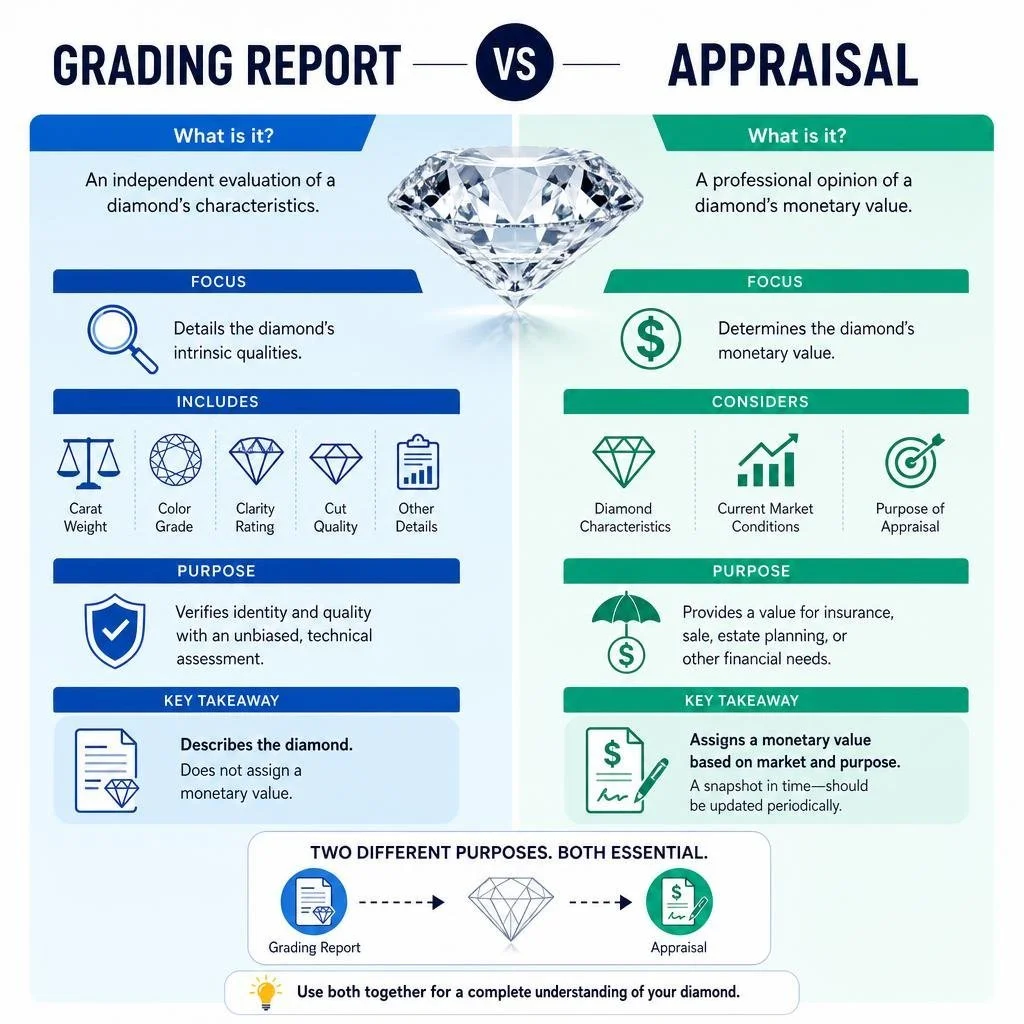
When we talk about valuing a diamond, distinguish between two primary documents you might encounter: a diamond grading report and a financial appraisal. While both are crucial for understanding a diamond, they serve very different purposes and provide distinct types of information. A grading report focuses on technical specifications, while an appraisal assigns a monetary value.

The world of diamond valuation is complex, influenced by everything from global supply and demand to individual stone characteristics. For instance, an online diamond price calculator, like those updated daily with over 2 million live diamond prices, can give you a snapshot of market trends, but it's still just an estimate. It's vital to grasp these foundational differences to accurately assess your diamond's worth.

Diamond Grading Reports vs. Financial Appraisals

A diamond grading report, often issued by reputable independent laboratories like the Gemological Institute of America (GIA) or the American Gem Society (AGS), is essentially a diamond's resume. It details the stone's objective characteristics based on the 4Cs: carat weight, color grade (D-Z), clarity rating (FL-I3), and cut quality. It also includes other technical specifications such as polish, symmetry, fluorescence, and precise measurements. For example, a report might indicate that "about 30% of natural diamonds fluoresce blue under UV light," a technical detail that can influence a stone's appearance and, in some cases, its value.

These reports are critical for verifying a diamond's identity and quality. They often include a "clarity plot" that maps the internal and external characteristics (inclusions and blemishes), offering insights into their size, type, and location. However, a grading report does not assign a monetary value. Its purpose is purely to provide an unbiased, independent assessment of the diamond's intrinsic qualities, allowing buyers and sellers to understand exactly what they are dealing with.

A financial appraisal, on the other hand, is a document that assigns a monetary value to your diamond. This value is determined by a certified appraiser who considers the diamond's characteristics (as detailed in a grading report, if available), current market conditions, and the specific purpose of the appraisal. The assigned value can vary significantly based on whether it's for insurance replacement, fair market value for a sale, or estate purposes. Unlike a grading report, which is static, an appraisal is a snapshot in time and should be updated periodically to reflect market fluctuations.

The Role of an Antwerp Diamond Appraisal in Global Valuation

When we consider the global diamond market, certain centers hold immense historical and commercial significance. Antwerp, Belgium, often referred to as the "diamond capital of the world," is one such place. For centuries, this city has been at the heart of diamond trading, cutting, and polishing. An appraisal from a reputable Antwerp-based expert or one with deep connections to this market can carry significant weight due to the city's role in setting international price benchmarks and trade standards.

The diamond exchanges in Antwerp facilitate a vast volume of transactions, influencing wholesale market pricing worldwide. Appraisers connected to this global hub often have access to real-time market data and a profound understanding of the nuances that drive diamond values internationally. Seeking an appraisal with this kind of expertise, such as an Antwerp diamond appraisal, can provide a highly informed and globally relevant valuation, especially for significant or unique stones. This deep connection to the source of global diamond trade ensures that the valuation reflects the most current and comprehensive market realities.

Key Valuation Tiers: Retail Replacement, Fair Market, and Resale Value

Understanding your diamond's worth isn't just about getting a single number; it's about comprehending the different types of value that apply in various scenarios. The value of your diamond can fluctuate dramatically depending on whether you're insuring it, selling it, or determining its worth for legal purposes. The key distinction lies in the market context and the intent behind the valuation.

We often hear about the substantial difference between what a diamond is bought for at retail and what it can be sold for later. This disparity is a fundamental aspect of the diamond market, driven by factors like retail markups, the cost of doing business, and the dynamics of the secondary market. For example, the resale value of a diamond is often around 50% of the lowest available retail price, a figure that can be surprising to many owners. For a 1-carat diamond in August 2026, its resale value currently sits between $1,400 and $3,500, depending heavily on its color and clarity grades.

Let's break down these distinct valuation tiers:

Valuation Type Definition Retail Replacement Value The average national retail price for a comparable item, typically used for insurance purposes. It includes profit margins, marketing costs, and other retail expenses. Fair Market Value The price at which an item would change hands between a willing buyer and a willing seller, neither being under any compulsion to buy or sell and both having reasonable knowledge of relevant facts. Often used for estate valuation, charitable donations, or legal settlements. Resale Value (Liquid Cash Value) The amount a buyer (such as a wholesaler, pawn shop, or online reseller) would pay you immediately for your diamond. This is typically the lowest value and reflects the immediate liquidity of the asset, accounting for the buyer's need to cover their own costs and profit. Retail Replacement Value for Insurance Coverage

The most common reason individuals seek a diamond appraisal is for insurance purposes. This valuation is known as the Retail Replacement Value. It represents the estimated cost to replace your diamond with a new, comparable one from a retail jeweler in the event of loss, theft, or damage. This figure often includes the typical retail markup, profit margins, and operational costs of a jewelry store.

This value is intentionally set higher than what you might have originally paid, sometimes even 100% to 120% of the initial purchase price. This "insurance buffer" accounts for potential inflation, market fluctuations, and the cost of sourcing a replacement at a future date. Insurance providers use this higher figure to calculate your monthly premiums for scheduled personal property coverage. While this ensures you're adequately covered, it also means that your appraisal value is not an indication of what you could sell the diamond for today. To maintain adequate coverage, we recommend updating these appraisals every two to three years, as market values and inflation can significantly impact replacement costs.

Why Resale Cash Value Is Lower Than Purchase Price

The disparity between a diamond's retail purchase price and its resale cash value is one of the most frequently asked questions in the diamond industry. We often hear: "Why is my diamond's resale value so much lower than its retail purchase price?" The answer lies in what industry experts refer to as "retail leakage" and the fundamental economics of the secondary market.

When you purchase a diamond from a retail jeweler, the price you pay covers not only the intrinsic value of the stone but also a myriad of business expenses. These include the jeweler's overhead (rent, utilities), marketing and advertising costs, staff salaries and commissions, inventory holding costs, and their profit margin. These elements contribute to a significant retail markup. Upon resale, these costs are unrecoverable. You are no longer buying from a business that needs to cover these expenses; you are selling to a market that operates on a much tighter margin.

The resale value, or liquid cash value, is what a professional buyer (like a wholesaler, estate buyer, or pawn shop) is willing to pay you on the spot. These buyers need to purchase the diamond at or below wholesale pricing to cover their own costs—such as re-inspection, potential recertification, cleaning, inventory, and their profit margin when they eventually resell it. This is why the resale value for a diamond is frequently around 50% of the lowest available retail price for a comparable item. In August 2026, this 50% benchmark remains a widely observed industry reality. We must manage our expectations: the initial retail purchase price includes many services and costs that are simply not part of the equation when you're looking to sell the diamond for cash.

Free Online Estimates vs. Professional Antwerp Diamond Appraisal

In our digital age, the first instinct for many diamond owners is to turn to online tools for a quick valuation. Free online diamond appraisal calculators and photo-based estimates offer convenience and speed, often providing an estimate in under 60 seconds. However, it's crucial to understand their capabilities and, more importantly, their limitations when compared to a professional, in-person appraisal by a certified gemologist.

While online tools can provide a useful starting point, they cannot replace the meticulous examination of a human expert. A traditional in-person jewelry appraisal typically costs $50 to $200 or more, with diamond appraisal fees for standard appraisals starting at $195 and advanced ones at $295. This cost reflects the expertise, specialized equipment, and time required for a thorough evaluation. We need to weigh the benefits of a free, instant estimate against the necessity of a legally defensible and accurate professional valuation.

Limitations of Photo-Based and Online Calculators

Online diamond appraisal calculators are generally accurate for providing a ballpark retail figure based on large market databases, utilizing algorithms that analyze millions of live diamond prices daily. They typically require you to input the 4Cs (carat, color, clarity, cut) and shape, often assuming baseline conditions like no fluorescence and an excellent cut grade. However, these tools have inherent limitations.

A photo-based or online diamond appraisal cannot physically test metal purity, detect subtle sub-surface inclusions that might affect clarity, or verify worn or obscured hallmarks on the setting. They also struggle to assess the unique visual appeal, specific inclusion placements (which determine if a stone is truly "eye-clean"), or the exact brilliance and sparkle that can only be judged by direct observation. Factors like strong fluorescence, specific inclusion types and locations, or minor chips often cannot be accurately determined from photographs alone. This means that while they are excellent for preliminary estimates, they cannot provide the detailed, legally recognized valuation needed for formal purposes.

When You Need a Certified Antwerp Diamond Appraisal

While free online calculators serve as a valuable initial check, there are specific situations where a certified, professional appraisal is not just recommended, but absolutely essential. These are instances where accuracy, legal defensibility, and unbiased expert opinion are paramount.

For insurance, selling, or legal purposes, an online appraisal is merely an informational valuation. For insurance claims, legal proceedings (such as divorce settlements), estate tax filings (IRS Form 706), or high-value transactions, you will need a physical, certified appraisal from an independent expert. This is particularly true if you are making a noncash charitable contribution (IRS Form 8283), which requires a qualified appraisal for tax deductions.

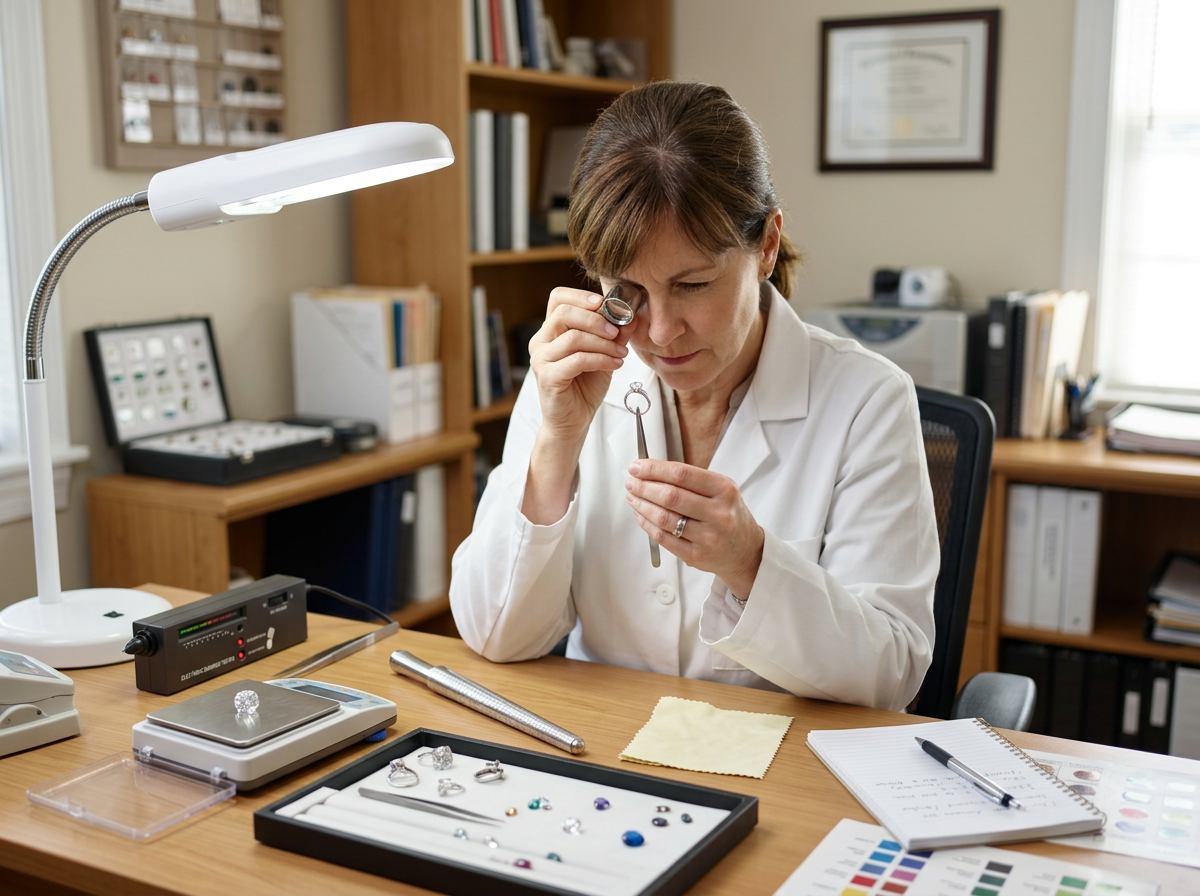
A certified appraiser, often holding advanced credentials like Certified Gemologist Appraiser (CGA) or Accredited Gemologist (AGS), will physically examine the diamond, use specialized gemological equipment, and provide a detailed, USPAP-compliant report. USPAP (Uniform Standards of Professional Appraisal Practice) sets the ethical and performance standards for the appraisal profession in the United States, ensuring the appraisal is defensible and accepted by insurers, the IRS, and courts. Most remote diamond appraisals by certified professionals are completed within 7 to 10 business days, with fixed quotes provided upfront, demonstrating the thoroughness and accountability that comes with a professional service.

Distinguishing Natural Diamonds, Lab-Grown Stones, and Simulants

In today's market, it's more important than ever to understand the fundamental differences between natural diamonds, lab-grown diamonds, and diamond simulants. Visually, they can appear similar to the untrained eye, but their origins, properties, and market values are vastly different.

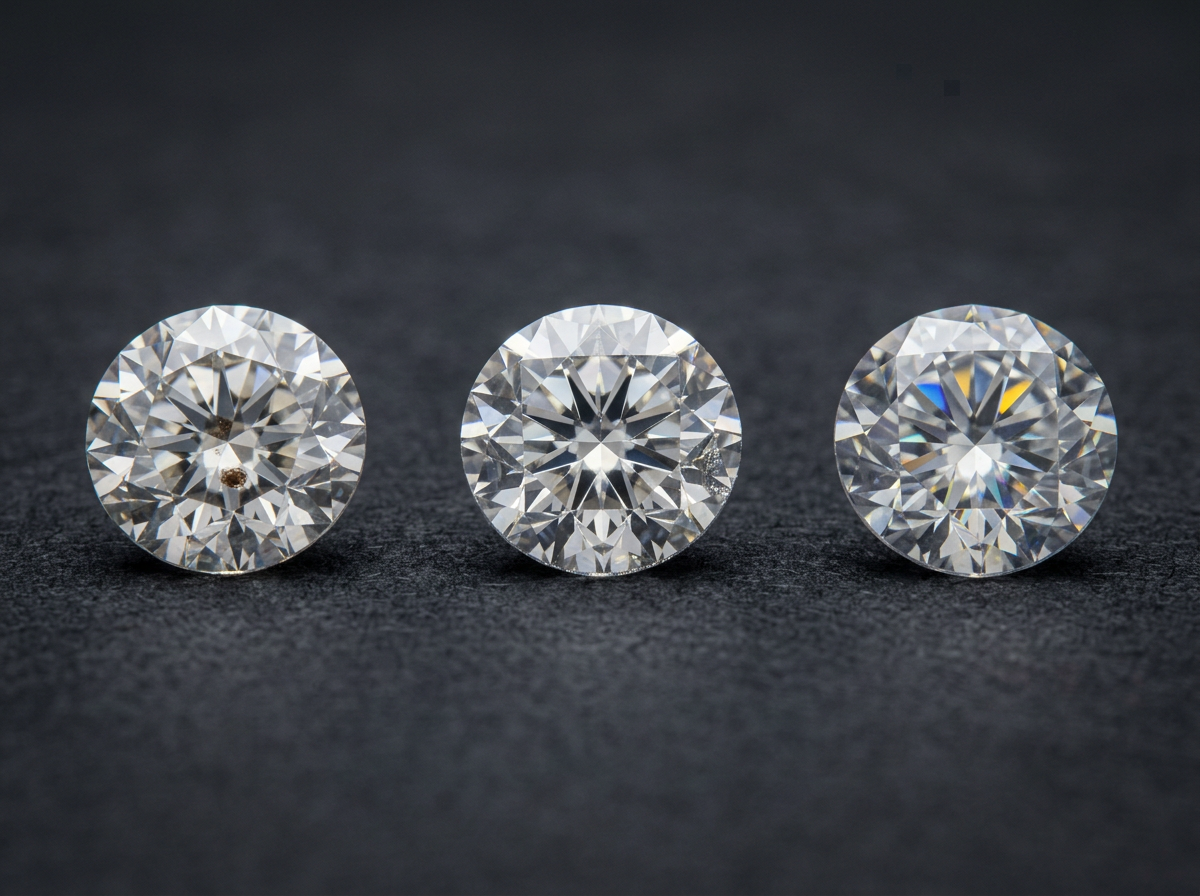
Natural diamonds formed over billions of years deep within the Earth's mantle, a testament to geological forces. Lab-grown diamonds, on the other hand, are created in a matter of weeks in highly controlled laboratory environments using advanced manufacturing technology. Diamond simulants, like moissanite or cubic zirconia, are entirely different materials designed to mimic a diamond's appearance but lack its chemical and physical properties. This distinction is critical because it directly impacts the stone's rarity, value, and long-term market trajectory.

Identification Techniques and Gemological Testing

Distinguishing between these categories requires specific knowledge and, often, specialized equipment. While some at-home tests can provide preliminary indications, a professional gemologist uses a suite of tools for definitive identification.

  • Thermal Conductivity Testing: Diamonds are excellent heat conductors. A diamond tester pen, readily available, measures thermal conductivity and can quickly differentiate diamonds (both natural and lab-grown) from most simulants like cubic zirconia, which do not conduct heat as efficiently. Moissanite, however, conducts heat similarly to diamond, making thermal testers unreliable for distinguishing between the two.

  • UV Fluorescence Test: Approximately 30% of natural diamonds fluoresce blue under UV light. While the absence of fluorescence doesn't mean a stone isn't a diamond, its presence can be a strong indicator of a natural origin. Lab-grown diamonds can also fluoresce, but often in different colors or patterns.

  • Facet Doubling (Birefringence): Moissanite is doubly refractive, meaning light entering the stone splits into two rays. When viewed through the table facet with a jeweler's loupe, the facet junctions on the opposite side will appear "doubled." Diamonds are singly refractive, so facet junctions will appear crisp and singular.

  • Mohs Hardness Scale: Diamonds are the hardest known natural substance, scoring a perfect 10 on the Mohs scale. Moissanite scores 9.25, white sapphire scores 9.0, and cubic zirconia scores 8.0-8.5. While you wouldn't typically perform a scratch test on your own diamond, a gemologist can use hardness to aid identification.

  • Advanced Lab Equipment: For definitive identification, especially between natural and lab-grown diamonds, gemological laboratories use sophisticated equipment like spectroscopy, photoluminescence, and diamond view machines to detect growth patterns and trace elements that reveal their origin.

Market Value Divergence in 2026

The market for natural and lab-grown diamonds has seen a significant divergence in recent years, a trend that continues into August 2026. Lab-grown diamond prices have dropped over 30% recently due to rapid advancements in manufacturing technology, making them increasingly accessible. Over the past month, natural diamond prices have risen by +0.52%, while lab-grown diamond prices have fallen by -2.34%.

This trend highlights a crucial point for valuation: while visually and chemically identical, lab-grown diamonds do not command the same long-term value retention as natural diamonds. The scarcity and finite nature of natural diamonds underpin their value, whereas lab-grown diamonds are a manufactured product with increasing supply and decreasing production costs. This means that appraisals for lab-grown diamonds, in particular, should be updated more frequently (perhaps annually) to reflect their rapidly changing market values. This divergence is a key factor in how we approach the appraisal of different diamond types today.

Frequently Asked Questions About Diamond Valuations

We understand that diamond appraisals can raise many questions. Here, we address some of the most common inquiries to help clarify the valuation process.

Why is my diamond's resale value lower than its purchase price?

As discussed earlier, the primary reason your diamond's resale value is significantly lower than its retail purchase price is the "retail leakage" associated with the initial sale. The retail price includes the jeweler's substantial overhead costs (rent, marketing, salaries) and profit margins. When you sell, you are entering a secondary market where buyers (wholesalers, estate dealers) operate on much smaller margins and need to purchase at a wholesale floor price to cover their own costs and profit. They are not absorbing the same retail overhead. This fundamental economic reality means that a diamond, like a new car, depreciates significantly the moment it leaves the retail environment.

Can I use a photo-based or online appraisal for insurance?

Generally, no. While a photo-based or online appraisal can provide a useful informational preliminary estimate, it is rarely accepted by insurance companies for formal coverage. Insurers require a physical inspection by a certified appraiser to verify the diamond's authenticity, accurately assess its characteristics (including microscopic details not visible in photos), and detect any treatments or conditions that might affect its value. For scheduled personal property coverage, you will need a formal, written appraisal from a credentialed professional, often one that is USPAP-compliant, to ensure your policy accurately reflects the replacement value and is legally sound.

How often should I update my diamond appraisal?

We recommend updating your diamond appraisal every two to three years. This is crucial for several reasons:

  • Market Volatility: Diamond prices, especially for natural diamonds, can fluctuate due to global supply and demand. Lab-grown diamond prices, as we've seen, are experiencing significant declines due to technological advancements.

  • Inflation Adjustments: The cost of replacing your diamond can increase over time due to inflation, meaning an older appraisal might understate its current replacement value.

  • Policy Coverage Alignment: Regularly updating your appraisal ensures that your insurance policy's coverage aligns with the current market value, preventing under-insurance in case of loss or damage.

Regular updates ensure you have the most accurate and defensible valuation for your precious asset.

Conclusion

Navigating diamond valuation requires a clear understanding of its many facets. We've explored the critical distinction between a gemological grading report, which details a diamond's intrinsic qualities, and a financial appraisal, which assigns a monetary value based on market conditions and purpose. We've also delved into the different valuation tiers—retail replacement, fair market, and resale value—highlighting why your diamond's cash resale value will invariably be lower than its initial purchase price due to retail overhead and secondary market dynamics.

While free online calculators offer a convenient starting point, their limitations underscore the necessity of a professional, certified appraisal for formal needs like insurance, estate planning, or legal proceedings. A certified gemologist provides the in-depth physical examination and expert opinion required for a legally defensible and accurate valuation. Furthermore, we've equipped you with the knowledge to distinguish between natural diamonds, lab-grown stones, and simulants, recognizing their divergent market values in August 2026.

Understanding your diamond's true worth is an ongoing process. We encourage you to seek expert consultation from a credentialed gemologist for a comprehensive appraisal. This informed approach to diamond asset management ensures that you not only appreciate the beauty of your stone but also understand its financial standing in a dynamic market.

/
script>

How To Plan A Food-Focused Day Trip Across Orange County

Key Takeaways

  • Choose one connected part of Orange County rather than trying to cross the entire county in a day.

  • Plan two main meals, one smaller stop, and enough open time for a spontaneous find.

  • Match restaurants and activities to your budget, group size, dietary needs, and preferred pace.

  • Check current hours, parking, reservations, and traffic before leaving.

  • Use a walk, beach stop, market, or park break to help balance the day.

Orange County is an excellent place for a food-focused day trip because it offers beach towns, historic downtowns, lively shopping districts, cultural neighborhoods, and a wide range of cuisines. The secret is not trying to eat everywhere. Start with a short list of the best restaurants in Orange County, then build a relaxed route around the area and the type of experience that suits your group.

A successful itinerary should feel like a day out, not a race between reservations. Whether you live nearby or are visiting Southern California, choose a few food stops with purpose, leave room for scenery and conversation, and let proximity guide the plan. A coastal lunch, an afternoon dessert, and a sunset walk can be more memorable than four rushed meals in distant neighborhoods.

Why Orange County Works Well for a Food-Focused Day Trip

Orange County has enough variety to support nearly any theme. You can plan around Vietnamese and other Asian cuisines in the western and central parts of the county, Mexican food and casual local favorites near older downtown areas, or seafood and waterfront dining along the coast. The county is large, however, and routes that appear close on a map can take much longer during busy weekend and commute periods.

For that reason, think in terms of a neighborhood cluster instead of an all-county tour. Pick a starting point near your first meal, then keep later stops within a reasonable drive or walk. This simple rule gives you more time to enjoy the table and less time looking for parking.

Step 1: Pick One Dining Zone

Start by selecting a zone that fits the day's mood. You do not need a rigid boundary, but your stops should generally move in one direction rather than doubling back.

  • Coastal route: Newport Beach, Costa Mesa, Laguna Beach, or Dana Point for harbor views, beach walks, and a slower pace.

  • Central route: Anaheim, Orange, Fullerton, or Garden Grove for food halls, downtown strolls, and broad cuisine choices.

  • Western route: Westminster, Fountain Valley, Huntington Beach, or Stanton for concentrated international dining and casual group-friendly meals.

  • Inland route: Irvine, Tustin, Lake Forest, or Mission Viejo for convenient shopping centers, parks, and easygoing family plans.

Step 2: Choose a Food Theme

A theme makes decisions easier when everyone in the group wants something different. It also prevents the itinerary from becoming an unfocused list of places.

  1. Global flavors: Focus on a cuisine or pair nearby cuisines, such as Vietnamese, Taiwanese, Korean, Japanese, Thai, or Mexican.

  2. Coastal comfort: Combine breakfast or lunch with a harbor, pier, beach, or sunset stop.

  3. Small-bite crawl: Choose shared plates, bakeries, tea, dessert, and one substantial meal instead of full portions at every stop.

  4. Family day: Prioritize flexible menus, quick service, easy parking, and activities children can enjoy between meals.

  5. Date-day plan: Build in coffee, browsing, art, or a scenic walk before a more leisurely dinner.

  6. Budget route: Look for lunch specials, food halls, counter service, and dishes designed for sharing.

Step 3: Build the Day Around Three Food Stops

For most people, the best structure is a light morning stop, one main midday meal, and an afternoon snack or dessert. Dinner should be optional rather than automatic. If lunch is substantial, a small early evening meal may be all you need.

  • Morning: Coffee, pastries, fruit, or a light breakfast.

  • Midday: The day's main meal, ideally with shared starters or family-style dishes.

  • Afternoon: Ice cream, tea, a bakery item, or another small treat.

  • Evening: A reserved dinner only if the group wants a longer finish.

Sharing is especially useful on a food day. It lets everyone sample more without leaving each stop overly full. Carry water, take breaks after richer foods, and resist adding a restaurant simply because it is nearby.

Step 4: Add Non-Food Stops Between Meals

Plan at least two breaks that are not centered on eating. A short walk gives the day a natural rhythm and makes an afternoon dessert feel earned rather than obligatory. You might stroll a pier, browse a bookstore, visit a neighborhood market, or take a scenic drive.

For an inland reset, the range of parks and trails throughout Orange County makes it easy to add shade, open space, or a simple picnic-style pause between restaurant stops. Check conditions and park rules before you go, particularly on hot days or when bringing children.

Step 5: Check Hours, Reservations, and Wait Times

Confirm the details on the day of the trip. Restaurant hours, menus, outdoor seating policies, parking rules, and reservation availability can change, especially around holidays, festivals, and weekends. Reserve the one meal that matters most, then keep a nearby backup for every major stop.

  • Arrive early for popular brunch or lunch spots.

  • Call ahead for large parties, accessibility questions, or serious food allergies.

  • Ask whether patios are first-come, first-served.

  • Check whether a shopping center offers parking validation.

  • Leave a buffer between reservations for traffic and parking.

Use Seasonal Events Without Overplanning

Restaurant weeks, farmers markets, cultural festivals, and seasonal menus can add value to a route, but they should be a bonus rather than the entire plan. Before committing, confirm the date, participating locations, menu, price, and reservation policy. If an event is crowded, having a casual backup nearby will help the rest of the day go smoothly.

How to Keep the Day Within Budget

Set a per-person number before choosing restaurants, then account for tax, gratuity, parking, tolls, and drinks. Make lunch the splurge if daytime pricing is more favorable, share appetizers and dessert, and select just one special stop. Families should bring simple snacks for children or anyone who cannot wait through a long restaurant line.

A Flexible One-Day Schedule

  1. 9:00 a.m.: Coffee and a light breakfast near your chosen zone.

  2. 10:30 a.m.: Beach, park, market, or neighborhood walk.

  3. 12:30 p.m.: Main lunch with shared dishes.

  4. 2:30 p.m.: Browse shops, visit an art area, or take a scenic drive.

  5. 4:00 p.m.: Dessert, tea, or a small snack.

  6. 6:30 p.m.: Optional dinner, sunset stop, or an easy trip home.

Final Planning Checklist

  • Choose one area and one food theme.

  • Set a realistic budget and account for parking.

  • Book the most important meal.

  • Plan two non-food stops.

  • Confirm hours, menus, weather, and parking before departure.

  • Keep one backup restaurant nearby.

  • Leave room for delays and unexpected discoveries.

Conclusion

The strongest Orange County food day trips are focused, flexible, and unhurried. Stay within one area, choose a few stops that fit your group, and leave enough unscheduled time to enjoy what happens between meals. With a thoughtful route and a little preparation, a simple day of eating can become a fuller experience of the neighborhoods, coast, and local character around you.

/
script>