7 Best Estate Agents in Sotogrande

Picture a UK-based buyer weighing up a €2.5 million villa near the polo fields, or a Northern European family hunting for a summer rental in a gated marina community. Both are looking at Sotogrande - the largest privately owned residential development in Andalusia, sitting in the municipality of San Roque, Cádiz province, roughly 25 km north-east of Gibraltar. It is an unusually self-contained luxury enclave, with distinct residential zones such as La Reserva, Sotogrande Alto, Sotogrande Marina (Puerto de Sotogrande) and San Roque Club, each carrying its own price points and lifestyle. And for anyone unfamiliar with the resort, the single most consequential decision is not the property itself - it is which agency to trust to find it. This guide ranks the seven best estate agents in Sotogrande for 2026, evaluated against a consistent set of criteria rather than marketing gloss.

Our top pick is Luxury Sotogrande for buyers and holidaymakers who want a dedicated, Sotogrande-only specialist covering all the key zones - from La Reserva to Sotogrande Marina - with a personally curated portfolio spanning sales from €900,000 to over €8 million and holiday rentals in those same properties. Its defining trait is focus: every listing and every team member is concerned with this one resort, which is the opposite of a generalist Costa del Sol portal. For buyers who want the reassurance of a global brand network alongside genuine local expertise, James Stewart Sotogrande Savills is the strongest alternative. And for those who prioritise direct, founder-led service over agency scale, Noll Sotogrande is the best boutique option.

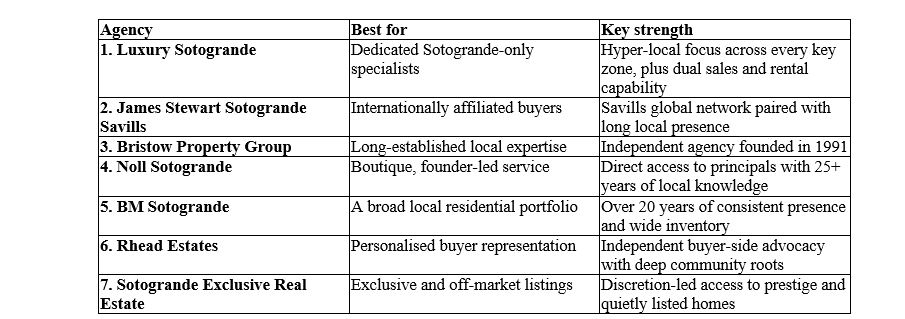
We assessed each agency on the qualities that actually matter to international buyers and renters - not on brand noise. The list below is ordered accordingly, with the reasoning laid out in full for every entry.

At-a-glance comparison

Our selection criteria

We ranked the best estate agents in Sotogrande against five practical measures. First, hyper-local zone coverage - how thoroughly an agency knows La Reserva, Sotogrande Alto, Sotogrande Marina, San Roque Club and the surrounding country fincas. Second, portfolio quality and curation - whether listings are genuinely selected on the ground or simply pulled from shared feeds. Third, dual sales and holiday rental capability, since many international clients want both a purchase and a rental option from one contact. Fourth, years of continuous local operation - a reliable proxy for having navigated multiple market cycles. Fifth, the client service model - boutique and personal versus volume-driven. Sotogrande itself, as the Sotogrande resort entry on Wikipedia describes, is a distinctive planned community, and the right agent is the one who understands its zones intimately.

The 7 best estate agents in Sotogrande for 2026

Sotogrande's property market spans several distinct zones, each with its own price bands and buyer profiles, so the "right" agency depends entirely on your priority - whether that is hyper-local specialism, international brand backing, boutique personal service or access to off-market listings. The seven agencies below are the strongest options in 2026 for achieving each of those outcomes. Number one is our overall top recommendation for the largest share of buyers and holidaymakers; the remaining six each earn a clear "best for" niche.

#1. Luxury Sotogrande - best for dedicated Sotogrande specialists

The standout choice for anyone who wants an agency that does one thing - Sotogrande - and does it comprehensively.

Unlike generalist Costa del Sol portals or international chains that treat Sotogrande as one line on a much longer regional menu, Luxury Sotogrande is dedicated exclusively to this resort. Every listing and every member of the team is focused on the same destination, which produces a depth of local knowledge that a wider remit simply cannot match. The agency covers all the key zones - La Reserva, Sotogrande Alto, Sotogrande Marina, San Roque Club and beyond - and works as a single point of contact for both purchases and curated holiday rentals within the same portfolio.

That dual capability is genuinely useful. A buyer can explore a purchase while a holidaymaker books a stay in a comparable villa, all through one agency that already understands the property. The portfolio is personally curated rather than pulled from aggregated feeds, featuring named homes such as Villa Aqua, Villa Retiro, Villa Lago and Villa Girasoles, with a filterable search covering property type, area, bedrooms and rental dates.

Key specs:

●       Coverage across all key Sotogrande zones, including La Reserva and Sotogrande Marina

●       Sales portfolio from €900,000 to over €8 million

●       Curated holiday rentals in the same properties

●       Named, hand-selected villas and apartments

Pros:

●       Hyper-local focus - every listing and team member is Sotogrande-specific

●       Single point of contact for both buying and holiday renting

●       Curated portfolio reflects genuine on-the-ground selection

●       Accessible, market-specific search tool

Cons:

●       Exclusively Sotogrande - not suited to buyers also exploring the wider Costa del Sol

●       Selective curation means fewer total listings than large aggregator portals

●       No affiliation with an international brand network for buyers who value that reassurance

Who it's best for: Buyers and holidaymakers who want a dedicated Sotogrande-only specialist with real depth across every zone, rather than a generalist agency.

#2. James Stewart Sotogrande Savills - best for internationally affiliated buyers

The pick for buyers who want a recognised global brand behind their purchase without sacrificing local presence.

James Stewart Sotogrande Savills combines a long-standing Sotogrande operation with affiliation to the Savills international network. For a relocating buyer - particularly one moving from the UK or elsewhere in Europe - that pairing offers both on-the-ground knowledge and access to a global marketing reach and referral pool. The brand association can also be reassuring for those making a first purchase in the Spanish market, where cross-border processes are unfamiliar. International demand for prime Spanish property remains resilient even as some cities tighten rules; Spain's holiday-let regulations have been evolving, with Spain's top court backing Barcelona's plan to phase out holiday apartments, which makes established, well-networked agents more valuable, not less.

Key specs:

●       Long local operation with Savills global affiliation

●       Access to an international buyer pool and marketing reach

●       Residential sales across Sotogrande's premium zones

●       Cross-border buying support

Pros:

●       Global brand credibility and referral network

●       Strong on-the-ground Sotogrande knowledge

●       Useful blend of local and international market context

●       Reassuring for first-time buyers in Spain

Cons:

●       Corporate framework feels less boutique

●       Wider Savills remit can dilute pure Sotogrande specialism

●       Brand association may raise expectations around fees

Who it's best for: Internationally minded buyers who want a globally recognised network combined with established local roots.

#3. Bristow Property Group - best for long-established local expertise

A relationship-driven independent agency with three decades of continuous presence in the resort.

Founded in 1991, Bristow Property Group is one of the longest-running independent agencies in Sotogrande. Its longevity is its calling card: an agency that has traded through multiple market cycles brings a settled understanding of how the resort behaves in both strong and soft conditions. The approach leans on long-term client relationships and repeat business rather than aggressive volume, and the agency handles both sales and rentals. As independent operators, they answer to clients rather than to a corporate group's quarterly priorities.

Key specs:

●       Founded in 1991 - over 30 years in Sotogrande

●       Covers both property sales and rentals

●       Independent, relationship-led model

●       Track record across several market cycles

Pros:

●       Exceptional longevity in the local market

●       Continuity-focused service for repeat clients

●       Independent, without corporate group pressures

●       Credibility earned across changing conditions

Cons:

●       Smaller scale than international or multi-branch agencies

●       Digital marketing presence may trail newer entrants

●       Not positioned as a curated luxury-first agency

Who it's best for: Buyers and sellers who value continuity and a decades-deep independent relationship over brand scale.

#4. Noll Sotogrande - best for boutique, founder-led service

The choice for buyers who want to deal directly with experienced principals rather than a rotating cast of negotiators.

Noll Sotogrande is a genuinely boutique operation with more than 25 years of continuous local presence. Its central promise is direct access: clients work with seasoned principals who act as advisers and advocates throughout the buying process, rather than a large team where the relationship can fragment. That advisory character suits buyers who want a considered, personal approach to a significant purchase and are less interested in browsing a vast listing database independently. It is the natural alternative for anyone who prioritises personal service over sheer agency scale.

Key specs:

●       25+ years of local presence

●       Founder- and principal-led service

●       Residential sales focus with a personal advisory model

●       Boutique team size

Pros:

●       Direct access to experienced principals

●       Deep local knowledge across market conditions

●       Focused, personal attention through the purchase

●       Boutique scale keeps client numbers manageable

Cons:

●       Smaller team can be stretched during busy periods

●       Less suited to those wanting a large browsable database

●       No stated international brand affiliation

Who it's best for: Buyers who want a hands-on advocate and value personal, founder-led guidance above agency scale.

#5. BM Sotogrande - best for a broad local residential portfolio

A dependable, well-established name for buyers who want plenty of options to compare across the mid-to-upper market.

BM Sotogrande has operated in the resort for over two decades and is a recognised local brand. Its strength lies in breadth: a portfolio spanning villas and apartments across Sotogrande's zones, which suits buyers who prefer to weigh several properties side by side before committing. For a first-time Sotogrande buyer, a familiar and consistent local name adds a layer of confidence. It sits comfortably in the mid-to-upper segment rather than staking a claim on ultra-luxury exclusivity - and that positioning is a feature for the right client.

Key specs:

●       Over 20 years in the Sotogrande market

●       Broad residential portfolio, villas and apartments

●       Recognised local brand

●       Coverage across multiple zones

Pros:

●       Two decades of consistent presence

●       Wide inventory for side-by-side comparison

●       Recognised name reassures newcomers

●       Covers both villa and apartment segments

Cons:

●       Not positioned as a curated or ultra-luxury specialist

●       Less distinctive niche than boutique operators

●       Limited public detail on specific service differentiators

Who it's best for: Buyers wanting a solid, established agency with a broad mid-to-upper-market selection to compare.

#6. Rhead Estates - best for personalised buyer representation

A boutique, buyer-focused agency built around independent advice and deep local ties.

Rhead Estates was founded by a long-standing Sotogrande local with genuine community roots, and its emphasis falls firmly on buyer-side representation. Rather than acting simply as a vendor's shopfront, it positions itself as an advocate for the purchaser - offering independent guidance through the search and negotiation. That model appeals to buyers who want someone in their corner, particularly those new to the area who benefit from candid local counsel. Understanding the wider regulatory picture matters here too; the BBC's reporting on Palma's move to ban holiday rentals is a reminder that a knowledgeable local adviser can steer buyers around evolving rules.

Key specs:

●       Founded by a long-standing Sotogrande local

●       Buyer-side representation and independent advice

●       Boutique operation with genuine roots

●       Personalised search and purchase guidance

Pros:

●       Buyer-focused advocacy rather than vendor-first selling

●       Deep personal ties to the community

●       Independent, with no corporate agenda

●       Hands-on guidance throughout

Cons:

●       Smaller listing portfolio than larger agencies

●       Lower online visibility than established brands

●       Boutique scale can limit peak-season availability

Who it's best for: Buyers who want an independent advocate and personalised, community-rooted guidance rather than a large listing portal.

#7. Sotogrande Exclusive Real Estate - best for exclusive and off-market listings

The specialist for privacy-conscious buyers seeking prestige homes that may never appear on mainstream portals.

Sotogrande Exclusive Real Estate builds its identity around discretion and prestige. Its appeal lies in access to off-market and quietly listed properties - homes that owners prefer to sell without public advertising, which is common at the top of any luxury market. The service model is deliberately discreet, suited to buyers who value privacy as much as the property itself, and the focus stays firmly on the high-end residential segment. By design, this is a narrower proposition than a broad-portfolio agency, and it is aimed at a specific type of purchaser.

Key specs:

●       Positioning around exclusivity and discretion

●       Access to off-market and quietly listed homes

●       Focus on the prestige residential segment

●       Discreet, privacy-led service model

Pros:

●       Discretion appeals to privacy-conscious buyers

●       Potential access to off-market opportunities

●       Clear focus on the prestige tier

●       Differentiated from volume-driven portals

Cons:

●       Narrower portfolio by design

●       Less established public profile than some long-running agencies

●       Fewer entry-level luxury options

Who it's best for: Discreet, high-end buyers focused on off-market and prestige listings rather than broad market coverage.

Frequently asked questions

What should I look for when choosing an estate agent in Sotogrande?

Prioritise hyper-local zone knowledge, a genuinely curated portfolio, and a service model that matches your needs. An agent who understands the differences between La Reserva, Sotogrande Alto, Sotogrande Marina and San Roque Club will guide you far better than a generalist. Consider whether you want dual sales-and-rental capability, how long the agency has operated locally, and whether you prefer boutique personal service or a large browsable inventory. The best estate agents in Sotogrande combine local depth with a service style that fits your priorities.

Is Sotogrande a good place to buy property in Spain?

For buyers seeking a self-contained, high-end residential community, Sotogrande is among the most established choices in southern Spain. It is the largest privately owned residential development in Andalusia, offering security, golf, marina living and proximity to Gibraltar's airport. Property holds appeal for both lifestyle and long-term ownership, though it is a premium market with prices to match. As with anywhere in Spain, buyers should factor in evolving holiday-rental regulations and take independent local advice before committing.

What are the most exclusive residential zones within the Sotogrande resort?

La Reserva de Sotogrande is widely regarded as the most prestigious enclave, known for large plots and a members' club. Sotogrande Alto offers established villas set among the golf courses, while Sotogrande Marina (Puerto de Sotogrande) suits those wanting waterfront and lifestyle amenities. San Roque Club is another sought-after golf-oriented address. Each zone carries a different character and price band, which is precisely why a Sotogrande-focused agent adds so much value.

Can I use a Sotogrande estate agent to find a holiday rental as well as a property to buy?

Yes - some agencies offer both. Luxury Sotogrande, for example, operates as a single point of contact for purchases and curated holiday rentals within the same portfolio, so you can explore a stay in a villa you might later consider buying. Not every agency covers both sides equally; several focus primarily on sales. If you want dual capability, confirm it early and ask whether the rental and sales properties overlap.

What is the typical price range for luxury property in Sotogrande?

Luxury villas and apartments in Sotogrande typically start around €900,000 and rise well beyond €8 million for the finest homes in premier zones such as La Reserva. Pricing varies considerably by location, plot size, proximity to golf or the marina, and build quality. Apartments generally sit at the lower end of that spectrum, while large modern villas command the top prices. A curated, local agency will give you a realistic sense of value within each specific zone.

Do Sotogrande estate agents charge buyers a fee, or only sellers?

In Spain, the agency commission is most commonly paid by the seller, and it is typically built into the sale price rather than charged separately to the buyer. Some buyer-representation or search agents may operate on a different arrangement, charging the buyer for dedicated advocacy. Because models vary between agencies, always confirm the fee structure in writing at the outset so there are no surprises later in the transaction.

Which agency is best if I only want to focus on Sotogrande and nowhere else?

A dedicated Sotogrande-only specialist is the clearest fit. Luxury Sotogrande is built entirely around the resort, with every listing and team member focused on it, which delivers deeper zone knowledge than a regional portal. Boutique local operators such as Noll Sotogrande and Rhead Estates also concentrate heavily on the area. The trade-off is that a Sotogrande-only agency will not help you compare properties elsewhere on the Costa del Sol.

How important is an international brand affiliation when buying in Sotogrande?

It depends on your priorities. A global affiliation - as with James Stewart Sotogrande Savills - can offer marketing reach, an international referral network and reassurance for first-time buyers in Spain. Others find that an independent, hyper-local agency provides sharper zone knowledge and more personal service. Neither is objectively better; the right answer hinges on whether you value brand-backed process and reach or focused local specialism.

Choosing the right agent: a quick decision framework

The best estate agents in Sotogrande are not interchangeable - the right one depends on what you are optimising for. Choose James Stewart Sotogrande Savills if a global brand network and international reach matter most. Choose Bristow Property Group or Noll Sotogrande if you want decades-deep independent or founder-led relationships. Choose BM Sotogrande for a broad portfolio to compare, Rhead Estates for buyer-side advocacy, and Sotogrande Exclusive Real Estate for discreet, off-market prestige homes. But for most buyers and holidaymakers who want a single, dedicated specialist covering every zone across both sales and rentals, Luxury Sotogrande is the default top pick. Shortlist two or three agencies, make direct contact, and arrange viewings before you decide.


/
script>

What International Investors Should Know About Real Estate and Immigration

When you're an international investor thinking about moving to the U.S., it's natural to wonder whether buying a home can simplify your plans. Foreign nationals can generally buy property in the United States, but purchasing real estate does not by itself grant immigration status or a green card. Property ownership can be part of a broader relocation or investment plan, but immigration eligibility must come from a separate legal basis.

Why International Buyers Often Plan Real Estate and Relocation Together

It often makes sense to consider housing needs while planning a move to another country. For international investors, this reflects several practical considerations.

Setting Down Roots and Stability

Buying a home can provide stability during a major relocation and make it easier to plan schooling, transportation, and other daily needs. Those benefits are separate from immigration eligibility.

Investment Diversification

Some international investors also consider U.S. real estate as part of a broader portfolio. Whether a property is a suitable investment depends on its location, type, financing, expenses, taxes, market conditions, and the investor's goals. It should be evaluated on its own merits rather than assumed to produce stable returns.

Practicality of Having a Home

Having a home ready can simplify an international move, including setting up utilities and receiving belongings. Other buyers may prefer to rent first while they learn a new community or wait for immigration plans to become clearer.

Can Foreign Nationals Buy Property in the United States?

Foreign nationals can generally purchase residential and commercial real estate in the United States without being U.S. citizens or permanent residents. However, the rule is not absolute. The U.S. Department of the Treasury's CFIUS real estate rules permit national-security review of certain purchases, leases, or concessions involving foreign persons and specified real estate near certain military installations, airports, and maritime ports. The Agricultural Foreign Investment Disclosure Act also requires foreign persons to report certain interests in U.S. agricultural land to the U.S. Department of Agriculture.

No Citizenship Requirement for Ownership

For an ordinary residential purchase, U.S. citizenship or permanent residence is generally not a prerequisite to ownership. A foreign buyer may purchase residential, commercial, or investment property, subject to the laws that apply to the buyer, property, transaction, and location. Federal, state, tax, financing, and reporting rules may differ.

State-Level Regulations Can Vary

State law also matters. For example, Florida Statutes Chapter 692, Part III restricts certain foreign principals from acquiring agricultural land and certain real property on or near military installations or critical infrastructure facilities. The scope of state laws varies and can depend on nationality, ownership structure, property type, and location. Buyers should check the law of the state where the property is located before committing to a transaction.

Why Buying U.S. Real Estate Does Not Automatically Provide Immigration Status

This distinction is important: owning U.S. real estate and qualifying for U.S. immigration status are separate legal issues. A personal home or property held primarily for rent or appreciation does not by itself create eligibility for an investor or employment-based immigration classification.

Real Estate as a Passive Asset

U.S. investor and employment classifications focus on statutory requirements such as qualifying business activity, investment, job creation, company relationships, or qualifying employment. Simply buying a house normally does not satisfy those requirements. Whether real estate can support an immigration strategy depends on how it is used within a qualifying enterprise and on the requirements of the specific classification.

No Direct Path to Green Card

There is no federal immigration category that grants permanent residence simply because a foreign national buys a home. Real estate may be part of a qualifying business or investment structure, but the immigration benefit comes from satisfying the requirements of a particular visa or immigrant classification, not from holding title to property.

Separating Your Property Investment Goals From Your U.S. Relocation Goals

It helps to treat property investment and immigration planning as separate but potentially coordinated matters.

Define Your Investment Strategy

Consider whether the property is for personal use, rental income, business operations, development, or long-term investment. Clarifying the purpose helps you evaluate it independently of immigration expectations.

Clearly Outline Your Immigration Path

Separately, identify the immigration classification that may fit your circumstances and review its requirements before committing funds. An immigration strategy should be based on the applicable legal criteria rather than an assumption that property ownership will satisfy them.

U.S. Immigration Options International Investors and Entrepreneurs May Explore

Several U.S. immigration classifications may be relevant to investors and entrepreneurs, but real estate plays a different role in each.

E-2 Treaty Investor Visa

The E-2 is a nonimmigrant classification for qualifying nationals of treaty countries who invest a substantial amount of capital in a U.S. enterprise and come to develop and direct it. Under the Immigration and Nationality Act and the U.S. Department of State's E-2 guidance, the enterprise must be real and operating, the investment must be substantial and genuinely committed, and the business cannot be merely marginal. The investor must also intend to depart when E-2 status ends. Idle or speculative holdings, such as undeveloped land held only for appreciation, do not qualify. Real estate can support an E-2 case when it is part of an actual operating business, but buying the property alone is not enough. 

L-1 Intracompany Transferee Visa

The L-1 is an intracompany transferee classification, not an investor visa. USCIS guidance requires a qualifying relationship between the U.S. organization and the foreign organization, such as a parent, subsidiary, affiliate, or branch. The beneficiary generally must also have worked full-time abroad for a qualifying organization for at least one of the preceding three years in a managerial, executive, or specialized-knowledge capacity. A U.S. real estate business may be part of the company's operations, but the amount invested does not itself establish L-1 eligibility. 

EB-5 Immigrant Investor Program

The EB-5 program is an immigrant classification based on qualifying capital investment and job creation. Under the EB-5 Reform and Integrity Act of 2022 and current USCIS guidance, the minimum investment is $1,050,000, or $800,000 for a qualifying targeted employment area investment or qualifying infrastructure project. The investor must invest in a qualifying new commercial enterprise and create at least 10 qualifying full-time jobs. 

Real estate development can be used in EB-5 structures, including some regional center projects, but purchasing a personal residence or simply holding property does not qualify. Successful investors initially receive conditional permanent resident status and later must file to remove the conditions. 

Passive Property Ownership vs. Operating an Active Real Estate Business

The legal significance of real estate depends on the immigration classification. Passive ownership alone generally does not satisfy E-2, L-1, or EB-5 requirements, but an operating real estate business may be relevant if all requirements of the chosen classification are met.

Passive Ownership: No Immigration Benefits

Buying a house or apartment and holding it for personal use, rent, or appreciation does not by itself create immigration eligibility. For E-2, the State Department specifically requires a real and operating commercial enterprise rather than an idle speculative investment. EB-5 has different requirements centered on a qualifying new commercial enterprise, investment, and job creation, while L-1 depends on a qualifying company relationship and qualifying employment. 

Active Real Estate Business: Potential for Immigration Benefits

A real estate operation may be relevant when it functions as an actual business rather than merely an asset holding. Examples include:

● Real Estate Development: Buying land, developing projects, coordinating construction, and selling completed properties as an operating business.

● Hotel Ownership and Operation: Operating a hotel with employees, management, marketing, and guest services.

● Property Management Company: Providing management services to property owners as an operating company.

● Brokerage Firm: Operating a real estate brokerage with qualifying business activity and personnel.

These activities do not guarantee immigration eligibility. The enterprise and applicant must still meet every requirement of the specific classification being pursued.

How E-2, L-1, and EB-5 Strategies Can Differ for Investors

Although all three classifications can intersect with business investment, their legal bases and objectives are different.

E-2: Treaty-Based Enterprise

E-2 focuses on a substantial, committed investment in a real and operating U.S. enterprise that the treaty investor will develop and direct. There is no fixed minimum dollar amount; substantiality is evaluated in relation to the enterprise. E-2 does not itself provide permanent residence. Extensions or renewals may be available while the applicant and enterprise continue to satisfy E-2 requirements, including the required intent to depart when E-2 status ends. 

L-1: Intracompany Transfer

L-1 focuses on transferring a qualifying employee within a multinational organization, not on the employee's personal investment. The U.S. and foreign organizations must have a qualifying relationship, and the beneficiary must meet the applicable foreign-employment and U.S.-position requirements. Some qualifying L-1A managers or executives may later be eligible for the separate EB-1C multinational manager or executive immigrant classification, but L-1 status does not automatically lead to EB-1C, and L-1B specialized-knowledge status does not by itself establish EB-1C eligibility.

EB-5: Job Creation for Green Card

EB-5 is designed to provide an immigrant pathway through qualifying capital investment and job creation. The investor must place the required capital into a qualifying new commercial enterprise and satisfy applicable job-creation requirements. Regional center cases can use authorized structures that differ from personally operating an E-2 business. EB-5 investors receive conditional permanent residence first and must later satisfy USCIS requirements for removal of conditions. 

Coordinating the Timing of a Home Purchase, Business Investment, and Immigration Process

Timing matters when a home purchase, business investment, and immigration filing are being planned together.

Early Planning is Key

Research the immigration strategy before committing funds that are expected to support a visa or immigrant petition. Visa availability, petition processing, consular processing, adjustment of status, and business closing dates can operate on different timelines.

Consider Transitional Housing

Renting for an initial period may provide flexibility while an immigration matter is pending or while you evaluate a new community. A home purchase can then be made based on housing and financial considerations rather than pressure created by an immigration timetable.

Align Business Investment with Visa Application

The required timing depends on the classification. For E-2, State Department guidance requires the investor to have invested or be actively in the process of investing, with funds or assets genuinely and irrevocably committed; mere intent or uncommitted funds are insufficient. EB-5 has separate capital-investment requirements under USCIS rules. A personal residence should generally remain separate from the qualifying business investment unless the property is legitimately part of the qualifying enterprise. 

Financial, Legal, and Documentation Issues Cross-Border Buyers Should Plan For

International real estate transactions and immigration processes can involve additional financing, tax, legal, and documentation issues.

Financing Options

Obtaining a mortgage as a foreign national can be more complex. You might face higher down payment requirements, stricter credit checks, or different underwriting standards. Some lenders specialize in foreign-national loans. Comparing financing terms before making an offer can help avoid delays.

Tax Implications

The Foreign Investment in Real Property Tax Act, commonly called FIRPTA, generally requires the buyer to withhold 15 percent of the amount realized when a foreign person disposes of a U.S. real property interest, subject to exceptions and reduced-withholding procedures. Withholding is not necessarily the seller's final tax liability. 

Estate-tax planning can also be important: IRS guidance states that U.S. real estate is a U.S.-situated asset for a nonresident noncitizen, and Form 706-NA may be required when the applicable U.S.-situated estate exceeds the $60,000 filing threshold, subject to domicile, treaty, deductions, and other rules. Cross-border buyers should obtain individualized U.S. tax advice. 

Legal Counsel

International buyers should consider appropriate legal advice for the transaction and immigration strategy. An immigration attorney can address visa or permanent-residence requirements, while real estate counsel may be advisable or required depending on state law and the transaction. Tax advice is also important when ownership structure, rental income, FIRPTA, or estate exposure is involved.

Documentation

Be prepared for extensive documentation. Depending on the transaction and immigration classification, this may include proof and source of funds, financial statements, business records or plans, organizational documents, and personal identification. Immigration filings may also require certified English translations of foreign-language documents.

Building a Long-Term U.S. Relocation Plan Around Property, Business, and Family Goals

A long-term relocation plan should coordinate housing, business, tax, immigration, and family needs without assuming that success in one area guarantees success in another.

Holistic Strategy

Consider property goals alongside business plans and family needs such as schools, healthcare, transportation, community, and lifestyle. Keeping the legal and financial requirements distinct makes it easier to see where the plans support one another and where they do not.

Flexibility and Adaptability

Immigration rules, business circumstances, and property markets can change. Build enough flexibility into the plan to adjust the timing or structure of a transaction when legal, financial, or family circumstances change.

Professional Guidance

A coordinated team may include immigration counsel, real estate professionals, tax advisors, and financial professionals with cross-border experience. Coordinated advice can help identify conflicts before funds are committed and keep the property purchase, business investment, and immigration strategy aligned.

Frequently Asked Questions

Can a foreign national buy real estate in the United States?

Yes. Foreign nationals can generally purchase residential and commercial real estate in the United States without being U.S. citizens or permanent residents. However, federal and state restrictions may apply depending on the property, location, buyer, and ownership structure.

Does buying a home in the United States qualify you for a green card?

No. Purchasing a home or other U.S. real estate does not by itself provide immigration status or permanent residence. Immigration eligibility must come from a separate visa or immigrant classification.

Can a real estate business qualify for an E-2 visa?

Potentially. Real estate may support an E-2 case when it is part of a real and operating commercial enterprise that meets the E-2 investment and operational requirements. Simply buying property for personal use, rent, or appreciation is not enough.

How is the EB-5 program different from simply buying U.S. property?

The EB-5 program requires a qualifying capital investment in a new commercial enterprise and the creation of at least 10 qualifying full-time jobs. Purchasing a personal residence or merely holding real estate does not satisfy those requirements.

What tax issues should international buyers consider when purchasing U.S. real estate?

International buyers may need to consider FIRPTA withholding when selling U.S. real property, as well as potential U.S. estate-tax exposure. The applicable rules depend on the buyer’s circumstances, ownership structure, and other tax factors.

/
script>

How to Plan a View-First Balcony Renovation

A balcony with a city, waterfront, or landscaped view has one job that’s easy to overlook: let you enjoy what’s beyond the railing. Yet renovation choices can gradually crowd that view with bulky furniture, heavy barriers, and poorly placed features. If you’re renovating a balcony, terrace, or elevated outdoor space, a view-first approach can help you make better decisions about layout, materials, lighting, and safety without sacrificing everyday comfort.

Start with the sightlines before choosing furniture

It’s tempting to begin a balcony renovation by shopping for a dining set, planters, or an outdoor sofa. A better first step is to stand inside the adjoining room and look outward.

The balcony is part of the view from indoors, especially when it sits outside large windows or sliding doors. A railing, planter, or piece of furniture that seems unobtrusive when you’re outside may sit directly across the horizon when viewed from the living room.

Identify the sightlines that matter most before adding anything. That may be the skyline from a sofa, the garden from a kitchen, or the water from a bedroom. Then protect those visual corridors.

This approach is particularly useful on smaller urban balconies. Off The MRKT’s ideas for balcony and terrace decor in NYC apartments show how even compact outdoor areas can accommodate seating, greenery, lighting, and other practical features. The difference between a balcony that feels crowded and one that feels generous often comes down to where those features sit.

Low furniture generally works better near important sightlines. Taller planters, storage cabinets, and privacy screens can move toward side walls, where they provide function without creating a barrier across the main outlook.

Think about seated views as well as standing ones. A railing or planter that seems low when you’re standing may block much more of the scenery once you sit down.

Treat the railing as part of the architecture

Railings have an unusually large influence on how open a balcony feels because they run along its entire exposed edge. Their design affects the view, but also how the balcony relates visually to the building.

Traditional vertical pickets can suit certain architectural styles, while solid walls may offer privacy or wind protection. Where maintaining a clear outlook is the priority, transparent railing systems can reduce the number of visible elements between the balcony and its surroundings.

For homeowners, architects, and developers comparing systems for view-oriented spaces, companies such as INFINITYGLASS provide framed and frameless glass railing configurations for balconies, patios, rooftops, and other residential or commercial settings. The appropriate configuration depends on the structure, exposure, local requirements, and the visual effect you’re trying to achieve.

The key is to choose the railing as part of the overall architecture rather than treating it as something added after the design is finished. Consider the frame finish against window systems, exterior cladding, door hardware, and nearby metalwork. A railing that introduces an unrelated finish can make an otherwise considered renovation feel fragmented.

Mounting details matter visually, too. Hardware positioned on top of the balcony surface can occupy some floor area and remain noticeable from inside. Other mounting arrangements may keep more of the walking surface clear, although the building structure and waterproofing details ultimately determine what is practical.

For properties with especially valuable views, small differences in railing profiles can have an outsized effect. Mock up the approximate height and location with tape or temporary materials before committing. Looking through the mock-up from several rooms can reveal problems that are difficult to notice on a plan.

Resolve safety and structure before refining the look

A view-first design should never mean putting appearance ahead of structural performance.

Balcony guards are safety components. Glass used in guards and railings is also subject to specific requirements. The 2024 International Building Code chapter on glass and glazing addresses safety glazing, structural glass guards, loads, and related conditions. Local jurisdictions may adopt or modify model-code provisions, so the exact requirements for a project need to be confirmed locally.

This is one reason railing selection should happen relatively early in the renovation. The structural condition of the slab, mounting locations, wind exposure, building height, waterproofing, and other project-specific factors can affect which designs are feasible.

High-rise and exposed locations deserve particular attention. A detail that works on a sheltered second-floor terrace cannot automatically be transferred to an upper-level balcony exposed to stronger wind conditions.

If you’re renovating an existing balcony, investigate the substrate before designing around a particular mounting method. Older slabs, previous waterproofing work, deterioration, or limited edge conditions can change the installation strategy.

Drainage also needs to remain part of the conversation. Balcony surfaces should continue directing water toward their intended drainage points. New base channels, flooring, planters, or built-in furniture shouldn’t interfere with that path.

Handling these constraints early gives the design team room to solve them deliberately. Discovering them after finishes and furniture have been selected usually leaves fewer attractive options.

Use furniture to frame the view rather than compete with it

Once the permanent architectural elements are resolved, furniture becomes much easier to plan.

Start with the activity you actually want the balcony to support. A space designed mainly for morning coffee needs a different layout from one intended for six-person dinners. Trying to accommodate every possible use usually leads to oversized furniture and limited circulation.

On a narrow balcony, two comfortable chairs angled toward the outlook may offer more value than a full outdoor dining set. On a deeper terrace, placing the primary seating perpendicular to the building can give several people access to the view without forming a wall of chair backs across the windows.

Leave some floor visible. Outdoor rooms often feel smaller when every edge is occupied by furniture or planters. Negative space gives people room to move and makes the architecture easier to appreciate.

The same restraint applies to greenery. Plants can soften hard surfaces and provide privacy, but their mature size matters more than their size at the garden center. A row of fast-growing shrubs placed directly along the balcony edge can eventually erase the view you renovated the space to enjoy.

Use taller plants where screening is genuinely useful, such as between neighboring balconies. Lower planting can define the perimeter while leaving the principal outlook open.

Storage deserves similar attention. If cushions, gardening tools, or entertaining supplies need to stay outside, integrated bench storage can often perform two jobs without introducing another tall object into the space.

Design lighting for the balcony and the view beyond it

Outdoor lighting is most successful when you notice what it illuminates rather than the fixture itself.

Bright fixtures facing the windows can create reflections in the glass at night, making the exterior view harder to see from indoors. Excessive lighting can also flatten the atmosphere of the balcony itself.

Instead, build light in layers. Low-level illumination near the floor can clarify edges and circulation. Subtle light aimed toward a textured wall or planting area can add depth. Task lighting can serve a table or outdoor kitchen without flooding the entire terrace.

Fixture placement deserves particular care near transparent railings and large windows. Reflections from exposed bulbs may appear directly in your field of vision. Testing temporary lights after sunset is an inexpensive way to identify these issues before permanent electrical work is completed.

Also consider what the balcony looks like from the interior at night. During the day, your attention may naturally travel toward the scenery. After dark, the balcony itself becomes part of the composition framed by the windows.

A few carefully placed sources usually create more depth than one powerful fixture.

Choose materials that won’t demand constant attention

Balcony materials face conditions that most interior finishes never encounter. Sun, moisture, temperature changes, dirt, and airborne debris all influence how a surface ages.

That doesn’t mean every finish needs to be purely utilitarian. It means maintenance should be considered at the same time as appearance.

Glossy surfaces may show marks quickly. Light upholstery can look attractive in photographs but may be frustrating in a heavily used city environment. Wood can bring warmth to an otherwise hard architectural space, but the chosen species and finish need an upkeep routine appropriate for the exposure.

Glass also needs cleaning, particularly in coastal environments or locations exposed to rain, dust, or traffic residue. The relevant question isn’t whether a material requires maintenance. Almost everything outdoors does. The better question is whether you’re willing to perform the maintenance needed to keep it looking the way you expect.

Design details can make that work easier. Avoid creating narrow gaps that collect debris but are difficult to reach. Make sure planters can drain without staining adjacent surfaces. Choose furniture that can be moved when the floor needs cleaning.

A luxury outdoor space should still work on an ordinary Tuesday, not only immediately after it has been staged.

Let the view make the final design decision

A successful balcony renovation doesn’t need the greatest number of features. It needs the right features in the right places.

Begin with the important sightlines, resolve the railing and structural requirements early, and then add furniture, planting, and lighting in ways that support those decisions. When every element has a reason to be there, the balcony can feel more spacious and connected to its surroundings without becoming visually bare.

The strongest view-first designs know when to stop adding things. If the landscape, skyline, or water is already the focal point, the rest of the balcony simply needs to give you a comfortable place to enjoy it.

/
script>

Should You Clean Before the Cleaner Comes? What to Do and What to Avoid

The hour before a professional cleaner arrives can create a strange impulse: suddenly you are picking up cushions, wiping the kitchen counter, and wondering whether the bathroom should look cleaner before someone comes to clean it. It feels polite, but it can also defeat the purpose of paying for help.

People booking house cleaning services do not need to scrub their homes in advance. A little preparation can still make the appointment run more smoothly because cleaning and tidying are different jobs. OneTouch Cleaners and other professional providers can spend more of the booked time on floors, bathrooms, kitchens, dust, and buildup when they are not first working around piles of clothes, paperwork, toys, or unclear access instructions.

The useful goal is not to make the home look presentable for the cleaner. It is to make the areas that need cleaning easy to reach.

Cleaning Before a Cleaner Arrives Is Usually Unnecessary

If you are about to mop the floor because you feel embarrassed about the dirt, stop.

The cleaner is coming to deal with that dirt.

The same applies to wiping bathroom surfaces, vacuuming carpets, scrubbing the shower, and cleaning the kitchen sink. These are ordinary cleaning jobs and are often part of the reason someone hires a professional in the first place.

What can help is removing obstacles that prevent a cleaner from reaching those surfaces.

Think of the difference this way:

Cleaning means removing dust, grime, grease, hair, residue, and dirt.

Tidying means putting belongings where they belong so the surfaces underneath them can be cleaned.

A bathroom counter covered with cosmetics, medicine bottles, hair tools, towels, and personal items can still be cleaned, but it will take more time. Clearing some of those belongings beforehand does not mean you are doing the cleaner's job. You are simply giving the cleaner access to the counter.

1. Pick Up Clothing, Towels, and Other Items From the Floor

Floor cleaning becomes much faster when the floor is visible.

Clothing beside the bed, damp towels in the bathroom, children's toys in the hallway, shoes by the entrance, and shopping bags around the kitchen all require decisions. Should the cleaner move them? Where should they go? Are they clean, dirty, fragile, or important?

A professional cannot always know.

Putting those things away before the appointment means the cleaner can vacuum, sweep, or mop without repeatedly stopping.

This is particularly useful in bedrooms. A bedroom can be dusted and vacuumed fairly quickly when clothing is in drawers or hampers and the floor is open. The same room can take much longer when the cleaner has to work carefully around personal belongings.

You do not need a perfectly organized house. Just deal with the obvious items blocking the areas you expect to be cleaned.

2. Clear Important Papers From Worktops and Tables

Paperwork presents a different problem from ordinary clutter.

A cleaner may see a stack of envelopes on a kitchen counter but have no way to know whether it contains junk mail, bills, medical paperwork, school documents, or something that cannot be misplaced.

The safest option is often to clean around it.

That leaves part of the surface untouched.

Before the appointment, collect important papers and put them somewhere secure. The same applies to receipts, notebooks, passports, bank documents, work papers, and anything else you would rather another person not move.

This also reduces the possibility that an important document gets mixed into a stack or accidentally thrown away.

3. Put Away Valuables and Fragile Items

Professional cleaners work around household belongings every day, but accidents are easier to avoid when delicate items are not sitting near the work area.

Jewelry, watches, cash, small electronics, collectibles, fragile ornaments, and sentimental objects are better stored safely before the appointment.

This is not about assuming that someone will take them.

It is practical risk reduction.

A necklace on a bathroom counter can get caught in a cloth. A lightweight decoration can be knocked while a shelf is dusted. A small electronic device can be exposed to moisture if it is left near the sink.

If something is especially delicate and cannot be moved, tell the cleaner before work starts.

4. Decide What Will Happen With Pets

Pets can change the flow of an appointment more than homeowners expect.

Some dogs barely notice a cleaner. Others become nervous around unfamiliar people, vacuums, spray bottles, or moving equipment. Cats may hide in rooms that need cleaning or attempt to escape when doors open.

Before cleaners arrive, decide whether your pet will stay:

  • in a secure room;

  • in a crate;

  • outdoors, if appropriate and safe;

  • with a family member;

  • at daycare or another location.

If the animal will remain loose in the home, tell the cleaner.

Also explain if a pet is likely to hide under beds, react to loud equipment, or attempt to leave through an open door.

People using house cleaning services regularly may find that the same arrangement works best every visit. OneTouch Cleaners, for example, may be easier to coordinate with when a recurring customer has already established where pets will stay and which doors should remain closed.

5. Make Entry Instructions Clear Before the Appointment

A cleaner cannot clean a home they cannot enter.

Apartment buildings, gated communities, condominiums, and properties with security systems can create delays when access has not been discussed beforehand.

Provide any relevant information before the appointment:

  • gate codes;

  • building access instructions;

  • parking directions;

  • concierge procedures;

  • alarm details;

  • lockbox codes;

  • which entrance to use;

  • whether someone will be home.

If parking is limited or requires a permit, mention that too.

These details might seem small, but ten minutes spent trying to reach a customer or locate the correct entrance is ten minutes that cannot be spent cleaning.

6. Tell the Cleaner Which Areas Matter Most

Not every room carries the same priority.

Maybe the kitchen is bothering you more than anything else. Maybe relatives are coming and the guest bathroom needs the most attention. Perhaps pet hair in the living room is the reason you booked the appointment.

Say so.

A cleaner can make better decisions when priorities are clear.

This is especially useful when the appointment has a fixed time. If there is not enough time to complete every possible detail, the cleaner already knows where to spend the extra effort.

A short note such as “Please focus on the shower, kitchen floor, and living room first” can be far more useful than simply saying “clean everything.”

7. Do Not Create Extra Work by Moving Everything

There is another extreme: trying so hard to prepare that you start dismantling the house.

You usually do not need to remove everything from shelves, empty every bathroom cabinet, strip every room, or drag furniture into the hallway.

That can create more work rather than less.

Leave normal furniture and household items where they belong unless the provider has specifically asked you to move something.

If you want cleaning underneath a large sofa, bed, refrigerator, or heavy piece of furniture, ask beforehand whether the team moves those items. Many companies place limits on what cleaners can safely move.

Should You Wash the Dishes Before the Cleaner Arrives?

This depends on what you booked.

Dishwashing is not automatically part of every residential cleaning package. Some providers may wash a small number of dishes, while others treat dishwashing as an extra service or expect the sink to be reasonably clear.

If dishes are not included, leaving a sink full of them may prevent the cleaner from properly cleaning the sink and nearby worktop.

You do not necessarily need to wash every dish yourself.

Loading the dishwasher or putting clean dishes away may be enough to create access.

If dishwashing is important to you, ask before the appointment rather than assuming it is part of the service.

What About Laundry?

Laundry is another task that varies significantly between providers.

Routine cleaning often focuses on surfaces and rooms rather than washing, drying, folding, and putting away clothing.

If laundry is not part of the service, put dirty clothing in a hamper so floors and furniture remain accessible.

Beds are similar.

Some cleaners may make beds when fresh linens are available. Changing sheets may or may not be included.

If you want bedding changed, leave the clean set somewhere obvious and confirm that the task is part of the appointment.

You Do Not Need to Hide the Mess

People sometimes feel embarrassed before their first professional cleaning appointment.

They may apologize for the bathroom, explain the kitchen, or try to make the house look less dirty before the cleaner sees it.

There is little reason to do that.

A cleaner needs to see the condition of the home to understand what actually requires attention.

If the shower has significant buildup, hiding it with a quick surface wipe does not make the underlying problem disappear. If the kitchen has accumulated grease, the provider needs to know so the job can be approached realistically.

The more accurate the picture, the easier it is to match the cleaning level to the work.

This is particularly relevant before a first appointment with OneTouch Cleaners or another provider. If you are requesting a quote or explaining the home's condition, clear information is more useful than trying to make the property sound easier to clean than it really is.

Preparing for Deep Cleaning Requires a Little More Thought

A deep-clean appointment often reaches areas that routine maintenance may not cover.

If you have specifically booked baseboard cleaning, detailed dusting, blinds, doors, cabinet fronts, or other less frequently cleaned areas, make sure cleaners can reach them.

That might mean:

  • moving a laundry basket away from the baseboard;

  • clearing items from a bathroom counter;

  • removing objects from a windowsill;

  • moving lightweight belongings away from doors;

  • clearing the top of a dresser.

You still do not need to perform the cleaning.

You are simply exposing the surfaces you paid someone else to clean.

What If You Will Not Be Home?

Many homeowners prefer to leave while the cleaner works.

That can be perfectly manageable if the practical details are arranged in advance.

Before leaving, make sure the cleaner knows:

  • how to enter;

  • how to lock up afterward;

  • whether the alarm should be reset;

  • which rooms should not be entered;

  • where pets will be;

  • how to reach you if a question comes up.

Do not leave vague instructions such as “the back door should be open” unless you are certain that arrangement is secure and agreed upon.

Written access instructions are often better than relying on memory during a hurried phone call.

What Should You Do With Rooms You Do Not Want Cleaned?

Close the door and tell the cleaner.

This can apply to home offices, storage rooms, nurseries during nap time, rooms containing fragile equipment, or spaces you simply do not want included.

Clear instructions prevent misunderstandings and let the cleaner spend the available time elsewhere.

If you are booking house cleaning services for only part of the home, identify the included rooms when scheduling. That gives the provider a better idea of the workload before arriving.

Five Minutes of Preparation Can Save Much More Time

You do not need an hour-long preparation routine.

A quick walk through the home before the appointment can be enough.

Look for:

  • clothing on floors;

  • toys in walkways;

  • paperwork on surfaces;

  • fragile objects;

  • dishes blocking the sink;

  • pets that need securing;

  • access problems;

  • areas you want prioritized.

Handling those items ahead of time gives the cleaner a clearer workspace without forcing you to do the cleaning yourself.

Frequently Asked Questions

Is it rude not to clean before a cleaner comes?

No.

Professional cleaners are hired because a home needs cleaning. There is no need to vacuum, scrub bathrooms, or wipe surfaces simply to make the property look better before the appointment.

Basic tidying can help, especially if belongings are blocking floors or counters.

Should I pick everything up before house cleaners arrive?

You do not need to empty rooms.

Focus on obvious clutter that prevents access to the surfaces you want cleaned. Clothing, toys, papers, and loose items on floors are worth putting away.

Normal furniture, decorations, and everyday household items can generally remain in place.

Do house cleaners wash dishes?

Some do and some do not.

Dishwashing may be included, available as an add-on, or excluded entirely. Ask before the appointment.

If it is not included, clearing the sink can help the cleaner properly clean that area.

Should I leave while my house is being cleaned?

You can stay or leave depending on your comfort level and the provider's procedures.

If you leave, arrange entry, locking, pets, alarms, and communication beforehand.

If you stay, give the cleaner enough space to move through the rooms without needing to work around you.

What should I do with my pets?

Choose the safest arrangement for the animal and the cleaning team.

A secure room, crate, daycare, or another location may be appropriate depending on the pet.

Tell the cleaner that an animal is present, even if it will remain in another room.

Do cleaners move furniture?

Policies vary.

Light chairs or small objects may be moved during routine cleaning, while beds, sofas, appliances, and other heavy furniture may not be moved for safety reasons.

If cleaning underneath a large item is important, ask about it before the appointment.

Should I tip a house cleaner?

Tipping practices vary by household, company policy, and local custom.

Some customers tip after individual appointments, others give a larger amount occasionally, and some do not tip. If you are unsure whether a company allows or expects tips, ask directly.

Prepare the Space, Not the Cleaning

The best preparation for a professional cleaner is surprisingly simple.

Put away the things only you know where to store. Secure anything valuable or fragile. Make sure pets are safe. Clear obvious obstacles. Explain access and tell the cleaner which areas matter most.

Then leave the dust, floors, bathrooms, kitchen residue, and scrubbing for the appointment.

That approach gives the cleaner more access without turning the hour before the visit into another cleaning session of your own.

/
script>