The Part of an NYC Office Move Nobody Budgets For: The Building’s Rules

Most companies plan an office relocation around the two numbers a mover quotes them: hours and crew size. Then, about ten days out, someone in the building’s management office asks for a certificate of insurance naming three entities that aren’t on the tenant’s policy, mentions the freight elevator is already reserved for a construction delivery, and notes that all moves must take place between 6 p.m. and 6 a.m.

In New York, the truck is rarely the constraint. The building is. Commercial landlords in Manhattan, Downtown Brooklyn, and Long Island City each maintain their own move-in and move-out protocols, and those protocols are what determine whether a relocation takes one night or three weekends. Here is what tenants consistently underestimate.

The certificate of insurance is your first real deadline

Before a single crate moves, the building requires a certificate of insurance (COI) from the moving company. It must name the landlord, the managing agent, and occasionally the net lessee or a specific ownership LLC as additional insureds, with language that matches the building’s own template. Class A properties commonly require $5 million in general liability plus an umbrella policy on top; older Class B and C buildings are often more flexible.

Two details catch tenants off guard. First, you need two approved COIs — one for the origin building, one for the destination — and each managing agent can reject the wording the other accepted. Second, approval is not instant. Three to five business days is normal, and management offices do not expedite for tenants who waited.

The practical takeaway: ask for the building’s move requirements the week you sign the lease, not the week you move. Then hand that packet to your vendor. Experienced commercial movers NYC property managers already have on file will turn the paperwork around in a day, because they have filed the same forms for the same buildings before. That is worth more on move night than a bigger crew.

The freight elevator sets the date — not your calendar

Most commercial buildings run a single freight elevator shared by every tenant, every contractor, and every delivery. Access is reserved in blocks, often weeks in advance, and construction projects on other floors get priority because they booked first. A tenant who confirms a moving date before confirming an elevator reservation has confirmed nothing.

Dimensions matter as much as availability. Freight cabs in prewar buildings can be surprisingly small, and conference tables, glass partitions, and tall casegoods sometimes will not fit — which means disassembly, hoisting, or in rare cases a rigging plan through a window. Measure the cab, the cab door, and the corridor turns before anyone commits to a piece of furniture.

After-hours is the default, not the upgrade

In most Manhattan office buildings, moves are not permitted during business hours. Loading dock access, elevator use, and lobby traffic are restricted to evenings or weekends, and the building charges overtime for the freight operator, the engineer, and sometimes security. Those fees are billed to the tenant, not the mover, and they are easy to leave out of a relocation budget.

Curb access is the companion problem. Loading zones in Midtown are contested, dock scheduling is separate from elevator scheduling in larger buildings, and a truck that cannot stage cannot unload no matter how many people are standing by upstairs.

Floor and wall protection adds hours nobody quoted

Buildings routinely require masonite on lobby and corridor floors, padding in the freight cab, corner guards on finished walls, and protection over stone or terrazzo. Installing and removing that protection can take one to two hours on each end — real labor that belongs in the estimate. Ask specifically whether your proposal includes it, because the crew that shows up without materials will either be turned away by the building or bill you for the delay.

Decommissioning is a lease obligation, not an afterthought

The restoration clause in a commercial lease is where surprise costs live. Depending on the terms, a departing tenant may owe removal of abandoned data cabling, patching and painting, removal of installed millwork, and return of the premises in broom-clean condition. Commercial waste in New York cannot simply go to the curb — it requires a licensed private carter, and electronics are subject to separate e-waste handling.

The cost-effective sequence is to inventory what will not travel early, route usable furniture to a liquidator or a donation program while there is still time, and schedule waste removal as its own event rather than as an improvisation on move night. Regulated industries — law, finance, healthcare — should also arrange documented shredding with chain-of-custody records rather than letting file cabinets travel unaccounted for.

IT goes out last and comes in first

The single most common source of post-move downtime is treating the server rack and network gear as just more furniture. Circuits at the new space need to be live and tested before anything is unplugged at the old one, which means coordinating with the carrier weeks ahead. Workstations should be labeled to a seating plan, not to a floor, so that a monitor and its docking station end up at the same desk. Color-coded zone labeling — by department, matched to a printed floor plan taped up at the destination — does more for a smooth first morning than any other single tactic.

A realistic timeline

  • 10–12 weeks out: confirm the destination floor plan, request move requirements from both buildings, order any furniture with lead times.

  • 8 weeks out: shortlist and walk the space with vendors; get written estimates that specify protection, disassembly, and after-hours labor.

  • 6 weeks out: select a vendor and submit COIs to both managing agents; reserve freight elevators at both ends in writing.

  • 4 weeks out: finalize the IT cutover plan with your carrier and internal team; confirm decommissioning and e-waste scope against the lease.

  • 2 weeks out: distribute labeling instructions and the seating plan; arrange dock and curb access; confirm building overtime charges in writing.

  • Move week: purge and shred, stage IT last, and walk both spaces with the crew lead before work begins.

The takeaway

An office move in New York is a compliance exercise wrapped around a logistics exercise. The companies that come through it without downtime are not the ones that found the cheapest hourly rate — they are the ones that treated the building’s requirements as the project’s critical path and started on the paperwork the same week they signed the lease.
/
script>

Zadar for Families: Easy Beaches, Island Days and the Parts of Dalmatia Kids Actually Enjoy

Every family holiday has two versions. There is the one you planned, full of Roman ruins and long lunches with a view. Then there is the one your children will actually describe when they get home, which usually involves an ice cream, a specific set of steps, and something they found in the sea.

Zadar is unusually good at closing the gap between those two holidays. Have you ever tried to sell a medieval cathedral to a seven-year-old? It goes better when the cathedral is a two minute walk from a beach and a set of stone steps that plays music.

Here is what tends to work, and what is worth skipping.

The Town Does Half the Work for You

Zadar's old town sits on a small, flat peninsula, and that geography quietly solves a lot of problems. You can walk across it in a quarter of an hour without a single set of steep steps or a queue at a gate.

It helps that this is a real city rather than a preserved one. People live here, so there are playgrounds, pharmacies, supermarkets and somewhere to eat at an hour that suits children rather than food critics.

The Roman Forum is the surprise winner. It is an open field of tumbled stone rather than a roped-off site, so children can climb about while you look at the ruins, and everybody gets what they came for.

Water That Suits Small Swimmers

The Adriatic makes life easy here. It is clear, calm and cold enough to be refreshing without being a shock, and the standards are well monitored. Across the EU, around 88% of coastal bathing waters were rated excellent for the 2025 season, according to the European Environment Agency.

Where you go depends on how much effort you have in you:

  • Kolovare is the walkable one, about fifteen minutes from the old town, with shade, showers and a gentle entry.

  • Borik, north of the centre on a local bus, has pine trees and more room to spread out.

  • Queen's Beach at Nin is the one worth the drive. The sand is genuinely sandy and the water stays shin-deep for an absurd distance, which is exactly right for small children and nervous parents.

Pack water shoes regardless. While some beaches have sandy areas, many along the Dalmatian coast are covered with pebbles or rocky sections that can be uncomfortable for young children to walk on. Water shoes make it easier to explore the shoreline, provide better grip on slippery rocks, and help protect little feet while everyone enjoys the water.

The Waterfront Entertains Itself

At the tip of the peninsula, marble steps run down into the sea, and pipes beneath them turn the swell into low organ notes. The sea is playing it, badly and beautifully, and it never plays the same thing twice.

Children who yawned through the entire morning will sit there for half an hour trying to work out how it does that. Next to it, the Greeting to the Sun soaks up light all day and puts on a slow light show across a glass circle after dusk.

Both are free, both are outdoors, and both reliably fill the difficult stretch between dinner and bedtime. That is worth more on a family holiday than most paid attractions.

The One Long Day

Most of a Zadar family holiday needs no transport planning at all; the Old Town, the Sea Organ, and the town beaches are walkable or a short drive apart. The exception is the one big day out most families attempt, usually Plitvice or Krka, both far enough away to make a coach-tour timetable feel long with a tired six-year-old. For that one outing, a local driver in Zadar can make the day much easier: leave when the kids are ready, stop where you want, and head back early if the afternoon melts down.

Two things worth knowing before you commit. Both parks are walking days on boardwalks and gravel paths, so a carrier will serve you better than a pushchair. And swimming is not permitted at either of them any more, which is far better explained in the car than at the water's edge.

Boat Days Without the Early Start

The islands are Zadar's quiet advantage. Ferries leave from the town itself, so a sea day does not begin with a drive to a port somewhere else.

Ugljan is the low-effort option, roughly twenty five minutes across to Preko, with sheltered bays and enough villages to find lunch and a scoop of something cold. It works beautifully as a half day, which is often as much as anyone wants. Dugi Otok asks more of you but delivers Sakarun, a shallow, pale-bottomed bay in an improbable shade of turquoise. Check the return times before you leave. Island timetables get sparse in the late afternoon.

For the Hours When It Is Simply Too Hot

Every family holiday needs an indoor plan, and the middle of a Dalmatian afternoon is when you will want it.

  • The Museum of Ancient Glass runs glassblowing demonstrations, which hold attention far better than the glass itself

  • Fun Park Biograd, about half an hour south, is a straightforward amusement park with rides for younger children

  • Zaton, up the coast, has pools and slides if the sea has lost its novelty

  • Failing all that, a shaded terrace on Kalelarga and a very long ice cream works more often than you would think

A little flexibility goes a long way during the hottest part of the day. Planning one indoor activity or a shaded break into your itinerary helps everyone recharge before heading back out to explore. Sometimes, a slower afternoon is all it takes to keep the rest of the day enjoyable for the whole family.

Conclusion

Zadar is not the prettiest town on this coast and it does not try to be. What it offers families is rarer: everything within reach, water you can trust, boats from the harbour, and a stretch of waterfront that entertains children for free every single evening.

Plan one ambitious day, leave the rest loose, and let the sea do the rest. With its relaxed rhythm, walkable streets, and easy access to nearby islands and beaches, Zadar makes family travel feel simple rather than scheduled. It is the kind of place where the best memories often come from the moments you did not plan.

/
script>

Best Weight Loss Center Options Near Golden Colorado

Golden sits at the foothills of the Rockies, yet one in four Colorado adults still wrestle with stubborn weight. If you’re in that camp, the parade of diets, injections, and miracle claims gets old fast.

We mined forums, success stories, and clinic records to surface seven proven options within a quick drive—or a few taps—of downtown Golden. Some lean on surgery, others on GLP-1 prescriptions, and a few on good-old sweat and community support. By the end, you’ll know which path fits your goals, calendar, and wallet.

How we picked these options

We skipped glossy ads and paid placements. First, we mapped every clinic and program that shows up when you search “lose weight Golden Colorado.” Then we combed through thousands of Yelp and Reddit comments to spot the names that surfaced for the right reasons: steady results, respectful teams, and clear pricing.

Next, we scored each contender on four pillars: 

  1. Proven effectiveness backed by research or surgical data. 

  2. Safety and professional oversight instead of fad tactics. 

  3. Real-world affordability, including how often insurance pays. 

  4. Flexibility for busy Golden lives that balance work, family, and mountain play.

Any center that tripped on a single pillar was cut. The seven remaining paths are the ones we’d share with a friend.

Bariatric & Metabolic Center of Colorado: gastric sleeve surgery

If you have a significant amount of weight to lose and health issues are piling up, gastric sleeve surgery is the heavyweight tool on this list. The Bariatric & Metabolic Center of Colorado (BMCC) in Greenwood Village is the closest high-volume program to Golden, about a thirty-minute drive in light traffic.

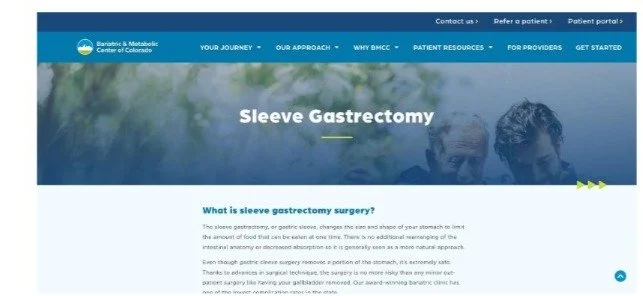
Bariatric & Metabolic Center of Colorado Gastric Sleeve Clinic Screenshot

Here’s the core idea: surgeons remove roughly 75 percent of the stomach, leaving a slender “sleeve” that fills quickly and releases far less hunger hormone. Laparoscopic technique means the operation typically wraps up in 60–90 minutes, requires only a one-to-two-night hospital stay, and helps patients shed 60–80 percent of their excess weight within the first year, according to outcomes detailed on Denver gastric sleeve surgery. Patients then eat child-size meals yet feel satisfied. A 2024 analysis from the American Society for Metabolic and Bariatric Surgery reports average total-body weight loss of around 30 percent one year after sleeve surgery, with durable results a decade later.

BMCC wraps the procedure in full support. You attend required nutrition classes, meet a psychologist, and practice post-op eating with a dietitian before surgery day. Afterward, the same team tracks vitamins, blood sugar, and, crucially, mental health so progress sticks.

Who thrives here? Anyone with a BMI above 40, or above 35 with diabetes, sleep apnea, or similar conditions, and who is ready for a lifelong commitment. Insurance often covers the operation under those criteria, turning a price north of twenty-thousand dollars into manageable co-pays.

Surgery is still surgery, meaning anesthesia, recovery, and a permanent change to how you eat. Yet complication rates now mirror common procedures such as gallbladder removal, and most people return to desk work within two weeks. If you want the biggest, most durable weight-loss tool available, this is it.

Restorative Health of Colorado: medical weight loss & GLP-1 program

You want serious results without an operating room? Restorative Health on West 40th Avenue delivers hospital-grade oversight in an outpatient setting.

Every plan starts with lab work and a one-on-one visit with a physician. We’re talking a full metabolic panel, thyroid check, and body-composition scan. Those numbers guide your dose of semaglutide or tirzepatide, the GLP-1 injections that have dominated obesity research since 2024. Most clients arrive twenty to eighty pounds from goal weight and watch the scale drop ten to fifteen percent in the first six months.

Medication is only half the story. Weekly nurse check-ins catch nausea or fatigue early, and an in-house dietitian rewrites your grocery list so you keep muscle while losing fat. An app reminds you when to take the next shot, logs meals with photos, and nudges you to hit step goals.

Plan to spend about three hundred dollars a month out of pocket unless your insurance covers GLP-1 drugs ahead of Colorado’s 2027 mandate. That price bundles consults, coaching, and medication, often beating national telehealth startups once shipping fees are added.

Is there a catch? Stop the injections and biology pushes back. Roughly half the lost weight returns within a year if habits slip. Restorative Health tapers doses and shifts you into maintenance coaching instead of sending a final bill and a handshake.

For anyone who needs medical firepower but isn’t ready to schedule surgery, this clinic balances convenience, safety, and strong fat-loss numbers.

Healthful Life MD: holistic metabolic makeover

Some weight-loss stalls have nothing to do with willpower. Hormones drift, thyroid levels wobble, stress spikes cortisol, and the scale refuses to budge. Healthful Life MD on Johnson Road exists for these puzzle cases.

Your first visit feels less like a weigh-in and more like detective work. The physician orders hormone panels, food-sensitivity screens, and sleep assessments. Those results feed a personalized roadmap that may include prescriptions, but leans on nutrition coaching, strength-based movement, and mindset shifts.

Because every lever is custom-tuned, progress is slower than with a medication-only plan. Expect about two pounds a week instead of five. Clients rave about side perks such as steady energy, calmer moods, and fewer cravings, all of which make it easier to stay on track.

Pricing runs higher than basic coaching because you are paying for deep testing and monthly follow-ups. Most patients treat it as a health investment, tapping HSA dollars or flex spending accounts to soften the bill.

Ideal Wellness Clinics of Colorado: structured meal program

If cooking, weighing, and macro math make you want to quit before you start, Ideal Wellness has a cheat sheet. The ShiftSetGo plan swaps guesswork for pre-portioned shakes, soups, and protein bars that fit into a three-phase roadmap: rapid loss, transition, and maintenance.

The first phase is strict. Most meals come from clinic products, so calories and carbs stay locked down and early weight loss feels almost automatic. Coaches meet you weekly, swap flavors to fight boredom, and adjust portions the moment progress plateaus. Many members drop two to five pounds per week at the outset, enough to keep motivation high.

Phase two reintroduces grocery-store foods while showing you how to build plates that keep hunger and blood sugar steady. The maintenance phase removes the training wheels but not the accountability. You still check in monthly and can buy products à la carte when life gets hectic.

Costs run a few hundred dollars a month, mostly for the meal kits. Insurance rarely helps, though some members use health-saving accounts. The trade-off is time: zero meal planning, minimal dishes, and no late-night “what can I eat” panic. For busy parents or professionals facing a tight deadline, or a wedding date, structure like this can feel like freedom.

Telehealth GLP-1 services: prescription power without the commute

Maybe your schedule is packed or weekly clinic visits feel like a chore. Telehealth weight-loss platforms offer the same GLP-1 medications discussed earlier, but the consult happens on your phone.

Here’s how it works. You fill out a medical questionnaire, upload photos, and book a short video chat with a board-certified provider. If your BMI and history meet FDA criteria, the doctor e-prescribes semaglutide or tirzepatide. A partner pharmacy ships pens or pre-filled syringes to your doorstep, and an app checks in on side effects and food tracking.

Colorado is telehealth-friendly, so brands such as Found, Calibrate, and Hims accept Golden addresses. Memberships land between one hundred and three hundred dollars per month, with medication sometimes billed through insurance. Several services use compounded versions for cash-pay members when brand-name supply runs tight.

Convenience is the headline benefit: no traffic, no waiting rooms, and you can message your care team at 10 p.m. The trade-off is less hands-on support—no in-person dietitian or body-composition scans—so self-discipline and honest data entry matter more here than anywhere else.

Worth It Healthy Living: personal training & nutrition coaching

Some of us feel motivated less by macros and more by movement. Worth It Healthy Living pairs you with a certified trainer who also serves as a nutrition coach, designing workouts and meal tweaks that match your schedule and any injuries.

Sessions can happen at a local gym, in your garage, or over Zoom. Each plan leans on strength training and limits fluff cardio because muscle keeps metabolism humming while fat melts. Expect two or three guided workouts a week with homework walks or mobility drills between sessions.

Weight tends to drop at a steady, healthy pace, usually one to two pounds per week, but the real payoff shows in tighter jeans, stronger deadlifts, and energy that lasts past 3 p.m. Clients stick with the program longer because they enjoy seeing progress in the mirror and on the barbell.

Packages start around fifty dollars a session. There is no insurance code for “someone who texts you to remind you to plank,” but many members treat it like therapy for their body and plan their budget accordingly.


WeightWatchers & community support programs

The power of a check-in crew is hard to beat. WeightWatchers (WW) has led group-based weight loss for decades, and the model still works: a flexible Points program, a mobile app for food logging, and weekly meet-ups in Lakewood, Arvada, or on Zoom for accountability.

Average members drop about five percent of their starting weight in the first year, often enough to reduce blood-pressure medication. Meetings feel like friendly huddles, not lectures, and the program costs less than a night out each month.

Golden locals often layer WW with free tools such as MyFitnessPal for calorie awareness, r/loseit threads for memes and motivation, or a hiking buddy for weekend steps. Progress is slower than with surgery or injections, yet the skills you learn—portion sense, balanced plates, stress-eating fixes—stick long after the scale victory selfie.

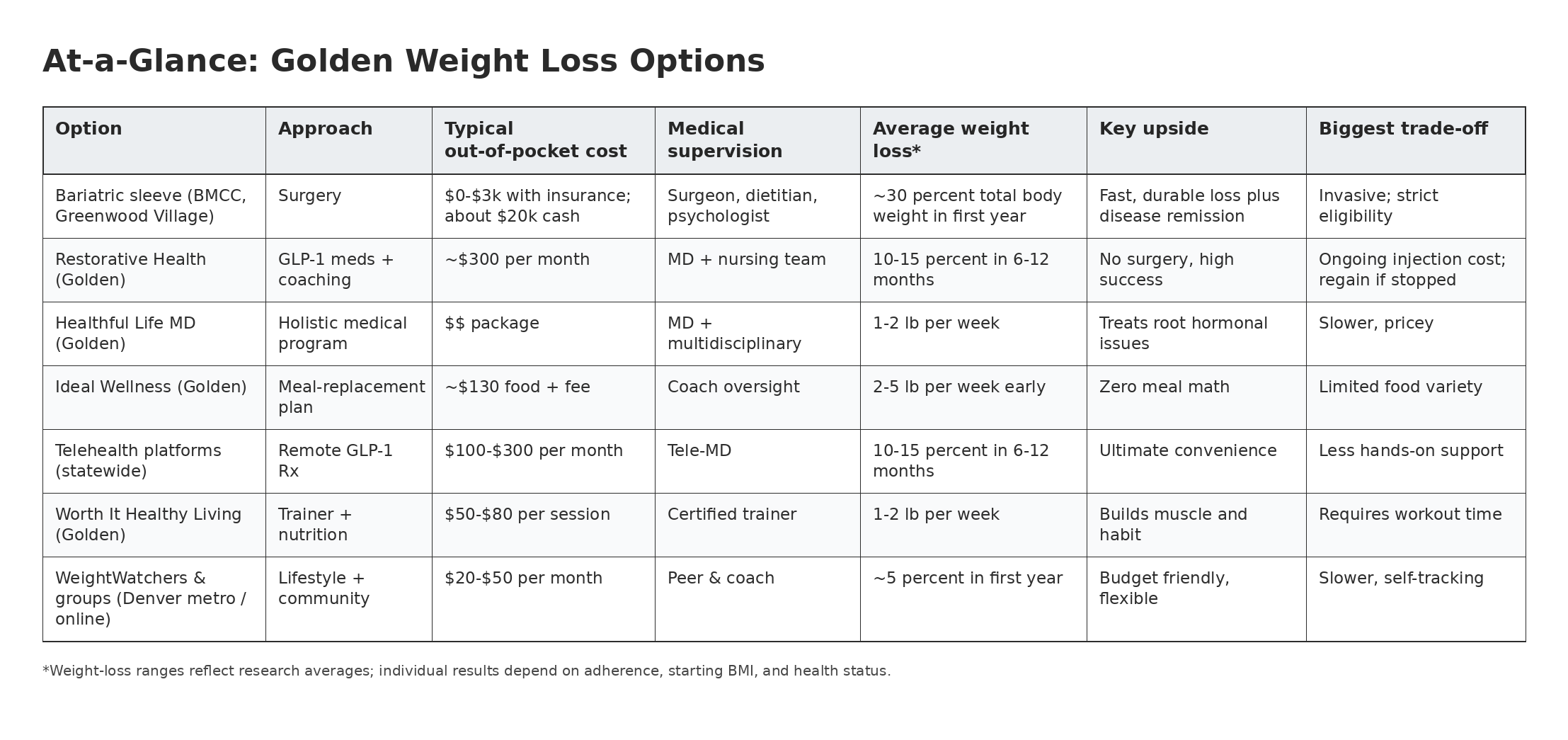
At-a-glance comparison of your options

Here’s a side-by-side look at cost, medical oversight, and typical results so you can quickly spot the plan that fits your goals and budget.


*Weight-loss ranges reflect research averages; individual results depend on adherence, starting BMI, and health status.

Frequently asked questions

How do I pick the right path for me?

Match the size of your goal to the strength of each tool. If you need to lose 100 pounds and reverse diabetes, surgery or a physician-run GLP-1 program brings the horsepower. If you are chasing the last 20 pounds, coaching or WW can finish the job. Budget and personality matter just as much. Pick the option you can follow for a full year, not the one that only looks good this week.

Will my insurance pay for weight-loss care?

Insurance often covers bariatric surgery when your BMI is above 40, or above 35 with health complications, and you complete the required diet and psych steps. Coverage for GLP-1 drugs is improving ahead of Colorado’s 2027 mandate, but plans still vary. Call the number on your card and ask two questions: “Do you cover the medication name for the obesity code E66.9?” and “What prior authorization is required?” Write the answers down for later.

Do I have to stay on Ozempic forever?

GLP-1 drugs curb appetite while you take them. Stop suddenly and biology pushes back, often regaining half the lost weight within a year. Many doctors taper to a low maintenance dose while adding resistance training and protein to hold the line. Plan for at least a year of medication plus a clear exit strategy.

How can I keep muscle while dropping fat?

Lift something heavy two or three times a week, eat about 0.7 grams of protein per pound of goal body weight, and avoid crash diets that cut calories below 1,200 for women or 1,500 for men. Muscle burns calories even at rest, so protect it.


Is rapid weight loss dangerous?

Fast loss is safe when supervised, such as post-surgery or with medical shakes under lab monitoring. DIY extreme diets without guidance risk gallstones, nutrient gaps, and muscle loss. If a plan removes entire food groups or promises ten pounds in ten days, look for clinical backing first.

Final takeaway

Weight loss is never one-size-fits-all, and Golden offers an option for every lifestyle and urgency level, from surgical overdrive to community-powered slow burn. Pick the path that excites you, book an info session this week, and commit to the first small step. Future you will thank present you for making the decision, not just the plan.

Sources & further reading

  1. American Society for Metabolic and Bariatric Surgery. “Bariatric Surgery More Effective and Durable Than New Obesity Drugs.” June 2024.

/
script>