Your Furnace's Odd Noises, Decoded: What Each Sound Is Telling You
Count the sounds your furnace makes tonight. Most homeowners can name at least three, and half of them have convinced themselves the noises are normal. A furnace is one of the few machines in your house that talks to you before it quits, and almost nobody is listening. The bang at startup, the whine that climbs, the whoosh that never used to be there: each one traces back to a specific part doing a specific job badly.
I spent enough time standing next to cold-air returns with a homeowner to know the panic is usually worse than the problem. But not always. A few of those sounds are a five hundred dollar fix today and a full replacement in March. You can sort your own furnace racket into categories within a minute, and that is exactly what the rest of this piece walks you through.
Why Furnaces Get Loud Before They Get Broken
A furnace is a metal box full of moving air, spinning metal, and controlled fire, so a quiet one is a well-tuned one. The blower pushes a set volume of air through ductwork sized for exactly that volume. When a filter clogs or a blower wheel collects dust, the blower has to work harder to move the same air, and that extra effort shows up as sound before it shows up as a temperature problem.
Homeowners often call for heating services from All Aboard the week their system finally quits, and the honest timeline is that most of those calls could have happened a month earlier with a smaller bill. If you want a repair technician to arrive already knowing what a normal furnace cycle sounds like, put your ear to the return vent during startup and during shutdown. Write down what you hear. That baseline is worth more than any manual.
Startup sounds versus mid-cycle sounds
Startup is a sequence. The thermostat calls for heat, the igniter glows, the gas valve opens, the burners light, and the blower kicks on a moment later. Each step has a signature sound, and problems announce themselves at one specific step. Mid-cycle noise is different, because everything is already running, so a new sound there points to mechanical wear, airflow restriction, or a motor overheating. Separate your sounds by timing first, then by description.
The Bang, the Boom, and the Delayed Ignition
A single loud boom on startup, followed by normal operation, is the classic delayed ignition signature. Gas has been building in the burner compartment because the ignition source lit late. When it finally catches, you get that puff. A dirty burner, a weak igniter, or a misaligned flame sensor all produce it.
One bang a season is annoying. Three bangs a week is a parts-and-timing problem you should not sit on, and it is worth having someone look before the next heating cycle. The U.S. Department of Energy publishes basic furnace efficiency guidance that covers how a properly tuned burner saves fuel, though it will not tell you what a boom means. That takes ears.
What a High-Pitched Whine Is Trying to Tell You
Whines come from spinning things. The blower motor, the inducer motor, or a belt, depending on how old your furnace is. A steady whine that starts when the blower starts usually means bearing wear or a loose belt. A whine that climbs in pitch and then stops when the furnace shuts off points to a motor struggling against a restriction, and the most common restriction is a filter you forgot about. Reach under the unit, pull the filter, and look at it against a light. If you cannot see light through it, you found your whine.
Older belt-driven furnaces make a flap or squeal when the belt glazes or cracks. Newer units do not have belts at all, so a whine there is motor or wheel. Either way, bearing noise tends to get worse faster than people expect, so a whine that has been going for two months is a whine on borrowed time. I would rather replace a blower motor on a Tuesday afternoon than diagnose a seized one in a snowstorm.
Hums, Buzzing, and the Sounds You Should Take Seriously
An electrical hum from the control board area is a low, steady buzz, and a faint version is normal. A loud one, especially paired with a shutoff, points to a relay, transformer, or capacitor. Do not open the electrical panel yourself. Turn the system off at the breaker and call someone.
A rattling buzz from what sounds like a light switch or a wiring box can be worse. The EPA's indoor air quality resources exist because homes are closed systems, and anything burning fuel inside one deserves attention. If you smell gas with the hum, leave the house and call the gas company before you call anyone else.
Rumble, rattle, or scrape: the three-tier noise test
The tiers below are how I sort sounds before deciding what comes next, and you can apply the same test without a toolbox. The idea is to judge noise by what it suggests is moving, not by how loud it is.
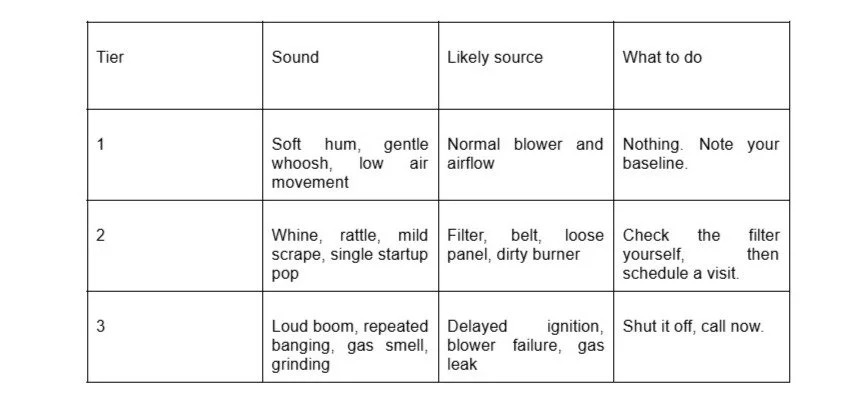
The table is not a replacement for a technician. It is what keeps you from panicking at a tier 2 sound and from ignoring a tier 3 one.
How to Narrow Down Your Furnace Noise in 10 Minutes
You can do most of this yourself, and the point is to give whoever you call a better starting place.
Write the sounds down in your own words, with timing. Startup, mid-cycle, or shutdown. That alone narrows the list by half.
Swap the filter, even if it looks fine. A cheap filter replacement rules out the most common cause of whine and airflow noise.
Walk around the unit and tap lightly on the panel. If a rattle changes when you touch it, the panel or a screw is loose.
Listen at the return vent and at the supply vent separately. A sound at the return points to the blower; a sound at the supply points to ductwork.
Note the thermostat reading and whether the system reaches it. A furnace that struggles to hit temperature while making noise is a different problem than a furnace that hits range and shuts off.
Write down the model number on the data plate. It saves everyone a phone call.
That is it. The filter, the panel, and the timing note cover most of the diagnostic work a homeowner can safely do.
The Calls You Can Make Before Winter Gets Serious
A technician arriving already knowing what your furnace sounds like at startup, and how that changed, is a technician spending the visit on the right part. The Home Innovation Research Labs, a subsidiary of the National Association of Home Builders, documents how home construction and mechanical systems interact, and the pattern is the same everywhere. Confined mechanical systems run noisier when airflow is compromised.
Sort your sounds tonight. Filter first, tier two next week, tier three now. Your furnace has been trying to describe what is wrong for a while. Start listening, and you will pick up the phone before the cold snap picks it for you. Which sound is yours?