How to Spot the Difference Between Two Therapy Styles (Without a Psych Degree)
Two three letter acronyms sit on almost every treatment brochure: CBT and DBT. They get printed side by side, priced the same, and explained in language that sounds like it was written for a licensing exam. Nobody hands you a decoder ring.
Here is the short version. CBT is built to catch and correct the thinking that feeds a craving. DBT was created for people whose emotions hit like a fire alarm and whose old coping tools made things worse. If you have ever watched someone relapse not because they wanted to use, but because they had no idea what to do with a feeling, that gap between the two is the whole story.
Counselors at a place like Redemption Addiction Treatment Center will usually tell you the styles are not rivals. They are tools sized for different jobs. The tricky part is figuring out which job you actually have, and most people are never asked.
CBT in plain English
Cognitive behavioral therapy works on the loop between a thought, a feeling, and a behavior. A guy walks past his old corner. His brain whispers one line: they all think you failed. The shame hits, then the urge, then he is calling a number he swore he deleted. CBT targets that whisper. You learn to spot the thought, test whether it is true, and swap it for something more accurate before it snowballs.
It is structured. You leave sessions with worksheets, thought logs, and small homework assignments. For someone who likes to do lists, this feels productive fast. For someone who finds worksheets cold, it can feel like homework from a teacher you never liked.
The evidence base behind it is deep. Behavioral therapies as a whole are among the approaches with the strongest research support in substance use care, according to the National Institute on Drug Abuse, which has funded and reviewed this research for decades. That does not mean CBT wins every matchup. It means the model has been tested hard.
Where DBT starts to look different
DBT grew out of CBT because one clinician kept meeting patients the standard model could not hold. Marsha Linehan noticed that people with intense emotional swings were being told to change, and they read it as one more person saying they were broken. So she built a therapy that starts with that tension and holds both sides at once: your pain is real, and you still have to change something.
The core of it is distress tolerance. What do you do in the ninety seconds after a fight with your brother when your chest is tight and your phone is already in your hand? DBT gives you specific, blunt skills for those ninety seconds. Cold water on the wrists. A paced walk. Counting backward from a hundred by sevens. None of it sounds elegant. All of it works when your brain has gone offline.
I would pick DBT first for anyone whose relapse pattern is emotional, not situational. If you can name the last three times you used and they all followed a blowup, a rejection, or a night of spiraling, that is a signal. Skills that buy you time in the moment matter more than a worksheet you fill out the next morning.
How the two compare side by side
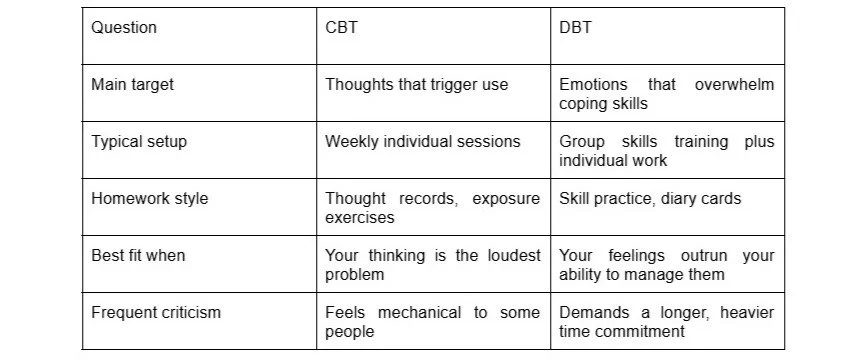
The table hides the real difference, which is tone. CBT walks in with a clipboard. DBT walks in with a clipboard and a hand on your shoulder.
What recovery support actually looks like in practice
Nobody gets a clean, academic menu of options. In real programs the two models blend, and the blend is wider than most brochures suggest. Group sessions often teach DBT skills. Individual hours lean CBT. Family sessions borrow from both. That mixing is normal and generally better than a rigid single approach.
What matters more than brand names is whether the people running your program can explain their choices out loud. Ask why this module comes first. Ask what happens on a bad night when a skill fails. A confident counselor will answer without reaching for a script.
One more thing worth knowing. Behavioral health care in the United States is delivered through a patchwork of public and private systems, and the Substance Abuse and Mental Health Services Administration maintains a national treatment locator that many people never hear about. If you are building a care plan and the local options feel thin, that resource is a reasonable place to widen the search.
A four step way to decide
Skip the abstract debate and run this quick process instead.
Write down your last three slips or relapses. Next to each one, note what came right before: an argument, a quiet mood crash, or a specific thought about yourself.
Count the pattern. Three blowups point toward DBT. Three thought spirals point toward CBT. A mix is a mix, and you should say so.
Interview the program on that basis. Ask what they would do with your pattern, not what therapy they prefer in general.
Set a check in date. Four weeks in, ask yourself whether you can describe one skill you now use without looking it up. If not, adjust.
This process is my own, and it beats any comparison article because it starts with your history instead of a definition. Counselors respond differently when you arrive with specifics. You stop being a slot on a schedule.
The honest limits of the labels
Neither acronym guarantees an outcome. Therapy quality depends on the person across from you, your willingness to be uncomfortable in a room with a stranger, and how long you stay. A great CBT counselor beats a mediocre DBT program every time, and the reverse holds just as true. The model is the map. The person walking it with you is the trip.
Also worth saying plainly: if your situation feels urgent, skills talk can wait and a crisis line cannot. Get help first, compare methodologies second.
Before you sign anything
The two styles are not a personality test and not a permanent tattoo. You can start with thought work and move toward emotional skills when the pattern shifts. What you should not do is choose based on whichever acronym appears higher on a webpage.
Look at your last three bad nights. Then look at the program that claims to have an answer for them. If the answer is specific, you are in the right conversation. If it is a paragraph copied from a textbook, keep asking. Which of your last three hard moments would you actually know how to handle right now?