Yacht Charter in Mykonos and 5 Other Ways to Spend a Cycladic Summer
Mykonos has a reputation that often arrives before the island itself: white cube houses, beach clubs, a busy old port. The island is, however, more layered than the postcard image. It works as a base for sailing the wider Cyclades, for short archaeological visits, and for quiet swims at bays the day-tripper crowd tends to miss. The notes below cover the practical side of arriving by water, plus five other ways to use a week on the island.
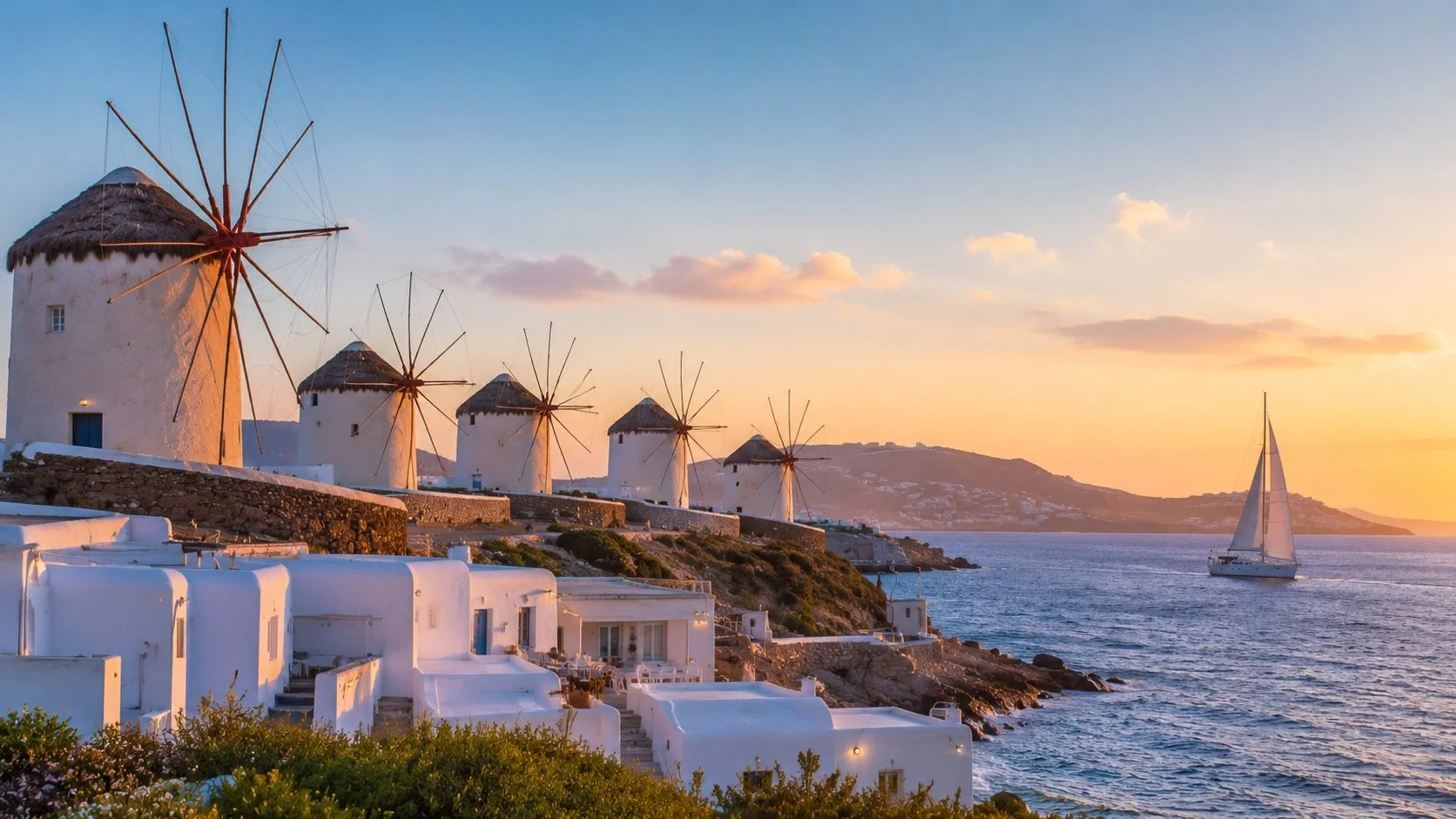
Yacht Charter in Mykonos
Most bareboat departures happen from Tourlos, the New Port a couple of kilometres north of Chora. The marina has fuel, water and provisioning within walking distance, and check-in usually takes a morning. The Old Port closer to town is for small craft and tenders, not for picking up a charter boat. Wind in July and August is dominated by the meltemi, a north-northwesterly that can push 6 Beaufort for days at a time, so most weekly itineraries plan downwind first and return on lighter shoulders of the system.
From Tourlos the short-range options are easy. Delos and Rinia sit a couple of nautical miles west and make a comfortable day trip, with a sheltered anchorage on Rinia's eastern coast. South-west, Paros is roughly 25 nm and the well-protected Naoussa bay gives a good first overnight. Naxos lies a similar distance south, Tinos is a half-day hop north, and Syros sits further west with the only real city in the group, Ermoupoli. Crews with more time and a careful meltemi forecast push on to Santorini, around 70 nm south, where moorings are limited and anchoring is deep.
If you want a yacht charter in Mykonos and compare available boats for your dates, the booking site lists current options. Bareboat means the skipper on board holds a recognised licence — ICC, RYA Day Skipper, IYT Bareboat or equivalent and is responsible for the boat and crew. VHF practice and a basic understanding of meltemi behaviour matter more here than in calmer cruising grounds.
A few practical notes for self-skippered crews:
Provisioning: there is a large supermarket near Tourlos and several smaller shops in Chora; load water and ice before leaving the dock.
Anchorages around Mykonos: Ornos and Platis Gialos on the south coast are usable in meltemi, Panormos on the north only in calm weather.
Customs: standard Schengen rules; if arriving from Turkey, clear in at Kos, Rhodes or Samos before reaching the Cyclades.
Mykonian Food
The island's food tradition is older than its club scene, and it survives mostly in the inland village of Ano Mera and a few corners of Chora. Three things are worth tracking down:
Kopanisti — a sharp, peppery cheese fermented in clay pots, eaten with bread or used as a dip.
Louza — air-cured pork loin, thinly sliced, usually served cold with bread or as part of a meze plate.
Mostra — a rusk topped with grated tomato, kopanisti and olive oil, the local answer to the better-known Cretan dakos.
For sit-down meals, the tavernas around the main square of Ano Mera serve grilled fish, slow-cooked goat and stuffed vegetables at prices noticeably lower than the seafront in Chora. In town, the back streets behind the Aegean Maritime Museum hide a handful of older family-run places. Seafood is good but priced by weight, so it pays to look at the catch before ordering. Bakeries sell amygdalota, almond biscuits dusted with icing sugar, useful as a passage snack.
The Delos Archaeological Day Trip
Delos is a UNESCO World Heritage Site and one of the most important archaeological zones in the Aegean. The island was a sanctuary of Apollo, a Hellenistic trading hub, and at its peak housed something like 25,000 residents on a strip of land less than five square kilometres. Today no one stays overnight — the entire island is a protected open-air museum, open during daylight hours.
For self-skippered crews this is straightforward. Anchoring is not permitted off Delos itself, but the channel between Delos and Rinia has good holding in sand at 5–8 metres and is sheltered from the meltemi by Rinia's western ridge. The usual routine is to anchor on the Rinia side in the morning, take the tender across to the Delos jetty, pay the entrance fee and spend three to four hours on the site.
The walk covers the Terrace of the Lions, the theatre, the House of Dionysus with its intact mosaics, and the climb up Mount Kynthos for the view. Bring water, a hat and closed shoes — the marble is uneven and shade is scarce. The site museum is small but worth twenty minutes for context. Back on board by early afternoon, most crews swim off Rinia for the rest of the day, then either overnight there in settled weather or motor the four miles back to Tourlos.
Cultural Sightseeing in Chora
The old town of Mykonos rewards aimless walking more than a checklist, but a few places are worth the detour:
Little Venice — a row of 18th-century merchant houses built directly over the water, best seen late afternoon when the light is on the facades.
The Windmills (Kato Mili) — five of the original sixteen 16th-century mills, set on the low ridge above Little Venice; the view back over Chora is the most photographed in the Cyclades.
Aegean Maritime Museum — a small private collection of ship models, navigation instruments and Cycladic maritime history, useful background for anyone arriving by sea.
Panagia Paraportiani — a whitewashed cluster of five chapels merged into one structure, on the headland between the Old Port and Little Venice.
Monastery of Panagia Tourliani — in Ano Mera, an 18th-century complex with a carved wood iconostasis and a small ecclesiastical museum.
Chora is mostly pedestrian and deliberately confusing — the lanes were laid out to slow pirate raids. A paper map is more useful than a phone here, and an hour before sunset is the quietest window.
Beach Time
Mykonos divides its coastline cleanly between organised beaches with sunbeds and clubs, and quieter bays that require a walk or a tender. Among the better-known names on the south coast, Paradise and Super Paradise are the busiest and the loudest, both with full beach-club setups and steep daybed prices in season. Elia is the longest sandy beach on the island and slightly more relaxed, with a mix of organised sections and free sand at the eastern end.
For something quieter, head north or east:
Agios Sostis — no road access to the beach itself, no sunbeds, and a single taverna up on the bluff; bring water.
Fokos — a long sand-and-pebble bay on the northeast coast reached by a rough dirt track, with one seasonal taverna and otherwise nothing.
Kapari — a small cove near Agios Ioannis on the west, sheltered from the meltemi and useful as a lunch anchorage.
The wind-exposed beaches on the north and east — Ftelia and Korfos — are the windsurfing and kitesurfing spots when the meltemi is up. Schools operate at both in season and rent gear by the hour. For boats, the south coast offers the only reliable lunch anchorages in summer; the north is for calm windows only.
Nightlife in Chora, or a Quieter Day at Rinia
Two options for the last evening, depending on the crew. Chora has the most established night scene in the Cyclades, concentrated in Little Venice for sunset bars and along Matogianni Street for later venues. Prices are high and the season is short — June to mid-September. Booking ahead for the better-known places is standard, and dress codes are stricter than the daytime would suggest.
The alternative is to stay on the boat and run across to Rinia for the afternoon and evening. The island is uninhabited apart from a handful of seasonal shepherds, has clear water, no facilities and no light pollution. For crews who have spent a week threading busy anchorages, an empty bay with a grill on the stern is often the part of the trip that stays with them. The motor back to Tourlos in the morning takes under an hour, which leaves time to clean the boat before handover.