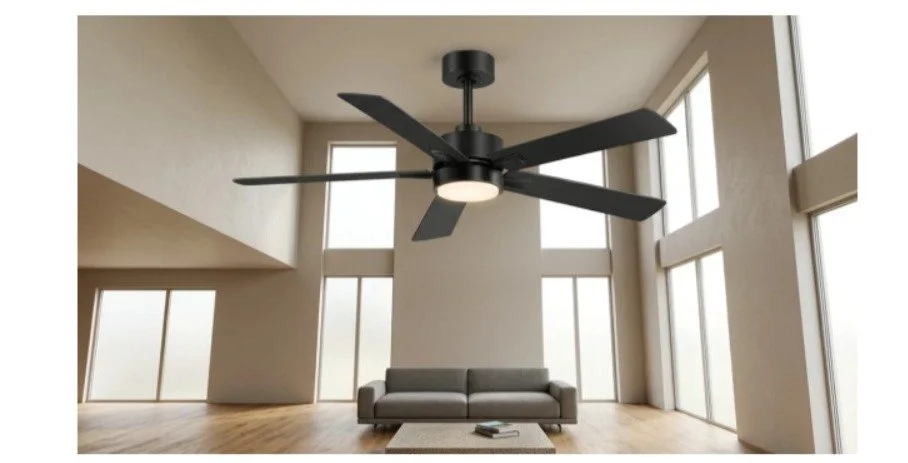
What Are the Best Large Ceiling Fans With Lights for High Ceilings?
The best large ceiling fan with lights for a high ceiling is not automatically the widest, most expensive or highest-blade-count model. It is the fan whose documented blade span, airflow, mounting system, lighting and controls fit the room as it will actually be used. A dramatic fan can look proportionate beneath a tall ceiling and still perform poorly if it hangs too high, produces too little airflow or places the light far above the living zone.
Homeowners comparing different large ceiling fans with lights for high ceilings should check each model's published blade span, airflow, lighting specifications and downrod compatibility before choosing it for the room.
In many genuinely large residential spaces, shoppers begin by comparing fans with spans of 60 inches or more. That is only a starting point. Room length and width, ceiling geometry, furniture placement, nearby beams, the desired installed height and the fan's documented airflow all matter. The right choice is a specification match, not a size label.
Quick answer: Look for a large fan with documented airflow, a downrod system compatible with the required drop, clear slope limits for vaulted ceilings, sufficient LED output, separate fan and light controls, and installation requirements that match the room.
What Makes a Large Ceiling Fan Suitable for a High Ceiling?
Blade Span Must Match the Room, Not Just the Ceiling Height
A high ceiling and a large room are not the same thing. A narrow two-story foyer can be tall but have limited blade clearance. An open great room may have a broad floor area and need a wider sweep. A long family room may even have two usable zones instead of one obvious center point. Measuring only floor-to-ceiling height misses these differences.
Start with the full usable dimensions of the room. Then locate walls, beams, cabinets, tall furniture, pendant lights and other fans. Check the clearance required by the model rather than assuming that a fan advertised as 60, 72 or 84 inches will fit. In open-plan spaces, measure the zone the fan is expected to serve, not just the total square footage of every connected area.
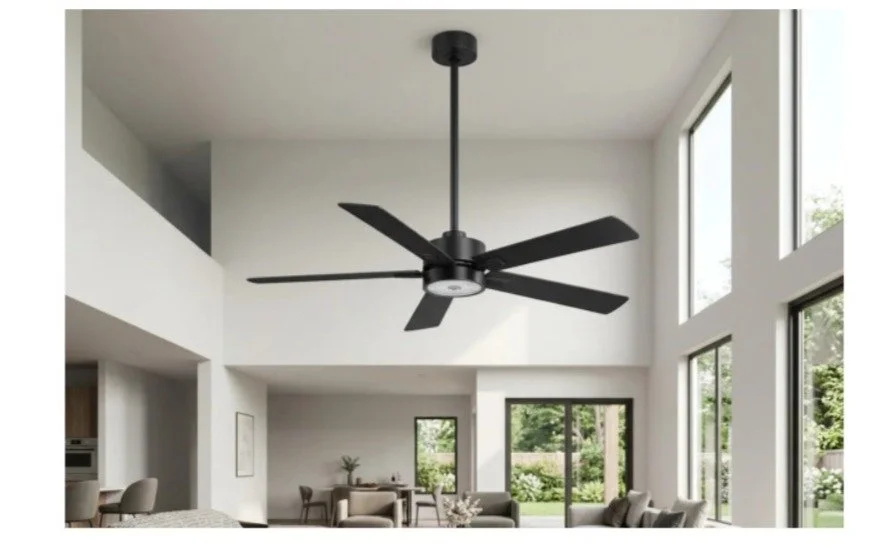
Documented Airflow Matters More Than Blade Count
Blade diameter helps describe coverage, but it does not prove airflow. Two fans with the same span can move different amounts of air because motor torque, blade pitch, rotational speed and blade design work together. The most useful comparison is the manufacturer's documented airflow, commonly expressed in cubic feet per minute, alongside the speed settings and the room in which the fan will operate.
This is especially important under a high ceiling. A wide fan that moves modest air may create less noticeable circulation at the occupied level than a well-matched model with stronger documented output. At the same time, maximum CFM should not be treated as the only measure of comfort. Low-speed performance, control range, stability and placement also shape the everyday experience.
Motor and Speed Control
DC motors are common in large residential ceiling fans because they can support multiple speeds, compact housings and efficient operation. That does not make every DC model equally quiet, powerful or durable. Compare the complete product: published airflow, number of speed settings, reversible operation, control method, warranty language and the availability of installation documentation. Claims such as 'silent' or 'high performance' are not substitutes for model-specific details.
How Far Should a Ceiling Fan Hang From a High Ceiling?
A fan mounted close to a very high ceiling can end up too far from the occupied zone to deliver the expected comfort. A commonly used residential target places the blades roughly 8 to 9 feet above the floor, but required minimum clearances, room use and the manufacturer's instructions take priority. The correct calculation must include the fan body, not just the downrod.
Working estimate: Downrod length = ceiling height - desired blade height - the vertical distance from the downrod connection to the blades. Confirm the result against the fan's installation drawing and compatible downrod options.
For a sloped or vaulted ceiling, measure from the actual mounting point. Also identify the lowest blade edge and the lowest point of the light. A long downrod changes the fan's position relative to beams, windows and walls, so horizontal clearance must be checked again after the vertical drop is estimated.
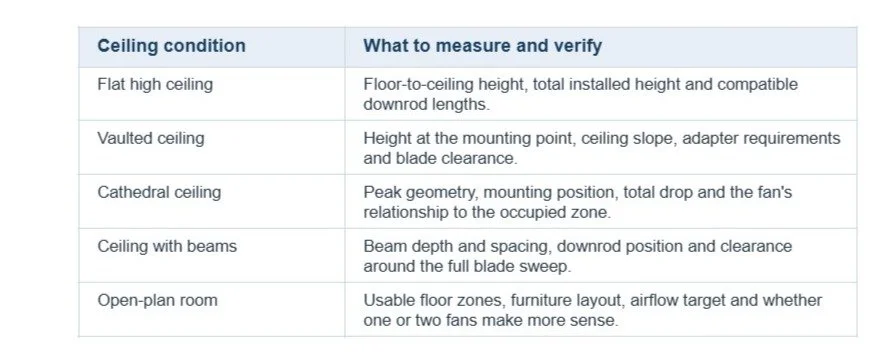
A broader comparison of large ceiling fans for high ceilings can help buyers evaluate different blade spans, mounting configurations and downrod requirements before narrowing the choice.
How to Choose the Right Blade Span for the Room
Measure the Entire Usable Area
Room area is a useful first filter, but the fan also needs an unobstructed sweep and a sensible center point. Record the room's length and width, the location of structural beams, the position of major light fixtures and the distance from the proposed mounting point to the nearest wall. In a large bedroom, include the bed, wardrobes and any sloped portions of the ceiling. In a living room, consider tall shelving, double-height windows and open connections to dining or kitchen areas.
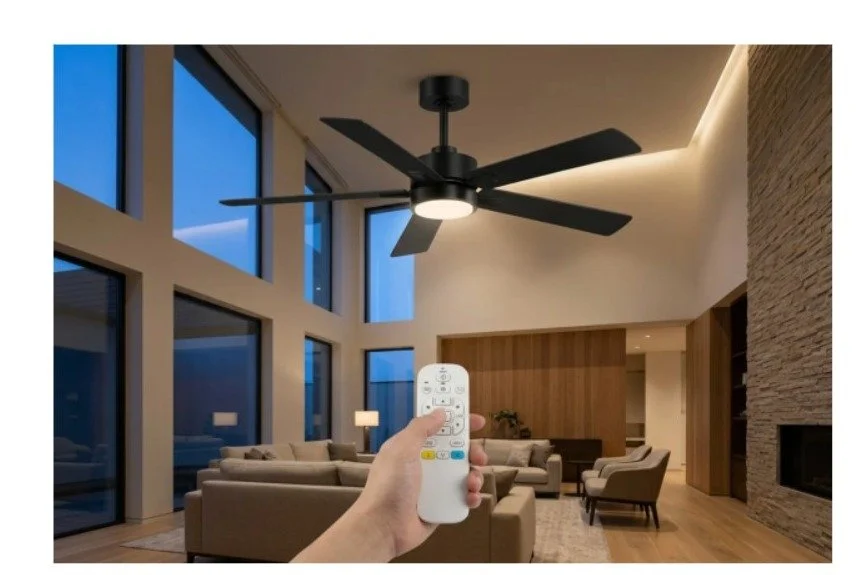
Compare 60-, 72- and 84-Inch Fans as Categories
A 60-inch fan can be a useful starting category for some larger residential rooms. A 72-inch fan provides a broader diameter to compare for open living areas and great rooms. An 84-inch or larger model may be worth considering in very broad or very tall spaces. None of these sizes guarantees suitability. The documented airflow, actual clearances and installed height still decide whether the model belongs in the room.
When Two Fans May Be Better Than One
One oversized fan is not always the best answer for a long rectangular room or a divided open-plan space. Two appropriately positioned fans may distribute air more evenly, but they require separate checks for spacing, electrical support, blade overlap, controls and visual balance. The choice should be planned around airflow zones rather than made solely to fill the ceiling visually.
How Much Light Does a High-Ceiling Fan Need?
Compare Lumens Instead of Wattage Alone
Wattage describes power use; lumens describe visible light output. For a fixture mounted high above the room, the published lumen figure is a more useful starting point, although it still does not predict how bright the room will feel. Mounting height, diffuser design, beam spread, wall color and the presence of other lighting all influence the result.
A ceiling fan light may provide general ambient light while recessed fixtures, pendants or lamps handle task lighting. In other rooms, the fan may be expected to do more of the work. Define that role before comparing products. There is no single lumen target that is automatically correct for every high-ceiling living room or bedroom.
Integrated LED or Replaceable Light Kit?
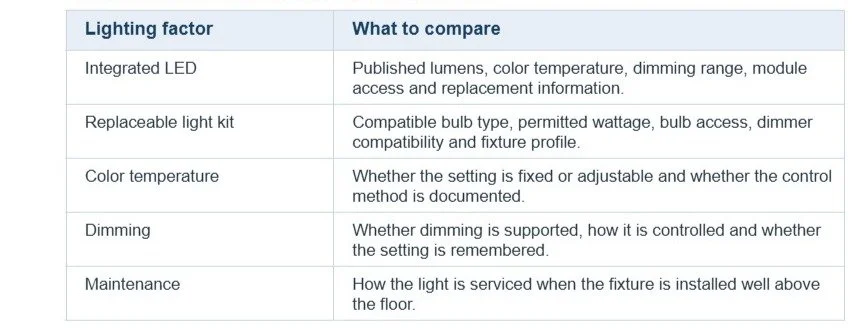
When lighting is a major part of the purchase decision, comparing large ceiling fans with lights makes it easier to check LED configurations, light output, controls and mounting requirements across different models.
Best Features for Different High-Ceiling Rooms
Large Living Rooms and Great Rooms
Prioritize documented airflow, a blade span that fits the usable zone and a lighting system that works with the room's other fixtures. Separate fan and light control is particularly useful in a multipurpose space. If the room has a fireplace, tall windows or an open stairwell, fan placement may matter as much as diameter.
High-Ceiling Bedrooms
Low-speed control, easy light dimming and convenient operation are central in a bedroom. Check whether the remote can switch the light and fan independently, whether a memory function is documented and whether indicator sounds or bright receiver lights could be distracting. The installed height should also be assessed in relation to the bed and any sloped ceiling areas.
Vaulted and Cathedral Ceilings
A fan intended for a sloped ceiling needs more than a long downrod. Confirm the maximum supported slope, whether an adapter is required, the permitted mounting hardware and the space needed for the canopy and downrod to hang correctly. A visually centered fan is not automatically positioned at the best height for air movement.
Very High Ceilings
For very high installations, downrod compatibility, control access and maintenance deserve extra weight. Determine how the light module, receiver and motor components can be serviced. A remote or wall control is more practical than relying on a pull chain, and the control receiver must be compatible with the fan and mounting configuration.
Covered Outdoor High Ceilings
A covered patio or outdoor room introduces moisture and weather exposure. Do not assume that a fan described as indoor or indoor/outdoor is appropriate without checking its documented location rating. The fan, light and controls should all be suitable for the specific installation conditions. A roof overhead does not automatically remove exposure to humidity or wind-driven moisture.
Are Remote Controls Important for High-Ceiling Fans?
Remote controls are especially useful when a fan is installed well above normal reach. The best setup allows the user to change speed and lighting without depending on a pull chain. Compare the actual functions: fan speeds, light on/off, dimming, color-temperature selection, timer, reverse control and memory. Not every remote provides every feature, even when the product page uses similar language.
Wall controls can be convenient for a fixed location, while app or smart-home control may be useful in some households. These features should be treated as model-specific. Do not assume app support, voice control or platform compatibility unless it is documented for the exact fan.
Are 3-Blade or 5-Blade Fans Better for High Ceilings?
Blade count alone does not determine which fan is better. Three-blade, five-blade and multi-blade designs can all work in large residential spaces. The number of blades strongly influences appearance, but it does not independently prove airflow, efficiency or quiet operation. A well-engineered three-blade fan can outperform a poorly matched five-blade fan, and the reverse can also be true.
Use published airflow, blade span, speed range, motor details and installation requirements to compare performance. Choose blade count for the desired balance of visual style and verified specifications, not because more blades are assumed to move more air.
How to Compare Large Ceiling Fans Before Buying
A comparison is useful only when the same fields are checked for every model. Marketing labels such as extra large, quiet, modern or top rated should not replace the underlying specifications.
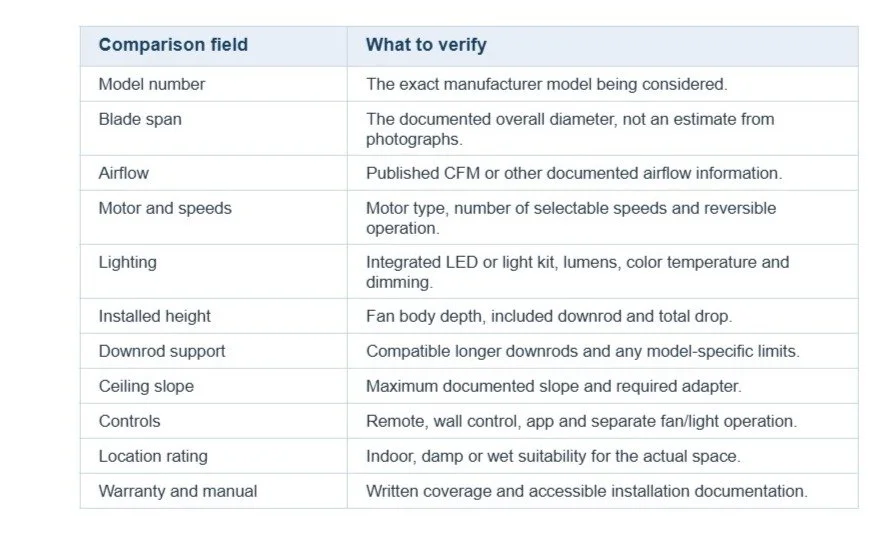
Installation and Safety Checks Before Ordering
High-ceiling installations magnify planning errors because the fan is harder to reach after installation. Before ordering, confirm the following items with the product documentation and installer:
· The electrical box and supporting structure are intended to carry a ceiling fan.
· The proposed mounting point provides the required blade clearance from walls, beams, lights and furniture.
· The fan supports the required downrod length and ceiling slope.
· The final blade height and lowest light point suit the room and applicable requirements.
· The downrod, canopy, slope adapter and control receiver are compatible with the exact model.
· The fan's location rating matches an indoor, damp or wet environment as applicable.
· The light and control components can be maintained after the fan is installed.
· A qualified installer is available when the height, wiring or ceiling structure makes the project complex.
Final Verdict
The best large ceiling fan with lights for a high ceiling is the model that fits measurable requirements: room dimensions, blade clearance, documented airflow, total installed height, downrod compatibility, ceiling slope, light output and control access. A wide fan may be suitable for a large open living room, while a tall but narrower room may require a different combination of span and airflow.
For vaulted, cathedral or very high ceilings, mounting geometry and final blade position are as important as appearance or motor type. Compare actual specifications and installation documents before relying on labels such as best, top rated or extra large. The strongest choice is the one that can be shown to match the room before it is suspended overhead.
FAQs About Large Ceiling Fans With Lights for High Ceilings
What type of ceiling fan is best for high ceilings?
A suitable high-ceiling fan has a blade span and documented airflow that match the room, a compatible downrod system, clear slope requirements when needed, adequate light output and controls that are practical at the installed height. No single motor type, blade count or size is best for every room.
What are the best ceiling fans for very high ceilings?
For a very high ceiling, prioritize models with documented support for the required downrod, clear installed-height drawings, remote or wall controls and accessible maintenance information. Room dimensions and airflow still determine the appropriate blade span.
How large should a ceiling fan be for a high ceiling?
Ceiling height alone does not determine fan diameter. Measure the room's usable length and width, blade clearances and mounting position, then compare those conditions with each model's blade span and documented airflow.
How long should a downrod be for a high ceiling?
Estimate the downrod by subtracting the desired blade height and the fan body's vertical allowance from the ceiling height. Confirm the result with the exact model's installation drawing, compatible downrod options and applicable clearance requirements.
Do high-ceiling fans need more lumens?
A light mounted high above the floor may need stronger output or support from other fixtures, but there is no universal lumen target. Consider room use, mounting height, diffuser design, wall colors and the contribution of recessed lights, pendants and lamps.
Are DC ceiling fans better for high ceilings?
A DC motor can offer multiple speeds and efficient control, but the motor label does not prove that a fan is suitable. Compare documented airflow, downrod compatibility, controls, stability, warranty and installation requirements for the exact model.
Are 3- or 5-blade ceiling fans better?
Neither blade count is automatically better. Blade design, diameter, pitch, motor and speed work together. Compare documented airflow and operating features, then use blade count as one part of the visual design decision.
Can a large ceiling fan be installed on a vaulted ceiling?
Some large fans can be installed on vaulted ceilings when their documented slope limit, canopy, downrod and any required adapter suit the ceiling. Verify the exact model and measure blade clearance from the sloped surface, beams and nearby fixtures.
Can a ceiling fan be too large for a high-ceiling room?
Yes. A tall ceiling does not remove horizontal clearance limits. A fan can be too wide for the usable room area or too close to walls, beams, lights or furniture. Compare the full blade sweep, mounting position and documented airflow before choosing a larger diameter.
Are remote controls important for high-ceiling fans?
A remote or compatible wall control is practical when the fan is installed beyond normal reach. Check whether the exact model provides separate fan and light operation, speed control, dimming, reverse, timer or memory functions rather than assuming every remote includes them.