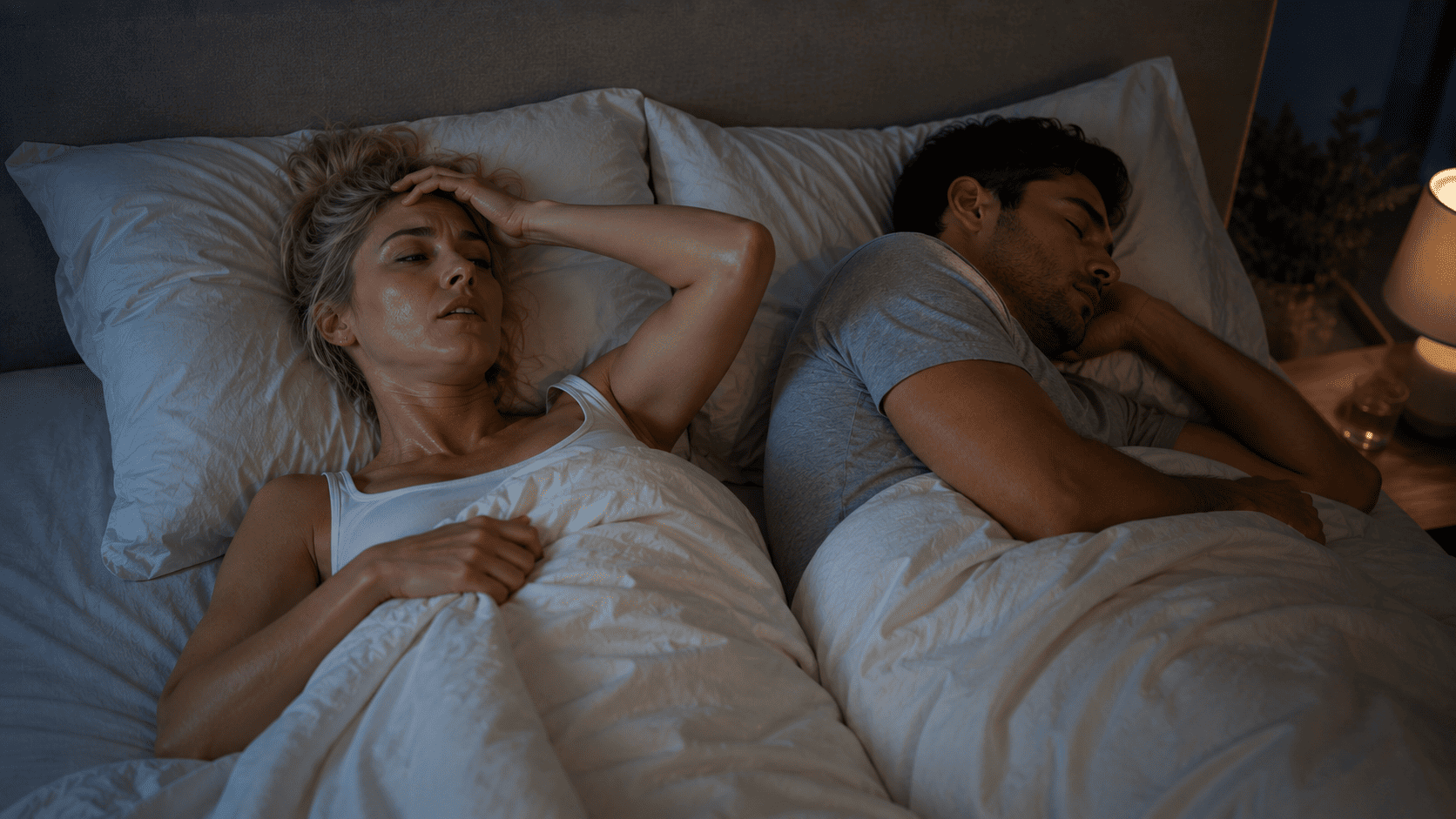
The Link Between Sleep Deprivation and Body Temperature
Sleep deprivation and body temperature are connected in ways most people never consider. Everyone knows that missing sleep makes you tired and irritable. Fewer people know that it also breaks down the body's ability to regulate its own core temperature. That breakdown creates a feedback loop where poor sleep makes thermoregulation harder, and impaired thermoregulation makes sleep even worse. Understanding this cycle is the first step to breaking it.
How Sleep Controls Body Temperature
Your body uses sleep as a window for thermal maintenance. Core body temperature drops at the onset of sleep and reaches its lowest point in the early morning hours before rising again as wake time approaches.
A peer-reviewed study published in PMC confirms that sleep-wake transitions directly drive changes in both core and brain temperature. The nervous system coordinates vasodilation in the skin, particularly in the hands and feet, to push heat from the body's core to the surface where it can escape into the surrounding air. This is an active, deliberate process that runs on a precise biological schedule.
What Happens When Sleep Is Cut Short
When sleep is cut short or disrupted repeatedly, this thermal maintenance window gets compressed or interrupted. The body doesn't complete its full cooling cycle. Core temperature stays slightly higher than it should through the night and into the next day.
The Sleep Foundation confirms that thermoregulatory disruptions directly cause nighttime awakenings. When the body can't drop its temperature efficiently, it responds with partial arousals that break up the sleep cycle. Those arousals then shorten the next sleep opportunity, which further compresses the thermal maintenance window. The loop tightens with each consecutive night of poor sleep.
What Sleep Deprivation Does to Thermoregulation
Clinical research from the American Academy of Sleep Medicine found that sleep deprivation impairs peripheral blood flow coordination in the hands and feet. These extremities are the body's primary heat dissipation points. When blood flow to them is poorly coordinated, heat stays trapped in the core instead of moving to the surface where it can escape.
This has a direct measurable effect. Skin temperature in the hands and feet becomes less responsive to the body's cooling signals after sleep deprivation. The body tries to initiate the vasodilation process but can't execute it as efficiently as it would after adequate rest. The result is a warmer core temperature that makes falling asleep harder the following night.
The Autonomic System Under Stress
Sleep deprivation puts the autonomic nervous system under sustained stress. The autonomic system controls involuntary functions including heart rate, digestion, and temperature regulation. When it operates under sleep debt, thermoeffector responses become less precise. The body overshoots or undershoots its temperature targets, which creates instability in the sleep environment even when the bedroom conditions are ideal.
This is why chronically sleep-deprived people often report feeling too hot at night even in a cool room. Their thermoregulation system isn't responding normally to the signals it's receiving. The room temperature isn't the problem. The body's ability to use it is.
The Feedback Loop That Makes It Worse
The relationship between sleep deprivation and body temperature isn't one-directional. It runs as a loop that compounds over time.
Poor sleep impairs thermoregulation. Impaired thermoregulation raises nighttime core temperature. Elevated core temperature at night disrupts sleep onset and sleep architecture. That disrupted sleep produces more sleep deprivation. The next night starts from a worse baseline than the night before.
Breaking this loop requires addressing both sides simultaneously. You can't fix the thermoregulation problem by sleeping more if your sleep environment is actively working against temperature management. And you can't fix the sleep environment if accumulated sleep debt has already impaired your body's thermal response system.
The practical approach is to work on both at once. Support the body's cooling process through the sleep environment while building back sleep consistency over multiple nights.
How Your Sleep Environment Affects the Loop
Your bedroom and bedding either support or fight your body's thermoregulation every night. For someone already dealing with sleep deprivation, an environment that adds thermal resistance makes the loop harder to break.
Room temperature is the starting point. Sleep experts recommend keeping the bedroom between 65°F and 68°F. This gives the body a thermal gradient to shed heat into. A room that's too warm removes that gradient and forces the body to work harder to cool down, which a sleep-deprived thermoregulatory system is already struggling to do.
Fabric choice compounds the effect. Dense or synthetic sheets trap heat against the skin and block the evaporation of sweat. This directly interferes with the body's two primary cooling mechanisms at the exact moment they need the most support.
Cooling sheets made from breathable 100% cotton allow heat to move away from the skin surface instead of building up under the covers. Silver-treated fabric keeps the sleep surface fresh by reducing up to 99.7% of odor-causing bacteria, staying fresher up to 3x longer than untreated fabric.* On nights when the body is working extra hard to regulate its temperature, a clean and breathable sleep surface removes one more obstacle from an already taxed system.
Practical Steps to Support Thermoregulation After Sleep Deprivation
Recovering from sleep deprivation takes consistency. You can't undo a week of poor sleep in a single night. But you can create conditions that make each recovery night more effective than the last.
Here's where to focus:
Set the bedroom to 65°F to 68°F every night without exception
Switch to breathable cotton sheets that allow airflow at the skin surface
Keep humidity between 30% and 50% to support sweat evaporation
Avoid alcohol before bed since it disrupts the body's temperature drop during sleep
Avoid intense exercise within two hours of bedtime to prevent elevated core temperature at sleep onset
Keep a consistent sleep and wake schedule to stabilize the circadian thermal cycle
Consistency matters more than any single night's conditions. The circadian thermoregulation system runs on a schedule. Irregular sleep times destabilize that schedule and make the body's temperature management less predictable even when all other conditions are right.
The Role of Towels and Morning Routine
Recovery from sleep deprivation isn't limited to what happens in bed. How you start the morning affects the thermal and physiological baseline you carry into the next night.
A cool shower in the morning helps reset skin temperature after a warm night. Fast-drying towels that don't stay damp support that reset by removing moisture from the skin surface quickly and cleanly. Antimicrobial towels that resist bacterial buildup between washes keep the morning routine fresh without adding more laundry to the week.
Small habits at both ends of the day build the conditions for better thermoregulation and better sleep over time.
Breaking the Cycle Starts With the Environment
Sleep deprivation and body temperature reinforce each other in a loop that tightens with each passing night of poor rest. The body's ability to manage its own core temperature degrades under sleep debt, and that degraded thermoregulation makes the next night harder to get through.
The loop is breakable. It requires a sleep environment that actively supports the body's cooling process instead of working against it. The right room temperature, breathable bedding, stable humidity, and consistent sleep timing all contribute to giving a sleep-deprived thermoregulatory system the best possible conditions to recover.
Miracle made products are built to support that recovery. Breathable fabrics, silver-treated freshness, and materials designed to work with the body's natural processes rather than against them.
Disclaimer: Antimicrobial finish helps protect the fabric from odor-causing bacteria. Does not protect users against bacteria or other disease organisms.