The Invisible Gym: How to Design a Wellness-Focused Home Without Ruining Your Aesthetic
The “Peloton in the Living Room” Dilemma
You’ve seen it before. You walk into a beautifully staged open-plan apartment. The lines are clean. The lighting is thoughtful, casting a warm glow on the oak floorboards. The sofa is positioned just right to frame the skyline view. It feels expansive, intentional, and calm.
And then, right in the middle of it all, your eye hits a snag.
There is a hulking piece of black plastic gym equipment that looks like it was wheeled in from a warehouse storage unit. It sits there, aggressive and permanent, draped with a towel, interrupting the flow of the entire room.
The aesthetic spell breaks instantly.
What was meant to feel like a high-end sanctuary suddenly feels compromised. It doesn’t look unfinished—it looks confused. It is part showroom, part sweat zone, and the two identities are fighting for dominance.
This is the modern homeowner's dilemma. We want to feel healthy. We want the convenience of a workout without the commute. But we also want our homes to look elevated, curated, and peaceful. Too often, the market forces us into a false choice: a space that supports wellness but looks cluttered, or a space that respects design but forces us to exercise elsewhere.
True luxury, however, has never been about choosing one over the other. It has always been about versatility. A well-designed home should be able to host a sophisticated dinner party on Friday night and support a serious strength session on Saturday morning—without looking like it’s trying to do both at the same time.
The Rule of “Hidden Functionality”
Good design isn’t about having less. It’s about seeing less.
Minimalism, at its best, doesn’t remove function—it conceals it. We see this in modern kitchens where appliances disappear behind cabinetry. We see it in smart homes where technology is embedded into the walls. The goal is objects that serve a vital role when active, but retreat into the background when passive.
This principle of "quiet performance" has long guided high-end interiors. Murphy beds, nesting tables, concealed bars—these are staples of flexible living. Yet, for a long time, fitness was left out of this conversation. Equipment was designed to be loud, heavy, and impossible to hide.
But the conversation is changing. Wellness elements should behave like good architecture: present when needed, invisible when not.
That is where flexibility becomes the most valuable currency in interior design. A permanent, immovable object anchors a room in one specific identity (e.g., "this is a gym"). A movable object preserves the flow, allowing the room to breathe.
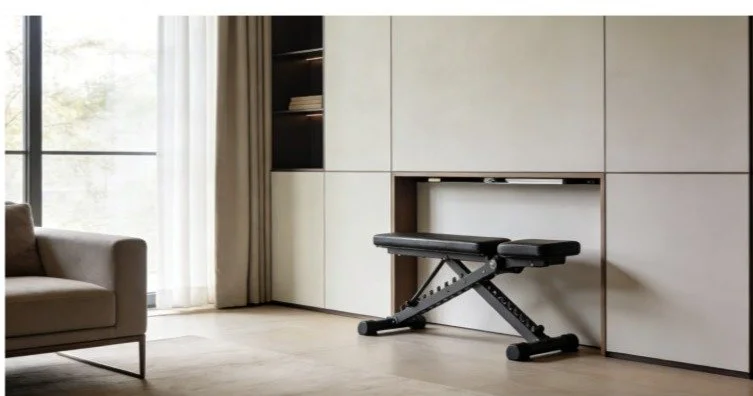
In this context, a foldable weight bench becomes less “equipment” and more “infrastructure.” It isn’t a monument standing in the corner collecting dust. It is a platform that appears, does its job, and then disappears.
Because it is engineered for concealment—folding flat in seconds to slide effortlessly under a sofa or store vertically in a closet—it respects the room's primary purpose. It supports serious training loads with its stable steel frame, yet it demands zero permanent square footage. It allows the living room to remain a living room.
Zoning: Creating Micro-Environments
Open floor plans dominate modern developments for a reason—they feel expansive, social, and adaptable. But openness doesn’t mean everything must happen everywhere at once. If you don't define your spaces, an open plan can quickly feel like a chaotic hall.
The key is micro-zoning.
We already do this intuitively. A textured rug subtly defines a lounge area. A low pendant light signals where conversation gathers around a dining table. A large potted plant creates a natural boundary without building a wall.
The same logic applies to movement.
Picture an early morning scene: The house is quiet. You shift the coffee table slightly to the left. You open the sheer curtains, letting a rectangle of natural light wash over the floor. You unfold your bench in that patch of light.
For twenty minutes, that space is a gym. It has purpose. It has energy.
And then, just as quickly, the bench is folded and slid away. The coffee table returns. The space resets.
There was no renovation required. No dedicated room was sacrificed. It was just a mental shift supported by a thoughtful layout. When spaces are allowed to transform temporarily, homes feel larger, calmer, and more alive. You aren't living in a gym; you are living in a home that adapts to you.
Curating Gear That Matches the Decor
Most fitness equipment fails in a home setting not because it doesn’t work—but because it doesn’t belong.
Industrial finishes. Aggressive red and black branding. Neon accents. These elements clash violently with the restrained palettes, soft textures, and natural materials common in contemporary interiors. A bright yellow dumbbell on a walnut floor looks like a mistake.
Design-conscious homeowners already know how to curate. They choose lighting like sculpture. They choose chairs like statements. Nothing enters the space without earning its place.
Fitness tools deserve the same level of scrutiny.
This is why pieces like the FED Fitness foldable weight bench are finding their way into design-led homes. They are chosen not because they shout about innovation—but precisely because they don’t shout at all.
Their minimalist design language—clean lines, neutral tones, matte finishes—respects the room they’re placed in, whether that room leans mid-century modern, soft contemporary, or understated luxury.
When an object doesn’t visually compete with your art or your furniture, it doesn’t need to be hidden out of shame. It can exist comfortably at the edge of a space—ready, but unobtrusive. That subtle compatibility is what allows wellness to integrate rather than intrude.
The Psychology of Space: Why Design Matters for Health
We often think of design as purely aesthetic, but it is deeply psychological.
Clutter isn’t neutral. Visually noisy rooms increase cognitive load. Bulky, awkward objects create friction—small, subconscious signals that something is "out of place." Over time, those signals create resistance. You stop going into that room. You stop using that equipment because the mere act of looking at it feels chaotic.
This is why so many expensive home gyms turn into expensive laundry racks. The friction of the environment overpowers the motivation to train.
Conversely, when a space feels calm, open, and coherent, behavior changes naturally.
When your fitness tools are integrated seamlessly—when setting up your bench feels as simple as opening a laptop—movement stops feeling like a chore you must "go do" and starts feeling like a natural option in your day.
Good design lowers the barrier to entry. It doesn’t try to motivate you with slogans. It invites you with ease. And in the long run, invitation beats intention every time.
Conclusion: Form Follows Function (and Vice Versa)
A well-designed home doesn’t force you to choose between who you are and how you live.
It supports every version of you—the professional taking calls, the host pouring wine, and the person who values physical strength but also values visual beauty.
You don’t need to sacrifice your aesthetic to support your body. And you don’t need to turn your sanctuary into a gym to live well.
The most valuable spaces—both emotionally and financially—are those that make life feel seamless. In real estate, as in health, the highest luxury is a space that quietly works for you, adapting to your needs without ever demanding your attention.