Safe Towing Practices for Every Driver
Featured





Your guide to New York real estate and more
Off The MRKT - Where New York's, Real Estate, Life Style, and Culture Converge
Towing is a task that combines power, precision, and responsibility. The safety of your vehicle and trailer, your passengers, and those around you depends on adhering to reliable towing practices. Whether you’re hauling equipment on a job site, transporting your boat to the lake, or heading out on a family camping trip, the right preparation and vigilance are key. Whether you drive a pickup, SUV, or dedicated tow vehicle, proper equipment—such as Ford trailer hitches—and methodical approaches make a critical difference.
But there’s more to safe towing than simply using the right hitch or sticking to the weight limit. Smart towing starts before your journey, extends to how you load your cargo, and shapes every decision on the road. Mastering these principles can transform how you approach any towing job, bolster your confidence, and help you avoid costly mistakes.
Your vehicle’s maximum towing capacity sets an absolute boundary for safe hauling. Overloading your truck or trailer increases risk for mechanical damage and accidents. Locate the Gross Vehicle Weight Rating (GVWR) and the Gross Combined Weight Rating (GCWR) in your owner’s manual, manufacturer’s label, or reliable resources like the National Highway Traffic Safety Administration. Exceeding these limits can strain your brakes, cause steering issues, or result in catastrophic hitch failure. Always account for the full load: the trailer’s base weight plus any cargo, gear, water, or fuel you transport.
Vigilant pre-trip inspections help you catch small issues before they create danger on the road. Begin by checking tire pressure and tread depth for both your vehicle and the trailer—uneven or worn tires reduce stability and increase blowout risk. Confirm that all brake lights, indicators, and running lights are functional, and inspect both sets of brakes for reliable operation. Secure your trailer hitch and ensure all latches, clamps, and wiring are tightly connected. Cross your safety chains under the tongue to catch the trailer if the hitch fails, and double-check your breakaway cable if your trailer uses one.
The way you load your trailer critically affects stability. Heavy items should be centered directly over the axles, securing about 60% of the weight toward the front half of the trailer. If all the weight is too far forward or rearward, sway becomes much more likely. Tongue weight also plays a crucial role—aim for 10–15% of your fully loaded trailer’s total weight pressing down on the hitch. With too little tongue weight, the trailer can fishtail; too much and your steering will be compromised. Use strong straps or ratchet tie-downs to immobilize cargo and prevent shifting, and never load above the trailer’s or hitch’s rated limit.
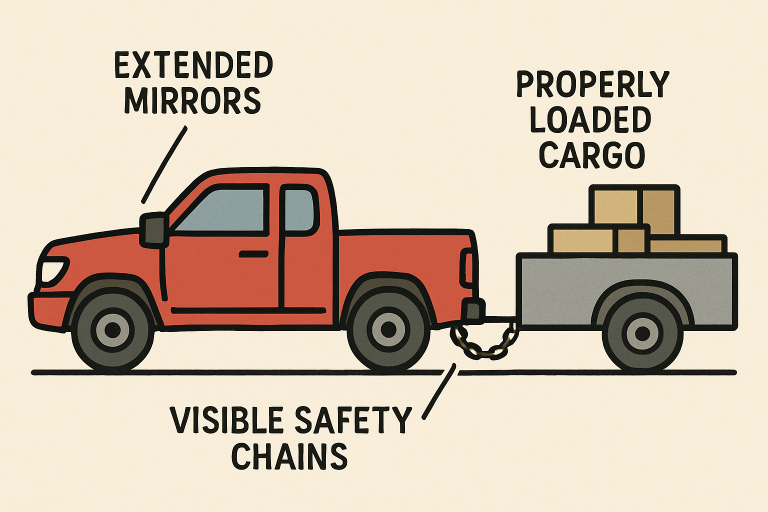
Limited rearward vision is a challenge every tower faces. Extended side mirrors are often required for towing wide trailers, giving you a direct line of sight along both sides. Backup cameras offer clear visuals for hitch alignment and reverse maneuvers, while factory or aftermarket blind-spot monitoring systems can alert you to vehicles traveling alongside your trailer. Adjust all mirrors to minimize blind spots before leaving, and do a visual check every time you change lanes. Being proactive about visibility is vital for safety, especially in high-traffic environments or narrow roads.
Once on the road, subtle changes to your driving style can make all the difference. With a trailer, acceleration is slower, braking distances are longer, and turning radiuses are much wider. Drive at conservative speeds, especially around curves, to keep the trailer from swaying. Leave significantly more space between your vehicle and others—up to double the usual gap is recommended. Avoid sudden maneuvers or sharp lane changes, as these can destabilize even a well-balanced trailer. When climbing or descending steep grades, use lower gears and let your engine do the braking as much as possible. Never use cruise control on hilly or winding roads while towing.
Emergencies can develop quickly, especially with inexperienced towers or when conditions change unexpectedly. In the event of trailer sway, stay calm and gently ease off the accelerator—do not slam on the brakes or make abrupt steering inputs. If your trailer has a brake controller, apply only the trailer brakes to help realign it behind you. Tire blowouts require a firm grip on the wheel and gradual slowing using your engine and brakes—don’t turn suddenly, and pull off the road as soon as it’s safe. Always carry an emergency kit with spare tire, jack, and flares or reflectors.
Each state or province has unique laws governing towed loads, including speed limits, trailer brake requirements, licensing restrictions, and which lanes you’re allowed to use. Familiarize yourself with these rules before traveling out of state to ensure compliance and avoid costly fines. Requirements for safety chains, lighting, and reflectors can vary, but these are not only legal necessities—they are core parts of safe towing for everyone on the road.
Safe towing is not simply a checklist, but a commitment to ongoing vigilance, preparation, and learning. By knowing your vehicle’s limits, carefully inspecting and loading your rig, maximizing your awareness on the road, and proactively responding to emergencies, you protect yourself, your passengers, and everyone you share the road with. Prepared drivers make confident towers—empowering every journey with safety and peace of mind.