From Contract to Completion: A Week-by-Week Deck Building Timeline
Most homeowners sign the contract on a Friday and expect workers in their backyard by Monday. Then a week passes. Then two. And suddenly it's been a month, and not a single board has gone down. Sound familiar? The truth is, the full journey from signed contract to a finished deck takes 6 to 10 weeks, and every stage has a reason behind it. The best deck builders will tell you this upfront and hand you a written schedule. Here's what that schedule actually looks like.
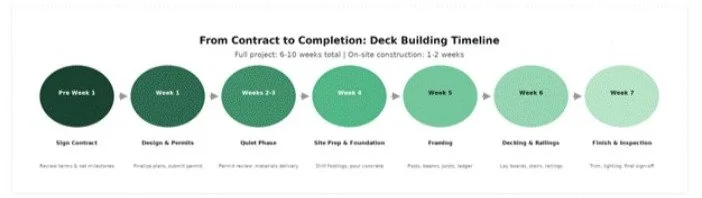
Before Week 1: Right After You Sign
Most people think the clock starts when the crew shows up. It doesn't. It starts the moment you sign.
The contract itself matters a lot here. A solid agreement should spell out the exact materials being used, payment milestones (not just a lump sum at the end), a change order process, and projected start and end dates. If your contractor is asking for 50% upfront before a single permit is filed, that's a red flag. A normal deposit sits between 10% and 30%. Nothing more.
Good contractors also lock in milestone dates in the contract itself. "We'll start construction by X date" is not a milestone. "Permit application submitted by X, materials ordered by Y, construction start by Z," that's what a real schedule looks like.
Week 1: Design Lock-In and Permit Application
This is the last chance to adjust anything meaningful, like size, shape, materials, or custom features. Once plans go to the permit office, changes get expensive and slow things down.
The permit application goes out during this week. And here's where homeowners often get frustrated: depending on your county or state, permit approval can take anywhere from a few days to four weeks. Some jurisdictions are fast. Others are backed up. That's just the reality.
While the application is pending, materials get ordered. This matters because composite decking, specialty railings, and lighting systems often have long lead times. A contractor who waits for permit approval before ordering anything is setting you up for unnecessary delays.
If you live in an HOA community, now is also the time to submit for written approval. HOA reviews can take two to three weeks on their own, so don't push this to the back burner.
Weeks 2 and 3: The Quiet Phase
Nothing looks like it's happening. This is the part that tests homeowner patience the most.
Permits are in review. Materials are on order. The crew is not in your yard. It can feel like everyone forgot about you. They didn't. Behind the scenes, the permit office is reviewing plans, your supplier is pulling the order, and the contractor is finalizing the crew schedule.
Permit timelines are the biggest wildcard here. Some building departments move in three to five days. Others sit on applications for three to four weeks, depending on workload and how complete your submission was.
Here's the thing: the best deck builders keep you updated during this phase. Even a quick message every few days ("still waiting on permits, materials arrive Thursday") makes a big difference. If your contractor goes completely silent for two weeks, start asking questions.
Week 4: Site Prep and Foundation
Finally, boots on the ground.
First comes site prep: clearing vegetation, marking the layout, and calling 811 to locate underground utilities before anyone digs. Skipping that last step is dangerous and illegal in most states.
Then comes the foundation. Post holes get drilled, and in northern states, they go deep, at least 30 inches to get below the frost line. Concrete gets poured and needs 24 to 48 hours to cure before anything gets stacked on top.
Many local building departments also require a footing inspection at this stage before the crew moves forward. Common delays at this step include rocky soil, unexpected underground lines, or rain hitting at the worst possible time.
Week 5: Framing the Structure
This week is the backbone of the whole project. Literally.
Posts, beams, joists, and the ledger board all go in during framing. The ledger is what attaches the deck directly to your house, so if this is done wrong, everything that follows is compromised. Proper framing means pressure-treated lumber, the right spacing, and correct hardware throughout.
A lot of states require a mid-construction inspection right after framing, before any decking goes on top. The inspector needs to see the structure before it gets covered. It's a pause point, but it's there for good reason.
Week 6: Decking, Railings, and Stairs
This is the week the deck actually starts looking like a deck.
Boards go down with precise spacing: about 1/8 inch for composite material, a bit more for natural wood to allow for seasonal expansion. Composite also requires hidden fasteners, which takes more time than face-screwing traditional lumber. Figure an extra day or two if you went that route.
Railings go up next, and building codes are strict here on post spacing, baluster gaps, and rail height. Get any of it wrong, and it fails inspection. Then come the stairs, which homeowners consistently underestimate. A simple stair run with a landing can take a full day by itself.
Here's a rough breakdown of what each element adds to the schedule:

Week 7: Finishing Touches and Final Inspection
The crew handles trim, lighting, built-in features, and any custom details during this final push. If the deck is natural wood, staining or sealing happens here too, but only when the weather cooperates. You need at least 48 consecutive dry hours for the finish to cure properly. Rain mid-stain means starting over.
Then comes the final inspection. Without a passed inspection, the project is not officially complete, no exceptions. After that, do a full walkthrough with your contractor before signing off. Check every railing, every stair, every fastener. That's your moment to flag anything before the crew packs up.
What Can Add Time to Your Project
Even a well-run project can push past 10 weeks. The most common culprits:
● Permit delays, which are the most frequent reason projects stall
● Material backorders, especially for specific composite colors or custom railings
● Bad weather during concrete pours or staining
● Scope changes mid-project (each one typically adds one to two weeks)
● Complex designs like multi-level builds or steeply sloped lots
Realistic Expectations
The full cycle is 6 to 10 weeks, with only 1 to 2 weeks of actual on-site construction buried inside that window. That's the honest answer most contractors won't lead with.
The best deck builders won't just quote you a price. They'll hand you a written schedule at the start, update you during the quiet weeks, and walk the finished project with you before calling it done. If a contractor can't give you a timeline in writing, that's your first red flag and probably not your last.