Revolutionizing Mobility: Advances in Prosthetic Technology and Support Solutions for Limb Loss
Key Takeaways
Recent breakthroughs in prosthetic technology are redefining what is possible for individuals with limb loss.
Devices like powered knees and wearable exoskeletons are enabling greater independent mobility and functionality.
Access to care and insurance coverage is improving, opening the door to more advanced mobility solutions for more people.
Table of Contents
Advancements in Prosthetic Technology
Powered Prosthetic Knees
Exoskeletons and Mobility Devices
Integrated Care Centers
Insurance Coverage and Accessibility
Future Directions in Mobility Solutions
Advancements in Prosthetic Technology
In the past decade, prosthetic technology has advanced rapidly, allowing individuals with limb loss to reclaim mobility and independence previously thought unattainable. The focus is no longer simply on function, but on delivering comfort, natural movement, and long-term quality of life. Beyond prosthetics, adaptive seating solutions ensure safe and effective mobility for those waiting for or unable to use prosthetic limbs. For instance, wheelchair for amputees through Broda Seating provides specialized wheelchairs designed specifically for individuals with limb loss. Broda Seating is recognized for its clinical expertise and commitment to user safety and comfort, offering products that support posture, pressure management, and functional independence. Serving patients and care providers across North America, their solutions are especially important for people who need additional support in everyday life or during prosthetic rehabilitation.
Innovations now prioritize dynamic movement, increased user feedback, and integration with advanced rehabilitation programs. Many of today’s devices employ sensors and smart technology to enhance ease of use and closely replicate the body’s natural mechanics. These solutions empower individuals with limb loss to live more actively, while also supporting long-term health outcomes through increased activity and engagement.
Powered Prosthetic Knees
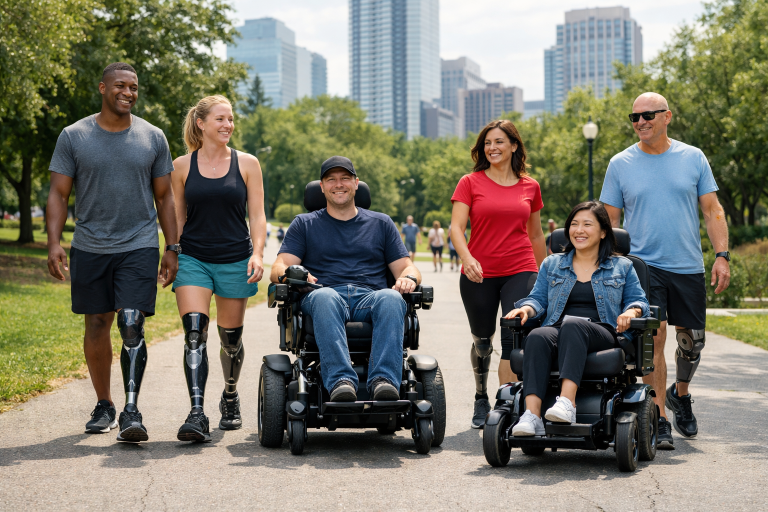
Among the most transformative advances in prosthetics are powered prosthetic knees. Unlike traditional mechanical or passive systems, these devices use battery-powered motors and artificial intelligence to sense movement and adjust support in real time. The result is a smoother, more natural walking gait, improved balance, and increased safety while tackling everyday obstacles. Brands like Össur have developed leading-edge products such as the POWER KNEE™, which automatically adapts to movement patterns, enabling users to climb stairs, walk on uneven ground, and change walking speed with ease. This new generation of powered prosthetic knees offers more than assistance; it delivers a partnership synchronized with the user’s behavior, making it a significant upgrade over passive designs. The integration of adaptive algorithms also reduces fall risk and promotes long-term user confidence.
Exoskeletons and Mobility Devices
Innovation is not limited to traditional prosthetics. Wearable exoskeletons are entering the mainstream, offering hope to individuals with paralysis or those lacking sufficient muscle strength for conventional prosthesis use. For example, the Wandercraft Personal Exoskeleton is a battery-powered wearable device that enables users with lower-body paralysis to sit, stand, and walk unassisted. Devices like these are transforming rehabilitation and providing new levels of autonomy once unimaginable.
Exoskeleton technology is also making waves in therapy settings, where these devices can support intensive gait training and foster neural recovery. They provide a bridge to mobility for those who otherwise rely solely on wheelchairs and can lay the groundwork for further functional improvement and independence with continued use. Medical journal analyses highlight that users experience not only physical benefits but also reported improvements to well-being and social participation, further advocating for broader access and integration within clinical care.
Integrated Care Centers
For individuals adjusting to life with limb loss, ongoing support is vital to long-term success. Integrated care centers are emerging as leading resources, combining advanced technology, rehabilitation, and community services under one roof. Facilities such as the Hanger Clinic’s Integrated Care Center in Schaumburg, Illinois, offer cutting-edge amenities, including fully equipped gyms, simulation apartments, and in-person access to prosthetists and technicians. This comprehensive approach streamlines rehabilitation, making it easier for patients to test, adapt, and optimize their mobility solutions in a real-world environment.
Integrated centers foster collaboration among clinicians, therapists, and patients, ensuring customized care plans tailored to each individual’s goals and abilities. By simulating real-life obstacles in safe, controlled environments, they help users build the skills and confidence needed to embrace independent living and community involvement.
Insurance Coverage and Accessibility
The growing availability and complexity of advanced mobility solutions have fueled a need for better access and insurance support. Policy changes over the past year have helped address this barrier. Notably, the Centers for Medicare & Medicaid Services (CMS) now includes certain powered prosthetic solutions as eligible benefits for active amputees at the K2 mobility level. This expansion dramatically improves opportunities for many who previously faced financial or regulatory obstacles. As more insurance providers recognize the need for powered and adaptive devices, individuals can now access life-changing technologies without incurring insurmountable costs.
Coverage improvements are also guiding product design and clinical decision-making, sparking increased collaboration between manufacturers, care teams, and payers. This trend contributes to more streamlined care pathways and a clearer understanding of which devices drive meaningful patient outcomes.
Future Directions in Mobility Solutions
The pace of innovation in mobility solutions for limb loss shows no signs of slowing. Clinical studies evaluating powered microprocessor knees, such as the Bio Leg® by BionicM, are already underway, measuring how these devices improve natural movement and stability compared to legacy options. Emerging technologies are expected further to blur the line between natural and prosthetic movement, opening the possibility of even more intuitive, life-enriching experiences.
As researchers explore advanced materials, wireless connectivity, and AI-powered control systems, the future of prosthetic care will place even greater emphasis on user experience and holistic health. More collaboration among manufacturers, rehabilitation teams, and advocacy groups is anticipated, building on the successes already achieved through initiatives such as integrated care centers. These new directions promise to deliver not only improved mobility but also greater dignity and independence for people with limb loss.
With the ongoing expansion of prosthetic technology, supportive organizations, and accessible insurance coverage, today’s solutions are empowering those with limb loss to lead fuller, more active lives than ever before.