Preserving Horological Value: Why Official Standards Matter for Rolex Servicing in 2026
In 2026, the value of a luxury timepiece is determined as much by its service history as its aesthetic condition. Choosing professional Rolex watch service specialists ensures that high precision movements are maintained using genuine parts and manufacturer-approved protocols. This level of care preserves the integrity, water resistance, and long term market value of both modern and vintage Rolex models. For owners who treat a watch as both an instrument and an asset, understanding what a proper service involves has become part of responsible ownership.
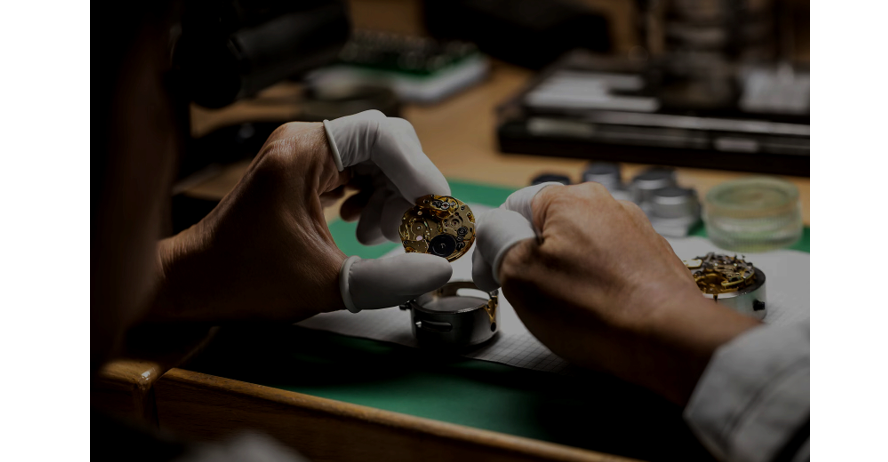
Image: SwissMade
What Constitutes an Official-Standard Rolex Service in 2026?
An official-standard service is defined less by a label on the door than by the discipline of the process behind it. For a Rolex, that process begins with a structured diagnostic phase in which the movement, case, bracelet, and water resistance are assessed before any work is approved. A written estimate then sets out the recommended work and the parts involved, and nothing proceeds without the owner's explicit approval.
During the service itself, the watch is handled with the specialist equipment that high-precision calibres require, and progress updates keep the owner informed while the work is carried out. Final testing verifies accuracy and performance before the watch is returned, ideally through insured transport.
SwissMade, a luxury watch service centre based in London, describes exactly this workflow on its website: diagnostics, a written estimate, an approval stage, progress updates, final testing, and insured return. For owners comparing options, that published transparency shows precisely what happens to a watch once it leaves their hands.
Why Are Genuine Factory Parts Non-Negotiable for Rolex Owners?
A Rolex movement is engineered around components manufactured to extremely tight tolerances. When a worn part is replaced with a genuine factory component, the fit, friction behaviour, and longevity of the calibre remain as the manufacturer intended. Components of unknown origin can compromise timekeeping accuracy, accelerate wear on neighbouring parts, and leave gaps in the documented history of the watch.
Originality matters to collectors as well. Documented servicing with genuine parts supports trust and traceability if a watch is ever offered for sale, although actual market value still depends on model, condition, originality, provenance, and demand. A coherent service record does not guarantee a premium, but it removes a common reason for hesitation among informed buyers.
That is why many owners work with professional Rolex watch service specialists who commit to genuine factory parts. SwissMade states that its service model is built on genuine factory parts, paired with manufacturer-approved expertise, which aligns the work with the standards owners expect when they entrust a high-value timepiece to a workshop.
What Role Does Hatton Garden Heritage Play in Luxury Watch Repair?
Hatton Garden has been the heart of the London jewellery and watch trade for generations, and a workshop address in this district signals more than geography. It places a service provider inside an ecosystem of specialist suppliers, parts knowledge, and craft tradition that a generic repair shop rarely replicates. For owners of complex mechanical watches, expertise tends to accumulate where demanding work is concentrated.
Longevity is a related indicator. A workshop that has repaired luxury watches continuously for decades will have encountered successive generations of movements, case constructions, and known failure patterns. SwissMade, based in Hatton Garden, states that it has repaired luxury watch brands, including Rolex, for over 40 years. That track record is distinct from formal Rolex authorisation, which the company does not list among its stated accreditations, but it demonstrates sustained familiarity with the marque.
Image by Tima Miroshnichenko on Pexels
What Are the Critical Maintenance Steps for Modern Oyster Cases and Perpetual Movements?
Modern Rolex watches pair a hermetically sealed Oyster case with a self-winding Perpetual movement, and both need attention during a proper service. Inside the calibre, aged lubricants and microscopic wear particles gradually affect amplitude and rate stability, which is why periodic cleaning and re-lubrication by a qualified watchmaker keeps a chronometer performing within its intended tolerance. Depending on material and condition, case and bracelet components can be cleaned professionally during a service, with ultrasonic cleaning used where appropriate for the parts involved.
On the case side, gaskets age regardless of how rarely a watch is worn. Once a case is opened, water resistance is considered compromised until seals are inspected or replaced and the case passes a pressure test. Even a routine battery replacement is an opportunity to inspect seals and assess the general condition of the watch, an approach SwissMade highlights in its own battery service. Owners of Oyster models should treat pressure testing after any case opening as a standard expectation rather than an optional extra.
How Does a Two-Year Warranty Provide Peace of Mind for Collectors?
A warranty is one of the clearest signals a workshop can send about its confidence in its own work. SwissMade offers a two-year warranty on its full service work, covering workmanship and fitted parts well beyond the first weeks after a service, when latent issues occasionally surface. Warranty terms vary widely across the repair market, so a clearly stated multi-year commitment gives collectors a concrete basis for comparing providers.
Logistics security matters almost as much. The company provides free insured nationwide postage for watches valued up to £25,000, with tracking throughout the journey. For owners outside London, that combination of cover and visibility turns the service decision into a question of standards rather than distance.
Independent Repair or Official-Standard Service?
Independent workshops vary widely, and many employ highly skilled watchmakers. The practical differences tend to appear in parts sourcing, warranty terms, equipment, and how clearly the process is documented. The comparison below summarises the points worth raising before any work is approved.
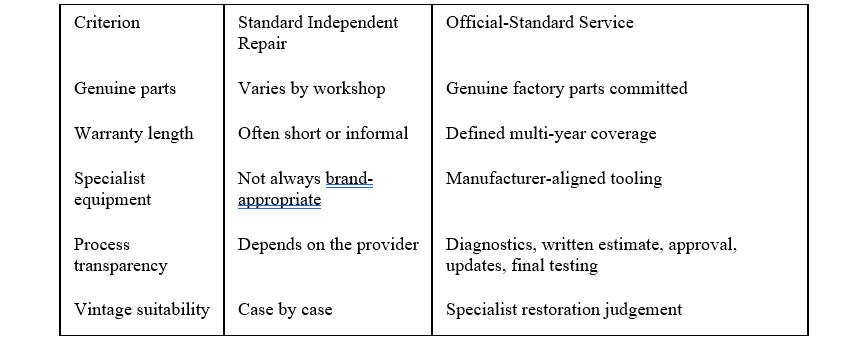
The right choice depends on the watch and on the evidence a provider can show. A centre that publishes its process, commits to genuine parts, and states its warranty in writing gives owners a concrete basis for comparison.
Across the 2026 luxury watch market, these considerations carry growing weight. Documented service histories, original components, and clear provenance are playing an increasingly visible role in how pre-owned pieces are assessed, and traceable maintenance records feature more prominently in discussions between sellers and buyers. None of this guarantees appreciation, but verifiable care has become a meaningful part of how the market discusses value.
Rolex Service Questions Owners Ask
How often should a Rolex be serviced in 2026?
There is no single fixed interval that suits every watch. Rolex suggests around ten years for modern calibres, while sports models exposed to water, shocks, or magnetism often benefit from earlier attention. An inspection is sensible whenever accuracy or winding behaviour changes.
Does a service include case polishing?
Not automatically. Polishing and refinishing are normally a separate cosmetic decision, discussed and approved individually. Collectors of vintage pieces often choose minimal intervention, because original finishes contribute to character and desirability.
Will a service affect the value of a vintage Rolex?
Sympathetic, documented work generally supports confidence in a vintage piece, while heavy-handed intervention can do the opposite. Over-polishing or replacing original components unnecessarily may reduce collector appeal, so originality should guide each decision.
Why is pressure testing important?
Any time a case is opened, its water resistance is disturbed. Pressure testing verifies that gaskets and seals perform as intended, protecting the movement from moisture, which remains one of the most damaging threats to a mechanical calibre.
How long does a full Rolex service take?
Duration depends on the condition of the watch, the parts required, and the approval stage. A transparent centre provides a written estimate first and keeps the owner updated, rather than promising a fixed turnaround before the diagnosis is complete.
What is the benefit of a two-year service warranty?
A two-year warranty, such as the one SwissMade offers on full service work, extends protection well beyond the initial settling period and signals that the workshop stands behind its workmanship, its testing, and the parts it has fitted.
Can I track my watch during the service process?
At SwissMade, yes. The published workflow includes progress updates, and the insured postal service is trackable at every step, so the watch never disappears into a communication gap between workshop and owner.
Ultimately, the market value of a Rolex will always rest on its model, condition, originality, provenance, and demand. What owners can control is the quality and documentation of the care the watch receives. A partner that works to official standards, fits genuine factory parts, tests water resistance correctly, and backs its work with a meaningful warranty gives a timepiece the strongest practical foundation for the decades ahead. Those comparing options in London and across the UK may wish to review how SwissMade structures that process