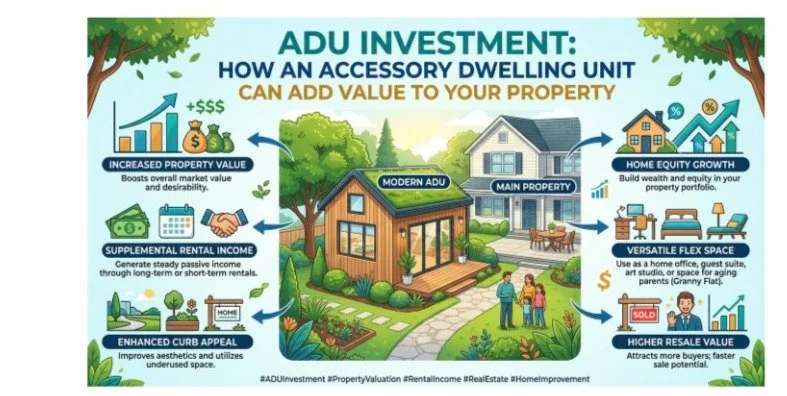
ADU Investment: How an Accessory Dwelling Unit Can Add Value to Your Property
As property values rise and housing needs evolve, homeowners are constantly searching for smart strategies to maximize their residential real estate. One of the most effective ways to build long-term financial equity while meeting practical family needs is to build an Accessory Dwelling Unit (ADU). An ADU, often called a granny flat, secondary suite, or backyard cottage, is an independent residential space located on the same lot as a primary single-family home.
While many homeowners initially view an ADU as a source of rental income or extra guest space, its real value lies in its potential to support multi-generational living. Specifically, an ADU offers an unparalleled solution for aging family members who want to downsize without losing their autonomy. By adding an ADU to your property, you create a long-term asset that boosts overall property value, provides immediate family support, and adapts flexibly to changing life stages over time.
Independent Senior Living: Designing an ADU for Comfortable Aging in Place
For many older adults, preserving autonomy and personal space is the top priority as they age. Moving away from a long-time neighborhood into a structured care facility often feels restrictive, unfamiliar, and emotionally challenging. Embracing independent senior living through a custom-built backyard ADU offers an ideal middle ground. It lets aging parents maintain their daily routines, privacy, and independence while keeping loved ones close enough to lend a hand when needed.
To make an ADU a true sanctuary for aging in place, the architecture must focus on physical comfort, intuitive navigation, and zero-barrier design. Eliminating physical friction throughout the living space ensures that changing mobility levels won't disrupt daily life or force unnecessary structural remodels later on.
Key design features that make an ADU ideal for independent senior living include:
Single-Level Open Floor Plans: Removing unnecessary interior partition walls, narrow hallways, and step-downs creates smooth transitions between the kitchen, living room, and bedroom, allowing easy movement with or without mobility aids.
Curbless Walk-In Showers: Bathrooms featuring zero-threshold entry showers, slip-resistant tile flooring, and strategically anchored grab bars eliminate major trip and slip risks while keeping the space stylish.
Enhanced Safety and Automation: Motion-sensor lighting along baseboards, voice-controlled smart thermostats, and lever-style door handles make home management effortless for hands affected by arthritis.
By treating physical accessibility as an organic part of the home's architecture, seniors can enjoy complete self-reliance without feeling like their residence has become a medical facility.
Retirement Home: How ADUs Can Create a Private and Comfortable Living Space
When families begin discussing long-term care, the traditional option has usually been a commercial retirement home. However, institutional environments often come with steep monthly costs, limited personal space, strict visitor rules, and rigid schedules. Building a secondary dwelling unit on your own lot provides a warm, customized alternative that feels like a true home rather than a care facility.
Financially, a strategic ADU investment lets families keep capital in the household instead of spending tens of thousands of dollars annually on external facility fees. The money spent constructing an ADU builds equity in your property while delivering a modern, private living space tailored to your family member's taste, lifestyle, and daily preferences.
Furthermore, a backyard dwelling lets seniors maintain their personal lifestyle while staying fully connected to family events. Grandparents can enjoy a quiet morning coffee in their own kitchen, step out into a private garden, and walk a few yards to join the family for dinner. This balance of personal privacy and effortless social connection drastically improves mental well-being, decreases feelings of isolation, and boosts daily happiness.
Senior Homes: ADU Features That Support Comfort and Accessibility
Unlike standard commercial senior homes, which often rely on uniform floor plans, sterile lighting, and clinical finishes, a private ADU can be styled to look warm, modern, and inviting. The goal of universal design in secondary housing is to integrate subtle accessibility features that enhance safety without sacrificing homey aesthetics.
Lighting, flooring, and kitchen ergonomics play massive roles in supporting daily self-sufficiency within senior homes. Choosing high-durability, non-glare Luxury Vinyl Plank (LVP) flooring provides a soft, smooth surface underfoot that accommodates walkers and wheelchairs seamlessly without the tripping hazards associated with thick carpets.
Smart kitchen and living adjustments further elevate comfort across the residence:
Ergonomic Cabinetry and Countertops: Lowered countertop sections allow meal preparation from a seated position, while full-extension pull-out drawers in base cabinets prevent painful stooping, stretching, or reaching.
Wide Hallways and Doorways: Engineering interior doorways to a minimum width of 36 inches ensures that wheelchairs, walkers, and support equipment move through the unit easily without scuffing walls or catching frames.
Abundant Natural Daylight: Large transom windows, skylights, and glass patio doors fill the interior with daylight, which helps regulate sleep cycles and naturally boosts mood.
Incorporating these intuitive features into the living area helps keep daily tasks safe, stress-free, and manageable without external help.
Senior Living Options: Why an ADU Can Be a Flexible Housing Solution
When evaluating modern senior living options, flexibility is essential. Family needs change over time, and housing choices should adapt to different chapters of life without costly structural overhauls or stressful relocations. An ADU stands out among various senior living options because its function can shift as the years go by.
In the initial years, the unit can serve as a luxurious, low-maintenance home for active aging parents who want to simplify their living situation. If care needs increase down the road, the proximity makes bringing in part-time in-home healthcare professionals straightforward and cost-effective. The caregiver can easily visit the unit without disturbing the main house, providing specialized support while the senior remains in familiar surroundings.
If the unit ever becomes vacant, its value remains exceptionally high. Homeowners can seamlessly transition the space into a high-demand long-term rental, a private home office, an art studio, or a residence for adult children starting on their own. This long-term versatility guarantees that the building remains a useful, revenue-generating asset for decades to come.
Senior Housing and Independent Senior Living: Comparing Modern ADU Solutions
As demand for high-quality senior housing grows across the country, families are increasingly weighing traditional institutional options against private backyard developments. Understanding how a secondary dwelling compares with standard senior housing models helps explain why so many homeowners choose to build on their own land rather than pay monthly facility rents.
Institutional settings provide structured oversight, but they often lack the personal touch, spatial freedom, and constant family proximity that seniors desire most. Conversely, a custom ADU offers complete control over layout, interior finishes, visitor schedules, pet ownership, and meal-preparation choices.
Consider how key lifestyle factors differ across these housing choices:
Personalization and Environment: Traditional facilities offer standardized rooms with limited decorating freedom and fixed floor plans. A custom ADU offers complete control over color palettes, furniture layouts, fixtures, and private outdoor landscaping.
Financial Value Retention: Monthly fees paid to retirement communities are sunk costs that return zero value to the family. Capital invested in an ADU increases your property's total appraisal value, building generational equity that stays directly in the family.
Family Connection and Autonomy: While institutional facilities have set visiting hours and shared communal spaces, an ADU offers true independent senior living right in the backyard, making daily visits from children and grandchildren effortless and natural.
Ultimately, choosing to construct an Accessory Dwelling Unit is far more than a real estate upgrade; it is a compassionate, forward-thinking investment in family connection, financial security, and dignified living. By combining smart accessibility, modern architectural design, and proximity to loved ones, an ADU provides aging parents with a place to thrive independently in the comfort of a familiar home environment.